


Getting the size of your split system air conditioner right is probably the most important decision you'll make for your comfort and your power bills. If you go too small, the unit will struggle on those scorching January afternoons, never quite cooling the room. If you go too big, it'll constantly switch on and off, failing to dehumidify the air properly and chewing through electricity. This guide will walk you through what you need to know.
Your Quick Guide to Split System Sising
When you first start asking, "what size split system do I need?", the best place to begin is with the size of your room. Think of this as a solid starting point before we dive into all the other factors that can make a real difference. A simple rule of thumb is to match the square metres (m²) of your space to the kilowatt (kW) capacity of the air conditioner.
A Simple Sising Chart
While nothing beats a professional assessment on-site, this chart gives you a pretty reliable initial estimate for a standard room with a regular 2.4-metre ceiling. It's a great starting point for matching your room size to the air con's power, measured in kilowatts (kW).
| Room Type or Area (m²) | Recommended Capacity (kW) |
|---|---|
| Small Bedroom (Up to 20 m²) | 2.0 – 2.5 kW |
| Master Bedroom / Lounge (20 – 40 m²) | 2.5 – 5.0 kW |
| Large Living Area (40 – 60 m²) | 4.0 – 6.0 kW |
| Open-Plan Space (60+ m²) | 5.0 – 9.0 kW |
These industry-standard guidelines are a fantastic first step. The kilowatt rating is a direct measure of the unit's power to pull heat out of your home, so getting this match right is crucial for efficiency.
Of course, this chart is just an estimate. Things like the size of your windows, how good your insulation is, and even where your home is located in Sydney or on the Central Coast can change the capacity you actually need. Nailing the size has a direct impact on both the upfront investment and your ongoing running costs. You can learn more about how system size affects split system air conditioner prices in our detailed guide.
Why Kilowatts Are The Key To Your Comfort
When we talk about the "size" of a split system, we're not talking about how much space it takes up on your wall. We're talking about its real power, its cooling and heating capacity, measured in kilowatts (kW). This one number tells you everything about how much muscle the unit has to keep you comfortable.
Think of it like the engine in a car. You wouldn't put a tiny hatchback engine in a big SUV; it would struggle and burn out. Likewise, a massive V8 in a small car would be wasteful and inefficient. The goal is to match the power to the job it needs to do.
What is Heat Load?
In the world of air conditioning, that "job" is all about managing your room's specific heat load. This is simply the total amount of heat that needs to be taken out in summer or pumped in during winter. A proper, professional calculation looks at every single detail that adds to this load, making sure the kW capacity is a perfect match for your space.
Getting this right is absolutely critical. An undersized unit will run flat out on a hot Parramatta afternoon, struggling to keep up while sending your power bill through the roof. On the other hand, putting a monster unit in a small Gosford bedroom creates a different problem. It will blast cold air, switch off, then switch on again moments later. This is called short-cycling, and it's a disaster for both your power bill and your comfort. It wastes energy and, crucially, doesn't run long enough to dehumidify the air, leaving the room feeling damp and clammy.
Your home's heat load is its unique fingerprint. It’s shaped by everything from the number of windows and the quality of your insulation to the local climate. Consider the sticky coastal humidity on the Central Coast versus the dry heat of the Hunter Valley.
Cooling vs Heating Capacity
For most of us in NSW, a reverse cycle split system is the obvious choice, giving you both cooling and heating from a single unit. But here’s something you might not know: a system's heating capacity is usually a bit higher than its cooling capacity. For example, a unit might be rated at 7.1kW for cooling but pump out 8.0kW for heating.
This isn't a mistake; it's down to how the technology works. The process of reversing the refrigeration cycle to create heat is just inherently more efficient. When we size a system for your home, whether you're in Newcastle or down in Lake Macquarie, we always look at both your summer cooling needs and your winter heating requirements. This ensures you get reliable, year-round comfort without paying for power you’ll never use.
Looking Beyond Room Size To Find The Perfect Fit
A simple square metre chart is a decent starting point, but honestly, it’s just that, a start. A professional sizing calculation goes much deeper because several factors in your home can dramatically change the kW capacity you actually need. Think of it like this: every home has its own unique thermal personality. This is where we move beyond basic rules of thumb and into a proper heat load calculation.
How High Ceilings Affect Air Volume
Standard sizing guides almost always assume a ceiling height of 2.4 metres. But plenty of homes, from older properties in Lake Macquarie to modern builds on the Central Coast, feature higher ceilings of 2.7 metres or more. That extra height means a much larger volume of air to cool or heat. For example, a 20 square metre room with a 2.4m ceiling has 48 cubic metres of air. That same room with a 3.0m ceiling has 60 cubic metres of air, a 25% increase in volume.
The Role of Windows and Sunlight
Windows are a massive factor in any heat load calculation, especially here in sunny NSW. A large, west-facing window in a Sydney home can feel like having a radiator in the room on a summer afternoon, letting in an enormous amount of solar heat. On the flip side, a south-facing window will have a much smaller impact. We have to consider several things about your windows: their orientation, size, glazing type, and whether they have any external shading like awnings or eaves.
Insulation: The Invisible Comfort Barrier
Insulation is one of the most important, and most overlooked, factors in sizing an air conditioner. Poor insulation in the ceiling or walls is like trying to fill a leaky bucket; your expensive cool air simply escapes, forcing the system to work much harder and longer. A well-insulated home on the Central Coast will hold its temperature for longer, so the air conditioner doesn't have to run as hard or as often. When we do an on-site assessment, we always check the quality of your insulation.
The flowchart below shows how we move from your room's basic needs to all these specific heat load factors to find the right size.
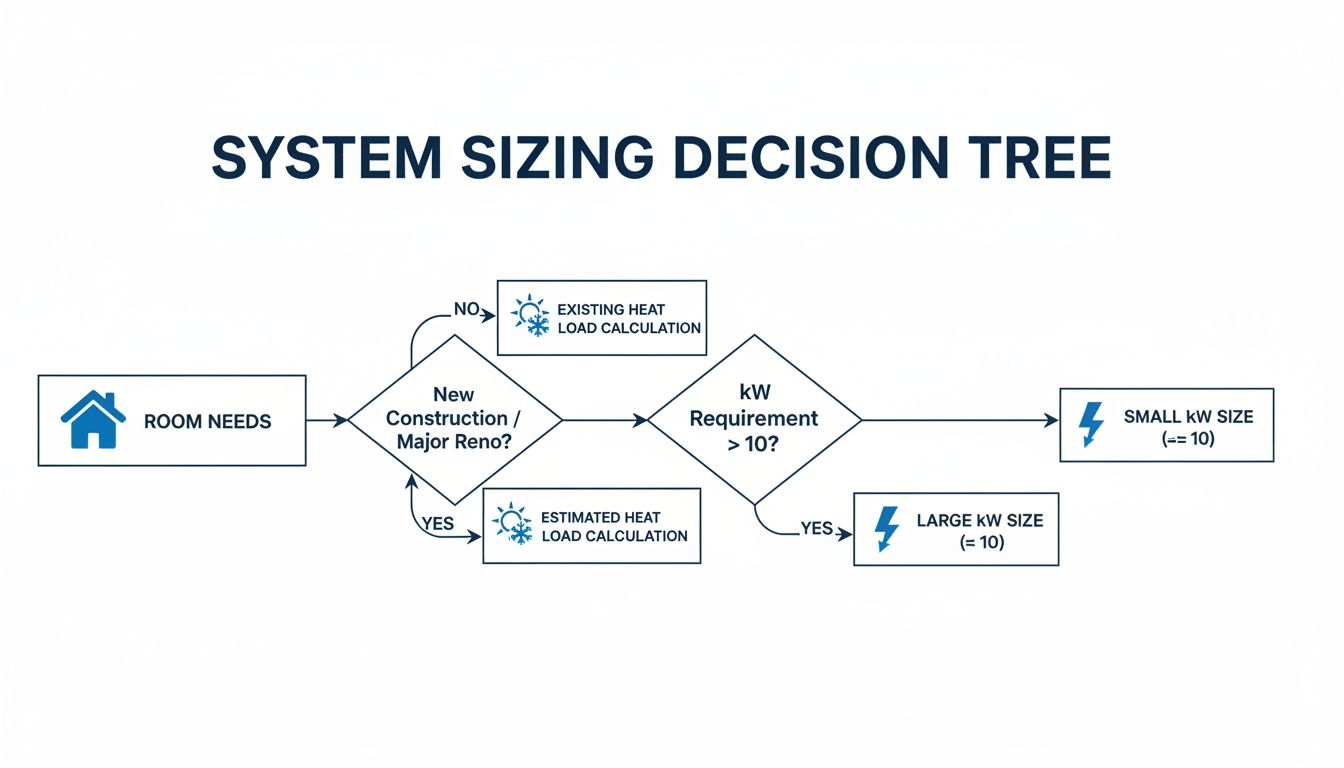
As you can see, considering these specific heat load factors is the essential step before landing on the final kW size.
People and Appliances Generate Heat Too
It’s easy to forget, but we generate our own heat. Every person in a room gives off body heat roughly equivalent to a 100-watt light bulb. Appliances add even more. A large TV, a gaming console, or a computer setup in a home office in Newcastle can all add a surprising amount to the heat load. An empty spare room has a very different heat load compared to a family living area that's frequently packed with people and active electronics. This is why we ask how you use the space.
By carefully weighing up all these variables, we can pinpoint the exact capacity you need. This detailed approach ensures your system delivers fantastic comfort and efficiency, which is especially important when you’re choosing the best reverse cycle air conditioner for year-round performance.
How Your Local NSW Climate Changes Everything
Australia’s climate is anything but uniform, and your postcode plays a massive role in figuring out what size split system you really need. A generic sizing chart designed for the entire country simply can't account for the huge local differences we see right here in New South Wales. The perfect system for a home in Hobart would be completely overwhelmed by a classic Sydney summer. A local, climate-aware approach is non-negotiable.
Coastal Humidity vs. Inland Heat
The climate challenges across our service areas, from the Central Coast and Sydney to Newcastle and Lake Macquarie, are incredibly diverse. Think about the humid, salt-laden air on the Central Coast. In suburbs like Terrigal or Avoca Beach, the high moisture content makes the air feel much warmer and stickier. Here, a split system needs strong dehumidification capabilities to pull that uncomfortable moisture from the air. An oversized unit would be a disaster, as it would chill the room too quickly without running long enough to properly dehumidify.
Now, contrast that with the intense, dry heat common in Western Sydney or the Hunter Valley. A home in Penrith or Maitland faces scorching summer temperatures that place a heavy, sustained load on an air conditioner. In these areas, the raw cooling capacity (kW) becomes even more critical to combat the sheer intensity of the sun beating down on your roof and walls.
A professional assessment considers these microclimates. We know that a house in Newcastle might benefit from coastal sea breezes, slightly reducing its cooling needs compared to an identical house just 30 kilometres inland.
Why Your Location Directly Affects kW Needs
These climate differences have a measurable impact on the system capacity your home requires. Independent analysis shows just how much location matters. For example, a standard 30 m² room in Sydney might need a 2.3 kW unit to stay comfortable. That same room in a much cooler climate like Hobart would only need about 1.8 kW. You can find out more about how climate influences sizing in CHOICE's detailed analysis.
This is why we focus so heavily on local conditions. We understand the specific challenges of different building types across our regions, from Sydney apartments with body corporate rules to sprawling family homes on the Central Coast. To understand more about the specific factors that influence system selection in our coastal areas, check out our guide on choosing air conditioning for Central Coast homes. Our local expertise ensures the advice you get is perfectly matched not just to your home, but to your suburb.
Common Sising Mistakes and How To Avoid Them
Choosing the wrong size split system is a frustrating and expensive mistake that we see all too often. Getting the kilowatts right is a delicate balance, and a few common pitfalls can lead to years of discomfort and shockingly high power bills. Let's walk through the most frequent sizing blunders and how you can steer clear of them.
The Myth of “Bigger is Better”
This is the number one mistake we see. People assume a more powerful unit will cool a room faster and better. While it might seem logical on the surface, an oversized air conditioner is actually a recipe for disaster. It blasts the room with freezing air and then shuts down abruptly, a process called short-cycling. This constant on-off cycle creates poor humidity control and increased wear and tear on components, leading to premature breakdowns.
The Solution: Trust the heat load calculation. A properly sized unit runs for longer, gentler cycles. It effectively manages both temperature and humidity, uses far less energy, and creates a stable, genuinely comfortable indoor environment.
Relying Solely on Online Calculators
Online sizing calculators can be a decent starting point, but they should never be the final word. These tools are generic by nature; they can't see the unique character of your home. They have no idea if you have single-pane windows facing the brutal western sun or a well-insulated ceiling in your Newcastle home. A calculator can’t account for your specific heat load factors. Relying on this limited information often leads to a system that’s either too big or too small.
The Dangers of Undersising Your System
While less common than oversizing, picking a unit that’s too small is just as bad. An undersized system is the little engine that just can't. On a truly hot summer day, it will run non-stop at its absolute maximum capacity, desperately trying (and failing) to reach the temperature you've set on the remote. This constant, high-stress operation leads to massive energy bills and a much higher risk of burnout or major failure.
Keeping an eye on your system can help you catch issues early, and you can learn some of the basics in our guide to split system air conditioner maintenance. Ultimately, the only surefire way to avoid these mistakes is to get a professional, on-site assessment from a licensed technician.
The Professional Process For a Perfect Installation
Now that you've got a handle on the factors that go into sizing, let's walk through how a professional ensures you get the perfect fit. A quality installation is a methodical process that guarantees your new split system delivers on its promises. We don't rely on guesswork; the foundation of every quality installation is a detailed, on-site heat load calculation.
The On-Site Assessment
Our process kicks off with a visit from a qualified technician who will carefully evaluate your space. During this visit, our tech will measure your rooms (including ceiling height), inspect your insulation, assess windows and doors for their direction and glazing, and discuss how you use the room to account for people and appliances. This methodical approach means the system we recommend is tailored to your home in every detail, not just its square meterage.
Why Quality Installation is Non-Negotiable
Even the best, most perfectly sized air conditioner will fail to perform if it's installed poorly. A professional installation by a fully licensed and ARCtick certified technician is absolutely essential for safety, efficiency, and the longevity of your system. This certification is a legal requirement in Australia and is your guarantee that the technician is qualified to handle refrigerants safely and in an environmentally responsible way.
A professional installation ensures all electrical work complies with Australian Standards, specifically AS/NZS 3000, and is completed by a licensed electrician. This protects your home, your warranty, and your family's safety.
Choosing a qualified installer means you can be confident your system will run efficiently from day one, without any nasty surprises on your first power bill. This expert process is how we make sure you get the right advice and a system that delivers reliable comfort for years to come.
Sising Questions We Hear All The Time
We get asked these questions constantly by homeowners across the Central Coast, Sydney, and Newcastle. Getting the answers right is the key to choosing a system that actually keeps you comfortable.
Can I Just Get One Big Split System to Cool a Few Rooms?
It’s a tempting idea, trying to save a few dollars by putting one powerful unit in a hallway and hoping it cools the whole wing of the house. In reality, it just doesn’t work. Split systems are designed to be brilliant in a single, defined space, like your living room or master bedroom. A big unit powerful enough for an open-plan area will never manage to push cold air effectively down long hallways or around corners. For separate rooms, a multi-head split system is the proper solution.
Does Ceiling Height Really Matter That Much?
Absolutely. It’s one of the first things we look at. Most of the simple sizing charts you find online are based on a standard 2.4-metre ceiling. But if your home, maybe an older classic in Lake Macquarie or a modern build in the Hunter Valley, has higher ceilings of 2.7 metres or more, the whole calculation changes. That extra height adds a significant volume of air to the room, which means a bigger heat load for the air conditioner to tackle.
How Does an Inverter System Change the Sise I Need?
Inverter technology is a game-changer for efficiency. It lets the air conditioner's compressor run at variable speeds instead of just slamming on and off like older models. While an inverter gives you more flexibility, it doesn't change the basic rules of sizing. A correctly sized inverter unit will spend most of its time running at a quiet, super-efficient low speed. If you oversize it, it will blast the room to the target temperature too fast and switch off before it's had a chance to properly dehumidify the air.
Getting the size right is the single most important step you can take towards years of comfort and lower energy bills. If you want a professional assessment that’s tailored to your home’s exact layout and needs, the team at ALC Air is here to help.