


When you type “split system installation near me” into Google, you’re not just looking for any tradie. You’re looking for a local expert who understands the unique climate we deal with here in NSW. Whether it’s the corrosive salt air on the Central Coast or the blistering summer heat in Western Sydney, a good local installer brings knowledge that a generic company just can’t match.
Finding the right professional is about more than a quick search. It’s the critical step that ensures your new air conditioner is safe, compliant with Australian Standards, and actually performs for the next decade. This guide is here to walk you through what to look for, what to expect, and how to make the best choice for your home.
How to Find the Right Local Split System Installer

Honestly, picking a reliable installer is the most important decision you’ll make. A dodgy installation can cripple even the best air conditioner, leading to poor efficiency, constant breakdowns, and genuine safety risks from incorrect wiring.
First things first: you need to check their credentials. Always ask for proof of a valid electrical licence and an ARCtick refrigeration handling licence. These are non-negotiable in Australia. They’re your guarantee that the person touching your wiring and handling refrigerant gases is qualified and legally compliant with standards like AS/NZS 3000.
Beyond the licences, a truly local installer brings invaluable regional insight. A Central Coast technician instinctively knows how to position an outdoor unit to shield it from that destructive salt spray. An installer who works in Newcastle’s older suburbs will anticipate the potential need for a switchboard upgrade before it becomes a costly surprise on installation day.
This local expertise is what saves you from headaches and unexpected bills down the track. A great way to tell if you’re dealing with a professional is to watch how they operate from the get-go. A reputable installer will insist on a site inspection before locking in a final quote. They should want to see the space, talk about your needs, and clearly explain why they’re recommending a particular solution.
This isn’t just about selling you a unit; it’s about finding the right one. This process is just as crucial for a new installation as it is for regular upkeep, a topic we cover in our guide to finding an air conditioning service near me. Look for a team that’s more interested in a quality, long-term solution than a quick sale.
Decoding Your Quote and Understanding the Costs
Getting a quote for your new split system shouldn’t feel like you’re trying to decipher a secret code. It should be a straightforward, transparent process that gives you a clear picture of what you’re paying for and why.
When a qualified technician comes to your home, they’re doing much more than just measuring a wall. They’re building a complete picture of your home’s unique heating and cooling needs. This on-site visit is absolutely critical. We look at everything: room dimensions, ceiling height, the quality of your insulation, and even which way your windows face.
Consider this scenario: a living room in a Blacktown home with huge west-facing windows cops the brutal afternoon sun. That room will need a far more powerful system than a similar-sized room in a leafy Lake Macquarie suburb with plenty of shade. This is the kind of detail a proper assessment uncovers.
What Goes into a Professional Quote
A proper, detailed quote should break down all the key components so there are no surprises. You should see a clear listing for the specific indoor and outdoor units being supplied, all materials like copper piping and electrical cabling, and the mounting hardware. It must also include the labour costs for both a licensed refrigeration mechanic and a licensed electrician, which is a non-negotiable legal requirement in NSW.
We also have to assess your home’s switchboard to make sure it can safely handle the extra load from the new air conditioner. An older switchboard might need a new dedicated circuit and safety switch to comply with Australian electrical standards (AS/NZS 3000). This isn’t an upsell; it’s a crucial safety step to protect your home and your new investment.
A professional quote is never just a single number. It’s a reflection of a tailored solution designed for your home’s specific layout, thermal performance, and electrical setup, ensuring both safety and efficiency.
Understanding the Price Variables
So, what actually makes the final price go up or down? A few key things. The biggest factor is the unit itself, its kW capacity and the brand you choose. But the complexity of the installation plays a huge part, too. A simple “back-to-back” install on a ground-floor brick veneer house is about as straightforward as it gets.
Compare that to a job on a second-storey apartment in Sydney with tricky access, and you can see why the labour costs would be different. On average, you can expect the supply and installation of a new reverse cycle split system to range from around $2,500 to $5,000. This depends heavily on the brand, system size, and how much work is involved.
When you’re comparing quotes, make sure you’re looking at like-for-like systems and that all the necessary electrical work and compliance certificates are included. For a much more detailed breakdown of what to expect, check out our guide on air conditioning installation costs on the Central Coast.
Choosing the Right Split System for Your Home
Getting the right split system is easily the most important part of the whole process. Get it right, and you’ll have year-round comfort without getting a shock every time your power bill lands. Get it wrong, and you’ll spend your summer frustrated.
A system that’s too small will constantly struggle on hot days, never quite cooling the room and chewing through electricity in the process. Go too big, and the unit will blast cold air, shut off, then repeat the cycle. This process fails to properly dehumidify the air, leaving you with that clammy, uncomfortable feeling common on the humid Central Coast.
The key is matching the air conditioner’s power, known as its kilowatt (kW) capacity, to your specific room. This ensures the system runs efficiently, quietly, and effectively.
Matching Kilowatt Capacity to Your Space
Think of kW capacity like the engine in a car. You wouldn’t put a tiny hatchback engine in a large ute and expect it to haul a heavy load up a hill. It’s the same with air conditioning. A small 2.5kW unit that’s perfect for a bedroom in a Newcastle apartment will be completely overwhelmed trying to cool a large, open-plan living area in a Terrigal home, especially if that room has west-facing windows copping the brutal afternoon sun.
That larger space would likely need a more powerful 7kW or 8kW system to even stand a chance. To figure out the right size, we look at much more than just the floor area. We have to assess things like window size and orientation (north and west are killers), ceiling height, the quality of your insulation, and even how many people typically use the room.
If you want to get into the nitty-gritty, we’ve put together a detailed guide on sizing your air conditioner correctly. Getting this right ensures your new system works smarter, not just harder.
Why Reverse Cycle Is the Australian Standard
In Australia, the reverse cycle split system has become the go-to solution for home comfort. The vast majority of models sold here are reverse cycle, and for a very good reason. A reverse cycle system gives you both powerful cooling in summer and incredibly efficient heating in winter.
It works by absorbing heat from inside your home and pumping it outside to cool you down. In winter, it simply reverses that process, extracting warmth from the outside air (even when it feels freezing) and bringing it inside. This technology is far more energy-efficient for heating than old-school electric bar heaters.
Choosing a reverse cycle system gives you a single, elegant solution for year-round comfort. It simplifies your home’s climate control and offers significant energy savings during the cooler months, making it the smartest choice for the varied climate across the Hunter Valley and Central Coast.
Understanding Energy Star Ratings
When you start comparing different brands and models, you’ll see the Energy Rating Label stuck to the front of the box. This is important. The sticker shows two sets of stars: one for cooling (blue) and one for heating (red). It’s simple: the more stars, the more energy-efficient the unit is. That translates directly to lower running costs over its lifetime.
An efficient 7-star unit might cost more upfront than a 3-star one, but the savings on your electricity bills can quickly make up the difference, especially with energy prices being what they are. It’s an investment that pays you back every quarter.
What to Expect on Installation Day
You’ve done the research, picked out the perfect system, and now the big day is here. Knowing what actually happens on installation day can make the whole experience feel a lot smoother and less intrusive. Our team always respects that we’re working in your home, not just a job site, and we follow a pretty strict process to keep things clean, safe, and efficient.
When our licensed technicians arrive, the first thing we’ll do is greet you and run through a final check of where the indoor and outdoor units are going. This is just to confirm everything we agreed on during the site visit and gives you a chance to ask any last-minute questions before we get stuck in. Before any tools come out, we’ll lay down drop sheets to protect your floors and furniture.
This simple guide breaks down the core steps, from measuring and choosing the right system to the final installation.
Each part of the process builds on the last, making sure the system we install is perfectly matched to your home.
The Installation Process Explained
The first major task is mounting the indoor head unit. We’ll carefully position it on the wall you’ve chosen, making sure it’s perfectly level and securely fastened. From there, we drill a small, neat hole through the wall for the pipework. This carries the copper refrigerant pipes, electrical wiring, and the condensation drain line through to the outside.
While that’s happening, another team member will be preparing the spot for the outdoor condenser unit. This usually means setting it on a pre-cast concrete slab or mounting it on sturdy wall brackets. The key is ensuring it’s level, has plenty of airflow around it, and meets any local council rules about placement and noise.
Once both units are in position, we connect them with the insulated copper piping and wiring, creating a sealed, closed-loop system. A licensed electrician then handles the final power connection at your switchboard. This is a critical safety step. It almost always involves installing a new, dedicated circuit with its own safety switch, a requirement under the AS/NZS 3000 electrical standards. This protects not only your new air conditioner but your entire home.
Final Checks and Handover
With everything connected, we move on to commissioning the system. This involves a series of crucial tests. We pressure-test the pipework with nitrogen to ensure there are absolutely no refrigerant leaks, then use a vacuum pump to remove every trace of air and moisture from the lines. Skipping this step is a common corner-cutting measure that drastically reduces a system’s efficiency and lifespan.
A standard, straightforward installation usually takes between 3 to 5 hours, but this can vary depending on the complexity of the job. Once we’re 100% happy that the system is running perfectly and efficiently, we’ll do a full clean-up of our work area. The final step is the handover. We’ll walk you through how to use the remote control, show you the basic maintenance you can do yourself (like cleaning the filters), and give you all your warranty paperwork and the certificate of compliance for the electrical work.
Leaving your home tidy and ensuring you’re confident using your new system is a point of pride for us in every air conditioning installation on the Central Coast.
Caring for Your New System to Maximise Its Lifespan
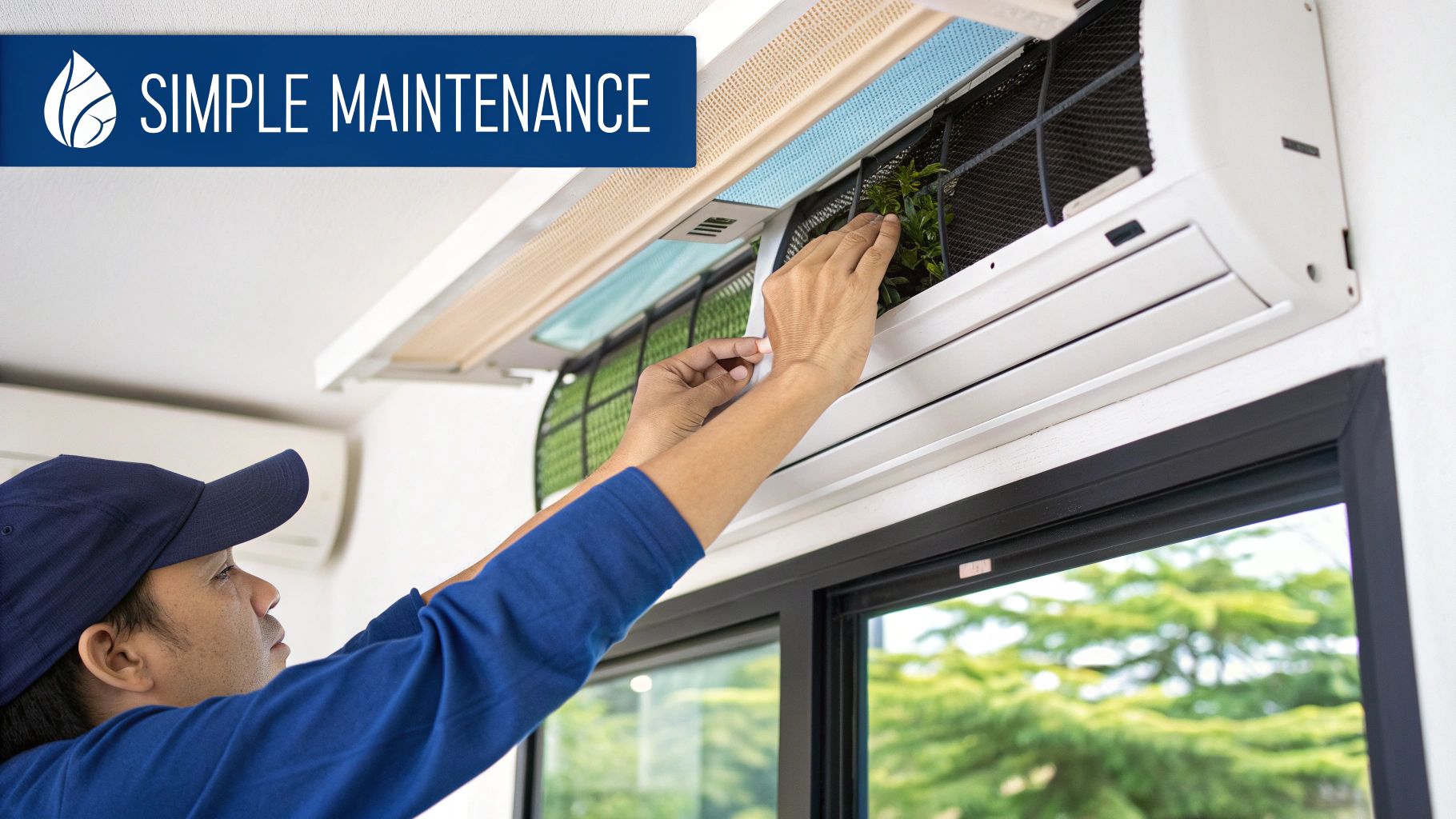
Your new split system is a significant investment in your home’s comfort, and a little bit of care goes a long way to protecting it. Think of it like a new car; regular, simple maintenance is the key to ensuring it performs efficiently for many years to come. Neglecting it is the fastest way to see higher power bills and shorten its operational life.
This proactive care ensures you get the best possible performance, especially during those scorching summer days in Sydney’s western suburbs or the chilly winter nights in the Hunter Valley. Luckily, the most important tasks are simple enough for any homeowner to handle themselves.
Simple DIY Maintenance You Can Do
The single most effective thing you can do for your air conditioner is to regularly clean the filters on the indoor unit. These filters are your system’s first line of defence, trapping dust, pet hair, and other airborne particles before they can clog up the delicate internal components.
When filters get blocked, your system has to work much harder to pull air through. This chews up more electricity and puts unnecessary strain on the fan motor. For most homes, we recommend checking and cleaning the filters every one to three months. If you have pets or live in a dusty area, you might need to do it more often.
It’s also crucial to keep the area around your outdoor unit clear. The big fan on the condenser needs unrestricted airflow to effectively release the heat it has removed from your home. Make sure it’s free from overgrown plants, weeds, fallen leaves, and any stored items. We recommend keeping at least 50cm of clear space around the entire unit.
Regular filter cleaning is not just about maintenance; it’s about efficiency. A clean filter can improve your system’s energy consumption by 5% to 15%, directly translating to savings on your electricity bill.
Why Professional Servicing Is Essential
While DIY cleaning is vital, it doesn’t replace the need for an annual professional service. A licensed technician does much more than just wipe things down. During a professional service, we perform a comprehensive check-up that you can’t do yourself.
This includes checking refrigerant gas levels to ensure they are optimal for performance, testing electrical connections for safety, and cleaning the coils and flushing the drain lines to prevent blockages and water leaks. It’s a preventative health check for your air conditioner. This annual check-up is the best way to catch small issues before they become major, costly breakdowns.
Got Questions About Split System Installation? We’ve Got Answers.
When you’re thinking about a new split system, a few questions always come up. Whether you’re in Sydney, Newcastle, or right here on the Central Coast, getting straight answers is the first step to feeling good about your decision. Here are the most common things we get asked.
How Much Does a Standard Installation Cost?
This is usually the first question on everyone’s mind. While every job is a little different, the labour for a standard “back-to-back” installation on a small or medium split system will typically be a few hundred dollars. The total price you’ll pay for both the unit and the install depends on the brand you choose, the kW capacity your room needs, and any installation complexities. Tricky wall materials or a long run between the units can add to the labour time and cost.
How Long Does the Installation Take?
For a straightforward job, it’s a pretty quick process. A typical installation on a single-storey home, where the indoor and outdoor units are placed on opposite sides of the same wall, usually takes between three to five hours from start to finish. Of course, more complex jobs, like an installation in a multi-storey home in the Hunter Valley or a Sydney apartment, will require more time for our technicians to get the job done safely and perfectly.
Do I Need a Special Electrician?
Yes, and this is a big one. Installing a split system in Australia is absolutely not a DIY job or something for a general handyman. It legally requires two separate qualifications: a licensed refrigeration mechanic with an ARCtick licence to handle the refrigerant gases, and a licensed electrician to manage all the wiring. A professional air conditioning company will ensure both are covered, which is the only way to get a safe, compliant installation that doesn’t void your warranty.
Always ask to see both the electrical and ARCtick licences before any work starts. It’s your best guarantee of a safe, compliant installation that protects your family and your new air conditioner.
When Is the Best Time of Year to Install an Air Conditioner?
We can install an air conditioner any time you need one, but if you want the easiest experience, aim for the “shoulder seasons” of autumn and spring. During these milder months, technicians are generally less swamped compared to the mad rush of a summer heatwave or the first proper cold snap of winter. This often translates to more flexible scheduling, meaning you’ll be ready to go long before the extreme weather hits.
For professional advice and a free, no-obligation quote tailored to your home, get in touch with the local experts at ALC Air. We’re here to help you find the perfect, energy-efficient solution to keep you comfortable all year round.