


If you're typing 'split system aircon installation near me' into a search bar, you're not just looking for a service. You’re looking for a reliable, local solution to beat the Australian heat and stay comfortable year-round. The real goal is finding a licensed and ARCtick certified technician who gets our unique climate, from the urban heat of Sydney's western suburbs to the specific humidity of the Central Coast.
Getting this right from the start ensures your system is installed safely, runs efficiently, and doesn't cause you headaches down the track. We'll walk you through what you need to know, from choosing the right unit for your Gosford home to understanding the legal requirements for installation in Newcastle or Sydney.

Why Local Expertise Really Matters
You're definitely not alone in wanting relief from our intense summers and chilly winters. Split systems, especially reverse cycle models, have become the go-to for countless Australian households across the Central Coast, Sydney, and the Hunter Valley. Their popularity is soaring, which means more homeowners than ever are looking for specialists to get the job done properly.
But a quality installation is much more than just mounting a unit on the wall. It involves crucial electrical work that must comply with Australian Standards, specifically AS/NZS 3000. This isn't a job for a handyman; it requires a licensed electrician to make sure everything is wired safely. On top of that, the job demands a technician with an ARCtick licence to handle the refrigerant gases. This is a non-negotiable legal requirement that protects both the environment and your system's warranty.
Choosing an installer who is genuinely local makes a huge difference. A true local expert understands the specific challenges our different environments throw at an air conditioning system.
For example, consider the difference in what we plan for. For properties in suburbs like Terrigal or anywhere along the Central Coast, we have to consider the impact of salt air on outdoor units. This influences where we place the unit and what materials we recommend to ensure it lasts. In Sydney’s dense suburbs, we’re used to navigating body corporate rules and finding the best installation solution for apartments. For homes in the Hunter Valley, we size systems to handle greater temperature extremes, from those scorching summer days to frosty winter mornings.
A professional doesn't just hang the unit; they provide vital advice on placement for optimal airflow and efficiency. They make sure your investment pays off through lower running costs and reliable comfort, year after year. Before you commit, it's also smart to know what’s involved in ongoing maintenance. You can get a head start by exploring our guide on what to expect during an air conditioning service to plan for the future.
Choosing the Right Split System for Your Home
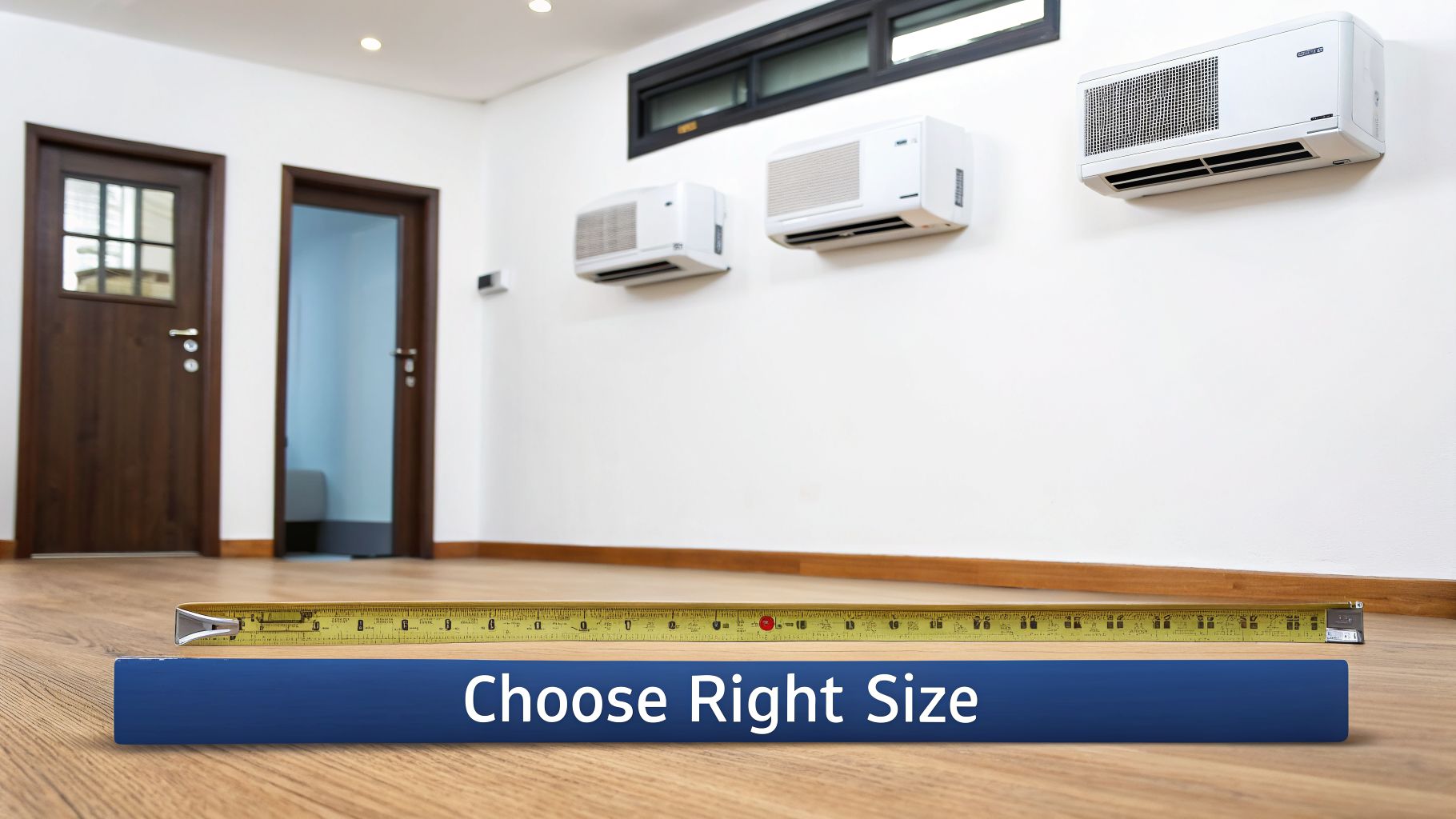
When it comes to choosing a split system, it’s about far more than just picking a brand you’ve heard of. The most critical decision you'll make is matching the unit's capacity, measured in kilowatts (kW), to the room it’s going into. This balancing act will directly impact both your comfort and your power bills for years to come.
Get it wrong, and you'll feel it. A system that’s too small will run flat-out on a hot day, never quite getting the room cool while your electricity meter spins. On the flip side, a unit that’s too big will constantly switch on and off. This is known as "short cycling," and it's a disaster for efficiency, puts a ton of wear on the machine, and does a poor job of dehumidifying the air, leaving you feeling cool but unpleasantly clammy.
Sizing Your System for Your Space
To hit that sweet spot, a professional installer doesn't just glance at the floor plan. We're trained to analyse a whole range of factors to calculate the correct kW capacity for your specific needs. This includes your room's dimensions (not just square metres, but ceiling height too), the size and orientation of your windows, and the quality of your home's insulation.
Local climate plays a massive role. The dry, intense heat of the Hunter Valley demands different considerations than the humid, salt-laden air of Newcastle or the "heat island" effect you find in many Sydney suburbs. Imagine you're cooling a two-storey home in Terrigal with afternoon western sun. The unit needed for that job will be different from one for a south-facing apartment in the Sydney CBD with good insulation.
For instance, a standard 3m x 4m bedroom might only need a 2.5kW unit. But if that exact same room has high ceilings, a big north-facing window, and is located in a hot Western Sydney suburb, you'll likely need to step up to a 3.5kW model to make sure it can handle a brutal 40°C day. If you want to get into the nitty-gritty of it, our guide on what size split system you might need is a great place to start.
Understanding Energy Efficiency and Key Features
Once you've nailed down the right size, it's time to look at the features that affect your long-term running costs and day-to-day comfort. The Zoned Energy Rating Label is your best friend here. It shows two separate star ratings, one for cooling and one for heating, giving you a clear, honest picture of running costs. The more stars, the lower your power bills. Simple as that.
Reverse cycle models are the standard across NSW for a reason. They provide powerful cooling in summer and surprisingly efficient heating in winter, often proving far cheaper to run for warmth than traditional electric heaters. Also, make sure you're looking for inverter technology. Think of an inverter as cruise control for your air con. Instead of the jarring stop-start of older units, it smoothly adjusts the compressor speed to maintain a constant temperature. This is not only much more energy-efficient but also keeps the room far more comfortable.
What to Expect During the Installation Process
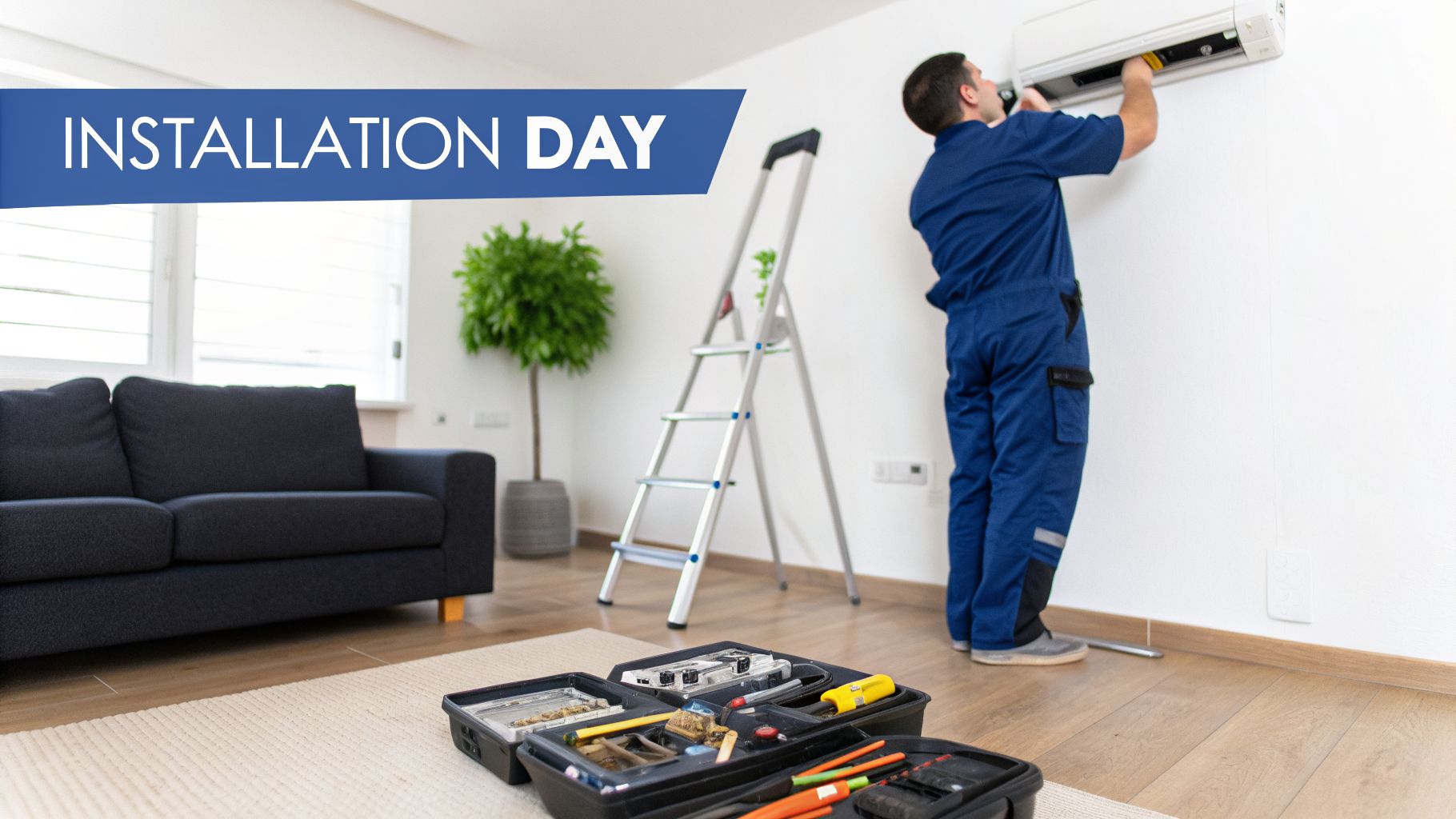
So, you’ve picked out the perfect split system for your home. What actually happens next? Knowing the ropes of the installation process helps you understand what to expect on the day, ensuring everything runs smoothly from start to finish. A professional installation is a well-orchestrated procedure, not just a job of hanging a couple of boxes on your walls.
It all kicks off with our on-site assessment and detailed quote. This isn't just about measuring a room; it’s about mapping out the entire job. Our technicians find the sweet spot for the indoor unit to give you quiet operation and fantastic airflow, and we pinpoint the best location for the outdoor unit, weighing up factors like noise, ventilation, and easy access for future servicing.
The Day of Installation
The most common type of job is a standard back-to-back installation, where the indoor and outdoor units are positioned on opposite sides of the same wall. For a straightforward setup like this, our team can usually have the whole thing wrapped up in just a few hours.
The process has a few key stages. First, we’ll mount the indoor head unit on the chosen interior wall. Then, we drill a core hole through the wall to run the copper piping, electrical wiring, and a condensate drain line to the outside. Don't worry, this is all done with specialised tools and care to keep any mess to a bare minimum. Outside, we secure the condenser unit on a solid base, either a concrete slab or sturdy wall brackets. This is vital to make sure it’s perfectly level and has proper clearance for airflow. Our installers treat your home like their own, using drop sheets and cleaning up thoroughly when the job is done.
Electrical Work and Safety Compliance
This is the part that is absolutely non-negotiable: all electrical work must be done by a licensed professional. A qualified electrician will handle all the wiring to ensure it’s safe and fully compliant with Australian Standard AS/NZS 3000. This standard is the rulebook for electrical work in Australia, ensuring everything is safe.
Important Safety Note: A new split system almost always needs its own dedicated electrical circuit running straight from your switchboard. An installer suggesting you can just plug it into a regular power point is cutting dangerous corners and putting your home at risk. Our electrician will install the correct circuit breaker and run the right wiring to the outdoor unit's isolation switch. All of this is done to meet strict SafeWork NSW regulations, which guarantees your system is safe and keeps your warranty valid. If you want to dive deeper into the technical side, you can learn more about the specifics of installing a reverse cycle air conditioner in our detailed guide.
Once everything is connected, we move on to the commissioning process. This involves pressure testing the refrigerant lines, using a vacuum pump to suck out any air and moisture, and then releasing the refrigerant gas. Finally, we power up the system, test its heating and cooling functions, and double-check that everything is running perfectly. Before we pack up, we’ll walk you through how to use the remote control, showing you how to operate the settings, timers, and louvres so you can get the most out of your new air con.
Breaking Down the Cost of a Split System Installation

Budgeting for a new split system is usually the first thing homeowners think about. If you understand what goes into the final price, you’ll be in a much better position to evaluate quotes and make a confident decision. The total cost really comes down to two main parts: the price of the air conditioner itself and the labour to get it installed properly.
The unit’s cost depends on the brand you go with, its cooling capacity (measured in kW), and its energy efficiency rating. The installation labour, on the other hand, depends almost entirely on the complexity of the job. A simple ‘back-to-back’ install, where the indoor and outdoor units sit on opposite sides of the same wall, is your most affordable starting point.
Factors That Influence Installation Labour Costs
The price for labour can swing quite a bit depending on your home’s specific layout. While that straightforward back-to-back job sets a baseline, a few common factors can add complexity and push the cost up.
If the outdoor unit can't be placed directly behind the indoor one, it requires longer copper pipes and drain lines. For example, the unit might need to be on a different side of the house or at ground level for a second-storey bedroom. This adds to the bill for both materials and the extra time involved.
Your home’s switchboard is a big one. If it’s old or already full, it might not have space for a new dedicated circuit for the air con. An upgrade might be necessary, and this work must be done by a licensed electrician to comply with AS/NZS 3000 and keep your home safe. Additionally, installing units on high walls, in tight roof spaces, or on multi-storey apartment balconies in Sydney often requires special equipment like scissor lifts and extra safety precautions. Naturally, that extra time and gear will be reflected in the quote.
Understanding Realistic Cost Ranges and Rebates
A standard back-to-back installation gives you a starting price, but you can realistically expect more complex jobs to add to the final bill. It's also critical to remember that attempting a DIY install will immediately void your manufacturer's warranty. Professional installation isn't just a good idea; it's a non-negotiable part of the investment.
To help with the cost, government incentives like the NSW Energy Savings Scheme (ESS) can make a genuine difference. Choosing a high-efficiency model could make you eligible for rebates that reduce your initial outlay. For a complete picture, it's worth exploring all the variables. You can get more details in our comprehensive breakdown of the cost of a split system air conditioner. When you get a quote, check that it’s itemised so you can see exactly what you’re paying for. A clear, detailed quote from a reputable installer gives you the confidence that there are no hidden surprises waiting for you down the line.
Why a Licensed Installer Is Your Only Option
Hiring the right person to install your split system is easily the most critical decision you'll make in this whole process. It's not just a good idea, in Australia, it's flat-out illegal for someone without the right licences to install a split system. Choosing a company with fully licensed and insured technicians isn't just a recommendation; it's your only safe and legal path forward.
Thinking you can save a few dollars by using an unlicensed handyman is a huge gamble with your home’s safety and your investment. The risks are severe, ranging from a system that barely cools to catastrophic electrical faults that could cause a fire.
The Two Licences You Must Verify
When you’re searching for an installer, you need to ensure they hold two specific, non-negotiable qualifications. Don't just take their word for it; ask to see the proof.
- Full Electrical Licence: All wiring must be performed by a licensed electrician in compliance with Australian Standard AS/NZS 3000. This ensures the unit gets its own dedicated circuit and is safely connected to your switchboard, which prevents overloads and fire hazards.
- ARCtick Refrigerant Handling Licence: It is against the law for anyone without an ARCtick licence to handle the refrigerant gases inside an air conditioner. This licence proves they are trained to handle these high-pressure gases safely, protecting both the environment from harmful leaks and your system from terminal damage.
These licences aren't just pieces of paper. They represent years of training and a real commitment to the safety standards set by bodies like SafeWork NSW. A professional installer will never hesitate to show you their licence numbers. If they get vague, make excuses, or flat-out refuse, that's a massive red flag. Walk away immediately.
The Dangers of Cutting Corners
The consequences of using an unlicensed operator can be incredibly costly and dangerous. You risk voiding your manufacturer's warranty from day one, leaving you with no recourse if the unit fails. Poor installation techniques, like incorrect pipe flaring or failing to vacuum the lines properly, lead to refrigerant leaks, dismal performance, and a drastically shortened lifespan for your new air conditioner.
To protect yourself, it pays to understand the specific contractor's licensing requirements in NSW for any trade working on your property. This knowledge is your best defence when vetting potential installers. When you're evaluating installers, it's crucial to understand what separates a true professional from a risky, unqualified operator. The differences go far beyond just having a licence, they impact safety, performance, and your legal standing.
Hiring an unlicensed operator is a false economy. Any money you might save upfront is quickly lost through voided warranties, poor performance, high repair bills, and serious safety risks. It's simply not worth the gamble. Before you hire anyone, run through this simple checklist:
- Ask for their electrical licence number and their ARCtick licence number.
- Request a copy of their public liability insurance certificate.
- Confirm they will provide a Certificate of Compliance for the electrical work.
- Ensure the quote specifies installation by a fully licensed and insured team.
For a deeper dive into what a compliant and professional job looks like, you can explore the details of our split system air conditioner installation process. Choosing a qualified professional is the only way to guarantee your system is installed safely, works efficiently, and provides reliable comfort for years to come.
Your Split System Installation Questions, Answered
When you're planning an installation, a few key questions always come up. Getting clear, practical answers upfront helps you know what to expect and makes the whole process smoother. Here are the things we get asked most often by homeowners looking for a new split system.
How Long Does a Standard Installation Take?
For a straightforward "back-to-back" installation, we're usually in and out in 3 to 4 hours. This is where the indoor unit is on an exterior wall, and the outdoor unit sits directly behind it on the other side. It’s the most common and efficient setup.
Of course, not every home is that simple. If the outdoor unit needs to be placed on a different wall, mounted on the roof, or if your switchboard needs a bit of love, it can easily turn into a full day's work. We’ll always give you a firm time estimate in our quote so there are no surprises on the day.
When Is the Best Time of Year to Install Air Conditioning?
The smartest time to book your installation is during the shoulder seasons: autumn (March to May) and spring (September to November). Demand is much lower during these milder months, which means you get more flexibility with scheduling and avoid the pre-summer rush.
If you wait until the first real heatwave hits, you’ll be in a queue with everyone else who had the same idea. That can lead to frustratingly long wait times. A little bit of planning in the cooler months means you’re ready to go when summer arrives.
How Much Space Does the Outdoor Unit Need?
Your outdoor unit (the condenser) needs to breathe. It works by pushing heat out of your home, and if it doesn't have enough clear space around it, it can't do its job efficiently. It will work harder, use more power, and could even overheat on those really hot days.
As a rule of thumb, we recommend at least 500mm of clear space around the sides and back of the unit. It also needs clear, open space above it to let the hot air escape. This is especially important for homes in hotter areas like Western Sydney or the Hunter Valley. Don't worry, finding a suitable and discreet spot for it is a key part of our initial site check.
Do I Need Permission from My Landlord or Body Corporate?
Yes, almost certainly. If you're renting, you absolutely must get written permission from your landlord or property manager before going ahead.
For anyone living in an apartment, townhouse, or any property governed by a strata scheme, you’ll need to get approval from the body corporate. They often have specific rules about where outdoor units can be placed and what they can look like to maintain the building's appearance. Strata committees are very familiar with these requests. Government initiatives like the NSW Energy Savings Scheme (ESS) have also encouraged the switch to high-efficiency models. If you’re interested in the data, you can read the full report on Australia’s air conditioning landscape to see how these schemes have shaped the market.
At ALC Air, we believe in giving you clear answers and expert advice to make your installation simple and stress-free. With over 15 years of experience on the Central Coast, we specialise in finding the right solution for every home. If you have more questions or you’re ready for a professional to take a look at your home, get in touch for a free, no-obligation quote.