


So, what's a new split system going to cost? Before we get into the details, here's the ballpark figure. For a standard split system air conditioning installation in NSW, including the unit itself and all the labour, you're typically looking at a range between $1,800 and $5,000+.
Where your job falls in that range really depends on the size of the unit you need, how tricky the installation is, and the specific layout of your home. This guide will walk you through every part of the cost so you know exactly what to expect when you're budgeting for a new air conditioner.
Your Quick Guide to Air Conditioning Installation Costs
Trying to budget for a new air conditioner can feel a bit like guessing in the dark, but it doesn't have to be. The total price is simply a mix of two main things: the cost of the air conditioner itself and the cost of getting it installed by a professional. Understanding how these two pieces fit together is the key to making a smart investment.
Think of it this way: the unit you choose, based on its brand, energy efficiency, and cooling power (measured in kilowatts, or kW), is the first big chunk of the cost. A smaller 2.5kW unit perfect for a bedroom will naturally be a lot cheaper than a powerful 7.0kW system designed to cool a big, open-plan living area in a Lake Macquarie home.
Core Cost Components
The second part of the equation is the installation. This isn't just about hanging a unit on the wall; it’s the skilled work of licensed electricians and ARCtick certified technicians who make sure everything is safe, efficient, and compliant with Australian Standards. We're here to ensure the job is done right the first time.
In our experience, professional installation fees for a straightforward split system can range from $600 to $2,500. The final figure is really dictated by how complex the job is. For a clearer picture of how the unit price and installation come together, here's a quick breakdown of what you can expect for different system sizes.
Estimated Total Cost Breakdown (Unit and Installation)
| Room Size and System Capacity | Typical Application | Estimated Total Cost Range |
|---|---|---|
| 2.5kW – 3.5kW | Bedrooms, home offices, small living areas (10-25m²) | $1,800 – $2,800 |
| 5.0kW – 6.0kW | Mid-sized living rooms, master bedrooms, small open-plan areas (25-40m²) | $2,400 – $3,500 |
| 7.0kW – 8.0kW | Large open-plan living/dining areas, large master suites (40-60m²) | $3,000 – $5,000+ |
| 9.0kW+ | Very large open-plan spaces, commercial applications (60m²+) | $4,500+ |
These price ranges give you a solid starting point for budgeting. They reflect what most homeowners in the Central Coast, Sydney, and Newcastle regions pay for a quality, professionally installed reverse cycle system that's built to last. For a deeper dive into unit-only pricing, check out our complete guide to split system air conditioner prices.
Deconstructing Your Installation Quote

When you get a quote for a new air conditioner, it’s natural for your eyes to jump straight to the final price. But to really understand the value you're getting, it helps to know what goes into that number. A split system air conditioning installation cost really comes down to two things: the air conditioner itself, and the skilled labour and materials needed to install it properly.
Think of it like getting a new kitchen benchtop. You’ve got the cost of the stone itself, and then you have the cost of the stonemason who cuts, polishes, and fits it perfectly. You need both for a result that looks great and lasts for years, and your air conditioner is no different.
The Air Conditioning Unit Cost
The first big chunk of your quote is the hardware. This means both the indoor unit you see on the wall and the outdoor condenser unit that does all the hard work. The price for the unit itself can vary quite a bit, and it usually comes down to a few key things.
Brand reputation is a big one. Names like Mitsubishi Electric, Daikin, and Fujitsu have spent decades proving their systems can handle tough Australian conditions, and that reliability is reflected in the price. They also tend to have better warranties and local support, which is invaluable if you ever have an issue.
Energy efficiency also plays a huge part. A system with a higher star rating might cost more upfront, but it'll save you real money on your power bills over its lifetime. That’s especially true with the scorching summers we get in Western Sydney and the Hunter Valley. Extra features, like built-in Wi-Fi for smart home control or advanced air filters, will also nudge the price up.
The Professional Labour Cost
The second part of the quote covers the labour and materials for a safe, compliant installation. This is where the expertise of our licensed technicians really shines. It’s not just a matter of hanging a box on the wall; it’s about making sure the whole system works flawlessly and meets strict Australian Standards.
A professional installation is your best insurance policy for system performance and safety. It ensures your warranty remains valid and your system complies with all electrical and refrigerant handling regulations, including AS/NZS 3000.
Let's look at a standard 'back-to-back' installation, which is the most common and cost-effective setup you’ll see. This is where the indoor unit is mounted on an exterior wall, with the outdoor unit placed directly behind it on the ground outside. This straightforward scenario gives us a clear scope of work to factor into the labour cost.
A back-to-back installation typically includes:
- Electrical Work: A licensed electrician must run a dedicated power circuit from your switchboard to an isolator switch near the outdoor unit. This is a non-negotiable legal requirement under SafeWork NSW regulations to ensure the system has a safe, stable power supply.
- Piping and Cabling: We install a set length of refrigerant copper piping (usually up to 3 metres) and interconnecting electrical cables that connect the indoor and outdoor units.
- Mounting and Drainage: This covers securely mounting the indoor unit, placing the outdoor unit on a sturdy base, and running a drain pipe to carry away condensation.
Every single step is handled by our ARCtick certified technicians, who are fully qualified to handle refrigerants safely and legally. When you pay for professional labour, you’re investing in safety, compliance, and the long-term health of your air conditioner. To get a better idea of what happens on the day, checking out a guide on what to look for in a split system installation near you can offer some helpful insights.
Factors That Shape Your Final Installation Cost
Ever wondered why your quote for a split system is different from your neighbour's, even though you live on the same street? It’s because no two homes are exactly the same, and a handful of key factors can dramatically change the final price. The real driver behind these differences is the complexity of the job.
Let's imagine two very different scenarios. First, a simple ground-floor installation in a new build out in the Hunter Valley. The walls are clear, the switchboard is brand new, and access is a breeze. Now, consider this scenario: installing a unit in a third-floor apartment in Sydney's inner west. You're dealing with double-brick walls, limited space for the outdoor unit, and a long list of strata rules to follow. As you can guess, that second job takes far more time and specialised gear.
Home and Building Characteristics
The type of home you live in is one of the biggest variables right off the bat. A single-storey house in a Newcastle suburb like Fletcher is usually the most straightforward and cost-effective installation we do. Our technicians can easily get to both the inside and outside walls, which makes running the pipes and electrical cables a much simpler task.
Things get trickier with a multi-storey home. If we're putting a unit on the second floor of a house in Terrigal, we’ll probably need extra equipment like extension ladders or even scaffolding to safely position the outdoor unit. This adds to the labour time and the amount of materials needed, like longer copper piping to connect the indoor and outdoor units.
Key Takeaway: The harder it is to access the location and the further apart the indoor and outdoor units are, the more labour and materials are needed. This is the number one reason quotes can vary so much from one property to another.
Unit Location and Accessibility
Where you actually want the indoor and outdoor units placed also has a huge impact on the price. The simplest setup is what we call a 'back-to-back' installation, where the indoor unit is mounted on the same wall as the outdoor unit, just on the opposite side. But that’s not always the best or most practical spot for your home's layout or for aesthetic reasons.
For example, you might want the indoor unit centred on your living room wall, but the only decent spot for the noisy outdoor unit is around the side of the house. This means we have to run the copper pipes and wiring through your roof cavity or under the floor. That extra work takes more time and uses more materials, pushing the installation cost higher than a simple back-to-back job.
Site-Specific and Environmental Factors
Your local environment plays a part, too. For homes right on the Central Coast, from Umina Beach up to Norah Head, the corrosive salt air is a serious issue. We often recommend installing outdoor units with special anti-corrosion coatings to protect them and make them last longer. It adds a little to the upfront cost, but it will save you from premature failure and expensive repairs down the track.
The condition of your existing electrical system is also critical. A licensed electrician has to make sure your switchboard can handle the extra load from a new air conditioner. If your home in an older part of Lake Macquarie has an outdated switchboard, it will almost certainly need an upgrade to comply with Australian Standard AS/NZS 3000. This is an additional but absolutely essential cost for safety.
Labour for these electrical jobs typically ranges from $600 to $1,500, with hourly rates falling between $80 and $110. You can explore more about these labour breakdowns and cost factors in this helpful guide on split system installation costs. Understanding these variables helps you see your quote not just as a number, but as a solution designed specifically for your home's unique needs.
Choosing The Right System Size And Why It Matters
When we talk about the split system air conditioning installation cost, picking the right size unit is easily one of the most critical decisions you'll make. It has a massive impact not just on the initial price tag, but on your power bills for the next decade and beyond. Many people fall into the "bigger is better" trap, but with air conditioners, that's a costly mistake. An oversized system is just as bad as one that's too small.
The Problem With Getting It Wrong
Let's get practical. Imagine you've got a large, west-facing living room in a Terrigal home that absolutely cops the afternoon sun. If you install an undersized unit, it's going to run flat-out all day long and never quite get the room comfortable. This constant, full-throttle operation chews through electricity and puts enormous strain on the machine, shortening its lifespan.
Now, flip that scenario. Say you install a massive, overpowered unit in a small, well-insulated bedroom in a Newcastle apartment. It will blast the room with icy air, hit the target temperature in a few minutes, and then abruptly switch off. This is called short cycling, and it's horribly inefficient. Because the system never runs for a sustained period, it doesn't get a chance to properly dehumidify the air, leaving the room feeling cold but unpleasantly clammy.
Matching Kilowatts To Your Space
A split system's power is measured in kilowatts (kW). A higher kW rating means more cooling (or heating) power. As a rough guide, you need about 1.0 to 1.5kW of power for every 10 square metres of space you want to cool.
So, a small bedroom or home office around 20 square metres is typically a great match for a 2.5kW system. A standard living area of 40 square metres would be looking at something in the 5.0kW to 6.0kW range. A large, open-plan living and dining area in a new Hunter Valley build might need a 7.0kW system or even larger.
Crucial Tip: Proper sizing is the absolute key to balancing comfort and running costs. A correctly sized system will run efficiently, control humidity effectively, and give you consistent temperatures without working itself into an early grave.
More Than Just Floor Area
While square metres give us a good starting point, our technicians look at much more than just the size of the room. A professional heat load calculation is the only way to get it right, every time. This decision tree gives a simple overview of how different property features can influence the complexity and, therefore, the cost of an installation.
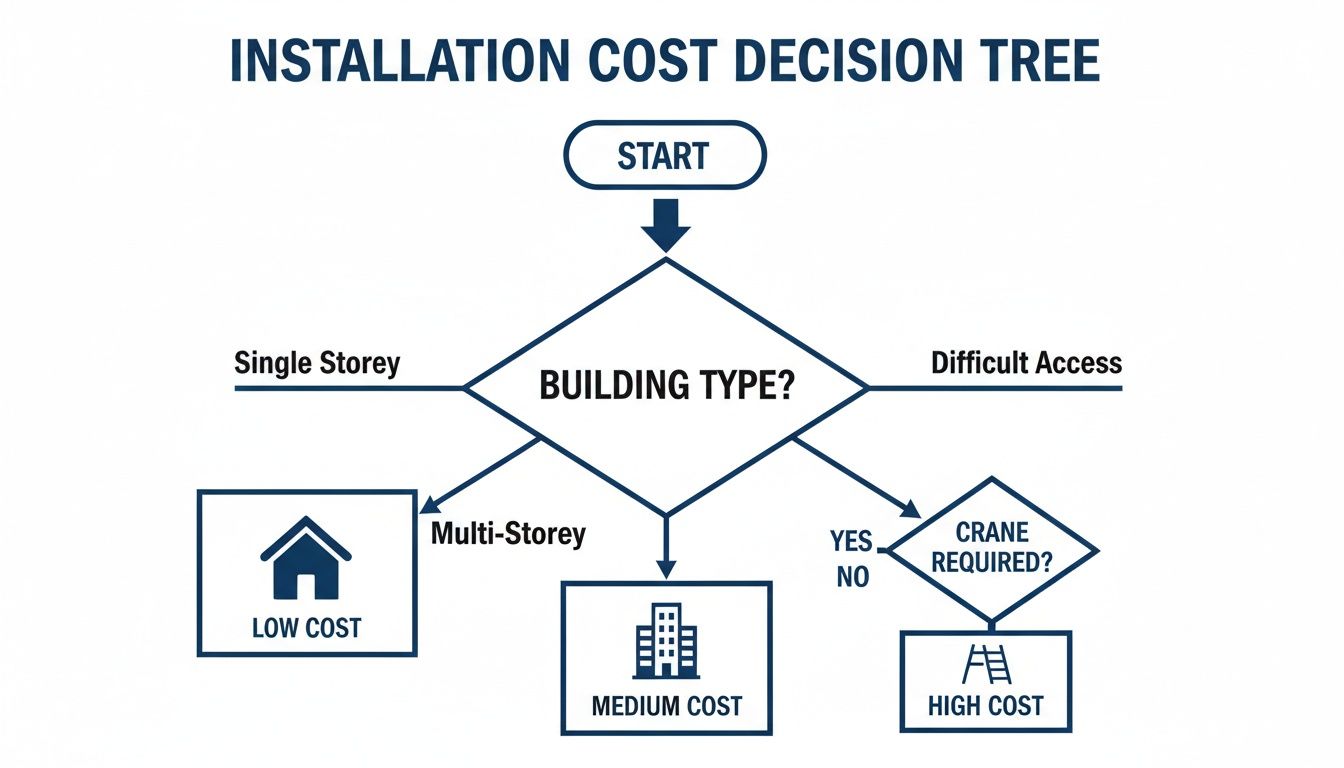
As you can see, things like whether your home is single-storey or multi-storey, and how easy it is to access, are primary drivers of the final installation cost. To make sure your system is perfectly suited to your home, we consider many different factors.
For example, a room with high ceilings has a much larger volume of air to cool, which often demands a more powerful unit. The size, orientation, and type of windows also make a huge difference. A room with large, single-glazed windows facing west will need a lot more cooling power than one with smaller, double-glazed windows facing south.
The quality of insulation in your ceiling, walls, and under your floor plays a massive role in how much heat gets into your home. Better insulation means you can often use a smaller, more energy-efficient system. We also account for the specific conditions of your area, from the humid coastal air in Lake Macquarie to the dry, intense heat you find in Sydney's western suburbs. To help you get a better idea, we've put together a detailed guide on figuring out what size split system you might need.
The Hidden Costs of DIY vs Professional Installation
When you're looking at the split system air conditioning installation cost, it’s natural to wonder if you can save a few dollars by tackling the job yourself. Here in Australia, the answer is a simple and firm no. A DIY air con installation isn't just a bad idea; it's illegal, incredibly dangerous, and almost guaranteed to cost you a lot more in the long run.
Thinking you can just mount the units and plug them in is a common but very risky misunderstanding. The reality is that installing a split system involves high-voltage electrical work and handling pressurised refrigerant gases. This is exactly why the law is so strict. In NSW, and right across Australia, you are legally required to use two different types of licensed professionals for the job.
Legal and Safety Requirements
First up, all the electrical work has to be done by a licensed electrician. This isn't negotiable, it's mandated by SafeWork NSW. Your new system needs its own dedicated circuit run from your switchboard to make sure it runs safely and doesn't overload your home's existing wiring. This work must follow the Australian Standard AS/NZS 3000, also known as the Wiring Rules.
Second, the technician handling the refrigerant side of things must hold a proper ARCtick licence from the Australian Refrigeration Council. Refrigerant gas is under seriously high pressure and can cause severe frostbite if it touches your skin. It’s also an environmental hazard, and letting it escape into the atmosphere is illegal. Only a certified professional has the training and specialised gear to handle, charge, and test these gases safely.
Important: Trying to do your own electrical work without a licence or handling refrigerant gas without an ARCtick certificate can lead to massive fines. More importantly, you're risking serious injury or even death. It's a gamble that is never, ever worth taking.
The Financial Pitfalls of a DIY Attempt
Beyond the immediate safety and legal dangers, trying to install the system yourself will void your manufacturer's warranty from day one. Brands like Mitsubishi Electric and Daikin simply won't honour a warranty claim without proof of installation by a licensed and certified technician. That means if the unit fails a week after you've put it up, you’re completely on your own.
An improperly installed system is also horribly inefficient. If the refrigerant isn't charged correctly, the pipe connections aren't perfect, or the drainage is wrong, you'll end up with a system that struggles to cool, chews through electricity, and breaks down all the time. The money you thought you were saving on the installation will quickly get eaten up by sky-high power bills and expensive repair calls.
Ultimately, professional installation is an investment in safety, compliance, and performance. For more on this, our guide on split system air conditioner maintenance and when to call a pro offers clear advice on what you can safely handle yourself.
Understanding the Long-Term Running Costs

The split system air conditioning installation cost is the first big investment, but it’s definitely not the last. To really get the full picture of what your new system will cost, you have to think about what you’ll be paying to run it over the next ten to fifteen years. Savvy homeowners across Sydney and the Central Coast know to budget for this, so there are no nasty surprises on their power bills.
The good news? Modern reverse cycle systems are incredibly efficient. The most important thing to look at here is the unit's energy star rating. A system with a higher star rating will almost always have a higher price tag, but it pays you back year after year through lower electricity use.
Your Electricity Bills and System Efficiency
Your air conditioner will likely be one of the biggest power consumers in your home, so how you use it really matters. The key to keeping those running costs down is simply to be smart about it. That means setting a sensible temperature, around 24 degrees in summer and 18-20 degrees in winter is a great rule of thumb.
Every degree you push the system further makes it work significantly harder, and that shows up directly on your power bill. Using timers, closing doors to rooms you aren't using, and keeping the blinds drawn on a hot Hunter Valley afternoon are all simple habits that make a huge difference. For a detailed breakdown of what to expect, you can learn more about how much running your air conditioner costs in our dedicated guide.
The Value of Regular Maintenance
Think of professional maintenance like a regular health check-up for your air con. An annual service is one of the smartest ways to protect your investment and keep your system running at peak efficiency. Over time, filters get clogged with dust, coils get dirty, and refrigerant levels can drop slightly.
A well-maintained system doesn't have to work as hard to cool or heat your home. This means it uses less energy, saving you money on every bill and preventing the wear and tear that leads to expensive, unexpected breakdowns.
During a service, our technicians will give the unit a proper clean, check all the electrical connections, test refrigerant pressures, and make sure everything is operating safely. This doesn't just extend the lifespan of your unit; it also ensures the air you're breathing is clean and healthy.
Understanding Your Warranties
When we install a new split system, it comes with two important layers of protection. First is the manufacturer's warranty, which typically covers parts and defects in the unit itself for a period of five years. This is your safeguard against any faults in the machine.
The second is our installation warranty. This covers all the workmanship and materials we use to install your system. It’s our guarantee that the electrical work, piping, and connections have been done correctly and to Australian Standards. Knowing you’re covered by both gives you complete peace of mind, ensuring your comfort is protected for years to come.
Common Questions About Installation Costs
We've covered a lot of ground on what goes into the cost of a split system, but it's completely normal to still have a few questions floating around. To help you feel confident and prepared, we've put together answers to the most common queries we hear from homeowners across the Central Coast, Sydney, and Newcastle.
How Long Will the Installation Take?
For a straightforward 'back-to-back' installation on a single-storey house, our technicians are usually in and out in about 3 to 5 hours. If the job is a bit more involved, like installing on a second floor or needing significant new electrical work, it can sometimes take up a full day. We’ll always give you a clear and realistic timeframe with your fixed-price quote so you know exactly what to expect.
Can I Supply My Own Air Conditioner?
Yes, you absolutely can. If you've already bought a unit, we're happy to install it for you. However, we really recommend having a quick chat with us first. It’s crucial to make sure the system you’ve chosen is the right size and type for your space. An undersized or oversized unit will struggle to perform efficiently, costing you more in the long run.
There's another benefit when we supply and install the system as a package: it simplifies any future warranty claims. If an issue ever pops up with the unit or the installation, you have a single point of contact, us. It makes the whole process much smoother.
Is Removing My Old Unit Included in the Quote?
A standard installation quote is focused on getting your new system up and running, so it typically doesn't include the removal of an old air conditioner. Taking out an old unit is a separate service because it involves safely decommissioning it, which includes recovering any leftover refrigerant gas to comply with environmental regulations. If you need an old system removed, just let us know when you request a quote.
Will I Need to Get Council Approval?
For the vast majority of residential split system installations in NSW, council approval is not required. You can usually go right ahead. There are a couple of exceptions, though. Apartment buildings are often governed by strata by-laws that can have specific rules about where you can place outdoor units. Also, properties in heritage-listed areas sometimes have strict restrictions. With over 15 years of experience across the region, we're very familiar with local requirements and can advise if any special considerations apply.
Ready to get a clear, fixed-price quote for your home? The team at ALC Air is here to help. We provide professional advice and a free, no-obligation assessment to ensure you get the perfect system for your needs. Contact us today to arrange your free quote.