


If you're wondering what a split system air conditioner is likely to set you back, you’re in the right place. For a standard, single-room setup in a typical home, you can realistically expect the total cost to land somewhere between $1,200 and $3,500.
This price tag covers both the unit itself, which usually costs between $600 and $2,500, and the professional installation, which can add another $600 to $1,000. Think of these numbers as a solid starting point before we dive into the details that can shift the final quote up or down.
Your Quick Guide to Split System Costs in NSW
When you're looking to get air conditioning installed, the first and most important step is getting a handle on the costs. For so many homeowners across the Central Coast, Sydney, and Newcastle, the split system is the go-to choice, striking that perfect balance between efficiency, performance, and what you actually have to spend.
This guide is designed to give you a clear, honest overview of what you should budget for, from the air conditioner itself to the final, professional installation. Consider this your starting point: a quick snapshot of the investment required to get year-round comfort in your home.
Why Split Systems Are So Popular
The popularity of split systems has absolutely surged across Australia, and for good reason. The simple need for efficient cooling has driven countless homeowners to choose them. In fact, split systems now make up over 70% of all residential air con installations, thanks to their competitive pricing and fantastic energy efficiency compared to older, bulkier options.
This trend is especially obvious in places like the Central Coast and Sydney's western suburbs. For more detail on this, you can check out these insights on Australian air conditioning costs.
What this means for you is simple: you can cool single rooms or open-plan living areas incredibly effectively, all without the massive investment required for a full ducted setup.
A General Cost Snapshot
Let's break down the costs into the two main parts you'll see on any quote. This will give you a clear idea of where your money is going. To give you a clearer picture, here’s a quick summary of what you can expect to pay for the different parts of a split system installation.
Estimated Split System Air Conditioning Costs at a Glance
This table summarises typical cost ranges for different components of a split system installation, helping you understand where your money goes.
| Cost Component | Typical Price Range (AUD) |
|---|---|
| Air Conditioner Unit | $600 – $2,500 |
| Professional Installation | $600 – $1,000 |
| Total Estimated Cost | $1,200 – $3,500 |
Of course, these are just ballpark figures. In the sections that follow, we’ll get into the specifics of what influences these numbers.
The Unit: The price of the indoor and outdoor units can vary massively depending on the brand, its cooling capacity (measured in kW), and the all-important energy rating.
The Installation: This covers the skilled work of a licensed and ARCtick certified technician to get your system installed safely and correctly. It involves mounting the units, running the refrigerant piping between them, and making all the necessary electrical connections to meet strict Australian Standards.
We’re big believers in upfront, transparent pricing, which is why we break down every single part of the cost. In the following sections, we’ll explore what’s behind these numbers in much greater detail.
The Two Parts of Your Quote: The Unit and the Installation
When you get a quote for a new split system, you’re looking at a final price made up of two key components: the cost of the physical air conditioner itself, and the cost of the professional labour needed to get it running in your home. It’s important to understand how both parts contribute to the total split system air conditioning cost, because it helps you see exactly where your money is going.
Think of it like getting new tyres for your car. You pay for the rubber, but you also pay a specialist to mount, balance, and align them properly. You wouldn’t just buy the tyres and hope for the best, because the professional fitting is what guarantees safety and performance. Air conditioning is exactly the same—a great unit and a quality installation are equally crucial for a reliable, long-lasting result.
What Determines the Price of the Unit Itself?
The price tag on the air conditioner box can vary wildly. This isn’t random; several key factors explain why one unit costs more than another.
- Brand Reputation: Big names like Daikin, Mitsubishi Electric, and Fujitsu have spent decades building a reputation for reliability. While they might cost a bit more upfront, you’re paying for rock-solid build quality, better warranty support, and a track record of longevity.
- System Capacity (kW): A small 2.5kW unit perfect for a bedroom is naturally going to be cheaper than a powerful 8kW system designed to handle a big, open-plan living area. Getting the size right is vital; an undersized unit will struggle and burn itself out, while an oversized one is just a waste of electricity.
- Energy Efficiency: That star rating is your best guide to how much the unit will cost you to run. A system with a higher star rating costs more to buy, but it will save you a serious amount on your power bills over its lifespan, making it a much smarter investment in the long run.
The Real Value of Professional Installation Labour
The installation part of your quote is about much more than just hanging a box on the wall. This is where the skill, experience, and compliance of a professional team become non-negotiable. A proper installation ensures your system runs efficiently, safely, and crucially, that your manufacturer’s warranty stays valid.
The labour cost reflects the technical expertise needed for a safe, compliant setup. This is one area where cutting corners can lead to a world of pain down the track, from sky-high power bills and poor performance to serious electrical hazards. You can get a deeper look into what goes into installation costs on our blog.
Crucial Insight: Professional installation isn't just a good idea; it's a legal requirement. In Australia, anyone handling refrigerants must hold an ARCtick licence, and all electrical work must be done by a licensed electrician to the AS/NZS 3000 standard. No exceptions.
What’s Covered in Your Installation Quote
When we quote for installation labour, we're quoting for a precise, regulated process that guarantees your system works perfectly and safely. Here’s what’s involved:
- Mounting the Units: We securely fit the indoor head unit and the outdoor condenser, making sure they’re in the best possible positions for airflow and future servicing.
- Running Refrigerant Piping: The two units are connected with specialised copper piping. This is then pressure tested for leaks and vacuumed out to remove every last bit of moisture and contaminants—a critical step many corner-cutters skip.
- Connecting Electrical Wiring: We run the dedicated power supply and interconnecting cables, making sure everything is 100% compliant with SafeWork NSW regulations and Australian electrical standards.
- Commissioning and Testing: Once it’s all connected, we fire up the system, test every function, check operating pressures and temperatures, and make sure it’s running at peak performance before we consider the job done.
This detailed process is your guarantee that the system is effective and, most importantly, safe for your family. A quality reverse cycle unit is an investment that protects your home and ensures you get every bit of value from your new air conditioner.
Key Factors That Influence Your Final Quote
Ever wondered why a quote for an installation in a Terrigal beach house looks so different from one for a two-storey home in Hornsby? It’s simple: no two homes are the same. Your final split system air conditioning cost will always be unique to your property.
Understanding the variables that shape your quote helps you see exactly what a technician is looking at when they prepare it. It’s not just about picking a unit off the shelf; it’s a careful process of matching the right system to your home's specific layout and needs. A pro considers everything from room size to wall materials, ensuring your system runs efficiently for years to come.
This diagram shows how your total cost is typically split between the price of the unit itself and the labour involved in getting it installed.
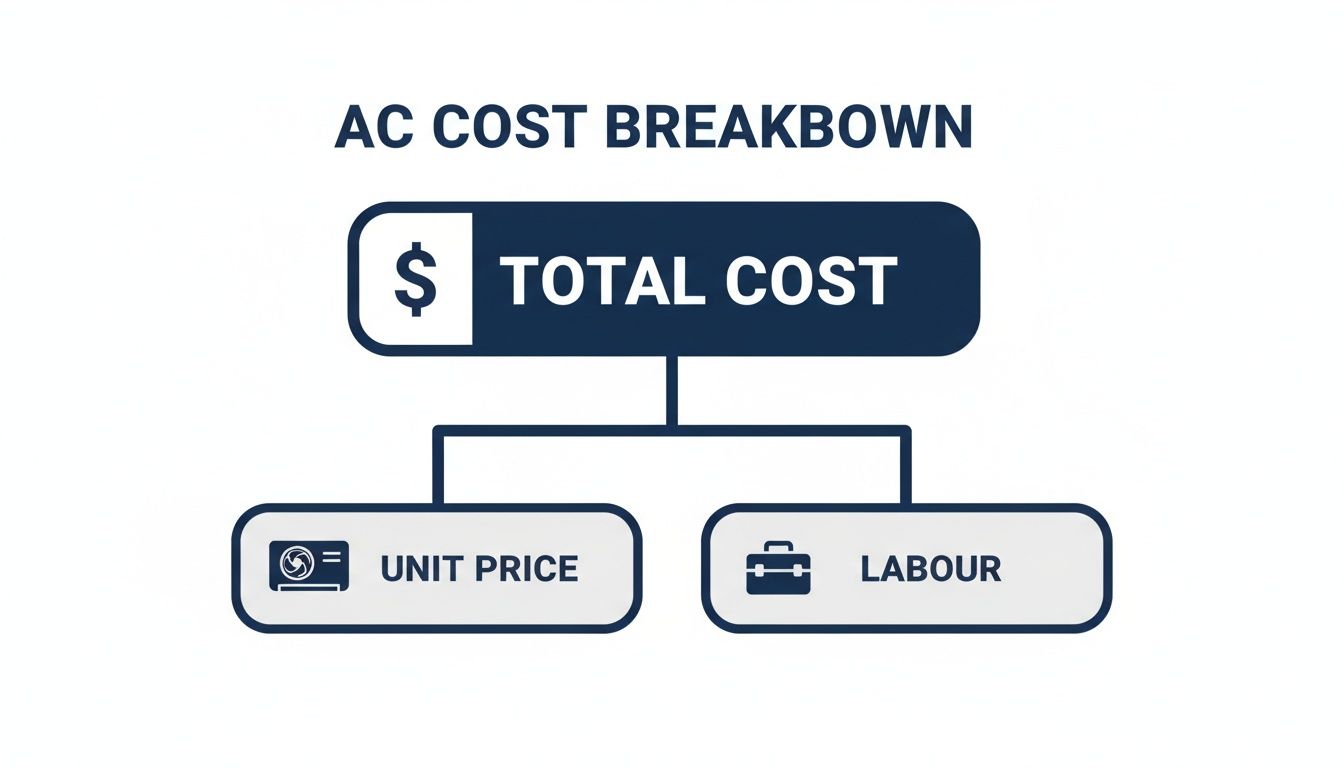
As you can see, the unit and the installation labour are the two major puzzle pieces, but the final picture depends on the specifics of the job.
System Capacity and The Right Fit
The single biggest factor driving the unit's price is its capacity, measured in kilowatts (kW). A small 2.5kW unit perfect for a bedroom will cost significantly less than a powerful 7kW or 8kW system needed for a large, open-plan living area in a Lake Macquarie home.
But choosing the right size isn’t just about raw power; it’s about efficiency. An undersized unit will run constantly, struggling to cool the space and driving up your power bills. On the other hand, an oversized unit will switch on and off too frequently—a process called short-cycling—which is also inefficient and creates annoying temperature swings.
Getting this right is crucial, and we cover it in more detail in our guide to correctly sizing your air conditioning.
Installation Complexity
How tricky the installation is will directly impact the labour component of your quote. The simplest and most affordable setup is what we call a "back-to-back" installation. This is where the indoor unit is mounted on an external wall, and the outdoor unit sits directly behind it on the ground outside. Easy.
But things get more complicated (and expensive) from there. To give you a clearer idea, here’s a quick look at how different factors can push the price up.
How Different Factors Affect Your Final Quote
| Cost Factor | Impact on Price | Example Scenario |
|---|---|---|
| Pipe Run Length | Moderate Increase | The indoor and outdoor units are at opposite ends of a room, requiring extra copper piping and labour to connect them. |
| Working at Heights | Moderate to High Increase | Installing the outdoor unit on a second-storey wall bracket or a hard-to-reach roof. This needs special safety gear and more time. |
| Wall Materials | Minor to Moderate Increase | Drilling through double brick or concrete is far more time-consuming and requires different tools than working with weatherboard. |
| Difficult Access | Moderate Increase | The property has a steep driveway, or the outdoor unit needs to be installed in a tight space with limited access for technicians. |
Each of these scenarios adds time, materials, and complexity to the job, which is naturally reflected in the final cost.
Your Home's Electrical System
Modern air conditioners are powerful appliances that draw a serious amount of electricity. Your home's switchboard has to be able to handle that load safely. In fact, Australian Standards (AS/NZS 3000) legally require every new air conditioner to be on its own dedicated circuit with a safety switch.
If your switchboard is old or already maxed out with other circuits, it will likely need an upgrade before the air conditioner can be installed. This is a critical safety step, not a nice-to-have. While it adds to the upfront cost, it protects your home from electrical faults and ensures you’re fully compliant with regulations.
A licensed electrician will spot this straight away during a site inspection.
Removing an Old System
If you're replacing an old air conditioner, the job involves a bit more than just slotting in the new one. The old system has to be professionally decommissioned by an ARCtick licensed technician.
This process involves carefully recovering the old refrigerant gas so it doesn’t escape and harm the environment. Only then can the indoor and outdoor units be physically removed. This all adds extra time and labour to the project, which will be factored into your quote.
Looking Beyond the Upfront Cost: Running and Maintenance Expenses
The price you pay for installation is really just the beginning of the story. Any savvy homeowner in Newcastle or Sydney knows the real cost of an air conditioner unfolds over its lifetime. It’s the long-term running and maintenance costs where you can either save a bundle or get stung with surprisingly high power bills.
Thinking about these ongoing expenses right from the start helps you pick a system that keeps you comfortable without giving you a heart attack every time your electricity bill arrives. It’s all about striking the right balance between the upfront investment and the day-to-day running costs.
Understanding Energy Efficiency Ratings
When you’re looking at a new air conditioner, you'll see a blue and red star rating sticker. That’s not just for decoration—it’s a government-regulated guide that tells you exactly how energy-efficient that unit is. The more stars, the less electricity it chews through to cool or heat your room. It’s that simple.
For example, a modern 7-star rated unit might cost a bit more to buy than a basic 3-star model, but it could easily save you hundreds of dollars on your power bills over its life. It's a classic case of spending a little more now to save a lot later, especially with the sweltering summers we get across the Hunter Valley and Central Coast.
Maximising Your Reverse Cycle System
A reverse cycle system is a brilliant bit of kit, giving you cool air in summer and surprisingly efficient heating in winter. But you have to use it smartly to keep the costs down. In summer, try setting the temperature to a comfortable 24°C instead of an icy 18°C. Every single degree cooler you go can ramp up your running costs by as much as 10%.
Come winter, aim for a cosy 18-20°C. Another great tip is to use the timer. Programming the system to pre-cool or pre-heat your home just before you get there means it doesn’t have to work flat-out to get the room comfortable, saving even more energy. For a much deeper dive, check out our article on how much an air conditioner costs to run.
The unit itself is only part of the puzzle. The efficiency of your entire setup matters. For instance, while it’s more common with ducted systems, understanding the principles behind insulating your air conditioning ductwork shows how critical it is to prevent temperature loss. It’s all about making sure the system’s hard work isn’t just leaking away.
The Importance of Regular Servicing
You wouldn't drive your car for years without getting it serviced, and your air conditioner is no different. Honestly, regular professional maintenance is the single best thing you can do to protect your investment. A yearly service keeps your system running at peak efficiency, stopping that slow creep of rising power bills caused by clogged filters and grimy coils.
Key Takeaway: An annual service isn't an expense; it's a preventative measure. It catches small issues before they snowball into major, expensive breakdowns and is usually a requirement to keep your manufacturer's warranty valid.
During a service, a licensed technician will give the indoor and outdoor units a thorough clean, check the gas pressures, test all the electrical components, and make sure everything is humming along perfectly. This not only helps your unit last longer but also ensures the air you and your family are breathing is clean and healthy. It's a small annual investment that is absolutely crucial for managing the long-term cost of your split system.
Local Cost Considerations for the Central Coast and Sydney
When you're getting a quote for a split system, geography plays a bigger role than you might think. A one-size-fits-all price just doesn't work across New South Wales. The unique climate and building styles—from the humid, salt-sprayed coastlines to Sydney’s dense urban sprawl—directly influence which system you need and what your final quote looks like.
Understanding these local factors helps you see why a recommendation for a home in Gosford might be completely different from one in Parramatta. It’s all about getting a system that’s not just powerful enough, but also tough enough for your specific environment.
Coastal Conditions: Central Coast and Newcastle
For anyone living along the Central Coast and Newcastle coastline, from Terrigal to Merewether, the air is thick with humidity and corrosive salt. This salty air is notoriously harsh on the metal components of outdoor condenser units, fast-tracking rust and dramatically shortening their lifespan.
To fight back, many of the leading brands offer models with enhanced anti-corrosion treatments on their outdoor coils and casings. While these units might have a slightly higher upfront cost, they are a genuinely wise investment for coastal homes. Opting for a standard unit in a location like Avoca Beach or Bar Beach could easily lead to premature failure and a costly replacement years earlier than you'd expect.
Urban Heat and Building Styles in Sydney
Sydney throws its own set of challenges into the mix. The "urban heat island" effect, especially noticeable in the western suburbs, means temperatures can be several degrees hotter than in coastal areas. This sustained, intense heat places a much greater demand on an air conditioner to perform.
On top of that, Sydney's housing is incredibly diverse. A high-rise apartment in Chatswood has completely different needs and restrictions compared to a federation home in the Inner West or a big new build out in Kellyville.
- Apartment Living: Body corporate rules are a huge factor. There are often strict regulations about where outdoor units can be placed, acceptable noise levels, and how pipework can be run. This can easily increase installation complexity and, therefore, labour costs.
- Heritage Homes: Older homes with classic double brick walls require more specialised installation techniques. Drilling through them without causing damage takes time and skill, which can affect the final price.
- Urban Density: In tightly packed inner-city suburbs, just getting technicians and equipment to the job site can be a challenge. Tight access can sometimes add to the time needed to complete the installation.
Labour Rates and Accessibility
While the price of the air conditioning unit itself is fairly consistent, regional labour rates can vary slightly. What makes a bigger difference, though, is accessibility. An easy job on a flat block in a suburb of Lake Macquarie will generally cost less in labour than a complex installation on a steep, hard-to-access property in the Sydney Hills district.
Travel time to more remote parts of the Hunter Valley can also be a minor factor in a technician's quote. An experienced local installer will have a clear grasp of these regional nuances and price their work accordingly. For a more detailed breakdown, you can read our guide on air conditioning installation costs on the Central Coast, which dives deeper into these local variables.
How to Choose a Reputable Installer
Here's a simple truth: the best air conditioner in the world will run like a dog if it isn't installed properly. A quality installation isn't just a nice-to-have; it's genuinely the most critical part of the whole process.
It’s what guarantees your new system runs efficiently, safely, and for its full expected lifespan. Getting it right protects your investment and saves you a world of future headaches. That means choosing the right professional is just as important as choosing the right brand.
Non-Negotiable Qualifications
In Australia, the air conditioning trade is tightly regulated for good reason: we're dealing with high-voltage electricity and potent greenhouse gases. Before you even think about price, make sure any installer has these two critical licences. No excuses.
A valid Electrical Licence: All wiring for your air con must be done by a licensed electrician. They need to comply with SafeWork NSW rules and the AS/NZS 3000 wiring standards. Never let an unqualified person touch your home's wiring.
An ARCtick Refrigerant Handling Licence: It is illegal for anyone without this licence to handle refrigerant gases. This certification, managed by the Australian Refrigeration Council, proves they're trained to manage these substances safely and without harming the environment.
These aren't just suggestions; they are the law. Always ask to see physical or digital copies of these licences and don't be shy about verifying them online. If an installer gets defensive or can't produce them on the spot, that’s a massive red flag.
Key Questions to Ask Your Installer
Once you've ticked off the legal stuff, you can dig a bit deeper to find the best fit for your home. Asking the right questions helps you accurately compare quotes and ensures there are no nasty surprises down the track.
Pro Tip: A good installer will insist on a free, no-obligation site inspection. It's impossible to give an accurate quote over the phone because a professional needs to see your room sizes, check your switchboard, and figure out the best spot for both the indoor and outdoor units.
Arm yourself with these questions:
- Do you provide a fixed-price written quote? This locks in the price and makes sure it won't creep up unless you change the scope of the job.
- What warranties do you offer? You should get two separate warranties: a manufacturer's warranty on the unit itself and a workmanship warranty from the installer covering their work.
- Are you fully insured? They must have public liability insurance. This protects your property just in case an accident happens during the installation.
- Can you explain why you've recommended this specific system size? A good technician will be able to clearly justify their recommendation based on your home's layout, insulation, and window placement.
Choosing a local, established business with deep roots in areas like the Central Coast or Sydney also brings real peace of mind. To make a smart choice, it helps to understand what influences a homeowner's hiring decision beyond just the number at the bottom of the quote.
For more local advice, our guide on choosing a split system installation near you dives even deeper into finding the right team for the job.
Common Questions About Split System Costs
We get asked a lot about the cost of split system air conditioning. It’s a decent investment for your home, so it’s only natural to have a few questions. Here are some of the most common ones we hear from homeowners across the Central Coast, Sydney, and Newcastle, with straightforward answers to help you plan.
Is It Cheaper to Install Air Con in Winter?
This is a very common belief, and there’s definitely some truth to it. The moment the first summer heatwave hits, demand for air con installation goes through the roof, and installers can be booked out for weeks. In the cooler months, demand naturally eases off.
While the base labour cost doesn't always drop, you’ll often find installers or manufacturers running off-season promotions to keep their teams busy. More importantly, you get your pick of installation dates. You won't be stuck waiting three weeks in sweltering heat for a booking.
Can I Buy the Unit Myself and Just Pay for Installation?
You absolutely can, but it’s often not the best way to go. It might feel like you’re saving a few hundred dollars by snagging a deal online, but it opens the door to some pretty big risks.
When a professional company like ours supplies and installs the unit, we’re responsible for the whole package. If there’s an issue, you make one phone call. But if you supply the unit and it’s faulty out of the box or dies under warranty, it’s up to you to chase the manufacturer. This can turn into a messy finger-pointing game between the supplier and the installer, leaving you stuck in the middle without any air conditioning.
A Word of Warning: An experienced installer also makes sure the unit you're getting is the right size and type for your space. We’ve seen it happen many times: a homeowner buys a unit online that's too small or just not right for the room, and fixing that mistake ends up costing more than they "saved".
Why Do I Need a Dedicated Circuit?
In one word: safety. A split system air conditioner is a powerful appliance that draws a serious amount of electricity, especially when it first kicks on. The Australian electrical safety standard, AS/NZS 3000, is very clear that these units must have their own dedicated circuit running straight from your switchboard.
This stops the air con from overloading other circuits in your home, which could constantly trip your power or, in a worst-case scenario, create a fire hazard. It’s a non-negotiable part of a safe, compliant installation. If any installer ever suggests just plugging it into a nearby power point, you should show them the door—fast.
What's the Average Lifespan of a Split System?
With a quality installation and regular annual servicing, you can realistically expect a good split system from a reputable brand to last between 10 and 15 years.
Local factors play a part, of course. The salty air we get here on the Central Coast can be tough on outdoor units, which is why choosing a model with good corrosion protection and keeping up with maintenance is so important. A well-maintained unit doesn't just last longer; it runs a whole lot more efficiently, saving you money on power bills for its entire life.
Ready to get a clear, fixed-price quote for your home? The team at ALC Air has over 15 years of experience providing transparent and professional air conditioning solutions across the Central Coast, Sydney, and Newcastle. We offer a free, no-obligation site assessment to give you an accurate cost tailored to your exact needs.