


Let's get straight to it. The final price you pay for a split system air conditioner is always a combination of two key parts: the unit itself and the professional installation. A system for a small bedroom will have a different price point than one powerful enough for a large, open-plan living area, so understanding the breakdown is crucial for your budget.
What Is the Real Cost of a Split System Air Conditioner?
When you start looking into split system air conditioner prices, you are really budgeting for two separate but equally important components. The first is the physical unit you purchase, and the second is the cost of having it safely and correctly installed by a licensed professional.
It is impossible to have one without the other for a system that performs well and meets Australian Standards. You need a quality unit and a quality installation.
The following infographic breaks down this relationship, showing how both the unit and installation contribute to the final cost you'll see on a quote.

As you can see, the installation is a significant part of the total investment, which is why it is so important to factor it into your budget from the beginning.
Key Drivers of Your Total Cost
Three main factors determine the price of the unit itself: its capacity (measured in kilowatts or kW), the brand's reputation, and its energy efficiency rating. Let's say you need a small 2.5kW unit for a bedroom in a Terrigal apartment; this will naturally cost less than a powerful 7.0kW system designed for a large living space in the Hunter Valley that cops the hot afternoon sun.
Installation costs also vary. The baseline is a standard 'back-to-back' setup where the indoor and outdoor units are placed on opposite sides of the same external wall. However, the final price can change based on your home's layout, electrical switchboard condition, and where the units are positioned.
For a deeper dive into these variables, you can read our detailed guide on air conditioning installation costs on the Central Coast.
Typical Price Ranges to Expect
To give you a clearer picture, let's look at some typical figures. The cost for a mid-range 5.0kW unit with a standard installation generally ranges from $2,000 to $3,500. For premium 7.0kW systems in more complex setups, the price can move towards $3,000 to $5,000.
Installation alone typically adds $600 to $2,500 to the total, with standard jobs at the lower end of that scale.
We aim to give you a clear, upfront understanding of all the variables. This way, you can set a realistic budget from the start and avoid any surprises.
Decoding the Price Tag on the Air Conditioner Unit
When you are comparing split system air conditioners, it is easy to get a bit of sticker shock. Why can two units that look almost identical have such different price tags? The cost of the unit itself boils down to a few key factors that directly impact its performance, your comfort, and, most importantly, your future power bills.
Getting your head around these elements is the first step to making a smart investment, not just a purchase. We want to help you understand what you are paying for.
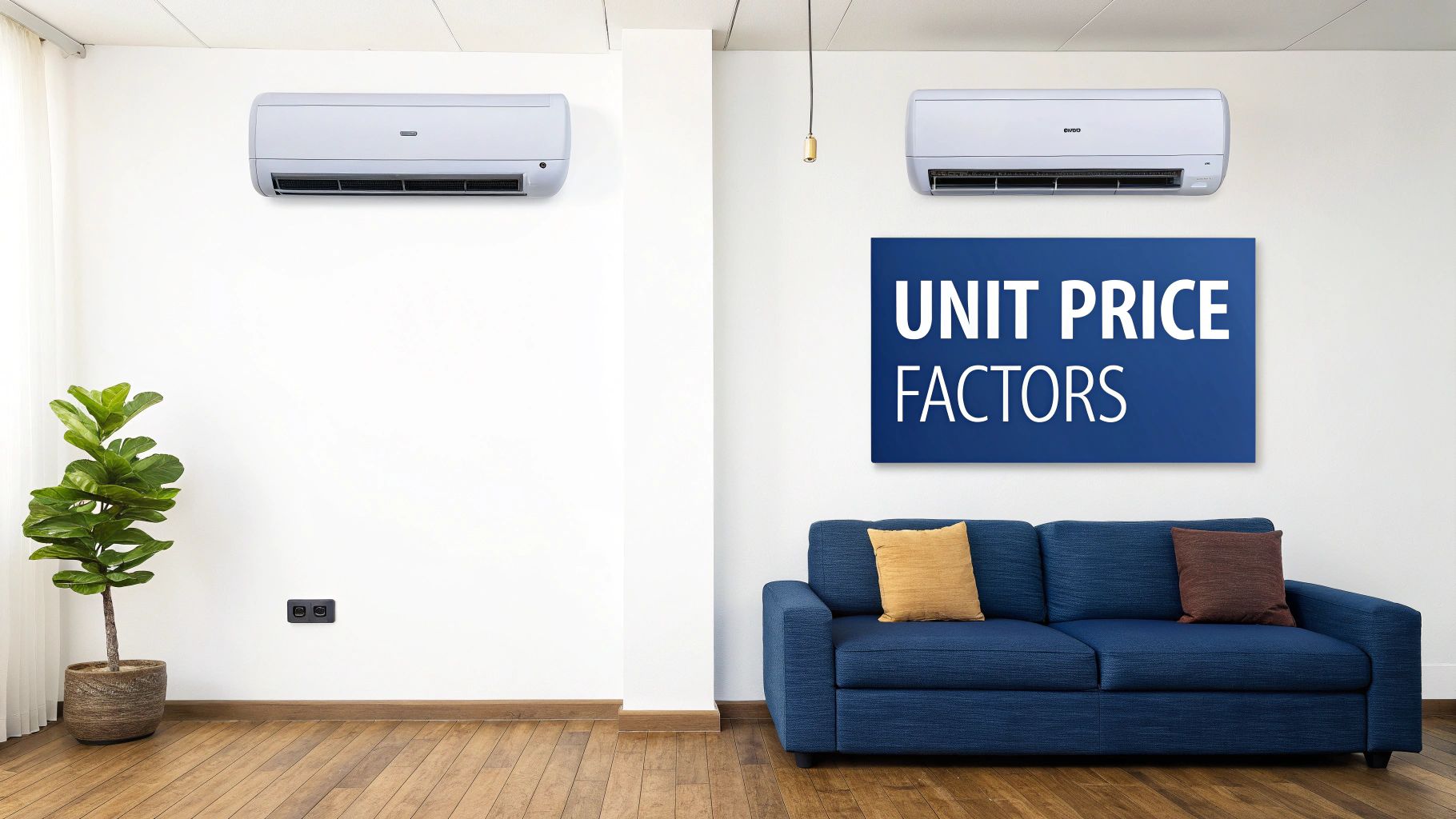
The biggest driver of a unit's price is its capacity, measured in kilowatts (kW). Think of kW like the engine size in a car. A bigger engine provides more power but also chews through more fuel. In the same way, a higher kW system delivers more cooling or heating grunt, but it is designed for larger spaces.
Kilowatt Capacity Explained
Choosing the right capacity is absolutely critical for both comfort and efficiency. It is a real Goldilocks situation: not too big, not too small.
A small 2.5kW unit, for example, is perfect for a standard bedroom in a Gosford apartment. It will cool the space effectively without constantly switching on and off, a problem known as short-cycling that just wastes energy and wears out the compressor.
On the flip side, trying to cool a large, sun-drenched open-plan living area in the Hunter Valley with that same 2.5kW unit would be a huge mistake. It would run non-stop, struggle to keep you comfortable, and send your electricity bills through the roof. For a space like that, you would need a more powerful 7.0kW or 8.0kW system with the muscle to handle the heat.
Brand Reputation and Features
Just like with cars or kitchen appliances, brand reputation plays a massive role in split system prices. You can generally group brands into three main tiers:
- Entry-Level Brands: These are your budget-friendly options, offering basic cooling and heating without all the bells and whistles. They get the job done and are a solid choice for smaller rooms or areas you do not use all the time.
- Mid-Range Brands: This is the sweet spot where you will find well-known names like Fujitsu, Panasonic, and Mitsubishi Heavy Industries. They offer a fantastic balance of reliability, energy efficiency, and modern features at a competitive price.
- Premium Brands: Brands like Daikin and Mitsubishi Electric often sit at the top. They are known for their superior performance, whisper-quiet operation, and advanced tech. They come with a higher upfront cost, but you are paying for exceptional long-term value and reliability.
It is interesting to see how global markets affect what we pay. Australia's air conditioning market is heavily reliant on imports, with average import prices dropping to $333 per unit. China is the dominant supplier, with an average unit price of just $276. This competitive import market helps keep a lid on retail prices, ensuring efficient split systems remain an affordable choice for Aussie homes. You can uncover more insights from the full research about the Australian air conditioner market.
Energy Efficiency and Modern Technology
That blue-and-white Energy Rating Label is one of the most important things to check on a new unit. The more stars a system has, the more energy-efficient it is. A unit with a high star rating might cost a bit more to buy, but it can save you hundreds of dollars on your power bills over its lifetime.
Modern features also influence the price, but they often pay for themselves. Inverter technology is a great example of this. Old-style air conditioners had a compressor that was either fully on or fully off; there was no in-between. An inverter system works more like a dimmer switch, smoothly adjusting its speed to maintain the temperature precisely. This uses way less energy and provides much more consistent comfort.
Many new systems also come with Wi-Fi control, letting you turn your air con on or off from your smartphone. This means you can start cooling your home on the way back from a hot day at Terrigal Beach, ensuring it is perfectly comfortable the moment you walk in the door. These smart features add to the upfront cost, but the convenience and efficiency gains are often well worth it.
What Is Included in Your Installation Quote
When a quote for a new split system lands in your inbox, it is tempting to skip straight to the bottom line. But that final number is more than just a charge for a few hours of labour. A professional installation quote is your roadmap to a safe, compliant, and reliable air conditioner that will perform for years to come.
Understanding what goes into that price is the key to comparing quotes fairly. It helps you see the crucial difference between a quality, long-term solution and a risky shortcut.
Think of a good quote not just as a price, but as a detailed plan. It should break down all the materials, labour, and compliance checks needed to get your system running perfectly. Let us unpack what you should expect to see.
The Baseline: A Standard Back-to-Back Installation
The most common and straightforward job is what we in the industry call a ‘standard back-to-back’ installation. This is the starting point for most installation prices and represents the simplest possible setup.
Here is how it works: the indoor head unit gets mounted on an external wall. The outdoor compressor unit is then placed directly on the other side of that same wall, usually on the ground. This keeps the copper piping and electrical cabling to a minimum, making it the most cost-effective scenario.
A back-to-back installation typically covers the supply and install of both units, up to 3 metres of copper piping and interconnecting cables, a weatherproof electrical isolator switch near the outdoor unit, and connection to a suitable existing power circuit.
When Costs Go Beyond the Standard
Of course, not every home allows for a simple back-to-back install. This is where variables come into play, adding a bit of complexity and cost to the job. A transparent quote will always itemise these extras clearly.
For example, fitting an air conditioner on the second-storey brick wall of a narrow Sydney terrace requires specialised safety gear and a lot more labour than a ground-floor job at a home in Lake Macquarie. Each challenge needs a specific solution, and that will be reflected in the final price.
Some common variables include:
- Extra Copper Piping: If the indoor and outdoor units need to be more than three metres apart, you will need longer copper refrigerant lines.
- Wall Brackets: When the outdoor unit cannot sit on the ground (common for apartments or properties with no clear ground space), it has to be mounted on sturdy wall brackets.
- Concrete Slab: For ground-level installs, the outdoor unit needs a solid, level base. If there is not one already, we will need to install a pre-cast concrete slab for it to sit on.
- Condensate Pump: If gravity alone cannot drain the condensation away from the indoor unit, a small pump is required to actively move the water outside.
The Non-Negotiables: Electrical and Compliance Work
This is, without a doubt, the most critical part of any installation. Every air conditioner installation in Australia must be performed by a licensed and insured technician. This is not a friendly suggestion; it is the law. Your installer must hold both an electrical licence and an ARCtick refrigerant handling licence.
A professional quote will always factor in the cost of a licensed electrician running a dedicated power circuit from your switchboard to the air conditioner. This is a strict requirement under Australian Standard AS/NZS 3000 and ensures your new system operates safely without overloading your home’s existing wiring.
Trying to save a few dollars with an unqualified installer is a massive safety risk. It can lead to electrical faults, house fires, and dangerous refrigerant leaks. It also instantly voids your manufacturer's warranty, turning what seemed like a cheap job into an incredibly expensive and dangerous problem.
For a deeper dive, our guide breaks down the true installation cost for a split system air conditioner and shows why professional work is the only safe choice. Always, always ask to see an installer's licence numbers before you agree to any work.
Thinking Beyond the Upfront Price to Running Costs
The price tag on the unit is a big number, and so is the installation quote. But that is only the starting line. The true cost of owning a split system air conditioner plays out over years on your quarterly power bills. It is easy to get fixated on the initial spend, but grabbing a cheap, inefficient unit is often a false economy that ends up costing you a whole lot more down the track.
Thinking about the ongoing expenses right from the start is the key to making a smart investment in your home’s comfort.

Why Energy Efficiency Is Your Best Investment
Think of an air conditioner's energy star rating like the fuel efficiency sticker on a new car. A car with a low sticker price that guzzles petrol will burn a hole in your wallet over five years. It is exactly the same with air conditioning. A 2-star rated unit might seem like a bargain, but it has to work much harder and use a lot more electricity to deliver the same cool air as a 6-star model.
That highly-efficient 6-star unit will have a higher purchase price, no doubt. But its lower power consumption means the savings on your electricity bills start adding up from the very first summer. Over the system's lifespan, which can be 15 years or more with good care, the more efficient model almost always ends up being the cheaper choice overall.
How Your Local Climate Affects Your Bills
Where you live in NSW plays a massive role in your running costs. An air conditioner installed in a coastal Newcastle home has to battle high humidity. This makes the air feel warmer and forces the unit to work overtime, dehumidifying as well as cooling.
Head inland, and a system in the hotter, drier parts of the Hunter Valley is up against brutal summer heat. It will likely be running for more hours each day just to keep up. This is exactly why getting the right size and type of system for your specific area is so important for keeping those power bills under control.
The good news is that modern split systems are one of Australia’s most affordable ways to stay cool. On average, a reverse-cycle system costs around $277 to run over summer, with an hourly cost of about $0.62. These numbers are significantly lower than ducted alternatives, making them a fantastic choice for targeted comfort.
Simple Habits for Lower Running Costs
The best part? You have a surprising amount of control over what you spend each quarter. A few simple habits can make a huge difference to your power bill without you having to sweat it out. For a full breakdown, you should check out our guide on how much running an AC really costs.
Here are a few practical tips to get you started:
- Set it and forget it: Find a comfortable temperature and stick to it. Setting your thermostat to a sensible 24°C in summer is the sweet spot for comfort and efficiency. Every degree you go lower can bump up your running costs by as much as 10%.
- Keep the filters clean: A clogged filter is like trying to breathe through a dusty rag. It makes your system work harder to pull in air, which chews through power. A quick clean of your indoor unit’s filters every few months makes a real difference.
- Use timers and zones: There is no point cooling an empty house. Use the timer to cool your bedroom just before you go to sleep, rather than running it all evening. And get in the habit of closing doors to rooms you are not using to help cool the target area much faster.
How Local NSW Conditions Influence Your Final Price
The price of a split system air conditioner is not a one-size-fits-all figure across New South Wales. Where you live plays a surprisingly big role in the final cost, not just for the unit but especially for the installation.
From the salty air of the Central Coast to the tight spaces of inner-city Sydney, local conditions create unique challenges that any professional quote will account for. Understanding these nuances helps you see why one quote might differ from the next and ensures you get a system that is genuinely built for your environment.
Coastal Corrosion and Humidity Challenges
Living on the beautiful Central Coast or near Newcastle's stunning beaches comes with a specific challenge: salt. The salty sea air, especially in suburbs like Terrigal or Merewether, is highly corrosive to the outdoor compressor unit of your air conditioner.
To protect your investment, we almost always recommend units with special corrosion-resistant coatings on their condenser coils. This might add a little to the upfront cost, but it is a smart move that prevents premature rust and system failure, saving you from a costly replacement down the line.
Plus, the high humidity from Gosford to Lake Macquarie means your system has to work harder to dehumidify the air as it cools. This directly influences the capacity and type of unit we would recommend. For more on this, our detailed guide on choosing air conditioning for Central Coast homes offers deeper insights.
Sydney’s Urban Installation Hurdles
Installing an air conditioner in Sydney presents a completely different set of obstacles. Imagine trying to fit a system in a high-rise apartment in Chatswood. This often involves navigating strict body corporate rules, dealing with limited access for technicians, and sometimes even requiring traffic management. It is a far more complex job than a ground-floor installation in a spacious suburban home.
Another factor is the urban heat island effect, particularly in Western Sydney. Densely packed buildings and all that concrete absorb and retain heat, making these areas significantly hotter than their coastal counterparts. This environmental factor often means a more powerful system is needed to achieve comfortable indoor temperatures, which impacts both the unit and running costs.
Property Type and Access Issues
The type of property you own is a major cost factor, no matter where you are in NSW. Different homes present their own unique installation challenges:
- Older Homes: Properties in historic areas of Newcastle or Sydney might have double-brick walls, which require more time and specialised tools to drill through for piping.
- Second-Storey Installations: Fitting an outdoor unit on a second-storey wall requires two technicians and specialised safety equipment like harnesses, which naturally increases labour costs.
- Townhouses and Terraces: These properties often have limited space. This might mean the outdoor unit needs to be mounted on wall brackets or even on the roof, adding to material and labour expenses.
To make this clearer, let's compare how some of these factors play out across our key service areas.
Local Installation Considerations and Cost Factors
| Factor | Central Coast (e.g., Gosford, Woy Woy) | Sydney (e.g., North Shore, Western Suburbs) | Newcastle & Lake Macquarie (e.g., Charlestown, Belmont) |
|---|---|---|---|
| Primary Challenge | High humidity and corrosive salt air. | High-density living, access issues, and urban heat. | Mix of coastal salt air and suburban layouts. |
| Equipment Needs | Units with coastal corrosion protection are essential. Higher capacity may be needed for dehumidification. | More powerful systems are often required in Western Sydney. Compact units for apartments/terraces. | Coastal-rated units are highly recommended, especially near the lake or beaches. |
| Installation Complexity | Standard for most houses, but steep blocks or waterfront properties can add complexity and cost. | Can be very high. High-rise apartments, heritage restrictions, and traffic management add significant time and cost. | Generally straightforward, but older homes in suburbs like Hamilton can have tricky double-brick walls. |
| Typical Cost Impact | +$100 to $300 for coastal-rated units. Sizing up for humidity can also increase unit cost. | +$500 to $2,000+ for complex access, crane hire, or extensive safety requirements. | +$100 to $500 for coastal units or installations on older, more complex properties. |
As you can see, the "where" is just as important as the "what" when it comes to pricing.
A professional installer always conducts a proper site assessment to identify these potential challenges. This is what ensures your quote is accurate and covers all safety and access requirements, preventing nasty surprises on installation day.
Ultimately, a detailed quote from a local expert will always reflect the unique demands of your property and location. It is a sign that the installer has considered every variable to ensure a safe, compliant, and effective installation that will last for years to come.
Choosing the Right Installer and Getting an Accurate Quote
You have researched the brands and figured out the capacity you need. This final step, however, is probably the most important one. You can pick the most efficient, top-of-the-line air conditioner on the market, but its performance and lifespan hinge entirely on the quality of the installation.
Choosing a trustworthy, qualified installer is the best thing you can do to protect your investment. It ensures your system runs safely, efficiently, and reliably for years to come.
When it comes to comparing quotes, it can feel a bit confusing. But a professional, transparent quote gives you the confidence that you are dealing with a reputable company. Your goal should not be to find the absolute cheapest price, but to find an experienced local business that values quality workmanship.
What a Professional Quote Must Include
A detailed, written quote is the hallmark of a professional operation. It shows the installer has actually taken the time to assess your home properly and is being upfront about every part of the job. You should avoid vague, one-line quotes at all costs.
A comprehensive quote should always lay out:
- Exact Unit Details: The full make and model number for both the indoor and outdoor units. No substitutions.
- Clear Cost Breakdown: A separate listing of costs for the unit, the labour, and any extra materials like wall brackets or additional piping.
- Warranty Information: Details on the manufacturer’s warranty for the unit itself, plus the installer's own warranty on their workmanship.
- Licence Numbers: The installer’s electrical contractor licence number and their ARCtick refrigerant handling licence number. This is non-negotiable.
A proper quote is your assurance of compliance. It confirms that the work will meet Australian Standards, including AS/NZS 3000 for electrical safety, and that all technicians involved are legally certified to do the job.
Red Flags to Watch For
Just as a good quote tells a positive story, a bad one can reveal some serious red flags. Be cautious of any installer who seems evasive or looks like they are cutting corners, as this can lead to major headaches down the track.
You can find more information about why this matters so much in our article about finding a great split system installation near me.
Keep an eye out for these warning signs:
- Quotes That Seem Too Good to Be True: An extremely low price often signals non-compliant work, a second-hand unit, or hidden costs that will magically appear later on.
- Refusal to Provide Licences: If an installer cannot or will not show you their licence details, walk away immediately. It is illegal to install an air conditioner without the proper certifications.
- Pressure to Pay in Full Upfront: Reputable companies typically ask for a deposit to secure the job, with the final balance due only when the work is done and you are happy with it.
- Vague or Verbal-Only Quotes: Always, always insist on a detailed, written quote that outlines the full scope of work.
Choosing the right partner for your air conditioning installation makes all the difference. As a local company with over 15 years of experience on the Central Coast, we have built our reputation on quality installations that deliver genuine, long-term reliability. If you want to make sure you get the perfect system for your home and a quote you can trust, we are here to help.
Got Questions? We’ve Got Answers
When it comes to sorting out pricing for a new split system, we know you have probably got a few questions buzzing around. To help clear things up, here are some straight answers to the most common queries we get from homeowners across the Central Coast, Sydney, and Newcastle.
Is It Really Cheaper to Install a Split System in Winter?
Yes, it often is. You can usually find more competitive pricing and better availability if you book your installation during the off-peak seasons of autumn or winter. Demand for technicians is way lower then, which can lead to better quotes.
Plus, it means you are all set long before the first summer heatwave rolls in. You get to skip the December and January rush when wait times can stretch out.
What Is a "Back-to-Back" Installation?
‘Back-to-back’ is the industry term for the simplest, most straightforward and cost-effective setup you can get. It is where the indoor head unit is mounted on an external wall, and the outdoor compressor unit sits on the ground directly behind it on the other side.
This layout keeps the copper piping and electrical cabling to a minimum. That directly cuts down on both material and labour costs, making it the starting point for most installation quotes. Any job that needs extra piping, wall brackets for the outdoor unit, or a condensate pump to get rid of water will naturally cost more.
How Much Extra Does a Licensed Electrician Add to the Price?
This is a really important one: a licensed electrician is not an optional ‘add-on’ but a non-negotiable part of a safe, compliant air conditioning installation. This cost is always included in any professional quote you get from a reputable company.
The sparkie’s job is to safely connect your new system to the switchboard, usually by running its own dedicated circuit. This work is required to comply with Australian Standard AS/NZS 3000 and makes sure your home's wiring is not overloaded. If you see a quote that lists critical electrical work as an optional extra, you should be extremely cautious.
Can I Just Buy the Unit Myself and Pay for Installation?
You can, but we generally advise against it. When you get the unit and installation as a complete package from one company, that business takes full responsibility for the entire system. That covers the warranty on the unit itself and their installation workmanship.
Imagine this scenario: you supply a unit that turns out to be faulty right out of the box. You might still have to pay the installer for their time on-site, and then you are left to handle a difficult warranty claim with the retailer yourself. A single supply-and-install package gives you one point of contact if anything goes wrong, making the whole process simpler and giving you far better peace of mind.
Ready to get a clear, upfront price for your home? The team at ALC Air provides free, no-obligation quotes tailored to your specific needs, ensuring you get the perfect system with no hidden surprises. Contact us today to schedule your assessment.