


Regular maintenance for your split system air conditioning is not just a “nice to have”. It is the difference between a reliable, efficient unit and one that costs a fortune to run and fails when you need it most. It is a mix of straightforward DIY jobs you can easily handle and deeper checks that really need a licensed technician’s eye to keep things safe and performing at their peak.
Why Your Split System Needs Regular Maintenance
Thinking of your split system as a “set and forget” appliance is a common mistake, and honestly, a costly one. Just like you would not drive your car for years without a service, your air conditioner needs consistent attention to perform at its best. This is especially true when it is battling the brutal summer heat in Sydney’s western suburbs or the thick humidity along the Central Coast.
When you skip this crucial upkeep, it is not just your comfort that suffers. It hits your wallet and your wellbeing, too.
A poorly maintained unit has to work much harder to cool or heat your space. This extra strain causes a serious drop in energy efficiency, something you will quickly notice on your quarterly power bills. Over time, dust, pollen, and other gunk build up inside the unit, choking the airflow and creating a perfect breeding ground for mould and bacteria. This not only tanks performance but also pumps compromised air right back into your home.
How to Clean Split System Filters Yourself: A Step-by-Step Guide
Of all the maintenance you can do yourself, cleaning the filters on your indoor unit is easily the most important. Think of these filters as the lungs of your system. When they get clogged with dust, pet hair, and pollen, your air conditioner simply cannot “breathe” properly.
This is a simple 10-minute job, but doing it regularly has a massive impact on your home’s air quality, cooling power, and even your power bills. For a family in a leafy suburb like Gosford or a home with pets in Newcastle, airborne particles are a constant battle. Dirty filters just end up circulating those allergens right back into the rooms you live in. Clean filters, on the other hand, do their job properly and trap all that gunk, leaving you with fresher, healthier air.
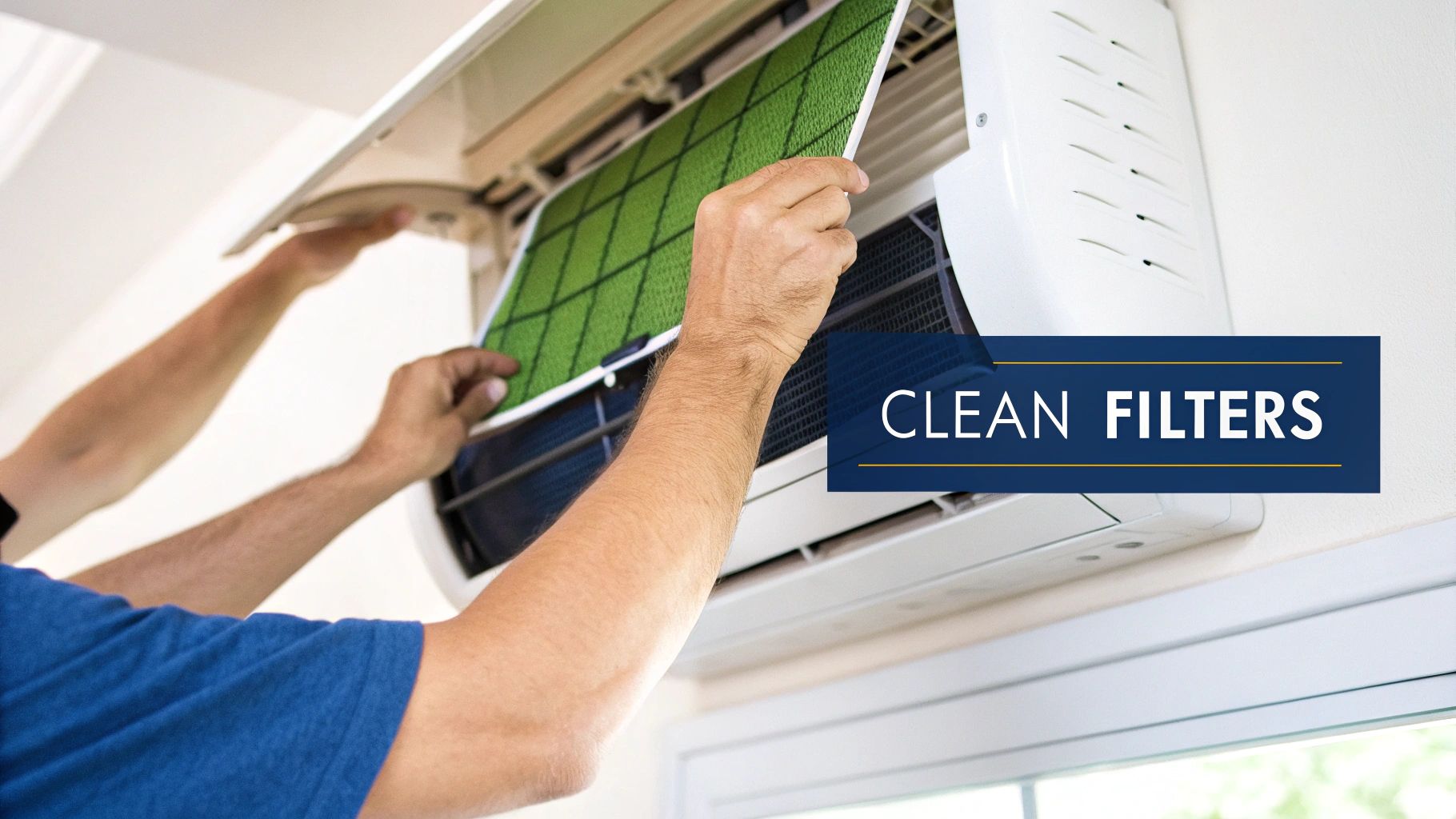
Here is how you can do it safely and effectively:
First things first: power down the unit completely. The safest way to do this is at your home’s main switchboard. Find the circuit breaker labelled for your air conditioner and flip it to the ‘OFF’ position. This is a critical safety step to ensure there is zero power going to the unit while you work on it.
Once you are sure the power is off, you can get started.
- Access the Filters: Gently lift the front panel of the indoor unit. Most panels hinge at the top and will click into an open position, staying up on their own. You will see one or two mesh filters sitting right there in front of you. (Photo opportunity: A clear shot showing the front panel of a split system lifted, revealing the mesh filters inside.)
- Remove the Filters: The filters are usually held in place by small clips or simply slide out along a track. Be gentle when you take them out; the plastic can become brittle over time. It is a good idea to note which way they were facing so you can pop them back in correctly later. (Photo opportunity: Hands carefully sliding one of the mesh filters out of its slot.)
- Wash Gently: Use lukewarm tap water to rinse away the remaining grime. A soft brush or cloth can help with any stubborn build-up. A word of warning: never use hot water, as it can warp the plastic mesh. You should also avoid harsh chemical cleaners or detergents, as they can damage the filter material itself.
- Air Dry Completely: After a good rinse, shake off any excess water and leave the filters to air dry in a shaded spot. Do not be tempted to use a hairdryer or place them in direct sunlight, as the heat can cause damage. Putting them back while still damp is a recipe for mould and mildew growth inside your unit. (Photo opportunity: The cleaned filters propped up to air dry, perhaps against a laundry sink or on a clean surface.)
- Reinstall and Close Up: Once the filters are bone dry, slide them back into their original position. Make sure they are seated correctly before closing the front panel until it clicks shut. You can then head back to the switchboard and restore the power.
This simple task should be done every one to three months, depending on how much you use your system. During the peak of a hot Sydney summer or a cold Hunter Valley winter when the unit is running daily, monthly cleaning is your best bet.
Why This Simple Task Matters So Much
A clean filter allows air to flow freely through your system. When it is clogged, the fan motor has to work much, much harder to pull air through, which chews up more electricity and puts a lot of unnecessary strain on the components. This leads directly to higher running costs and can shorten the lifespan of your unit.
This basic clean is a core part of effective DIY maintenance, but it is just one piece of the puzzle. For a deeper dive into what a complete professional service involves, check out our guide on air conditioning maintenance. While you handle the filters, our licensed technicians can take care of the complex electrical and refrigerant checks that keep your system running safely and efficiently for years to come.
Common Split System Problems Caused by Poor Maintenance
Skipping regular maintenance on your split system is a bit like never changing the oil in your car. It will run for a while, sure, but you are setting yourself up for a much bigger, more expensive problem down the track. Most of the callouts we get across the Central Coast and Sydney are for issues that could have been easily prevented with a bit of basic care.
When your system starts playing up, it is usually giving you a pretty clear signal that something is wrong. Learning to read these signs can help you sort out the small stuff yourself and know when it is time to call in the professionals. Ignoring the warning signs almost always ends in a bigger repair bill and a shorter life for your air con.
Why Is My Air Conditioner Not Cooling Properly?
This is, without a doubt, the number one problem we hear about, especially during that first brutal heatwave of summer in places like the Hunter Valley. You flick the air con on, expecting that sweet, cold relief, and all you get is a pathetic, lukewarm breeze.
Before you panic, the most common culprit is incredibly simple: clogged filters and dirty coils.
When the filters are choked with dust, air cannot physically pass through the indoor unit to be cooled. It is like trying to breathe through a dusty rag. The system works its guts out but cannot get the job done.
It is the same story outside. The outdoor unit’s condenser coil is designed to dump heat from your home into the outside air. When it is caked in dirt, leaves, and grime, it cannot release that heat efficiently, and the whole system struggles to cool.
Unpleasant Smells Coming From the Unit
Ever turn on your air con and get hit with that musty, “dirty socks” smell? That is the unmistakable odour of mould and bacteria having a party inside your indoor unit. The dark, damp environment of the internal coils and drain pan is the perfect breeding ground for this stuff to thrive.
This is more than just a bad smell. Pumping mould spores through your home is a genuine air quality concern, especially for anyone with allergies, asthma, or other respiratory issues. Cleaning your filters helps, but a deep, professional clean is often the only way to properly sanitise the coils and flush the system, getting rid of the problem at its source.
Water Leaking From the Indoor Unit
Seeing water dribbling down the wall from your indoor unit is definitely alarming, but it is rarely as bad as it looks. The cause is almost always a blocked condensate drain line.
As your air con cools the air, it pulls out humidity, which turns into water on the cold internal coil. This water is supposed to drip into a tray and flow harmlessly outside through a small pipe. But over time, that drain line can get clogged with sludge and mould. With nowhere to go, the water backs up, overflows the tray, and ends up running down your wall. A quick check and flush of this line during a service is all it takes to prevent this messy situation.
Your System Is Making Strange Noises
Your split system should run with a quiet, consistent hum. If it suddenly starts making new and unusual sounds—grinding, squealing, or rattling—it is crying out for help. A rattle might just be a loose panel or some debris in the outdoor unit. But a loud grinding or screeching is a red flag for a serious mechanical failure, like a worn-out fan motor bearing.
If you hear noises like that, turn the unit off at the circuit breaker immediately. Continuing to run it could cause catastrophic damage to the compressor, which is the heart of the system and the most expensive part to replace. This is not a DIY fix; it is a problem that needs urgent professional attention from a team equipped for these emergency air conditioner service and repair calls.
Neglecting maintenance does not just cause annoying problems; it hits you directly in the wallet. A struggling, unserviced system can chew through 25-30% more electricity just to keep up. For an average household, that inefficiency can easily add hundreds of dollars to your annual power bills.
When You Need to Call a Professional Technician
While regularly cleaning your filters is a fantastic habit, there is a clear line between simple upkeep and tasks that absolutely must be left to the professionals. Trying to tackle complex split system repairs without the right licences and tools is not just risky for your unit—it is a serious safety hazard for you and your family.
Knowing when to put the tools down and pick up the phone is the key to keeping your system running safely and efficiently for years to come.
The Real Dangers of DIY Repairs
It can be tempting to have a go at fixing a problem yourself, but some issues are completely non-negotiable.
Any work involving your system’s electrical wiring is strictly off-limits for anyone but a licensed sparky. Australian Standard AS/NZS 3000 sets clear, legally-binding rules for electrical work. Only a licensed electrician can safely inspect, repair, or replace components like capacitors, contactors, and wiring. It is just not worth the risk of shock or fire.
Likewise, handling refrigerant gas requires an ARCtick licence for a very good reason. Your split system is a sealed unit, and if it is low on gas, it means there is a leak somewhere. A professional technician will not just “top it up”; they have the specialised equipment to find and repair the leak properly, then correctly recharge the system. Mishandling refrigerant is not just illegal—it is also seriously harmful to the environment.
What a Professional Service Actually Includes
A proper professional service is a world away from a quick filter clean. It is a detailed health check for your entire air conditioning system, tailored to your local environment.
When our technicians service a unit on the Central Coast, we are not just cleaning it. We are looking for the early signs of salt air corrosion on the outdoor coil. Up in the Hunter Valley, we are checking for the fine dust build-up that chokes motors and fans. Each location presents unique challenges that a trained eye knows exactly how to spot and address.
A typical professional service involves things you simply cannot do yourself:
- Checking refrigerant levels and pressures to make sure the system is charged correctly for peak performance.
- Inspecting and testing all electrical components for safety and compliance with Australian Standards.
- Deep cleaning the indoor evaporator and outdoor condenser coils with specialised solutions to remove the stubborn grime that strangles airflow and efficiency.
- Properly flushing the condensate drain line to prevent the blockages that cause messy water leaks and property damage.
- Testing thermostats and controls to ensure you are getting accurate temperature readings and your system is responding as it should.
This infographic can help you quickly decide if a problem is something you can investigate yourself versus when it is time to call us in.
As the decision tree shows, poor cooling might just be a clogged filter you can fix in five minutes. But if you are hearing strange noises or seeing water where it should not be, that usually points to a deeper issue that needs a technician.
Beyond just keeping you comfortable, professional maintenance has a real impact. A well-serviced system runs more efficiently, reducing greenhouse gas emissions. It also prevents refrigerant leaks, which aligns with Australia’s national effort to phase out high-impact refrigerants. A typical service, lasting one to two hours, includes these critical safety and environmental checks to keep your system compliant and safe.
Finding the Right Technician for the Job
Not all technicians are created equal. When your air con needs attention, you want someone who is fully licensed, insured, and experienced with the specific conditions in your area, whether you have a coastal home in Terrigal or a suburban property in Sydney.
Before you hire anyone, always ask to see their licence numbers. A qualified tech will have both an electrical licence and an ARCtick refrigerant handling licence and will be more than happy to show you. If you are ever in doubt, a quick check with Fair Trading NSW or the Australian Refrigeration Council (ARC) can verify their credentials in seconds.
If your system is playing up and you need reliable, licensed help, feel free to get in touch with our team for a professional assessment.
Is an Annual Air Con Service a Cost or an Investment?
It is easy to look at professional maintenance as just another bill to pay. But when it comes to your split system, is that annual service call really an expense? Or is it a smart investment in your home’s comfort and your system’s future?
Let’s break down the real-world numbers and see why a regular service almost always pays for itself.
We do not do fixed pricing because every home and system is different. That said, the split system maintenance cost for a standard professional service in Sydney, Newcastle, or here on the Central Coast is a pretty modest annual outlay. Think of it as a tiny fraction of what you would pay for a single major repair, let alone having to replace the whole system.
The True Cost of “Saving Money” by Doing Nothing
Ignoring your air conditioner does not actually save you money. It just pushes the cost down the road, and usually makes it a whole lot bigger when it finally comes due.
A poorly maintained unit has to work significantly harder to cool or heat your place. This is not just a minor issue; it is a constant drain on your electricity, pushing your power bills higher and higher every quarter.
Imagine a family in a hot western Sydney suburb like Penrith, where the air con runs pretty much non-stop from December through to March. An inefficient unit, clogged with dust and maybe struggling with low refrigerant, can easily tack on hundreds of dollars to their summer power bills alone. Suddenly, that annual service fee looks tiny in comparison.
Beyond the slow burn of high running costs, you have got the risk of a sudden, total breakdown. These things rarely give up on a mild spring day. They almost always happen during a heatwave, like on a 40-degree scorcher when every technician in NSW is already swamped with emergency calls. You are left sweating it out and facing premium rates for an urgent repair.
Weighing Up the Upfront Cost vs. Long-Term Savings
A proactive approach to split system air conditioner maintenance completely flips the script from reactive spending to smart savings.
The financial benefits are clear and measurable:
- Lower Energy Bills: It is simple. A clean, well-tuned system uses less power to keep you comfortable. That improved efficiency translates directly into lower running costs, season after season.
- Fewer Expensive Repairs: Our technicians catch the small stuff—like a frayed wire or a partially blocked drain—before they can snowball into major mechanical failures. This preventative care helps you sidestep the high cost of emergency repair work.
- A Longer-Lasting System: An air conditioner is a big investment in your home. Just like a car, regular servicing drastically extends its working life. A well-maintained unit can reliably serve your family for 15 years or more, pushing back the need for a costly full replacement.
When you think about the thousands of dollars it costs for a new installation, the value of getting a few extra years out of your current unit becomes crystal clear. For those considering larger systems, understanding the full picture of expenses is key; our guide to the factors influencing ducted air conditioner cost has some valuable insights that apply to all system types.
The Hidden Financial Killer: Your Manufacturer’s Warranty
There is one more critical reason to stay on top of servicing that many homeowners miss: your warranty.
Pretty much every major air conditioning manufacturer includes clauses in their warranty terms requiring proof of regular professional maintenance. If a major component fails and you need to make a claim, the first thing they will ask for is the service history from a licensed technician.
Without a documented service history, you run a very real risk of having your warranty claim denied. This could leave you on the hook for the full cost of repairs that would have otherwise been covered, potentially turning a free fix into a bill for thousands of dollars.
At the end of the day, scheduling an annual service is one of the smartest financial decisions you can make for your home. It is a small, predictable expense that shields you from the much larger, unpredictable costs of high power bills, emergency repairs, and premature replacement—all while keeping your warranty firmly intact.
Your Split System Maintenance Questions Answered
When it comes to keeping your split system running smoothly, a few questions always pop up. We get calls from homeowners all over the Central Coast, Sydney, and Newcastle with the same queries. To clear things up, here are some straightforward answers from our technicians on the ground.
How Often Should I Get My Split System Professionally Serviced?
For most homes, a professional service once a year is the gold standard. We usually recommend booking this in the shoulder seasons, like autumn or spring. It is the perfect time to get your system checked and ready for the heavy lifting of a hot summer or a chilly winter.
However, if your reverse cycle system is your go-to for both cooling and heating all year round, a six-monthly service is a much smarter move. The same goes if you live right on the coast where salt spray can speed up corrosion, or in a dusty spot where filters and coils get clogged much faster.
Can I Top Up the Refrigerant Gas Myself?
In a word, no. In Australia, handling refrigerant gas is a strictly regulated job that legally requires an ARCtick refrigerant handling licence. An air conditioner is a sealed system, so if it is low on gas, it means there is a leak somewhere.
A licensed professional does a lot more than just ‘top it up’. Their job is to find the leak, repair it properly, and then recharge the system with the exact amount of refrigerant it needs. Trying to do this yourself is not only illegal and dangerous, but it also releases harmful greenhouse gases into our atmosphere.
Will Regular Maintenance Make My Old Air Conditioner Run Like New?
Regular maintenance will absolutely make an older unit run as efficiently and powerfully as it possibly can for its age. A professional service cleans out the gunk, improves airflow, restores cooling power, and cuts down its energy use.
What it cannot do, though, is turn back the clock on years of wear and tear or update outdated technology.
Think of it like this: a well-maintained ten-year-old unit will always outperform a neglected one, but it just will not have the whisper-quiet operation or energy efficiency of a modern inverter system. If your unit is over 10 to 15 years old and you are seeing repair bills more often, a service is also a great way to get a clear picture of whether it is more economical to keep repairing it or finally replace it.
What Is That Strange Smell Coming From My Air Conditioner?
That unpleasant, musty, ‘dirty socks’ smell is almost always caused by mould, mildew, and bacteria building up on the indoor unit’s coil and in the drain pan. It is a classic problem in humid coastal climates like those around Lake Macquarie and the Central Coast, where moisture and dust create the perfect breeding ground for this stuff.
While cleaning your filters regularly definitely helps, you will usually need a deep, professional clean to fully sanitise the system and get rid of the odour for good.
A quick heads-up: other smells, like a burning or sharp electrical odour, are far more serious. If you notice anything like that, turn the unit off at the circuit breaker immediately and call a technician. This could signal a dangerous electrical fault that needs urgent attention.
At ALC Air, we know that proactive care is the key to an air conditioning system that lasts longer and runs efficiently. Our licensed and experienced technicians provide thorough maintenance services that keep your unit running smoothly, saving you money on power bills and preventing those expensive, unexpected breakdowns.
If it has been over a year since your last service, or if you have any worries about how your system is performing, get in touch with our friendly team. We are happy to provide a free, no-obligation quote and some expert advice. Visit us at https://alcairconditioning.com.au to book your service today.