


Thinking about getting a new air conditioner? The most important decision you'll make isn't just the brand you choose, it's getting the split system air conditioner installation done right. It can be tempting to try a DIY job to save a few dollars, but we can tell you from experience, it’s illegal, dangerous, and almost guaranteed to cost you a lot more down the track.
Professional installation is the only way forward to guarantee safety, efficiency, and keep your new system’s warranty intact. Let’s walk through why it matters so much.
Why Professional Installation Is a Must for Your Home
When you buy a split system, you’re not just getting a box that blows cold air. You're investing in a complex piece of equipment that needs to be installed with real precision to handle Australia's tough climate. From the sticky, humid summers on the Central Coast to the baking dry heat of Western Sydney, a correctly installed unit is your foundation for years of reliable comfort.
Trying to install a split system yourself isn't just a bad idea, it’s illegal. In Australia, only a licensed professional with an ARCtick certification is allowed to handle refrigerants, which are potent greenhouse gases. On top of that, all the electrical work must be done by a licensed electrician to meet Australian Standards, specifically AS/NZS 3000. This isn't just bureaucratic red tape; it’s about protecting your home and family from the very real risks of electrical faults and fires.
A professional ensures every electrical component, including proper overcurrent protection devices, is up to the strict safety standards your new unit demands. Skipping this step can create immediate hazards and could even void your home insurance policy if something goes wrong.
The True Cost of Cutting Corners
Beyond the immediate safety risks, a shoddy installation hits you directly in the wallet. An incorrectly installed system will never run efficiently. It will struggle to cool your home, run non-stop, and send your electricity bills through the roof.
Common DIY mistakes like refrigerant leaks, poor insulation on the pipework, or incorrect drainage can cause the system to fail prematurely. This leads to expensive repairs that will quickly dwarf any money you thought you were saving. A professional installation is your best defence against the headache and cost of future problems, ensuring everything is done right the first time. If you do find your unit isn't performing as it should, our guide on common air conditioning repairs might give you some pointers.
At a Glance: Professional vs DIY Air Conditioner Installation
It's easy to underestimate the complexity of a split system air conditioner installation. This table breaks down exactly what's at stake.
| Factor | Professional Installation (Licensed) | Attempted DIY Installation |
|---|---|---|
| Legality | Fully compliant with national laws and standards (ARCtick, AS/NZS 3000). | Illegal. Handling refrigerants without a licence is a federal offence with heavy fines. |
| Safety | Safe. Electrical work performed by a licensed electrician, eliminating fire and shock risks. | Highly dangerous. Risk of electrical faults, fires, and refrigerant burns. Voids home insurance. |
| Warranty | Manufacturer's warranty is valid. Plus, a separate warranty on installation workmanship. | Manufacturer's warranty is voided immediately due to unauthorised installation. |
| Performance | Optimal efficiency. Correct refrigerant charge, sealed pipework, and proper placement. | Poor performance. Inefficient cooling, higher running costs, and frequent breakdowns. |
| Longevity | Maximises system lifespan (10-15 years) through correct setup and commissioning. | Shortens system lifespan significantly due to stress from improper installation. |
| Cost | Higher upfront cost that pays for itself in efficiency, safety, and reliability. | Lower initial "cost" that leads to much higher expenses in repairs and energy bills. |
As you can see, the initial savings from a DIY attempt are what we call a false economy. The risks to your safety, warranty, and long-term costs just aren't worth it.
There's no denying how popular split systems have become across Australia. In 2021 alone, Aussies bought around 1.09 million non-ducted split systems, showing just how much we rely on them for efficient cooling. Government initiatives like the NSW Energy Savings Scheme (ESS) have pushed this trend even further by supporting thousands of high-efficiency installations.
This boom really underscores how vital these systems are to modern Australian life and reinforces why a professional installation is so critical to protect that investment.
The Installation Process from Start to Finish
Ever wondered what actually happens on the day your new split system gets installed? It’s a lot more involved than just hanging a couple of boxes on the wall. A professional job is a careful, deliberate process designed from the ground up to give you brilliant performance and long-term reliability.
We’ll walk you through our entire journey, from the first visit to the final handover, so you know exactly what to expect. This process ensures your new system is safe, efficient, and perfectly suited to your home, whether you're in a coastal Terrigal property battling the afternoon sun or a modern apartment in Newcastle's CBD.
Step 1: The All-Important Site Assessment
The first and most critical step is a thorough site assessment. This is where we come to your home to map out the perfect strategy for your new air conditioner. It’s not a quick glance; we’re analysing everything that will affect how your system performs day-to-day.
We measure up room dimensions, check window sizes and orientation, look at ceiling height, and assess the quality of your insulation. For example, a north-facing living room in Gosford has completely different cooling demands than a heritage-listed bedroom in Maitland.
We also pinpoint the best, most practical spots for both the indoor and outdoor units. We have to consider airflow, aesthetics, noise, and future access for servicing. This detailed planning prevents nasty surprises on installation day and guarantees the unit we recommend is the right fit.
Step 2: Selecting and Sizing Your System
Once the site assessment is done, we can accurately lock in the right size, or kilowatt (kW) capacity, for your space. Getting this right is absolutely crucial.
A system that's too small will run flat-out, struggling to cool the space while driving your power bills through the roof. On the other hand, an oversized unit will blast the room with cold air too quickly, shutting off before it has a chance to properly dehumidify. This leaves you with that cold, clammy feeling, especially in humid areas like Lake Macquarie.
This is where our experience really counts. We use the info from our assessment to recommend a system that perfectly balances power with energy efficiency, so you get maximum comfort without wasted energy. We’ll talk you through the benefits of different models and features, helping you make a choice you feel confident about.
The diagram below gives a clear overview of the key pillars of a professional installation, focusing on safety, performance, and long-term peace of mind.
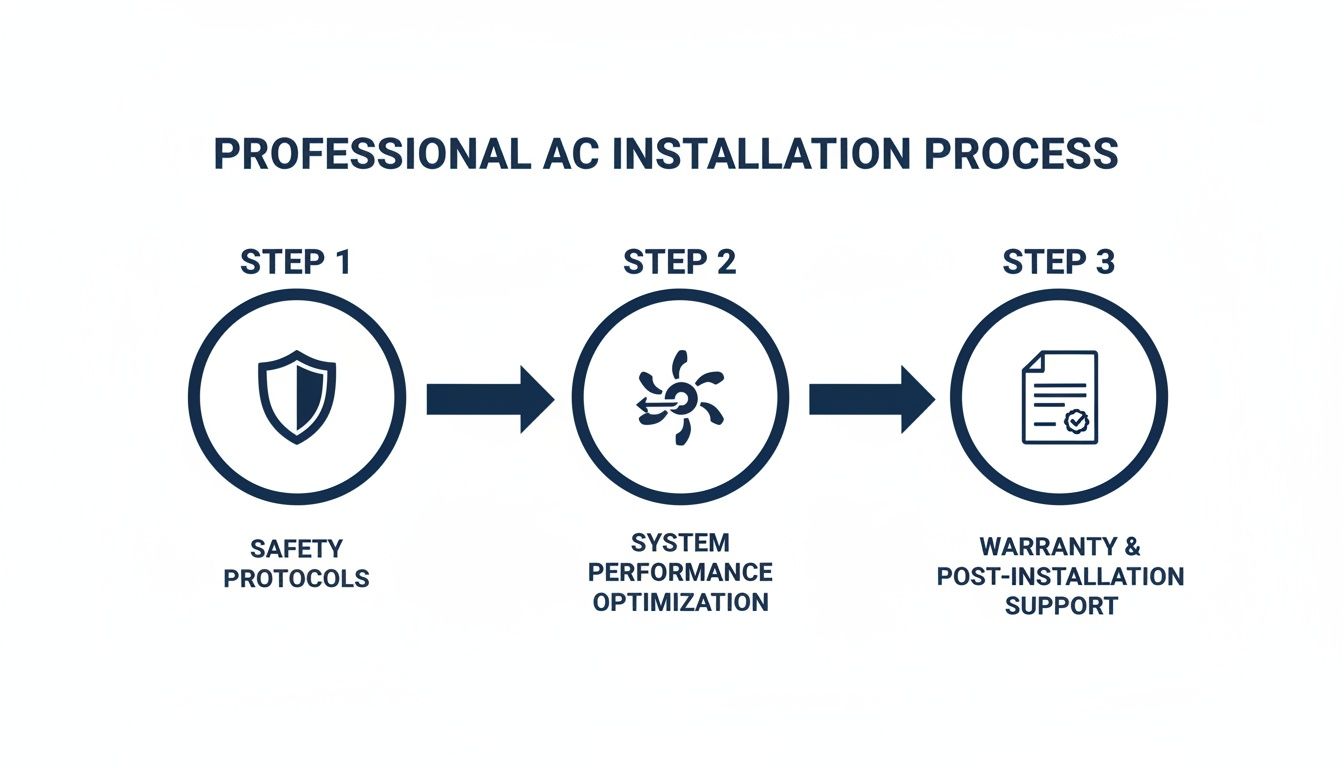
This shows how a quality installation is a balanced process where technical skill supports reliability and your comfort for years to come.
Step 3: The Installation Day
On the day, our licensed and ARCtick-certified technicians will arrive ready to get the job done properly. We treat your home like it's our own, using drop sheets to protect your floors and cleaning up thoroughly as we work.
The core tasks for the day include:
- Mounting the units: We securely install the indoor head unit and the outdoor condenser in the spots we agreed on during the assessment.
- Running the connections: This involves drilling a small, neat hole through the wall to connect the two units with refrigerant piping, electrical cabling, and a drain hose.
- Electrical work: Our licensed electrician will run a dedicated power circuit from your switchboard to the outdoor unit. This ensures it complies with AS/NZS 3000 and all SafeWork NSW regulations.
- Commissioning the system: Once everything is connected, we commission the system. This involves pressure testing the refrigerant lines for leaks, using a vacuum pump to remove all air and moisture, and charging it with the exact amount of refrigerant specified by the manufacturer. It's a non-negotiable step for performance and longevity.
Step 4: Handover and Demonstration
The job isn't done until you're completely happy and confident using your new system. After the installation is complete, our technician will walk you through the remote control, explaining all the key functions and modes.
We’ll show you how to do basic maintenance, like cleaning the filters, and answer any questions you might have. You'll receive all the paperwork, including your warranty information and our certificate of compliance for the electrical work. We want to leave you feeling ready to enjoy your perfectly climate-controlled home.
For a deeper dive into the components, you can learn more about what makes up an air conditioner split unit in our dedicated guide.
How to Choose the Right Size and Type of System
"So, what size air conditioner do I actually need?" It's easily the most common, and most important, question we get from homeowners. Getting the size and type right is the secret to an efficient system that keeps you comfortable without sending your power bills sky-high.
Get it wrong, and you could be stuck for years with a system that's either working itself to death and still not cooling the room, or one that costs a fortune to run because it’s constantly switching on and off.
Think of an air conditioner's kilowatt (kW) capacity like its engine size. A small 2.5kW unit is perfect for a standard bedroom, but it would struggle endlessly trying to cool a big, open-plan living area. On the flip side, putting a huge 8kW system in that same small bedroom would be complete overkill. It's not just inefficient; it's a massive waste of energy.

More Than Just Room Size
While the dimensions of your room are the starting point, they're far from the only thing that matters. A professional assessment looks at the whole picture to make sure your new system is a perfect match for your home's unique personality.
Here are just a few of the critical variables we analyse on-site:
- Windows and Sunlight: A room with large, west-facing windows that cops the brutal afternoon sun in a suburb like Penrith will need a much more powerful unit than an east-facing room of the same size over in Charlestown.
- Insulation Quality: Good ceiling and wall insulation basically acts like an Esky for your home, keeping the cool air in and the heat out. A poorly insulated home is like a leaky bucket; it will need a bigger system to compensate for all the cool air it's losing.
- Local Climate: The humid, coastal air around the Central Coast (postcodes 2250-2264) places different demands on a system than the dry, intense heat you get in the Hunter Valley. A good system needs to be just as effective at dehumidifying as it is at cooling.
- Ceiling Height and Layout: High ceilings or an open-plan design that flows into other areas means there’s simply more air volume to cool, which naturally calls for a larger capacity unit.
Proper system sizing is everything when it comes to efficiency and comfort. Factors like your home's insulation and airtightness can have a massive effect on the capacity you need. Understanding the impact of an airtight comfort system can help you appreciate why these details matter so much.
For a detailed breakdown of how to match kW to your room size, check out our guide on what size split system you need.
Reverse Cycle and Inverter Technology Explained
Here in Australia, a reverse cycle split system is the smartest choice for year-round comfort. It's an all-in-one solution that provides powerful cooling in summer and surprisingly efficient heating in winter, just by reversing how it operates. This gets rid of the need for separate heaters, saving you space and money.
The other key feature to look for is inverter technology. The best way to think of it is like the cruise control in your car.
An older, non-inverter system is like a driver constantly slamming on the accelerator and then the brake. It runs at full power until the room is cold, then switches off completely, repeating the cycle. This is incredibly inefficient and creates noticeable temperature swings.
An inverter system, however, is much smarter. It gently ramps up to reach the temperature you want, then adjusts its speed, running continuously at a low power level to maintain it perfectly. This uses significantly less energy, runs much quieter, and keeps you far more comfortable. All the modern systems we install feature this energy-saving technology as standard.
Understanding Your Installation Costs
So, let's talk about what actually goes into the cost of a professional split system air conditioner installation. When you get a quote from us, you're really looking at two things combined: the price of the air conditioning unit itself, and the cost of the skilled labour needed to install it safely and correctly.
Knowing what affects that final price helps you understand the value behind a detailed quote. With us, there are no hidden surprises; just fixed, upfront pricing that covers the whole job from start to finish.

What Is a Back-to-Back Installation?
You'll hear the term ‘back-to-back’ installation thrown around a lot. It’s the simplest, most common, and most cost-effective scenario. All it means is the indoor head unit is mounted on the very same wall as the outdoor condenser unit, just on the opposite side.
Imagine a modern, single-storey home in a Lake Macquarie suburb like Warners Bay. A back-to-back job is usually straightforward. The pipes and electrical cables only need to travel a short distance through the wall, which keeps the labour time and material costs right down. This is the baseline that more complex installations are built on.
Factors That Influence the Final Quote
Of course, not every home is set up for a simple back-to-back install. A few common factors can add complexity and, as a result, increase the cost. It’s important to know what these are so you can see exactly what your quote is covering.
For a deeper dive, our guide on split system air conditioning installation costs breaks it down even further.
Here are the most common variables we look at during an assessment:
- Unit Placement and Accessibility: If the outdoor unit has to be placed a long way from the indoor one, it needs longer copper piping and electrical cabling. Installing a unit on a second storey or a tricky-to-reach wall also adds to the labour time and might require special gear like scissor lifts.
- Wall Brackets or Concrete Slabs: The outdoor unit needs a solid, level base to sit on. If there isn't a suitable spot on the ground, it'll need to be mounted on sturdy wall brackets, which is an extra cost for materials and labour.
- Electrical Switchboard Upgrades: Older homes, especially in established Sydney suburbs, sometimes have switchboards that can’t handle the electrical load of a modern air conditioner. A licensed electrician has to install a new dedicated circuit, and sometimes the whole switchboard needs an upgrade to meet AS/NZS 3000 safety standards.
- Pipework Concealment: For a neater, cleaner look, you might want the connecting pipes hidden inside the wall cavity or run through the roof space. This is a lot more labour-intensive than running it down the outside wall in a neat ducting cover.
While the cost to install wall-hung split systems has nudged up a little over the years, they’re still a really accessible option for most homeowners. A quality installation by licensed pros is an investment in your home's comfort and energy efficiency for years to come.
Navigating Licensing and Australian Standards
When it comes to your split system air conditioner installation, there are a few things that are absolutely non-negotiable. Your safety and peace of mind sit right at the top of that list.
Australia’s air conditioning industry is tightly regulated, and for very good reason. These rules aren't just bureaucratic box-ticking; they're in place to protect your family, your home, and your investment from dangerous shortcuts and costly mistakes.
The regulations cover two completely separate areas of expertise: handling the refrigerant gas and doing the electrical work. These are not jobs for a general handyman. They legally require two distinct, specific trade licences to ensure everything is done safely and to a professional standard.
The Two Key Licences Your Installer Must Have
First, any technician who touches the refrigerant gas in your air conditioner must hold a national ARCtick licence. This is a legal requirement under federal law, specifically the Ozone Protection and Synthetic Greenhouse Gas Management Act 1989. The refrigerant in your system is a potent gas, and this licence proves a technician is qualified to handle it without releasing it into the atmosphere, protecting both the environment and your system's performance.
Secondly, every bit of electrical wiring for your new unit has to be completed by a fully licensed electrician. This is governed by strict safety rules, including the AS/NZS 3000 Wiring Rules. It ensures the new dedicated circuit for your air conditioner is installed correctly, preventing the very real risk of electrical faults or house fires.
Choosing an installer who isn't fully licensed is like hiring an unlicensed driver; you're taking a huge risk that can have serious consequences. A fully compliant installation guarantees that every part of the job meets Australia's high safety standards.
Why It Matters to You
So, what actually happens if you hire someone without the right tickets? The risks are significant.
For starters, using an unlicensed installer immediately voids your manufacturer’s warranty. If the unit fails a month later, you’re on your own. More critically, dodgy electrical work is a serious fire hazard, and incorrect refrigerant handling will lead to a system that struggles to cool and costs you a fortune in high power bills.
Before you agree to any work, you should feel completely confident asking your potential installer to show you their licences. Any reputable professional will be happy to pull them out.
You just need to ask two simple questions:
- "Can I please see your ARCtick refrigeration handling licence?"
- "Can I also see your NSW electrical contractor licence?"
This simple check is your best insurance. It confirms you're working with a qualified, insured, and legitimate professional who will complete your split system air conditioner installation safely and correctly, giving you total peace of mind.
The Advantage of Choosing a Local Installation Expert
When it comes to something as important as your home’s climate control, why does choosing a local expert for your split system air conditioner installation make such a big difference? It goes far beyond just finding someone in your neighbourhood. A local specialist brings a level of on-the-ground understanding that a nationwide company or a generalist tradesperson simply can't match.
We’re not just installers; we’re part of the communities we serve, from Sydney and Newcastle to the Central Coast and Lake Macquarie. We’ve spent over 15 years working in these specific environments, and that experience is genuinely invaluable. We know exactly what your home is up against.
Deep Knowledge of Local Conditions
A home in the Hunter Valley faces a completely different set of climate challenges than a coastal property in Terrigal. The Hunter’s extreme temperature swings, from scorching summer days to frosty winter nights, demand a robust reverse cycle system with enough grunt to handle both ends of the spectrum.
In contrast, a Central Coast home needs a system that can effectively combat high humidity and is built with materials that resist corrosion from the salty air. We understand these subtle but critical differences and can recommend specific models and installation techniques to ensure your system performs flawlessly and lasts for years, no matter your postcode.
This firsthand understanding of local building styles and microclimates is crucial. We know how to navigate the older brick homes of inner-city Newcastle just as well as the modern builds popping up around Sydney's western suburbs.
Choosing a local expert means you get more than just an installation. You get a solution truly designed for your specific corner of the world, ensuring optimal comfort, efficiency, and longevity for your investment.
The Australian HVAC market, where split systems play a huge role, was valued at USD 3.25 billion in 2023 and is projected to hit USD 6.05 billion by 2030, driven by new energy efficiency mandates in the National Construction Code. For homeowners, this just highlights the importance of partnering with local experts who understand these compliance rules inside and out. You can read the full research about the Australian HVAC market for more details.
Strong Relationships and Unbeatable Warranties
Over the years, we've built solid, direct relationships with the industry's most trusted brands, including Daikin, Mitsubishi Electric, and Fujitsu. These partnerships mean we have deep product knowledge and can recommend the perfect system that fits both your home and your budget. It's never about selling you the most expensive unit; it's about finding the right one for your situation.
Our local presence also provides a crucial layer of security for you. When you work with us, you receive two layers of protection: the manufacturer's warranty on the unit itself and our own installer's warranty on the quality of our workmanship.
If you ever have an issue, you know exactly who to call. You won’t be stuck in a queue for a national call centre, trying to explain your setup to someone in another state. You’ll be talking to the same local team who installed your system and understands it inside and out. For more on finding a trusted local installer, our guide on searching for a split system installation near me provides additional helpful tips.
We are committed to quality work, respectful service, and being accountable to our neighbours. When you’re ready for expert advice you can rely on, get in touch with our team for a free, no-obligation assessment.
Common Installation Questions Answered
When you're looking at getting a new split system, it’s the practical questions that often come up first. To give you a clear picture of what to expect, here are some straightforward answers to the queries we hear most from homeowners across the Central Coast, Sydney, and Newcastle.
How Long Does a Typical Split System Installation Take?
For a standard, back-to-back installation in a single-storey house, our technicians are usually in and out in about three to five hours. We work as efficiently as possible to get your new system running with the least amount of fuss.
Naturally, more complex jobs can take a bit longer. If we’re installing a unit on a second storey, need to run longer pipes through a tricky wall cavity, or have to do an electrical switchboard upgrade, that will add to the timeframe. We always give you a realistic timeline with your quote, so you’ll know exactly what the day will look like.
Where Is the Best Place to Install the Units?
Figuring out the optimal spot for both the indoor and outdoor units is one of the most important parts of the whole process. Getting it right makes a huge difference to how well the system performs and how comfortable you feel day-to-day.
The indoor unit needs to be mounted high on a central wall, somewhere it can push air evenly across the room. We'll find a spot away from direct sunlight and make sure the airflow won't create an annoying draught right where you sit on the couch.
As for the outdoor unit, ventilation is everything. It needs plenty of clear space around it to breathe properly and work efficiently. We’ll look for a stable base in a shaded spot, ideally away from bedroom windows to keep any operational noise out of earshot. Our site assessment is all about finding that perfect balance between performance and aesthetics.
Do I Need to Be Home During the Installation?
Yes, we do need an adult to be home for two key moments. You’ll need to be there at the start of the day to walk through the final placement of both units with our technician and to give them access to the property.
You’ll also need to be around at the end for the handover. Once everything’s installed and tested, our technician will run you through the remote control, explain the different modes, and show you simple maintenance tasks like how to clean the filters. This way, you’re completely confident with your new system from the moment we leave.
What Is a Multi-Head Split System?
While a standard split system is a one-to-one deal, one indoor unit connected to one outdoor unit, a multi-head split system works a little differently. It uses a single, more powerful outdoor unit to run multiple indoor units, usually anywhere from two to five.
This is a fantastic solution for homes in places like the Hunter Valley or Sydney that need air con in several rooms but don't have the roof space for a full ducted setup. The best part is that each indoor unit is controlled independently, so you can have different temperatures in different parts of your house.
Ready to get expert advice on the perfect air conditioning solution for your home? The team at ALC Air is here to help with a free, no-obligation quote.