


When you’re trying to budget for a new air conditioner, the number that really matters is the total split system installation cost. This isn't just the price tag on the box; it's the complete figure that covers both the air conditioning unit itself and the skilled, professional labour needed to get it installed safely and correctly in your home. We'll walk you through everything you need to know.
Understanding Your Total Split System Installation Cost

So, let's get straight to it. If you're planning to install a split system in Sydney, Newcastle, or here on the Central Coast, the final price is what you need to focus on. The total figure you'll see on a quote is always a blend of the system you've chosen and the work involved in getting it running perfectly.
Most initial quotes are based on what we call a 'standard back-to-back' installation. This is the simplest, most straightforward scenario: the indoor unit is mounted on an external wall, and the outdoor unit sits on the ground directly behind it. It's a useful starting point, but every home is different, so it's rarely the final story.
What Is a Typical Price Range in NSW?
Here in Australia, there’s a fairly well-established market price for split system installations. As of 15/03/2024, you can expect a standard supply-and-install package to fall somewhere between $1,800 and $4,800. Of that total, the labour component alone often accounts for $1,000 to $1,200.
For homeowners across our local service areas—the Central Coast, Sydney, Newcastle, and Lake Macquarie—a basic install for a small 2.5kW unit might land between $1,200 and $2,000. Stepping up to a mid-range 5.0kW system with a standard installation will generally be in the $2,000 to $3,500 ballpark.
For a broader perspective on what other people are paying, guides on how much does it cost to install aircon can offer some great insights into the current market rates.
To give you a clearer idea, here’s a quick breakdown of what you can expect to pay for different system sizes, fully installed.
Estimated Split System Supply And Install Costs In NSW
This table gives a good snapshot of the typical total costs you'll find for different split system sizes in our local NSW regions, including the unit and a standard installation.
| System Size (Capacity) | Ideal Room Type | Estimated Total Cost (Supply & Install) |
|---|---|---|
| 2.5kW | Small Bedroom or Home Office (10-20 m²) | $1,800 – $2,500 |
| 3.5kW | Master Bedroom or Small Living Area (20-30 m²) | $2,100 – $2,900 |
| 5.0kW | Medium Living Area (30-40 m²) | $2,400 – $3,300 |
| 7.1kW | Large, Open-Plan Living & Dining Area (40-60 m²) | $2,900 – $4,200 |
| 8.0kW+ | Very Large, Open-Plan Area (60+ m²) | $3,500 – $4,800+ |
These figures are a solid starting point for budgeting, but remember that specific site factors can and will adjust the final price.
How System Size and Brand Affect the Price
The unit's capacity, measured in kilowatts (kW), is one of the biggest drivers of cost. It makes sense, right? A small 2.5kW unit, perfect for a bedroom in a Gosford apartment, is naturally going to be more affordable than a powerful 8.0kW system needed to cool a big, open-plan living area in a Terrigal family home.
The brand you choose also plays a massive role. Premium brands like Daikin and Mitsubishi Electric often carry a higher price tag, but you're paying for a reputation built on reliability, advanced features, and top-tier energy efficiency. While the upfront investment is higher, these systems can genuinely lead to lower running costs over their lifespan.
Thinking about those long-term expenses is smart. We actually have a whole article breaking down how much an aircon costs to run that’s worth a read. Understanding these variables is the key to setting a realistic budget and making sure there are no surprises down the line.
Decoding Your Quote: The Unit vs. The Labour
When a quote for a new split system lands in your inbox, it’s easy to just see a single, final number. But that figure is really two stories rolled into one: the cost of the air conditioner itself, and the cost of the skilled labour needed to bring it to life in your home. Understanding this split is the key to comparing quotes properly and seeing what you’re really paying for.
First up, there’s the unit. You'll see different prices for brands like Daikin, Mitsubishi Electric, and Fujitsu, and it’s not just about the logo on the front. What you’re paying for are real differences in energy efficiency, how smart their inverter technology is, handy features like Wi-Fi control, and the quality of their warranty. A more efficient unit might cost a bit more today, but it’ll chip away at your power bills for the next decade.
What Does the Labour Cost Actually Cover?
The second part of the equation is the labour charge, which is a whole lot more than just screwing a couple of boxes to your walls. This is where professional skill and strict compliance come into play, protecting both your investment and your home. It’s a detailed, methodical process that ensures your new system runs safely and efficiently for years.
Our labour cost covers the entire installation from start to finish. This means carefully mounting the indoor head unit and the outdoor condenser, running the copper refrigerant pipes that are the lifeblood of the system, and installing all the necessary electrical wiring. We also sort out the condensate drain line, making sure any water is channelled away safely without causing a hint of damage to your home.
A professional installation isn't just about getting the air con working for the weekend. It's about ensuring it works safely and efficiently for the next ten to fifteen years. Every single connection has to be perfect to prevent refrigerant leaks or electrical faults down the track.
Every step we take is in line with Australian Standards, especially the crucial AS/NZS 3000 for electrical wiring rules. This isn't just a friendly guideline; it's a legal requirement that keeps your home and your family safe. For a deeper dive into what makes the top-tier systems stand out, you might find our guide to the best split system air conditioner brands useful.
The Non-Negotiables of a Professional Installation
Here in Australia, installing an air conditioner is a tightly regulated trade, and for very good reasons. Messing with refrigerants without the right licence is illegal and terrible for the environment, while dodgy electrical work is a genuine fire hazard. This is why you must always check an installer's credentials.
Every single installation must be done by:
- A Licensed Electrician: All the electrical work, from your switchboard right through to the unit, has to be completed by a qualified sparky. This is a SafeWork NSW rule and it’s non-negotiable for your home insurance to be valid.
- An ARCtick Certified Technician: Only technicians holding a licence from the Australian Refrigeration Council (ARCtick) can legally handle the refrigerant gas inside your air conditioner.
Trying to save a few hundred dollars by hiring an unlicensed installer is a massive gamble. It will void your manufacturer's warranty instantly, likely lead to a system that performs poorly and costs a fortune to run, and, most importantly, it can create a seriously dangerous situation in your home. When you see a labour charge on our quote, you’re not just paying for time; you’re paying for the peace of mind that comes from guaranteed compliance, safety, and a job done right the first time.
Key Factors That Influence Your Final Installation Price
Ever wondered why your neighbour’s split system installation cost was different from the quote you got? It’s rarely about one home getting a "better deal". The final price is shaped by the unique quirks of your property. A simple, ground-floor installation in a Newcastle home is a completely different job from fitting a unit in a multi-storey Sydney townhouse with tricky access.
The price of a split system installation moves beyond a 'standard' setup when site-specific challenges come into play. These are the variables a professional technician assesses during an on-site visit to give you an accurate, fixed-price quote.
Property Layout and Accessibility
The physical layout of your home is the single biggest factor influencing labour costs. A straightforward back-to-back installation, where the indoor and outdoor units sit directly opposite each other on the same wall, is the most cost-effective scenario. But things get more complex from there.
Imagine you live in a two-storey home in the Hunter Valley and want the indoor unit on the second floor. This immediately adds complexity. Your technician might need scaffolding or specialised ladders to safely access the high wall, which bumps up the labour time and equipment needed. Likewise, installing a unit in a tight Sydney apartment might require more intricate work than a spacious Central Coast home.
Electrical Work Requirements
Your home’s existing electrical system plays a huge role. Every new air conditioner needs its own dedicated circuit running back to your switchboard to operate safely and comply with Australian Standard AS/NZS 3000. If your switchboard is old or already maxed out, an upgrade will be necessary to handle the new load.
This is a common requirement in older homes across Newcastle and Lake Macquarie. An electrical upgrade is an additional cost, but it's a non-negotiable safety measure to prevent overloaded circuits and potential fire hazards. A licensed electrician has to complete all this work, which gets factored into your final quote.
This infographic shows how a typical quote is structured between the unit and the various labour components.
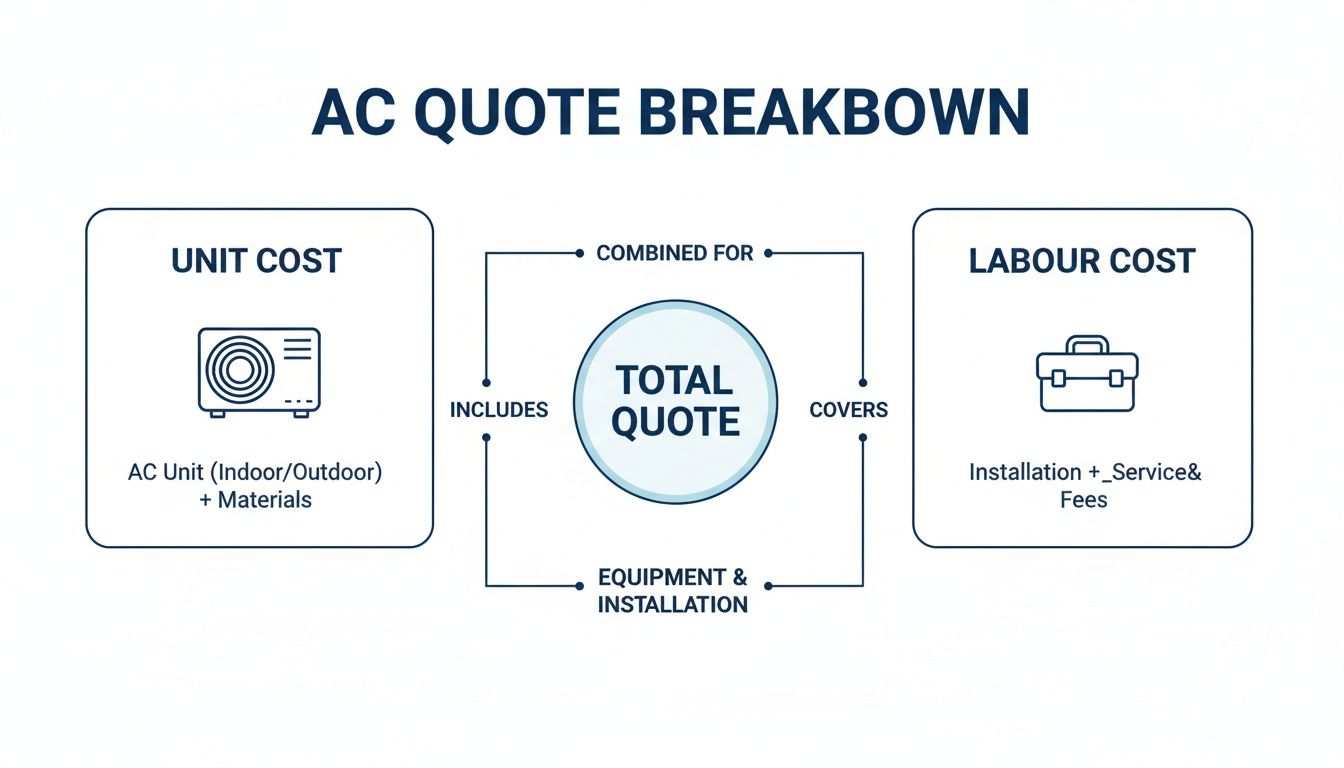
As you can see, the final cost is a careful balance between the equipment you choose and the specific labour needed to install it safely and correctly at your property.
Materials and Mounting Needs
Beyond the unit itself, the materials needed for the job also affect the price. The length of copper piping and electrical cabling is a key factor. A simple back-to-back installation might only need a few metres, but if the outdoor unit has to be placed further away, say, around the corner of the house to comply with body corporate rules, the need for extra piping will increase the material cost.
The way the outdoor unit is mounted matters, too. Placing it on a simple, pre-cast concrete slab on the ground is standard. However, if it needs to be mounted on wall brackets to save space or improve airflow, this adds to both the material and labour parts of the quote. These small details ensure the system is stable, performs optimally, and lasts for years to come.
As a guide, the labour for a licensed technician in NSW can range from $80 to $110 per hour. A straightforward job might take 8-10 hours, while more complex setups can demand 15-20 hours, significantly impacting the final installation cost. To get a better sense of how these variables affect pricing across different system sizes, you can explore more insights about Australian aircon installation costs.
Why Choosing The Right System Size Impacts Your Wallet

Let's get straight to it: the kilowatt (kW) rating of an air conditioner is like its engine power. Picking the right size is easily the most critical decision you'll make, and it affects everything from the initial split system installation cost to your power bills for the next ten years.
Getting this wrong is a costly mistake. And it’s not as simple as thinking "bigger is better", in fact, an oversized system can be just as bad as one that’s too small.
The Goldilocks Problem: Too Big or Too Small
Imagine trying to cool a big, open-plan living room in a hot Sydney suburb with a little 2.5kW unit built for a bedroom. That unit would be screaming on full power, 24/7, desperately trying to hit the temperature on your remote. Your power bill would be astronomical, and the room would never really feel comfortable.
Now, flip that scenario. You install a massive 8.0kW beast in a small, well-insulated home office. It’s so powerful it blasts the room with freezing air, hits the target temperature in a few minutes, and then abruptly shuts off. This constant on-off cycle is known as short cycling, and it’s horribly inefficient and puts a huge strain on the compressor.
Worse still, it doesn't give the system enough time to do its other vital job: dehumidifying the air. The room will feel cold, but also damp and clammy, a common complaint in the humid coastal air of the Central Coast. An oversized unit costs you more upfront and delivers a less comfortable result.
Matching Kilowatts to Room Size
While a professional assessment is always the best way to go, here are some general guidelines to give you a rough idea of what you might need. These are just a starting point, assuming a standard ceiling height of about 2.4 metres.
- Small Rooms (10-20 m²): A 2.5kW system is usually spot on for a bedroom or home office.
- Medium Rooms (20-35 m²): A 3.5kW to 5.0kW unit is a good fit for a master bedroom or a small lounge room.
- Large Areas (35-60 m²): A 6.0kW to 8.0kW system is what you’ll need for open-plan living and dining spaces.
Getting the size right is the key to balancing performance and efficiency. A correctly sized unit will run smoothly and consistently, using its inverter technology to maintain the temperature perfectly without wasting energy. This is how you achieve both comfort and lower running costs.
Why a Professional Assessment Is Crucial
These numbers are just a guide. A real professional assessment from a company like ALC Air goes much deeper. We don't just measure the floor; we calculate the precise heating and cooling load for your specific room by looking at the whole picture. For a more detailed breakdown, our guide on what size split system you need is an excellent resource.
Factors we analyse during an on-site assessment include:
- Ceiling Height: High ceilings in older Newcastle homes or modern Hunter Valley builds mean a larger volume of air to cool.
- Window Size and Direction: That huge, west-facing window copping the afternoon sun adds a massive heat load compared to a small, south-facing one.
- Insulation Quality: We check your ceiling and wall insulation, as it has a huge impact on how well your home holds onto the cool air.
- Local Climate: The persistent humidity on the Central Coast requires a different approach to the dry, intense heat you get further inland in the Hunter Valley.
Beyond the basics, understanding how to size units for different property types is also important. There are great resources out there for specific situations, like sizing ductless mini-splits for apartments or smaller homes. By taking all these factors into account, we can recommend a system that’s perfectly matched to your home, ensuring it runs efficiently for years to come and keeping your installation cost appropriate for your needs.
The Hidden Costs and Dangers of DIY Installation
It's tempting to look at an installation quote, see the labour component, and think, "I could probably do that myself and save a bit of money." When it comes to air conditioning, though, that thought can lead you down a very expensive and dangerous path. A DIY install isn't just cutting corners; it's a gamble with your home, your safety, and your wallet.
Here in Australia, the rules are non-negotiable for a good reason. It is completely illegal for anyone without a valid ARCtick licence to buy or handle refrigerant gases. These aren't just harmless chemicals; they're potent substances regulated for serious environmental reasons, and a botched job can lead to harmful leaks. This isn't a friendly suggestion, it's the law.
Electrical and Safety Compliance
Beyond the refrigerant, you've got the high-voltage electrical work. Every single split system needs its own dedicated circuit running back to your switchboard. This isn't a job for a handyman or a YouTube tutorial; it has to be done by a licensed electrician to comply with SafeWork NSW regulations and the Australian Standard AS/NZS 3000.
Trying to wire it up yourself is one of the riskiest things you can do in your home. Faulty electrical work is a leading cause of house fires, and an improperly connected air conditioner can easily overload your system with catastrophic results. Professional installation isn't just about making it run; it's about making sure it does so safely.
The Financial Fallout of a DIY Job
That money you thought you were saving? It can vanish in an instant. The very moment an unlicensed person touches your new air conditioner, you have instantly voided the manufacturer’s warranty. If that unit fails down the track because of a small mistake made during the install, you’re on your own. You'll be footing the entire bill for any repairs or even a full replacement.
Professional installation isn't a luxury; it's a non-negotiable part of your investment. It guarantees safety, compliance, a valid warranty, and the peace of mind that comes from knowing the job was done right.
On top of that, an amateur installation almost never performs well. Incorrectly flared pipes, a really common DIY mistake, will cause slow refrigerant leaks. This forces the system to work much harder to cool your home, sending your electricity bills through the roof. Over time, a poorly installed unit will cost you far more in running costs and inevitable repairs than you ever "saved" on the initial labour. If you want to see how a correct setup should look, our guide on the split system air conditioner installation process walks you through it.
Peace of Mind Is Priceless
Choosing a professional, licensed installer like ALC Air means you sidestep all these headaches. You get the solid assurance of:
- Guaranteed Safety and Compliance: We make sure every bit of electrical and refrigeration work meets, and usually exceeds, all Australian Standards.
- A Valid Manufacturer's Warranty: Your investment is properly protected for its full term, just as it should be.
- Optimal System Performance: We set up your system to run efficiently from day one, which translates directly into lower power bills for you.
- Workmanship Guarantee: We stand behind the quality of our work, giving you long-term confidence and a system you can rely on.
At the end of the day, the true split system installation cost includes the guarantee of safety and reliability. A professional job protects your home, your family, and your investment for years to come.
How To Get An Accurate And Trustworthy Quote
Getting a quote for your new air conditioner is the final step, but it’s where you need to be the most switched on. A vague price scribbled on the back of a business card or rattled off over the phone is a massive red flag. A trustworthy, professional quote for a split system installation is always detailed, transparent, and based on someone actually looking at your home.
The goal here is to move past a sales pitch and get to the real details that protect your investment. An accurate quote isn’t just a number; it’s a clear plan of action that prevents nasty surprises on installation day. It shows the company has taken the time to understand your specific needs, from your home’s layout in a Sydney suburb to the unique climate challenges of a Hunter Valley property.
Questions To Ask Every Installer
Before you agree to anything, you need to ask a few key questions. This isn't about trying to catch someone out; it's about making sure you’re partnering with a professional who is properly licensed, insured, and happy to be upfront. A good installer will welcome these questions and have the answers ready to go.
Here’s your essential checklist:
- "Can you please provide your electrical contractor licence number and your ARCtick licence number?"
- "Is the person doing the electrical work a fully licensed electrician employed by you?"
- "Does this quote include a dedicated electrical circuit from the switchboard?"
- "What brand and model of air conditioner are you quoting for?"
- "Is the price on this quote fixed, or could there be extra charges on the day?"
- "What’s your workmanship warranty, and how long does it last?"
You can easily verify a NSW electrical licence on the Fair Trading NSW website and check an ARCtick licence on the Australian Refrigeration Council’s online lookup tool. These are non-negotiable credentials.
Why A Site Visit Is The Only Way
A proper, fixed-price quote is only possible after a technician has physically seen your property. A quick phone estimate can never account for all the real-world factors that influence the final split system installation cost.
During an on-site assessment, a technician will measure the room, check your switchboard's capacity, figure out the best and neatest route for piping and wiring, and determine the safest, most efficient place to mount the outdoor unit. This process turns guesswork into certainty. It’s what allows a reputable company like ALC Air to give you a comprehensive quote that won't change, giving you complete confidence in your budget.
A detailed quote is your best defence against hidden costs. It should clearly list the exact make and model of the unit, all materials like piping and cables, mounting brackets, and a full breakdown of the labour involved. If a quote is just a single number on an email, ask for more detail.
Get Your Free, No-Obligation Fixed Quote
We believe in being completely upfront. Our experienced technicians have been serving the Central Coast, Sydney, and Newcastle for over 15 years, and we know that a quality installation starts with an accurate and honest quote. We provide a free, no-obligation site assessment to give you a fixed price you can rely on. If you're searching for more information on finding a qualified installer, our article on choosing a split system installation near you provides additional helpful tips.
Ready to get a clear, trustworthy price for your new air conditioner? Contact ALC Air today to schedule your free on-site quote. Call us or fill out our online form, and let’s get your home comfortable.
A Few Common Questions We Get
When you’re looking into getting a split system installed, a few questions always come up. Here are the straight answers to the things we’re asked most often by homeowners across the Central Coast, Sydney, and Newcastle.
How Long Does a Split System Installation Actually Take?
For a straightforward, back-to-back job on a single-storey house, we're typically in and out within four to six hours. It’s a pretty smooth process.
Of course, if things are a bit more complex, like installing on a second storey or needing to run pipes a longer distance, it can take a full day. The same goes for jobs that need a switchboard upgrade. We’ll always give you a clear time estimate with your quote so you know exactly what to expect.
Is It Really Cheaper To Install an Air Conditioner in Winter?
It can be, yes. It’s no surprise that everyone wants air con when the summer heat hits, which makes it the busiest time for installers.
If you can plan ahead and schedule your installation for autumn or winter, you'll often find we have more flexible availability. This can sometimes lead to more competitive pricing because you’re booking outside of that peak season rush.
What Does 'Back-to-Back' Installation Mean?
You'll hear this term a lot because it’s the simplest and most cost-effective way to install a split system.
A back-to-back installation is exactly what it sounds like: the indoor head unit is mounted on a wall that backs onto the outside of your house. The outdoor condenser unit is then placed on the ground directly behind it. This setup keeps the copper piping and electrical cabling to a minimum, which helps keep the cost down.
Think of a back-to-back installation as the starting point for pricing. Any variations, like putting the outdoor unit further away, up on wall brackets, or on a different level, will naturally adjust the final split system installation cost.
Does the Price Include Taking My Old Unit Away?
This is a great question to ask because it really varies from one installer to the next. You don’t want to be left with an old, heavy unit sitting on your lawn.
At ALC Air, our quotes always spell this out clearly. We’ll specify whether the removal and proper, responsible disposal of your old air conditioner are included in the price, so there are no surprises on installation day.
Ready for a clear, fixed-price quote you can trust? The team at ALC Air has over 15 years of experience providing quality installations across the Central Coast, Sydney, and Newcastle. We offer a free, no-obligation site assessment to give you a detailed and accurate price.
Get your free quote today by visiting https://alcairconditioning.com.au or calling our friendly team.