


Getting the size of your air conditioning system right is everything. We can't stress this enough. A unit that’s too powerful is genuinely just as bad as one that’s too weak. Go too big, and the system will constantly switch on and off without properly pulling the humidity out of the air. Go too small, and it will run itself into the ground trying to keep up, sending your power bills through the roof.
Nailing the right size from the get-go is the single most important step towards years of comfort and efficiency.
Why The Right Air Conditioner Size Is So Important
Choosing an air conditioner for your home involves more than just picking a brand you recognise off the shelf. The most critical decision you'll make is getting the size, or capacity, spot on. Think of it like buying shoes: a pair that's too big or too small will cause you nothing but problems, no matter how good they look.

The Problem With Oversized Units
It’s a common myth that "bigger is better," but with air conditioning, this couldn't be further from the truth. An oversized unit blasts the room with cold air, hits the target temperature way too quickly, and then shuts off.
This constant on-off process is known as short cycling. Because the system isn't running for long enough, it never gets a chance to do its other crucial job: removing moisture from the air. The result is a room that feels cold but unpleasantly clammy and damp. This is something we see all the time in the humid coastal climates of the Central Coast and Newcastle.
Short cycling also puts massive wear and tear on the unit's components, which often leads to premature failure and expensive repairs down the track.
The Dangers Of Undersized Systems
On the flip side, an undersized air conditioner is a recipe for high energy bills and pure frustration. On a scorching summer day in Sydney’s western suburbs or the Hunter Valley, a system that's too small will run non-stop without ever managing to reach your desired temperature.
This constant operation not only fails to keep you comfortable but also places immense strain on the system. It’s working flat-out just to keep its head above water, leading to significantly higher electricity consumption. If you want to see how that hits your wallet, check out our guide on the cost to run air conditioning.
Getting the size wrong isn't just a minor hiccup. Industry analysis suggests that a staggering 10–30% of installed systems in Australia are incorrectly sized. This leads to a huge amount of wasted energy and unnecessary replacement costs right across the country.
Ultimately, getting a professional to size your system is an investment, not an expense. It’s the foundation for reliable comfort in the varied climates across NSW, ensuring your system cools and heats effectively, runs efficiently, and lasts for its full expected lifespan.
Key Factors That Influence Air Conditioner Sizing
When we talk about sizing an air conditioner, it's easy to assume it’s all about the floor area. But if that were true, you wouldn't need a professional, you'd just need a tape measure. A proper assessment goes much deeper. It involves a detailed heat load calculation, which is our methodical way of figuring out exactly how much heat your home gains (and holds) throughout the day.
This calculation looks at dozens of variables unique to your property. Getting these details right is the difference between an air conditioner that hums along efficiently and one that’s constantly struggling to keep up. It’s the only way to be sure you're investing in a system that’s genuinely right for your home.
Your Home's Orientation and Sunlight Exposure
One of the biggest factors, hands down, is how your home is positioned in relation to the sun. Imagine you're cooling a two-storey home in Terrigal with afternoon western sun. A house like this with huge, west-facing windows copping the full force of the sun will gain a massive amount of heat. It's a completely different story to a south-facing home shaded by established gum trees.
This solar heat gain dramatically increases the cooling load. We carefully assess which rooms get blasted with direct sunlight and at what time of day. This is especially critical in places like Sydney's western suburbs or the Hunter Valley, where summer temperatures can be absolutely brutal.
Insulation Quality and Building Materials
Think of your home's insulation as being like an Esky, the better it is, the better it keeps the cool air in and the hot air out. The quality of your insulation plays a massive role in sizing.
An older brick home in Lake Macquarie with zero wall insulation and thin, old ceiling insulation will have a much higher heat load than a modern, fully insulated home.
We look at a few key things:
- Ceiling Insulation: What type is it (batts, loose-fill) and what’s its R-value? The R-value measures its thermal resistance, and higher is better.
- Wall Insulation: So many older homes simply don’t have it, which is a major source of heat gain in summer.
- Underfloor Insulation: This is also a factor, particularly for homes built on piers which can lose a lot of cool air through the floor.
Even your roof colour makes a difference. A dark tile roof absorbs significantly more heat than a light-coloured Colorbond roof, transferring that heat straight into your roof space and, eventually, into your living areas.
Windows and Glass Doors
Windows are basically thermal holes in your walls. A simple square metre measurement of a room doesn't tell you anything about how much glass it has, which is a huge source of heat transfer. When we assess a home, we're looking at the number of windows, their size, and, importantly, their type.
For instance, a living room in Newcastle with old-school, single-glazed aluminium windows will let in a truckload more heat than the same-sized room with modern, double-glazed windows. Even your window coverings, like thick block-out curtains or external blinds, contribute to the overall calculation.
Internal Heat Sources and Occupancy
The heat generated inside your home also adds to the cooling load. This is something those simple online calculators never, ever account for. We need to consider how many people typically use the space, because every person in a room is like a little 70-watt heater.
Appliances are another major contributor. Think about all the heat produced by ovens and cooktops in an open-plan kitchen, multiple computers running in a home office, or large televisions and home theatre systems. Lighting, especially older halogen downlights which get incredibly hot, also adds to the load.
All these small heat sources add up, and they have to be factored into the final sizing calculation. This ensures your system can handle the load on a hot summer's day when the whole family is home, the TV is on, and you’ve got a roast in the oven.
Understanding how all these pieces fit together is crucial. If you're curious about the mechanics behind it all, you can learn more about how an air conditioner works in our detailed guide.
A professional heat load calculation isn't about guesswork. It’s a scientific process that evaluates every element contributing to your home's thermal performance. This ensures the system we recommend is perfectly matched to your specific environment and lifestyle.
How We Figure Out The Right Kilowatt Capacity
When it gets to the technical side of things, we move past rough estimates and into precise calculations. Forget those basic online tools that just ask for your room's length and width. To get this right, we carry out a professional heat load calculation, which is the industry standard for making sure your system is perfectly matched to your space.
This isn't guesswork. It's a methodical process that quantifies exactly how much heat your home gains from all sorts of sources, giving us the cooling power needed to keep you comfortable on even the most brutal summer days.
Demystifying Kilowatts (kW)
First, let's quickly cover the key measurement we use here in Australia: the kilowatt (kW). You'll see this number plastered on every air conditioner. In simple terms, a kilowatt is a measure of an air conditioner's cooling (or heating) output.
Think of it like the horsepower of a car engine. A higher kW rating means more grunt and more cooling power. It’s a direct measure of how much heat the unit can pull out of a room in an hour. When you see a 2.5kW system, you know exactly what its output capacity is.
Breaking Down The Heat Load Calculation
A proper heat load calculation accounts for every single factor that adds warmth to a room. It’s a detailed deep-dive into how heat gets in and where it's generated inside your space.
We meticulously analyse three main types of heat gain:
- Solar Heat Gain: This is the big one, the heat radiating into your home through windows and glass doors. A massive, west-facing window in a Hunter Valley home is going to dump a huge amount of heat into a room compared to a small, shaded south-facing one.
- Conduction and Convection: Heat also moves through solid materials. We calculate the transfer through your ceiling, walls, and floors, taking into account the type and quality of your insulation. An uninsulated roof space basically acts like an oven, radiating heat down into your living areas all afternoon.
- Internal Heat Loads: We also have to factor in the heat generated inside the room. This includes everything from body heat from people, warmth from appliances like TVs and computers, and heat from lighting, especially older halogen bulbs.
This flowchart gives you a simplified look at the primary factors we're piecing together during an on-site assessment.
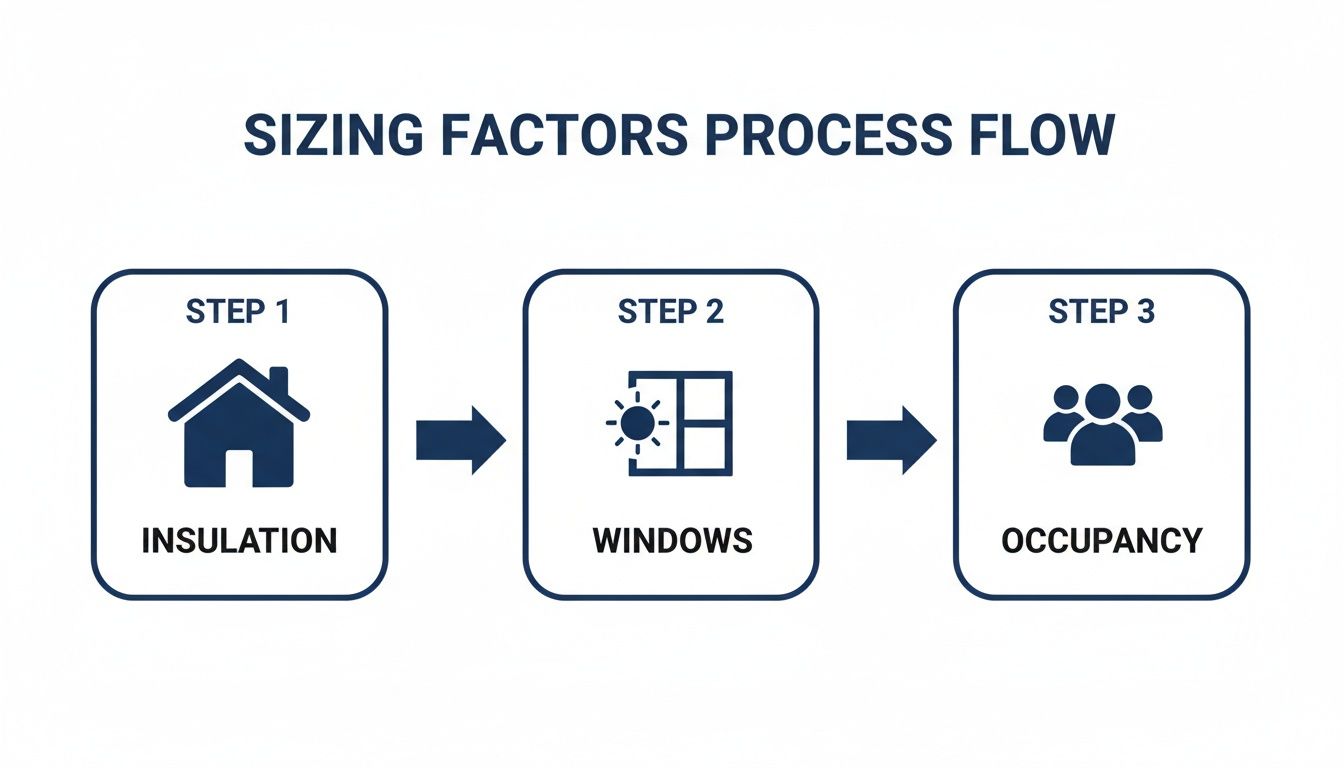
As you can see, every element from the quality of your insulation to how many people use the room is a vital piece of the puzzle. Getting any one of them wrong can lead to choosing the wrong size system.
A Practical Sizing Example
Let's put this into a real-world scenario. Imagine you have a standard 20 square metre (4m x 5m) living area in a home in Gosford on the Central Coast. A simple online calculator might spit out a suggestion for a 2.5kW system based purely on the floor size.
But a professional calculation tells a much more detailed story.
Scenario A (High Heat Load): Let's say this room has a large, single-glazed, west-facing window, poor ceiling insulation, and is regularly used by four people. The heat load here is going to be substantial. The required capacity would likely jump to 3.5kW or even 5.0kW to effectively battle the intense afternoon sun and internal heat.
Scenario B (Low Heat Load): Now, picture the exact same-sized room. This time, it has a small, south-facing window, good R4.0 ceiling insulation, and is only used by two people in the evenings. The heat load is dramatically lower. Here, a 2.5kW system would be more than enough, saving you on both the purchase price and your power bills.
This example really highlights why a simple square metre rule of thumb is so unreliable. For a deeper dive into choosing the right unit for specific rooms, our guide on what size split system you need offers some extra insights.
Key Takeaway: A professional heat load calculation is the only way to accurately determine the correct kW capacity. It replaces guesswork with data, ensuring your investment delivers optimal comfort and efficiency for years to come.
A General Guide to Capacity
While nothing beats a professional on-site assessment, we get that you might want a rough idea to start with. The table below provides a general guide to cooling capacity based on room size and an estimated heat load.
Just remember, these are starting points only. They absolutely do not replace a detailed, professional heat load calculation that's tailored to your specific home and lifestyle.
General Guide to Air Conditioner Capacity by Room Size
| Room Size (Square Metres) | Suggested Cooling Capacity (kW) for Low Heat Load | Suggested Cooling Capacity (kW) for High Heat Load |
|---|---|---|
| Up to 15 m² (e.g., small bedroom) | 2.0 – 2.5 kW | 2.5 – 3.5 kW |
| 15 – 25 m² (e.g., average bedroom) | 2.5 – 3.5 kW | 3.5 – 5.0 kW |
| 25 – 40 m² (e.g., living room) | 5.0 – 6.0 kW | 6.0 – 7.1 kW |
| 40 – 60 m² (e.g., open plan area) | 7.1 – 8.0 kW | 8.0 – 9.0+ kW |
Use this table to get a feel for what you might need, but the next step should always be getting an expert opinion based on your actual home.
Sizing Differences Between Ducted and Split Systems
When it comes to sizing up an air conditioner, one of the first things we look at is the type of system you're considering. The way we calculate the right size for a single split system in a bedroom is worlds apart from how we design a ducted solution for an entire home.
They're built for different jobs, and the maths behind sizing them reflects that reality.
Sizing For A Single Zone Split System
A split system is designed to heat or cool one specific area, what we call a 'zone'. This means the sizing calculation is highly focused, almost forensic, on that single room. We’re treating it as its own little ecosystem.
Think about a home office in Lake Macquarie. It’s packed with heat-generating electronics like computers and monitors. That room is going to need a more powerful split system than a guest bedroom of the exact same size that’s rarely used. It's not just about square metres; it’s about how the room is actually lived in.
With a split system, we dig into every detail of that one room.
Imagine two identical 15 square metre rooms in a Charlestown home. One is a south-facing study with a small window. The other is a north-facing master bedroom with a huge glass sliding door. Even though the floor space is identical, the bedroom is going to soak up far more solar heat and will need a bigger unit to keep it comfortable.
This is exactly why a simple "watts-per-square-metre" rule of thumb so often gets it wrong. We have to account for the specific heat gain of that single zone to make sure the unit isn't undersized and struggling, or oversized and constantly switching itself off.
The Complexity of Ducted System Sizing
Moving on to ducted air conditioning, the calculation becomes a much bigger, more intricate puzzle. Instead of zeroing in on one room, we have to look at the total heat load of your entire home. But, and this is the important part, it’s not as simple as just adding up the requirements for every single room.
The great strength of a ducted system is its ability to be zoned. Zoning lets you divide your home into different areas that can be cooled or heated independently. A classic setup is a "day zone" for the living and kitchen areas and a "night zone" for the bedrooms.
This changes everything for sizing the central unit.
Because you're almost never cooling every single room in the house at the same time, we don't need a monster unit capable of handling the entire home's peak load at once. We can be much smarter.
By designing a system with effective zones, we can often recommend a smaller, more energy-efficient central unit. This not only reduces the upfront installation cost but also leads to significant savings on your long-term running costs.
Let's take a two-storey home in the Hunter Valley. During the day, the family is downstairs in the open-plan living area. At night, everyone's upstairs asleep. A properly zoned ducted system lets you direct all the cooling power to the living area during the day and then switch it exclusively to the bedrooms at night.
Because you're only ever conditioning a portion of the house at any given time, the central unit doesn't need the brute force to cool the entire property simultaneously. This intelligent design is at the heart of effective ducted air conditioning. If you want to dive deeper into how these systems compare, our guide on the differences between ducted air conditioning and split systems is a great read.
Ultimately, the goal is the same for both: perfect comfort and efficiency. The path we take to get there, however, requires a completely different strategy.
Common Sizing Mistakes Homeowners Should Avoid
Getting your air conditioner sizing wrong is an easy trap to fall into, and unfortunately, it's an expensive one. After more than 15 years of installations across the Central Coast and Sydney, we’ve seen a few predictable errors that homeowners and even some less experienced installers make.
Understanding these pitfalls is the first step to making a smart investment.

Relying Only on Floor Area
By a long shot, the most common mistake is grabbing a tape measure, calculating the square metres of a room, and picking a unit based on that number alone. This approach completely ignores all the critical factors that actually determine your home's heat load.
It doesn't account for your big west-facing window, your dark tile roof, or the quality of your ceiling insulation. A simple online calculator might suggest a 5.0kW system for your 35 square metre living room, but that's just a guess. Sizing purely on floor area is a gamble that rarely pays off.
Believing Bigger is Better
Many people assume that buying a more powerful air conditioner than they need is a safe bet, a bit like buying a car with a bigger engine. In reality, an oversized unit is just as problematic as an undersized one.
It leads to a phenomenon called short cycling, where the system blasts cold air, reaches the set temperature way too quickly, and then shuts down. This constant on-off cycle puts immense strain on the compressor, leading to premature wear and tear.
Even worse, because the unit isn't running for long enough, it fails to properly dehumidify the air. This leaves you with a room that feels cold and unpleasantly clammy, a common complaint in the humid coastal air of Newcastle and the Central Coast.
Ignoring Your Local Climate
NSW has a diverse climate, so a one-size-fits-all approach just doesn’t work. Sizing an air conditioner for a home in the hot, dry Hunter Valley requires a different calculation than for a home battling the coastal humidity of suburbs like Umina Beach or Swansea.
High humidity makes the air feel warmer than it is, meaning the system has to work harder to remove moisture just to make you feel comfortable. An installer who doesn't account for these local nuances might undersize your system, leaving it struggling to cope on a sticky summer afternoon.
Choosing the best air conditioner for your home always involves matching the system's capabilities to your specific regional climate.
A correctly sized air conditioner is the foundation of an efficient and reliable system. Oversizing leads to poor dehumidification and unnecessary wear, while undersizing results in constant running and high power bills. Both mistakes will cost you money and comfort.
Skipping a Professional Load Calculation
The only way to avoid these expensive mistakes is to have a proper heat load calculation performed by a qualified professional. This isn't just about good practice; it's about protecting your investment and ensuring your system is safe and compliant.
A technician with an ARCtick licence has the training and tools to assess every variable in your home accurately. They follow Australian Standards, such as AS/NZS 60335 for appliance safety, and ensure the entire installation is carried out correctly by a licensed electrician according to AS/NZS 3000.
These professionals don't guess; they calculate. They will stand by their recommendation, giving you peace of mind that the system you're paying for is perfectly matched to your needs.
Our Process for Getting Your Sizing Perfect
Once you see all the variables involved, it becomes crystal clear why a professional, on-site assessment isn’t just a good idea, it’s non-negotiable. At ALC Air, this isn’t just a step in our process; it’s the absolute cornerstone of how we work. Honestly, we believe getting the sizing perfect from day one is the most important job we do.
Our entire approach is built around a thorough, in-person evaluation. One of our experienced technicians will visit your home, whether you’re in the Sydney suburbs, up in Newcastle, or right here on the Central Coast, to conduct a detailed assessment that goes way beyond just measuring floor space.
It All Starts With a Proper On-Site Evaluation
We meticulously inspect your ceiling and wall insulation, check the orientation and type of your windows, and take the time to understand how you and your family actually live in your home.
Got a home office packed with heat-generating electronics? Do you get blasted by that harsh western sun in the afternoon? These are the real-world details that make all the difference, and they’re exactly what we look for.
After our assessment, we’ll sit down with you and explain our findings in plain English. No confusing jargon or technical mumbo-jumbo, just clear, practical advice.
We then provide you with a detailed, fixed-price quote. This isn't a rough estimate; it’s a precise calculation outlining our recommendation for the correctly sized split system or ducted solution, designed for ultimate comfort and long-term efficiency.
Our commitment doesn’t stop once the quote is accepted. We're focused on a quality installation from start to finish, which includes ensuring all electrical work is handled by a licensed professional and is fully compliant with Australian Standards like AS/NZS 3000. This guarantees not only the performance of your new system but, more importantly, the safety of your home and family.
Our goal is simple: deliver a solution that runs efficiently, keeps you comfortable for years, and truly stands the test of time.
Your Top Questions About Air Conditioning Sizing Answered
When it comes to getting air conditioning right, a few common questions pop up time and time again. Here are straight answers to the things homeowners across NSW often ask us.
Can I Just Use an Online Sizing Calculator?
Honestly, those online calculators can be a bit of a trap. They’re a fun starting point, but they’re often wildly inaccurate for real-world homes.
Think about it: a simple web form can't possibly know about the quality of your ceiling insulation, whether your living room windows face west into the brutal afternoon sun, or the specific coastal humidity we deal with here in Newcastle. It's these local details that make all the difference.
Relying on a generic calculator is a gamble that can easily lead you to a system that’s either too weak to cope or so powerful it costs a fortune to run. There's no substitute for having a professional take a look at your actual space.
What’s the Big Deal If My Air Conditioner Is a Bit Too Powerful?
This is a bigger problem than most people realise. An oversized air conditioner will blast the room with cold air, hit the thermostat temperature in a flash, and then shut down. It sounds efficient, but it’s not.
The real issue is that it shuts off before it’s had a chance to do its other crucial job: dehumidifying the air. This leaves the room feeling cold but unpleasantly clammy and damp.
This constant on-off process is called short cycling. It’s incredibly stressful for the system’s compressor and key components, leading to premature wear and tear. On top of that, it actually uses more energy than a correctly sized unit that can run consistently at a low, efficient speed.
Does the Brand of Air Conditioner Change the Size I Need?
Not at all. If your room needs 5kW of cooling power, it needs 5kW whether you choose a unit from Daikin, Mitsubishi Electric, or another quality manufacturer. The physics of cooling your space doesn't change based on the logo on the front of the unit.
What does change between brands and models is energy efficiency. A more efficient 5kW system will deliver the exact same cooling power but use less electricity to do it. That’s where you see the difference in your long-term running costs, not in the initial size calculation.
Ready for an accurate, no-obligation assessment? The team at ALC Air provides professional sizing and installation to ensure your system is perfect for your home. Get your free quote today.