


Sizing your air conditioner correctly is all about finding the perfect match between a unit’s cooling capacity, measured in kilowatts (kW), and the unique demands of your home. We can’t stress this enough: getting the size right is the single most important step for genuine comfort and long-term efficiency. A system that’s too small will struggle on hot days, while one that’s too big will waste energy and leave your home feeling damp.
Why Accurate Air Conditioner Sizing Matters
Imagine a scorching summer afternoon on the Central Coast. Your air conditioner is running flat out, but the room just never feels properly cool. Or maybe it blasts icy air for five minutes, shuts off, and leaves the space feeling clammy and uncomfortable. This is the classic signature of an improperly sized air conditioner.
Choosing the right capacity isn’t just about hitting a target temperature; it’s the key to protecting your investment. An incorrectly sized system can trigger a host of problems that will cost you money and comfort down the track.
The Problem of Under-Sized vs Over-Sized Air Conditioners
A unit that’s too small for the space will run constantly without ever reaching the temperature you’ve set, especially during a Sydney heatwave. This continuous operation puts a massive strain on the components, leading to premature wear and tear and power bills that are much higher than they need to be.
On the other hand, a system that’s too powerful is often even worse. This is a common mistake homeowners make, falling into the “bigger is always better” trap. An oversized unit will cool the room far too quickly and then shut down. This constant starting and stopping, what we call short cycling, is incredibly inefficient and fails to properly remove humidity from the air. It also puts a huge amount of stress on the compressor, which is the heart of your air conditioner.
In Australia, we measure cooling capacity in kilowatts (kW). You might also hear the term BTU (British Thermal Units), but kW is the standard here. While there are plenty of online calculators that can give you a rough starting point, they can never account for the unique characteristics of your home. This is where getting professional advice becomes so important. You can learn more about how experts evaluate a home’s specific needs in our detailed guide to ducted air conditioner costs. For a deeper dive into the technical standards behind these calculations, organisations like ASHRAE provide excellent resources.
A Simple Formula for Sizing Your Air Conditioner
To get a solid starting point for sizing your air conditioner, there’s a simple formula we use in the industry. It’s all about multiplying your room’s area in square metres (length x width) by a ‘watts per square metre’ factor. This factor isn’t set in stone; it shifts depending on your home’s unique layout and features.
As a general rule of thumb for Australian homes, we typically work on a requirement of about 125 to 150 watts per square metre.
Let’s say you have a 20 square metre master bedroom in a Gosford home. Using the higher end of our guide to be safe, the maths looks like this: 20m² x 150W = 3000W. That simple sum tells you a 3.0kW system is a sensible place to start your search. This method gives you a reliable ballpark figure and helps you understand the language of air con capacity. But remember, it’s a foundational estimate, not the final word.
Room Size to kW Capacity Conversion Table
To make things even easier, we’ve put together this table to give you a general idea of the cooling capacity needed for different room sizes. Think of it as a quick reference for your Central Coast property before you get a licensed professional on-site.
| Room Size (Square Metres) | Example Room Type | Recommended Cooling Capacity (kW) |
|---|---|---|
| Up to 15m² | Small Bedroom / Home Office | 2.0 – 2.5 kW |
| 15m² – 25m² | Master Bedroom / Medium Lounge | 2.5 – 4.0 kW |
| 25m² – 40m² | Large Lounge Room | 4.0 – 6.0 kW |
| 40m² – 65m² | Open-Plan Living & Dining | 6.0 – 9.0 kW |
This table is a great starting point, but every home is different. Factors like ceiling height, window size, and insulation will fine-tune these numbers, which is where a proper assessment from an ARCtick licensed technician comes in.
The “Goldilocks” Problem: Under-Sized vs Over-Sized
Getting the size right is absolutely crucial for both your comfort and your power bill. It’s a classic Goldilocks situation: not too big, not too small, but just right. An oversized unit is almost always worse than a slightly undersized one.
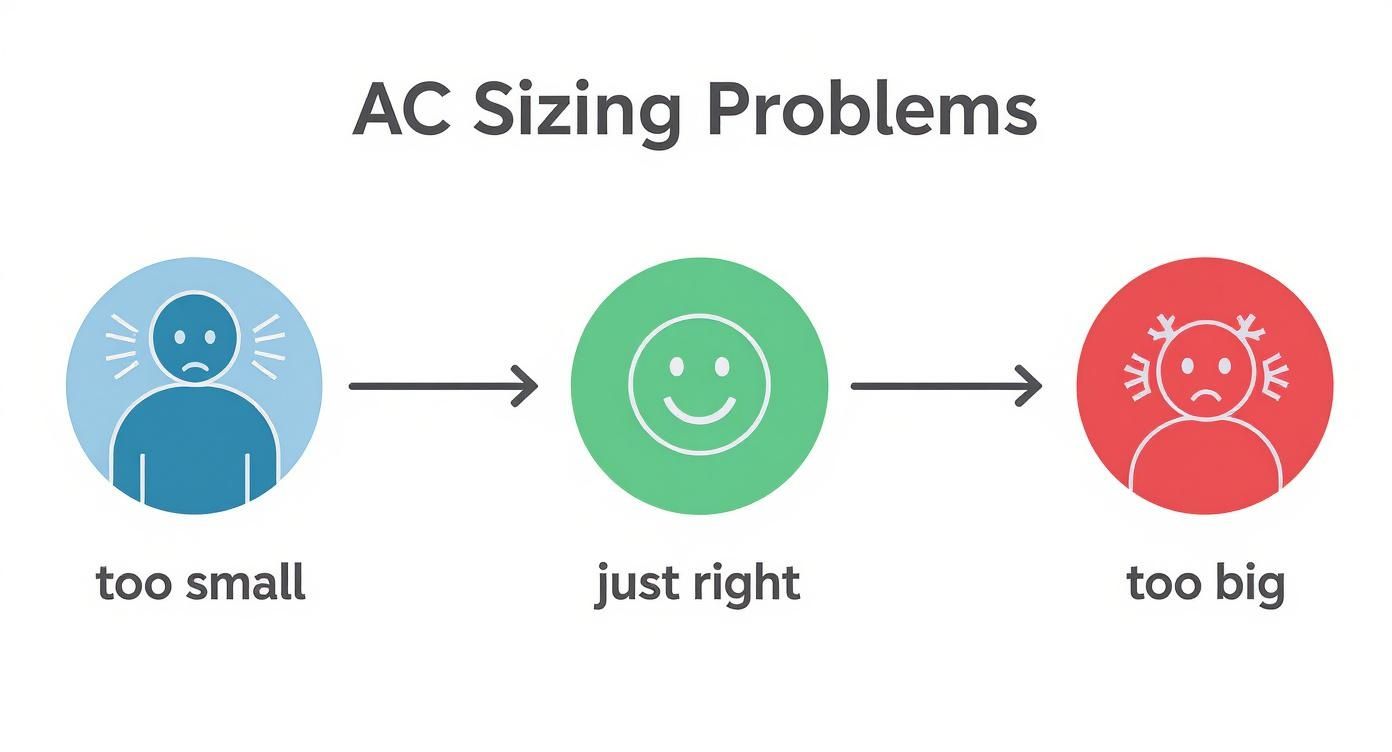
As you can see, both undersized and oversized units cause headaches. An undersized unit will run flat out all day and never quite get the room cool, costing you a fortune in electricity.
An oversized unit will constantly switch on and off. This short cycling is inefficient and, more importantly, it doesn’t run long enough to properly dehumidify the air, leaving you feeling cool but clammy. That’s a particularly big deal in the humid coastal climates of Newcastle and Lake Macquarie.
Factors That Change Your Sizing Calculation
That simple square metre calculation is a fantastic starting point, but a professional installer digs much deeper to get the sizing just right.
Consider this scenario: a west-facing living room in Penrith with large, single-glazed windows will need significantly more cooling power than a south-facing room in Terrigal with shaded windows. The raw area might be the same, but the demand on the system is completely different.
These subtle but critical factors are what separate a good guess from a precise calculation. We call this a “heat load calculation,” and it’s how we ensure your system works perfectly without wasting energy.
Insulation and Building Materials
The quality of your insulation is one of the most significant factors in sizing an air conditioner. A well-insulated home with modern, double-glazed windows holds onto cool air much more effectively, meaning a smaller, more efficient system can do the job comfortably.
Conversely, an older home in Newcastle with poor insulation, draughty windows, and a dark-coloured roof will constantly fight to keep the heat out. In this scenario, we might need to increase the calculated capacity to compensate for this heat gain. The type of construction, such as brick veneer versus weatherboard, also plays a part in how quickly your home heats up and cools down.
Room Layout and Ceiling Height
High ceilings dramatically increase the total volume of air that needs to be cooled. A standard sizing formula assumes a ceiling height of around 2.4 metres. If you have 3-metre ceilings in your Hunter Valley home, you have 25% more air volume to condition, requiring a corresponding increase in the system’s kW capacity.
The layout also matters. An open-plan living and kitchen area on the Central Coast needs a unit powerful enough to handle the entire combined space, including the extra heat generated by cooking appliances.
Australia’s varied climate zones have driven a need for precisely sized residential air conditioners to balance comfort and efficiency. Research shows that factors like building construction year, dwelling type, and home size significantly influence cooling load requirements. Find out more about how these factors affect energy use in this detailed report.
Local Climate and Adjusting for Coastal Humidity
Where your home is located and which way it faces are crucial. The humid coastal climate of Lake Macquarie requires a system that excels at dehumidification, whereas the dry, intense heat of the Hunter Valley demands raw cooling power.
A room’s orientation to the sun is another major consideration. A south-facing room gets very little direct sun, so its cooling needs are lower. However, a west-facing room in a Sydney suburb cops the full force of the brutal afternoon sun, absorbing a massive amount of heat. This room will require a more powerful unit than its square meterage might suggest.
For coastal areas like those from Gosford to Newcastle, humidity is a key factor. An oversized unit is a humidity nightmare because it cools the air too quickly and shuts off before it can properly remove moisture. A correctly sized unit runs for longer, more consistent cycles, which is far more effective at managing that coastal humidity and leaving you feeling genuinely comfortable. Neglecting these environmental factors can compromise the effectiveness of your system, highlighting the importance of proper air conditioning maintenance to keep it running efficiently.
Common Air Conditioner Sizing Mistakes to Avoid
After installing systems across the Central Coast and Newcastle for over 15 years, we’ve seen homeowners make the same honest mistakes when it comes to sizing. We want to help you sidestep these common pitfalls, which can lead to nothing but discomfort and high running costs.
The most frequent mistake we encounter is the ‘bigger is better’ myth. It seems logical that a more powerful unit would deliver better cooling, but the opposite is often true. An oversized air conditioner is like using a V8 engine for a short trip to the local shops: powerful but incredibly inefficient for the job.
The Problem with Short-Cycling
An oversized air conditioner will blast out cold air, hit the set temperature way too quickly, and then abruptly shut down. This constant on-off process, known as short-cycling, is a major problem because the unit doesn’t run for long, consistent periods, failing to properly remove humidity from the air.
This can leave you feeling cool but unpleasantly clammy, a common issue in humid coastal climates from the Central Coast to Lake Macquarie. Short-cycling also puts excessive strain on the compressor, which can seriously reduce your system’s lifespan. You can find out more by reading our guide on how long air conditioners should last.
Other Common Sizing Errors
It’s easy to fall into a few other traps when thinking about what size system you need. Being aware of them can save you a lot of hassle down the track.
- Compensating for Poor Insulation: Some people buy a massive unit to make up for a poorly insulated home. This is just a band-aid solution that leads to massive power bills. A smarter long-term investment is to improve your home’s insulation first, which could allow you to install a smaller, more efficient air conditioner.
- Ignoring Room Usage: It’s also easy to forget how a room is actually used. A rarely occupied guest room has very different cooling needs than a home office packed with heat-generating electronics like computers and monitors.
- Trusting Online Calculators Blindly: Finally, relying solely on a generic online
air conditioner capacity calculatoris a risky move. These tools are a decent starting point but they can’t see the unique character of your home. They don’t account for window orientation, local climate nuances, or ceiling height and are no substitute for an on-site assessment by a licensed technician.
How We Size Ducted Systems for an Entire Home

Sizing an air conditioner for a single room is one thing, but planning a ducted system for an entire home is a completely different ball game. It’s where we move beyond simple area calculations and into a detailed analysis of your entire property.
This is where a proper heat load calculation, performed by licensed technicians, becomes absolutely essential for long-term comfort and efficiency. Our process is all about creating a balanced and intelligent system, not just a powerful one. We start by looking at your home’s layout, its construction, and how your family actually lives in it.
Designing for Efficiency with Zones
One of the most powerful tools we have when designing a ducted system is zoning. By dividing your home into separate zones, we can give you precise control over which areas get cooling or heating at any given time. It’s a fundamental part of smart air conditioner sizing for larger properties.
A classic two-storey family home in the Hunter Valley is a perfect example. We might set up one zone for the upstairs bedrooms and a separate zone for the downstairs living and kitchen area. This lets you cool only the living areas during the day, then switch to just the bedrooms at night, saving a significant amount of energy.
The Importance of Ductwork Design
The physical layout of the ductwork is just as critical as the capacity of the outdoor unit. I’ve seen it time and again: a poorly designed duct network leads to noisy operation, uneven temperatures, and some rooms feeling stuffy while others are freezing cold.
We carefully map out the duct runs to ensure smooth, consistent airflow to every outlet. This involves calculating the right duct diameter and length for each run to maintain the correct air pressure and volume. It’s a technical process that has to comply with Australian Standards like AS/NZS 3000, and it’s the only way to ensure your system performs exactly as the manufacturer intended. Our technicians are fully licensed and hold ARCtick certification, which is your guarantee of a compliant and professional installation.
Selecting the right outdoor and indoor unit capacity ultimately comes down to the home’s total floor area, layout, and how many zones you’re planning. For those weighing their options, understanding the differences between these whole-home solutions and single-room units is key. You can explore this further in our guide comparing ducted air conditioning vs split systems.
Getting a Professional Sizing Assessment
Look, while our guide gives you the tools to get a really solid estimate, the final step should always be getting a professional on-site. The simple truth is an accurate size can only be determined by a qualified technician standing in your home, not by an online calculator.
When we come out for an on-site visit, we’re not just glancing at a floor plan. We’re in the rooms with a tape measure, we’re looking at your insulation quality, checking the type and orientation of your windows, and talking to you about your family’s lifestyle to understand what comfort actually means to you.
This tailored approach ensures your system is a perfect fit, not a one-size-fits-all guess. You can learn more about how Aussies are using air conditioners from this CSIRO report. This detailed process also helps us recommend the right unit from the best air conditioner brands in Australia that will actually suit your home’s unique needs.
If you’re anywhere in the Central Coast, Sydney, Newcastle, or Hunter regions, we invite you to get in touch for an accurate, no-obligation sizing assessment. We’re here to help you get it right from the very start.
Your Sizing Questions Answered
We get asked these questions all the time by homeowners across the Central Coast and Hunter regions. Here are some straight answers based on years of experience installing systems in homes just like yours.
What size split system do I need for my bedroom?
For a standard bedroom, say around 12 to 15 square metres, a 2.0kW to 2.5kW split system is usually the perfect fit. This is the go-to answer for “what size split system for bedroom” for a reason.
But if that bedroom is upstairs, has big west-facing windows copping all that brutal afternoon sun, or you know the insulation is a bit average, you’ll probably need to step up to a 3.5kW unit. This is a classic example of where a simple m² calculation falls short, and a proper assessment is the only way to be certain.
Is an undersized or oversized air conditioner worse?
An undersized unit will obviously struggle and run itself into the ground on a hot day. It’s a bad situation.
However, almost every experienced technician will tell you that an oversized unit is actually worse for your overall comfort and efficiency. It works a bit like a drag car, all power, no finesse. It blasts the room with cold air, hits the thermostat temperature way too fast, and then shuts off. This constant on-off cycle is known as “short-cycling.”
This process is terrible because it never runs long enough to properly dehumidify the air, leaving you feeling cool but clammy. It also hammers your power bill and puts massive strain on the system’s most important components.
How does coastal humidity affect sizing?
That sticky, humid air we get on the coast makes everything feel hotter than it is. A huge part of your air conditioner’s job is to pull that moisture out of the air.
This is exactly why getting the sizing right is so critical in places like Newcastle and the Central Coast. An oversized unit is a humidity nightmare. It cools the room too quickly and shuts down before it has a chance to do its dehumidifying job properly. The result? You feel cool, but still sticky and uncomfortable.
A correctly sized unit, on the other hand, runs for longer, more consistent cycles. This is far more effective at managing that coastal humidity, leaving you feeling genuinely comfortable, not just cold.
Getting the sizing right from the very beginning saves you a fortune in running costs and guarantees your comfort for years to come. For a free, no-obligation sizing assessment for your home, get in touch with the team at ALC Air.