


Sizing an air conditioner properly means looking way beyond a simple square metre measurement. While floor space is a good starting point, we find things like which way your windows face, how high your ceilings are, and our local climate are what really determine the right kilowatt (kW) capacity for genuine comfort and efficiency.
Why Getting the Air Conditioner Size Right is So Important
Choosing the right size air conditioner isn't just a technical box to tick; it's the key to being comfortable without dreading your quarterly power bill. We see it all the time across Sydney, Newcastle, and the Central Coast—getting this wrong leads to two very common, very frustrating problems. An incorrectly sized system can quickly turn your investment into a source of constant irritation.
The Problem With Undersized Units
An air conditioner that's too small for the room is easy to spot. Imagine an undersized unit in a Western Sydney home during a blistering summer heatwave. It’ll run non-stop, working its guts out but barely making a dent in the heat.
This constant, frantic operation causes excessive wear and tear on the components and sends your power bill through the roof, all while failing to deliver the cool relief you paid for. It's a false economy that ends up costing you more in the long run.
The Dangers of an Oversized System
On the flip side, a massive, oversized system might seem like a clever "better safe than sorry" idea, but it creates a whole different set of issues. The big problem here is something we call ‘short cycling’.
This is where the unit blasts the room with cold air so quickly that it shuts off before it gets a chance to properly dehumidify the air. The result? A cold but unpleasantly clammy and damp feeling—a very common complaint in the humid coastal air of Lake Macquarie. Over time, all that excess moisture can even lead to mould growth.
Getting the size right from the start is non-negotiable. It means your system performs better, costs less to run, and has a longer, more reliable lifespan. This holds true whether you're cooling a Newcastle apartment, a family home in Terrigal, or a rural property in the Hunter Valley.
The cooling power of an air conditioner is measured in kilowatts (kW). A higher kW rating means the unit can remove more heat from a space. Our goal is to match this kW capacity as closely as possible to your room's unique needs.
A perfect match ensures the system runs in smooth, efficient cycles, keeping the temperature consistent while effectively managing humidity. This balance is the real secret to true comfort and long-term savings on your energy bills.
Finding Your Room's Baseline Cooling Requirement
Alright, let's ditch the guesswork and figure out a solid starting point for your room's cooling needs. This first step is simple but absolutely crucial. It gives us a reliable baseline to work from before we start tweaking for all the unique details of your home. All you need to begin is a tape measure.
First up, calculate your room's floor area. Just measure the length and width of the room in metres, then multiply those two numbers. For instance, a bedroom that's 4 metres long by 5 metres wide gives you a floor area of 20 square metres. That number is our foundation.
A Basic Sizing Rule of Thumb
In the air conditioning industry, we often use a general rule of thumb to get a quick estimate. You'll need about 120 to 150 watts of cooling power per square metre. This isn't the final answer, but it’s a brilliant way to get into the right ballpark for what size unit you might need.
Let's use our 20 square metre bedroom as an example:
- Low estimate: 20m² x 120 watts = 2,400 watts, or 2.4 kW
- High estimate: 20m² x 150 watts = 3,000 watts, or 3.0 kW
So for a standard bedroom of this size, we’re already zeroing in on a split system with a capacity somewhere between 2.4kW and 3.0kW. You can see how this simple formula immediately helps narrow down the huge range of options out there.
Quick Guide to Air Conditioner Capacity by Room Size
To make things even simpler, we've put together this table showing rough estimates for common room sizes we see every day in homes across NSW. Think of this as your quick reference guide for a baseline figure, before we factor in all the other crucial details a professional technician would assess on-site.
| Room Size (Square Metres) | Room Type Example | Estimated Cooling Capacity (kW) |
|---|---|---|
| 10m² – 20m² | Small bedroom or home office in Newcastle | 1.5kW – 2.5kW |
| 20m² – 30m² | Master bedroom or average lounge in Sydney | 2.5kW – 3.5kW |
| 30m² – 45m² | Large lounge or small open-plan Central Coast | 3.5kW – 5.0kW |
| 45m² – 60m² | Large open-plan living/dining in Hunter Valley | 5.0kW – 7.1kW |
Important Note: This table is a starting point only. Factors like window size, insulation, and ceiling height will adjust these numbers, which we'll cover in the next section.
It’s worth pointing out that some online tools can be a bit heavy-handed and recommend oversized systems. For example, expert analysis from CHOICE shows that a 30 square metre room in Sydney only requires about 2.3 kilowatts of cooling. Yet, their research found many commercial calculators often suggest units between 3.5kW and 5.0kW, which is often far more power than needed and leads to higher running costs.
This baseline calculation is a powerful tool to get you started, but it’s only one piece of the puzzle. For a more detailed look at how different variables can impact these numbers, feel free to check out our own detailed aircon calculator for room size for a deeper dive. The next step is to refine this baseline by factoring in the specific features of your home.
Adjusting for Your Home's Unique Features
A simple calculation based on floor area gives you a solid starting point, but honestly, it’s only one part of the story. To really nail the right size air conditioner for your room, we need to look at what makes your home your home. These are the real-world variables that separate a good guess from a precise, professional assessment.
Think of the baseline number as the right size engine for a generic car. Now, we need to figure out if that car is driving up a steep hill, carrying extra weight, or has all the windows down. These factors completely change the power needed to keep things running smoothly and efficiently.
This quick visual guide shows the essential steps a professional takes to size your system correctly.
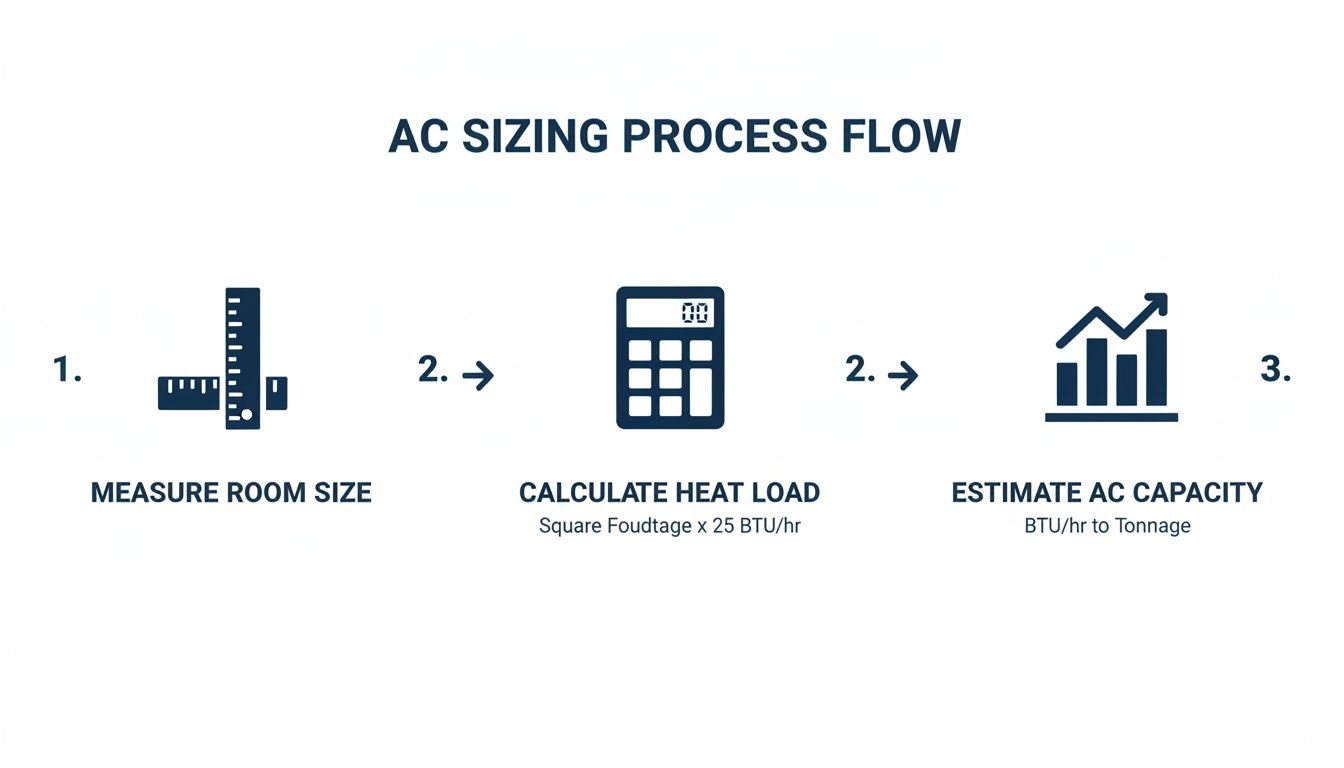
As you can see, moving from a basic measurement to an accurate estimate means layering on multiple adjustment factors.
Ceilings High and Mighty
Most sizing guides assume a standard ceiling height of 2.4 metres. But plenty of homes, especially newer builds on the Central Coast or character homes in Newcastle, have higher ceilings. We regularly see 2.7 metres, 3.0 metres, or even dramatic vaulted designs.
A room with high ceilings has a much larger volume of air that needs to be cooled. All that extra space up high acts like a heat trap, and an air conditioner sized only for the floor area will constantly struggle to keep up.
As a rule of thumb, for every 30cm of ceiling height above 2.4 metres, you should add about 10% to your cooling capacity.
The Impact of Windows and Sunlight
Windows are a massive source of heat gain, especially in sunny NSW. It’s not just about the size of the windows, but crucially, which direction they face. A large, west-facing window in a Penrith home can let in an incredible amount of intense afternoon sun, effectively turning your living room into a greenhouse.
Here's a real-world scenario: take two identical rooms. One has a large, unshaded west-facing window and the other has a smaller, shaded south-facing window. The room facing west could easily need 20-30% more cooling capacity to stay comfortable. Understanding the benefits of energy-efficient windows can also drastically change a room's cooling needs.
The Role of Insulation
Think of insulation as your home's Esky. Good quality insulation in the ceiling and walls helps keep the cool air in and the hot air out. A well-insulated modern home in the Hunter Valley will hold its temperature far more effectively than an older, uninsulated house just down the road.
If your home has little to no insulation, you'll need a more powerful air conditioner to compensate for the cool air that's constantly escaping. For a poorly insulated room, you might need to increase your baseline kW estimate by up to 20%.
A properly sized unit in a well-insulated home is the ultimate combination for efficiency. The system won't have to work as hard, which means lower running costs and a longer lifespan for your air conditioner.
People and Appliances Generate Heat
Every person in a room generates body heat, roughly the same as a 100-watt light bulb. On top of that, appliances like computers, big-screen TVs, and kitchen equipment all produce heat when they're running.
If you're sizing an air con for a home office in Sydney with multiple computers and monitors, or a media room that’s often full of people on game night, you need to account for this extra "internal heat load". Adding about 0.15 kW for each person regularly in the space is a wise move.
This is a key reason why single split systems are so popular. The Australian market reflects this preference, with sales hitting 1.14 million units in 2022 alone. It shows just how many households are choosing targeted cooling, making correct sizing for each individual room more important than ever.
Local Climate Considerations
Finally, our local climate plays a vital role. The humid, salt-laden air on the Central Coast needs a system that excels at dehumidification. In contrast, the dry, intense heat of the inland Hunter Valley demands raw cooling power. Urban areas like Sydney also experience a "heat island" effect, where buildings and roads retain heat, pushing cooling requirements higher than in surrounding leafy suburbs.
A professional assessment will always factor in these microclimates. Our experience working across postcodes from 2250 to 2290 gives us unique insight into these local nuances. We cover more on this topic in our guide to choosing air conditioning for Central Coast homes. Getting this right ensures your system is perfectly matched not just to your house, but to your specific location.
Common Sizing Mistakes That Cost You Money
Getting the right size air conditioner for your room isn't just about picking a number off a chart. We see homeowners across NSW make a few common, costly mistakes that lead to uncomfortable homes and high energy bills. Sidestepping these traps is the first step toward getting an efficient and effective cooling solution.

One of the biggest and most persistent myths is that "bigger is always better." It feels logical, right? But in the world of air conditioning, it’s completely wrong. An oversized unit is just as bad as one that's too small, and in many ways, it's actually worse for your overall comfort.
The Oversizing Trap
When an air conditioner is too powerful for the space, it blasts the room with cold air, hits the target temperature in a flash, and then shuts off. This constant on-off process is known as short cycling.
The problem? Because the system doesn't run long enough to pull moisture out of the air, you end up with a room that feels cold but damp and clammy.
This is a huge issue in humid areas like the Central Coast or along the shores of Lake Macquarie. That excess moisture left hanging in the air can contribute to mould growth, musty smells, and a generally unpleasant indoor environment. On top of that, the constant starting and stopping of the compressor uses a surge of electricity every single time, driving up your power bills while putting unnecessary strain on the system's most vital component.
Ignoring How You Use the Room
Another frequent mistake is failing to consider a room's primary function. A basic square metre calculation doesn't know the difference between a quiet guest bedroom that’s used twice a year and a busy home office running two computers all day. These two spaces have vastly different cooling needs, even if they're the exact same size.
Think about it. You're setting up a home office in Newcastle that will house two computers, a large monitor, and a printer. All that gear generates a significant amount of heat. A system sized purely on the floor area would be undersized and struggle to keep up.
Always think about the internal heat load from both people and appliances. A living room that regularly hosts family movie nights needs more cooling power than one that sits empty most of the time.
Relying Solely on Online Calculators
Online calculators can be a fantastic starting point, but they should never be the final word. Most of these tools are generic and simply can't account for the unique characteristics of your home, like the quality of your insulation, which way your windows face, or local climate nuances.
For instance, a simple calculator won't know that your living room in Terrigal has a huge, unshaded west-facing window that absolutely bakes in the afternoon sun. Relying on its generic output would almost certainly leave you with an undersized unit that runs non-stop.
These tools are useful for a rough idea, but as we’ve seen, the details matter immensely. You can get a more tailored estimate with a detailed aircon calculator for room size that prompts you for more specific information.
Key Takeaway: An oversized system wastes energy, fails to dehumidify properly, and wears out faster. An undersized system runs constantly, costs a fortune, and never truly cools your space. Precision is the key to both comfort and long-term savings.
Choosing the right size air conditioner for a room involves more than just a quick measurement. By avoiding these common errors, you put yourself in a much better position to invest in a system that will perform efficiently and keep you comfortable for many years to come.
When to Call in a Professional for an Accurate Assessment
While this guide gives you a fantastic head start, the only way to guarantee a perfectly sized air conditioner for your room is with a professional assessment. Think of our guide as a very reliable estimate; an expert on-site visit is the final, precise measurement that ensures years of comfort and efficiency.
A licensed technician doesn't just guess or rely on simple square metre rules. We perform a detailed analysis known as a 'heat load calculation'. This is the proper, scientific process that considers every single factor we've discussed, from the R-value of your insulation to the precise amount of heat gain from your west-facing windows.
The Importance of Proper Licensing
When you invite a technician into your home, you need to be certain they are qualified and insured. In Australia, anyone who handles refrigerants must hold a national refrigerant handling licence, commonly known as an ARCtick licence. This is non-negotiable and ensures the work is done safely and legally, protecting both you and the environment.
On top of that, any electrical wiring work must be completed by a licensed electrician, adhering strictly to Australian Standards like AS/NZS 3000. Using an unqualified person not only voids your manufacturer's warranty but also poses a serious safety risk. Always ask to see their licences; a true professional will be happy to show you.
A quote from a reputable company isn't just a price on a piece of paper. It's a comprehensive sizing assessment designed to ensure your new system runs efficiently for years, saving you money on bills and preventing future headaches.
Why Local Expertise Matters
Our local expertise across the Central Coast, Sydney, Newcastle, and the Hunter Valley gives us a distinct advantage. We don't just see a "room"; we see a specific challenge unique to its location.
- Central Coast Homes (Postcodes 2250-2264): We account for the high humidity and corrosive salt air, recommending systems that excel at dehumidification and have durable outdoor units.
- Sydney's Varied Suburbs (Postcodes 2000-2999): We understand the difference between cooling a modern apartment with body corporate restrictions and a heritage-listed terrace house in the inner west.
- Newcastle & Lake Macquarie (Postcodes 2280-2290): We factor in the impact of coastal sea breezes versus the more sheltered inland areas, tailoring the system to your specific microclimate.
This local knowledge is built over years of practical experience and allows us to recommend the perfect solution for your specific home, not just a generic one from a manual.
Energy efficiency is another critical area where professional advice pays off. With buildings accounting for 25 per cent of Australia's emissions, making a smart choice matters. Modern systems with inverter technology are designed to drastically reduce energy use, and new government regulations are constantly pushing for better environmental performance.
A properly sized system is the cornerstone of this efficiency. Getting it wrong leads to wasted energy and higher costs, defeating the purpose of investing in a new unit in the first place. For those looking for more guidance on specific system types, we have a helpful article on navigating split system installation near you.
Ultimately, investing in a professional assessment is an investment in long-term peace of mind. You get the confidence that your new air conditioner is the perfect size for your room, installed safely and correctly, and ready to provide years of reliable comfort.
Answering Your Air Conditioner Sizing Questions
Even after you've run the numbers, it's completely normal to have a few more questions before you invest in your home's comfort. Choosing the right size air conditioner can feel a bit technical, so we've pulled together some of the most common questions we hear from homeowners across the Central Coast and Sydney to give you clear, straightforward answers.
Can I Use One Large Split System To Cool Multiple Rooms?
It's a tempting idea, especially when you're trying to manage a budget. You think, "Can't I just install one big unit in the living room and hope the cool air makes its way down the hallway to the bedrooms?"
In our experience, this strategy almost never works. A single split system is designed to circulate and cool the air within one specific, defined space.
It will really struggle to push that cool air effectively into other rooms or down long corridors. What usually happens is the main room becomes an icebox while the bedrooms stay uncomfortably warm. This also forces the unit to run flat-out, all the time, which drives up your power bill without actually delivering the comfort you were hoping for.
For cooling separate areas properly, a dedicated multi-head split system or a ducted air conditioning system is a much more effective and efficient way to go.
How Much Does Ceiling Height Really Affect The Size I Need?
Ceiling height is a huge factor, and it's one that basic online calculators often get wrong. Most standard formulas are based on an old-school ceiling height of 2.4 metres. But take a look at modern homes in Lake Macquarie and Newcastle—many feature higher 2.7-metre ceilings, or even dramatic vaulted ceilings, to create a greater sense of space.
Those higher ceilings mean you have a much larger volume of air to cool. All that extra space up high acts like a heat trap, and an air conditioner sized only for the floor area will have to work overtime to keep up.
As a rule of thumb, you should plan to increase your estimated cooling capacity by about 10-20% to compensate for high ceilings. A professional heat load calculation will factor this in precisely, giving you a much more accurate result.
The brand itself doesn't change the kilowatt (kW) capacity your room needs. A 2.5kW unit from Daikin has the same raw cooling power as a 2.5kW unit from Mitsubishi Electric. Where premium brands differ is in their advanced inverter technology. This means that while the 'size' is the same, a higher-quality unit might maintain your comfort more efficiently and with lower running costs.
Our advice is always to choose the correct size first, then select the best quality brand that fits your budget. For a deeper look at specific systems, you can find more information in our guide about what size split system you might need.
What Happens If My Air Conditioner Is Too Small?
An undersized air conditioner is a recipe for frustration and shockingly high energy bills. On a blistering summer day in the Hunter Valley, it will run constantly without ever getting close to the temperature you've set on the remote.
This relentless operation puts a huge amount of strain on critical parts like the compressor and fan motors, which can seriously shorten the unit's lifespan and lead to expensive, premature breakdowns.
From an energy perspective, it's incredibly inefficient. You end up with massive electricity bills for very little actual cooling relief—a system that costs a fortune but still can't keep you comfortable when you need it most.
While getting the right AC is key, on milder days you might also find some helpful alternative strategies for cooling a room without AC.
Getting the sizing right is the single most important step to ensure your new air conditioner runs efficiently for years to come. If you're feeling unsure or just want the peace of mind that comes with an expert assessment, the team at ALC Air is here to help.
We offer a free, no-obligation quote that includes a professional sizing assessment for your home. Contact us today to schedule your consultation.