


Reverse cycle heating is a seriously clever way to warm your home. It uses the exact same technology that cools your place down in summer, just flipped on its head. The magic is not in creating heat from scratch; it is all about moving it. The system literally finds warmth in the outside air, even on a cold day, concentrates it, and brings it inside.
This makes it an incredibly efficient choice for keeping comfortable all year round, whether you are dealing with a chilly winter morning in the Hunter Valley or a humid summer afternoon on the Central Coast. Let us dive into how this technology provides both heating and cooling in one smart package.
How Reverse Cycle Heating Actually Works
The term "reverse cycle" might sound a bit technical, but we can explain the core idea in a simple way. Think about your fridge for a moment. Its job is to pull heat out from the inside to keep your food cool. A reverse cycle system in heating mode does the complete opposite for your home, pulling available heat from the outdoors and pumping it inside. The key component that makes this all happen is called a heat pump.
Even when the air outside feels crisp and cold to us, there is still plenty of usable heat energy floating around. The outdoor unit of your air conditioner contains a special refrigerant fluid that circulates through a series of coils. This refrigerant is an amazing substance, engineered to absorb heat even at very low temperatures. As the outdoor air is drawn over these coils, the refrigerant soaks up the heat, transforming from a chilly liquid into a gas.
This gas is then sent to a compressor, which, as the name suggests, compresses it. This simple action rapidly increases its temperature, making it very hot. Now, this super-heated gas is pumped through to the indoor unit inside your home. A fan blows your room's air over the hot coils, transferring all that lovely heat into your living space and providing consistent, comfortable warmth. As it releases its heat, the refrigerant cools back down into a liquid, ready to head back outside and start the whole process over again.
This diagram gives you a great visual of that basic flow, showing how cold outside air is transformed into warm air for your home.
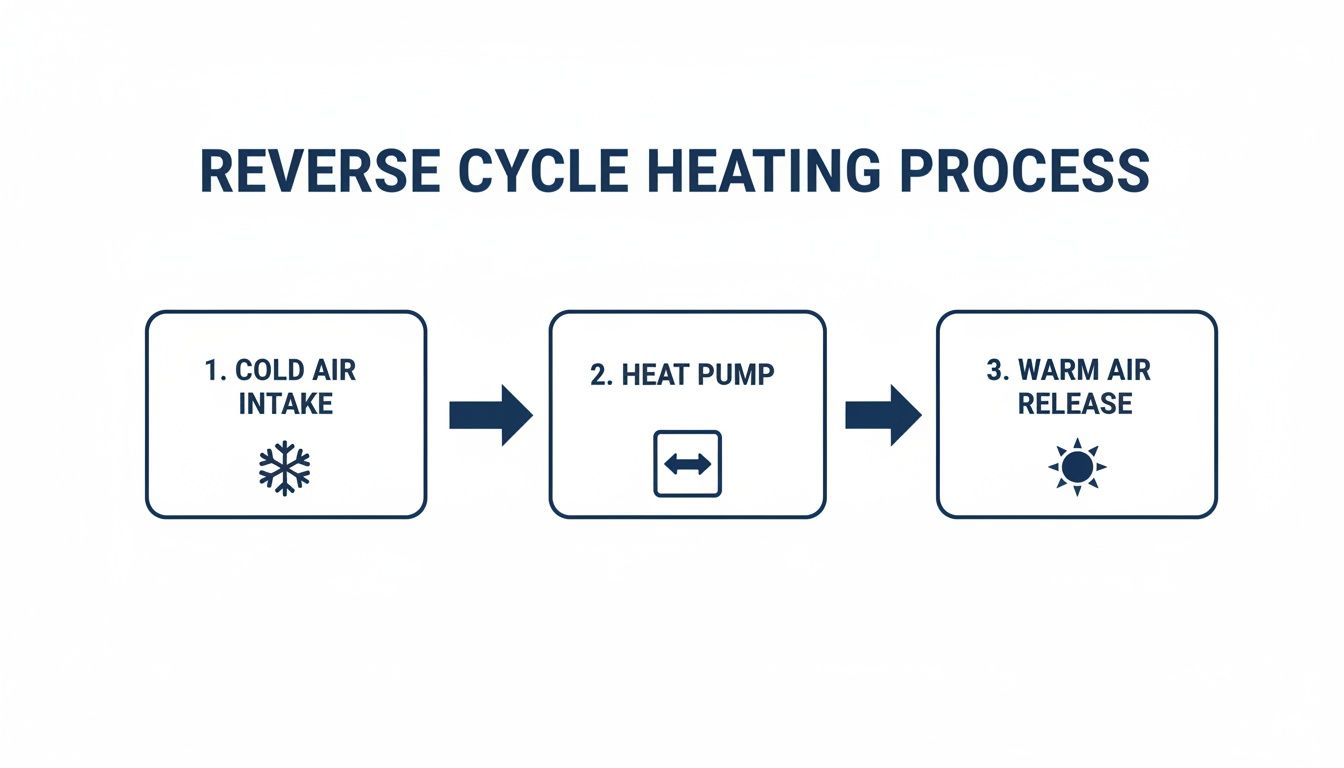
The main thing to remember is that the system is not burning fuel or using a power-hungry electric element to generate warmth. We are just intelligently moving existing heat from one place to another.
The Magic of Heat Exchange
At the very heart of this clever process is the heat exchanger. This is the component responsible for the actual transfer of thermal energy from the refrigerant to your air. It works a bit like the radiator in your car, but instead of getting rid of heat, it is designed to capture and move it as efficiently as possible. To get your head around the fundamentals, it is worth learning more about the role of a heat exchanger in these systems.
This efficient process is what makes reverse cycle heating so perfect for the climate we get here on the Central Coast and in Sydney’s suburbs. The system does not struggle on those chilly winter mornings because it is built to find and transfer heat effectively, even when the temperature outside really drops.
Cooling and Heating All in One
Of course, the real beauty of a reverse cycle system is its brilliant dual function. When summer rolls around, the whole process simply reverses. The indoor unit starts absorbing the unwanted heat from inside your home, and the system pumps it outside, leaving you with cool, comfortable air.
It is the exact same technology, just working in the opposite direction. You can get the full rundown in our guide explaining how an air conditioner works. This incredible versatility makes it the ideal all-in-one solution for year-round comfort.
The Real Reason Reverse Cycle Systems Are So Efficient
When you start looking at ways to heat your home, energy efficiency is usually the number one concern. This is where reverse cycle heating really pulls away from the pack. The secret to its incredible performance is not some complex engineering marvel; it comes down to a simple, brilliant principle: it is far easier to move existing heat than it is to create new heat from scratch.
Think about a traditional electric heater. It works by forcing electricity through a resisting element, converting that energy directly into heat. It is a brute-force approach, and its efficiency is capped at 100%. For every one unit of electrical energy you feed it, you get one unit of heat out.
A reverse cycle system, on the other hand, is much cleverer. It uses electricity to power a compressor and fan that act like a heat sponge, soaking up warmth from the outside air and moving it inside your home. It is a heat mover, not a heat creator, and that makes all the difference.
Understanding The Coefficient Of Performance
To put a number on this efficiency, the industry uses a rating called the Coefficient of Performance (COP). This figure tells you exactly how many units of heat you get for every single unit of electricity the system consumes.
While a standard electric heater has a COP of 1, a modern reverse cycle system can easily achieve a COP of 3, 4, or even higher. This means for every dollar you spend on electricity to run the system, you could be getting three to five dollars’ worth of heat into your home. It is an efficiency multiplier that makes a massive difference to your winter power bills.
For homeowners anywhere from the Central Coast to Sydney’s western suburbs, this efficiency translates directly into budget relief. Heating and cooling can make up around 40% of an average household's energy bill, so picking the right system is critical. A quality Daikin or Fujitsu reverse cycle system boasts a COP of 3-4, meaning it pumps out 3-4 times more heat energy than the electrical energy it uses, leaving traditional heaters in the dust.
The Perfect Partner For Rooftop Solar
This incredible efficiency creates another huge advantage, especially for the thousands of homes across Newcastle and the Hunter Valley with rooftop solar panels.
On a sunny winter day, your solar system can easily generate more than enough electricity to run your reverse cycle heating for free. You are literally warming your home with clean energy from the sun, something that is simply not possible with a gas heating system. This synergy between solar power and reverse cycle technology makes it an economically smart and environmentally sound choice for modern Australian homes.
Of course, while the system itself is highly efficient, you can get even better results by understanding how to reduce heating costs through smart usage. Pairing an efficient appliance with good habits ensures you get maximum comfort for the minimum cost. Ultimately, choosing reverse cycle heating is an investment in both your immediate comfort and your long-term financial wellbeing.
Reverse Cycle vs. Gas and Electric Heating: What's the Real Difference?
When it comes to warming your home, you have essentially got three main choices, and the decision can feel a bit overwhelming. Let us cut through the noise and look at a practical comparison between the key players: reverse cycle heating, traditional ducted gas, and old-school portable electric heaters.
We will focus on the three things that matter most to homeowners: running costs, safety, and your home's environmental footprint. Making the right call is about understanding the real-world differences, not just the technical jargon. For a family in a typical home in Sydney's western suburbs, the difference in annual heating bills between these systems can be huge.
Heating System Comparison for a Typical NSW Home
To see how these systems stack up at a glance, this table breaks down the key features. It is a side-by-side look at what you can expect in terms of running costs, safety, and environmental impact for an average home in our region.
| Feature | Reverse Cycle Heating | Ducted Gas Heating | Electric Resistance Heater |
|---|---|---|---|
| Running Costs | Lowest by a significant margin due to high energy efficiency. | Moderate to high, and becoming more expensive as gas prices rise. | Highest running costs. Very inefficient for whole-home heating. |
| Energy Efficiency | 300-500% efficient (moves heat, does not create it). | Around 80-95% efficient (loses some heat through the flue). | 100% efficient (1 unit of electricity creates 1 unit of heat). |
| Safety | No risk of carbon monoxide or combustion fumes. No hot surfaces. | Small but real risk of carbon monoxide leakage. Requires regular checks. | Fire hazard if placed near flammable materials or knocked over. |
| Air Quality | Can improve air quality by filtering dust and allergens. | Can produce dry air and potentially circulate fumes if not maintained. | No impact on air quality, but can circulate existing dust. |
| Environmental Impact | Runs on electricity, so can be powered by renewables (like solar). | Burns a fossil fuel, directly releasing greenhouse gases. | High electricity consumption contributes to emissions unless from renewables. |
| Year-Round Use | Yes. Provides both highly efficient heating and cooling in one unit. | No. Heating only. A separate system is needed for cooling. | No. Heating only. |
As you can see, while gas and electric heaters have their place, reverse cycle systems consistently come out ahead on the factors that matter most for long-term value and peace of mind.
Running Costs: The Clear Winner
The biggest difference you will feel is in your wallet. The incredible efficiency of reverse cycle heating directly translates into much lower power bills compared to any other method.
Conventional electric heaters, like those little column or fan heaters, are notoriously expensive to run. They work on a simple one-to-one principle: for every kilowatt of electricity you feed them, you get one kilowatt of heat back. This is shockingly inefficient and can cause your power bills to skyrocket during a cold snap in the Hunter Valley.
Ducted gas heating has been a popular choice for whole-home warmth for years, but rising gas prices and the huge efficiency leaps in modern reverse cycle systems have completely changed the game. While gas is effective, it is still just burning a fossil fuel to create heat, an increasingly expensive process.
Reverse cycle systems, on the other hand, do not create heat; they cleverly move it from the outside air to inside your home. This process is so effective that modern systems can achieve efficiencies of 300% to 500%. In simple terms, for every single unit of electricity you pay for, a reverse cycle system delivers three to five units of heat into your home.
Australian research shows that a standard reverse cycle system can provide cheaper central heating than even a top-rated 6-star gas ducted system. For households in Lake Macquarie or on the Central Coast, this efficiency leads to dramatically lower winter bills. To see how this works out in real numbers, check out our detailed guide on what an air conditioner costs to run.
Safety and Air Quality in Your Home
Your family's safety is non-negotiable, and different heating systems come with very different safety considerations. One of the biggest concerns with gas heating, particularly older or unflued units, is the risk of carbon monoxide (CO) leakage. CO is a colourless, odourless gas that can be extremely dangerous. While proper installation and regular maintenance by a licensed gasfitter are crucial to manage this risk, it is an inherent factor with any gas appliance.
Portable electric heaters carry their own risks, mainly as a fire hazard if they get knocked over or are placed too close to flammable things like curtains, bedding, or clothes. Reverse cycle heating completely sidesteps these specific dangers. Because there is no flame or combustion, there is absolutely zero chance of carbon monoxide being produced. Heat is delivered via warm air, meaning there are no dangerously hot surfaces that could pose a risk to curious kids or pets.
As a bonus, many modern reverse cycle systems come with advanced filters that help remove dust, pollen, and other allergens from the air as it circulates, which can be a real benefit for your family's health.
Environmental Impact and Future-Proofing
As NSW continues its shift towards cleaner energy, the environmental impact of our home appliances is more important than ever. This is another area where reverse cycle heating stands out as the clear, forward-thinking choice. Gas heating is simple: it relies on burning a fossil fuel, which directly releases greenhouse gases into the atmosphere. With the big push towards electrification and renewables, relying on gas is fast becoming a less sustainable option for the long term.
Reverse cycle heating, however, runs on electricity. This is a huge advantage because when that electricity is sourced from renewables, like your own rooftop solar panels, your heating becomes virtually emissions-free. For a homeowner in Newcastle with a solar setup, this means you can heat your home on a sunny winter's day with clean energy you have generated yourself. This amazing synergy makes reverse cycle heating an environmentally responsible choice that aligns perfectly with the future of sustainable living in Australia.
How to Choose the Right Reverse Cycle System
Choosing the perfect reverse cycle system is not about grabbing the most expensive model off the shelf. It is about matching the right technology to your home and your lifestyle. Get this decision right from the start, and you will enjoy years of efficient comfort. Get it wrong, and you could be stuck with high power bills and a system that just cannot keep up on those cold winter nights.
The first step is getting your head around the main types of systems available. Each one is designed for a different job, from heating a single room to keeping the entire house warm.
Understanding Your System Options
For most homeowners, the choice boils down to three main setups. A single split system is what most people picture: one sleek indoor unit on the wall connected to one outdoor unit. It is the perfect solution for heating a specific area like your main living room or the master bedroom.
Next up is a multi-head system. This clever setup allows you to connect several indoor units to a single, more powerful outdoor unit. It is a fantastic option for homes without the roof space for ductwork, letting you control the temperature in a few different rooms independently.
Finally, there is the fully ducted system, which delivers whole-home heating and cooling. The main indoor unit is usually hidden away in the roof space, connected to a network of ducts that deliver warm air to multiple rooms through subtle ceiling vents. It gives you that clean, seamless look and consistent temperature control everywhere.
Why Correct Sizing is Crucial
Once you have settled on the type of system, the single most important factor is its size, measured in kilowatts (kW). This is not about physical dimensions; it is all about the system's heating and cooling power. Getting the kW capacity right is a balancing act that only a professional technician is properly trained to perform.
An undersized system will be forced to run flat-out all the time, constantly struggling to reach the temperature you have set on the thermostat. This not only causes excessive wear and tear but also leads to shockingly high energy bills. On the other hand, an oversized system will switch on and off too frequently, failing to dehumidify the air properly and creating an uncomfortable, clammy feeling in the room.
A proper size calculation takes several key things into account. These include the room dimensions, insulation quality, and the size and orientation of your windows. We also consider local climate. For example, a system for a humid apartment on the Central Coast will be sized differently to one for a large house in the hotter western suburbs of Sydney, where cooling is just as important in summer.
Reading the Energy Rating Label
Every reverse cycle system sold in Australia has to display a Zoned Energy Rating Label. This label is brilliant because it provides specific performance data for three different climate zones across the country. For us here in the Sydney, Newcastle, and Central Coast regions, we fall into the "average" climate zone.
On the label, you will see two sets of stars, one red, one blue. The red stars show you the heating efficiency, while the blue stars show cooling efficiency. It is simple: more stars mean better efficiency and lower running costs over the life of the system.
A high star rating might mean a slightly higher purchase price, but the savings on your power bills often pay for the difference in just a few years. Learning how to find the best reverse cycle air conditioner involves looking past the price tag to these crucial long-term running costs. Ultimately, getting the sizing and selection right is a job for the experts. A licensed and ARCtick certified technician will perform a proper heat load calculation on your home, ensuring the system you choose is perfectly matched to your needs.
What To Expect During The Installation Process
Choosing the right reverse cycle heating system is only half the battle; a quality installation is just as crucial for getting the performance and efficiency you are paying for. Getting it right from the start means years of reliable comfort. We have refined our process to be as clear and straightforward as possible, so you know exactly what is happening at every step.
It all kicks off with an on-site consultation and quote. A technician will come to your property, whether it is a family home in Terrigal or a new build in Newcastle, to properly assess what you need. This is much more than just measuring a room. We are looking at your home’s insulation, where the windows are, which way the house faces, and how you actually live in the space. This detailed look allows us to give you a fixed, upfront quote with no nasty surprises down the track.
Strategic Placement for Performance And Quiet
Where we physically place the indoor and outdoor units has a massive impact on how well the system works and how quietly it runs. This is one of the most critical decisions we make on installation day.
Inside, we find the sweet spot for the unit to distribute air evenly across the room, avoiding those annoying drafts right where you sit on the couch. For the outdoor unit, we are looking for a stable, level surface with plenty of ventilation, placing it where any operational noise will not be a bother to you or your neighbours. It is all about making the system effective without being intrusive.
Electrical Work And Compliance
Installing a reverse cycle system involves serious electrical work, and it is not a job for a handyman. To comply with Australian Standards (AS/NZS 3000), all wiring must be performed by a fully licensed and insured electrician. Depending on the power your new unit needs, it will likely require its own dedicated circuit from your switchboard.
This is not just bureaucratic red tape; it is a critical safety measure. A dedicated circuit stops your new system from overloading existing wiring, a major fire risk, and ensures it gets the stable power it needs to run efficiently for its entire lifespan. Our team includes licensed electricians who handle all the necessary wiring as part of the job. Once we are finished, you will receive a Certificate of Compliance for Electrical Work, giving you documented proof that everything has been installed safely and to the highest industry standards. We also ensure every installation meets the stringent requirements set out by SafeWork NSW.
You can find more detail on the whole process in our complete guide to installing a split system air conditioner. A typical installation takes between four to eight hours. Our technicians work meticulously to keep disruption to a minimum and always leave your home as clean and tidy as they found it.
Maintaining Your System for Long-Term Performance
A reverse cycle system is a fantastic investment in your home's year-round comfort, and looking after it properly is the key to getting the best performance for years to come. Just like a car, your system needs a bit of regular attention to run efficiently, prevent costly breakdowns, and keep your power bills in check. The good news is that the most important maintenance task is one you can easily do yourself.
Regularly cleaning the filters in your indoor unit is crucial. When these filters get clogged with dust and debris, it forces the system to work much harder to pull air through, which uses more electricity and puts unnecessary strain on the components.
Simple DIY Filter Cleaning
Cleaning your filters only takes a few minutes every month or two. Simply open the front panel of the indoor unit, slide the filters out, and give them a gentle wash in lukewarm water. Let them dry completely in the shade before popping them back in. This simple habit not only helps with energy savings but also dramatically improves the air quality in your home.
The Importance of a Professional Annual Service
While filter cleaning is your job, a full system "tune-up" is a task for the professionals. We strongly recommend scheduling an annual service with a licensed and ARCtick certified technician. This goes far beyond a simple clean. During a professional service, a technician will perform a series of vital checks to ensure everything is operating safely and at peak efficiency.
This comprehensive inspection typically includes checking refrigerant levels, thoroughly cleaning the indoor and outdoor coils, and inspecting all electrical components for safety. We also test the thermostat and clear any blockages from the condensate drain to prevent water leaks. Think of it as a preventative health check for your air conditioner. An annual service helps catch small issues before they become major, expensive repairs, ensuring it is ready for whatever a Central Coast summer or a chilly Hunter Valley winter throws at it.
You can learn more about what is involved in our detailed guide on air conditioning maintenance.
Common Questions About Reverse Cycle Heating
Even with all the benefits laid out, it is completely normal to have a few questions before deciding if reverse cycle heating is the right fit for your home. We hear similar queries from homeowners all the time, so let us tackle some of the most common ones head-on with clear, straightforward answers.

Is Reverse Cycle Heating Expensive to Run in Winter?
No, it is actually one of the most cost-effective ways you can heat your home. Because these systems move heat rather than creating it from scratch, they are incredibly efficient. A modern unit will often deliver three to five times more heat energy than the electrical energy it consumes. This leads to significantly lower power bills compared to old-school electric heaters and even modern gas systems.
Can a Reverse Cycle System Work When It Is Very Cold Outside?
Absolutely. Modern reverse cycle systems are engineered to work brilliantly in very low temperatures, with some high-end models functioning perfectly in conditions down to -15°C. They are designed to find and extract ambient heat from even the coldest winter air. For the typical winter conditions across the Central Coast, Sydney, Newcastle, and the Hunter Valley, a quality reverse cycle system will provide consistent and reliable warmth all season long.
Do I Need Special Electrical Work for a Reverse Cycle System?
This really depends on the size of the system you are installing. Smaller split systems can often run on a standard power circuit that is already in place. However, larger units and nearly all ducted systems require a dedicated electrical circuit installed by a licensed electrician. This is a critical safety measure and a legal requirement under Australian Standards (AS/NZS 3000). Any professional installation quote will always include the cost of this necessary electrical work to ensure everything is handled safely and to code.
How Often Should I Service My Reverse Cycle System?
We strongly recommend a professional service at least once a year, ideally just before the peak heating or cooling season kicks off. Getting a licensed and ARCtick certified technician in ensures your system runs at peak efficiency, which keeps your energy bills down and extends the unit's lifespan. It also helps spot small issues before they turn into major, expensive repairs. Between professional services, it is a great idea to clean the filters on your indoor unit every month or two during heavy use. It is a simple job that makes a big difference.
Ready to explore the benefits of efficient, year-round comfort for your home? The team at ALC Air has over 15 years of experience providing tailored reverse cycle heating solutions across the Central Coast, Sydney, and Newcastle.