


When you start looking into a new air conditioner, the first question on your mind is always the same: what's this actually going to cost? The short answer is that a basic reverse cycle split system can start from around $1,400 fully installed, while a comprehensive whole-home ducted system can range anywhere from $8,000 to over $15,000.
Of course, the final price tag isn't just one number. It’s a mix of the system itself—the hardware you choose—and the skilled, professional labour needed to get it installed safely and correctly. We're here to walk you through all the factors so you can make a smart choice for your home.
A Quick Look At Air Conditioning Costs In 2024
Before we dive into the nitty-gritty details, it helps to have some ballpark figures in mind. These typical price ranges give you a realistic starting point for budgeting, whether you're in a Sydney apartment, a Central Coast family home, or a larger property in Newcastle.
Think of the total cost as two main components. First, there's the cost of the unit itself, which will change depending on the brand, size, and type you need. The second part is the installation labour, which covers the time and expertise of a licensed and ARCtick certified technician to ensure your system runs perfectly from day one.
Typical Upfront Costs
Getting a quality system installed involves a significant upfront investment, and the price will vary depending on the system type and the specifics of your home. To give you a clearer idea, here’s a breakdown of what you can generally expect to pay for common reverse cycle systems, including both the unit and professional installation.
| System Type | Best For | Estimated Cost Range (AUD) |
|---|---|---|
| Single Split System | Cooling/heating one room or a small open-plan area (e.g., a bedroom or living room). | $1,400 – $3,000 |
| Multi-Head Split System | Cooling/heating 2-4 individual rooms with one outdoor unit. Good for apartments or homes without roof space. | $4,000 – $9,000+ |
| Ducted System | Whole-home cooling/heating with discrete vents. Ideal for larger family homes with adequate roof space. | $8,000 – $15,000+ |
These figures give you a solid foundation for planning your budget. While the upfront price is a major factor, remember that it's not the whole story. The long-term running costs, which appear on your power bills for the next decade or more, are just as important. A more efficient system might cost a bit more today but save you a small fortune over its lifespan.
For a deeper dive into what you can expect for single-room units, you might find our specific guide on split system air conditioning costs helpful.
Installation and Rebates
Don't underestimate the cost of labour. For a complex job like installing a full ducted system, the labour component alone can run into thousands of dollars. This reflects the skill involved in properly assessing your home, sizing the system correctly, and ensuring it runs efficiently for years to come.
It's worth remembering that these costs aren't just for labour. They represent the professional expertise needed for a safe, compliant installation that performs perfectly in homes across the Central Coast, Sydney, Newcastle, and Lake Macquarie regions.
The good news is that homeowners in NSW can often soften the financial blow. Government rebates are frequently available when you install a new, energy-efficient system or replace an old, power-hungry one. These incentives can help make that initial investment a little easier on your wallet.
What Really Drives Your Installation Cost
When you get a quote for a new air conditioner, that final number isn't just pulled out of thin air. It’s a story about your specific home, its construction, and what you actually need to stay comfortable. Understanding the 'why' behind the price is the key to making a smart investment, not just a purchase.
Let's unpack what really shapes the cost of a reverse cycle air conditioning system.
The biggest single factor, without a doubt, is the type of system you choose. A ducted system designed to cool or heat your entire home is a completely different beast to a single split system for one room. It's a bigger upfront investment because it involves a central unit, extensive ductwork, more materials, and significantly more complex labour to integrate it properly.
System Capacity and Your Home
Think of an air conditioner's capacity, measured in kilowatts (kW), like a car's engine. You wouldn't use a little hatchback to tow a heavy caravan, but you also don't need a massive V8 just to pop down to the shops. The same logic applies here.
A small 2.5kW unit is the perfect hatchback for a standard bedroom in Gosford – efficient and ideal for that one job. On the other hand, a big 14kW ducted system needed for a large two-storey home in Killara is the powerful SUV, built to handle a much heavier load.
Why it matters: Getting the size wrong is a classic and costly mistake. An undersized unit will run flat out, constantly struggling to cool the space and sending your power bills through the roof. Go too big, and the unit will switch on and off too quickly. This short-cycling means it never gets a chance to properly dehumidify the air, leaving you with that damp, clammy feeling.
Installation Complexity
Not all installations are born equal. A huge part of any quote comes down to the complexity of the job, which directly affects the time, materials, and expertise needed from our licensed technicians.
- A simple 'back-to-back' installation is the most straightforward and cost-effective scenario. This is where the indoor unit is mounted on an external wall, and the outdoor unit sits directly behind it on the ground outside. It needs minimal piping and labour.
- Complex installations are where things get tricky. Imagine needing to run pipes through a double-brick wall in a Newcastle heritage home, or hiring a crane to lift an outdoor unit onto the roof of a second-storey Sydney apartment. These situations demand more time, specialised gear, and extra materials, all of which are reflected in the quote.
For instance, your job might require a new dedicated electrical circuit run from your switchboard. This has to be done by a licensed electrician to meet Australian Standard AS/NZS 3000, ensuring your home’s electrical system can safely handle the load without creating a fire risk.
Brand and Features
Finally, the brand you choose plays a big part in the total cost. Just like with cars or kitchen appliances, you have your premium brands known for top-tier performance and reliability, and you have more budget-friendly options that get the job done.
We often recommend leading brands like Daikin and Mitsubishi Electric. They might have a higher price tag upfront, but they're renowned for their exceptional energy efficiency, quiet operation, and long-term durability. We also work with other excellent, reliable brands that offer fantastic value. The choice really comes down to balancing your budget with your priorities. Whether that's a lower initial cost or maximising long-term savings and performance, our job is to help you find that perfect fit for your home.
As you can see, a lot goes into figuring out the final price. For a deeper dive specifically on single-room units, our guide explaining split AC unit installation costs offers even more detail.
Thinking Beyond The Upfront Price Tag
It’s incredibly easy to get fixated on the installation quote and forget about the bigger picture. But the true reverse cycle air conditioning cost isn't what you pay on day one; it's what shows up on your power bills for the next decade or more.
The temptation to grab the cheapest unit is completely understandable. When you're looking at quotes, saving a few hundred dollars feels like a win. The problem is, a less efficient system can easily cost you thousands more in electricity over its lifespan, especially with the brutal summer heat we see in Penrith or those frosty winter mornings in the Hunter Valley.
Upfront Investment vs Ongoing Running Costs
A smarter way to think about it is the total cost of ownership. This just means balancing the price on the quote with the day-to-day running expenses. A high-efficiency system might cost more upfront, but it’s an investment that often pays you back year after year through lower power bills.
Here’s a real-world scenario. Imagine you're choosing between two 7kW split systems for your living room in Terrigal.
- Unit A is $300 cheaper to buy but has a basic 3-star energy rating.
- Unit B costs more initially but boasts a 5-star rating, meaning it uses a lot less power to deliver the same amount of cool air.
Over ten years, Unit B will almost certainly save you far more than that initial $300 difference.
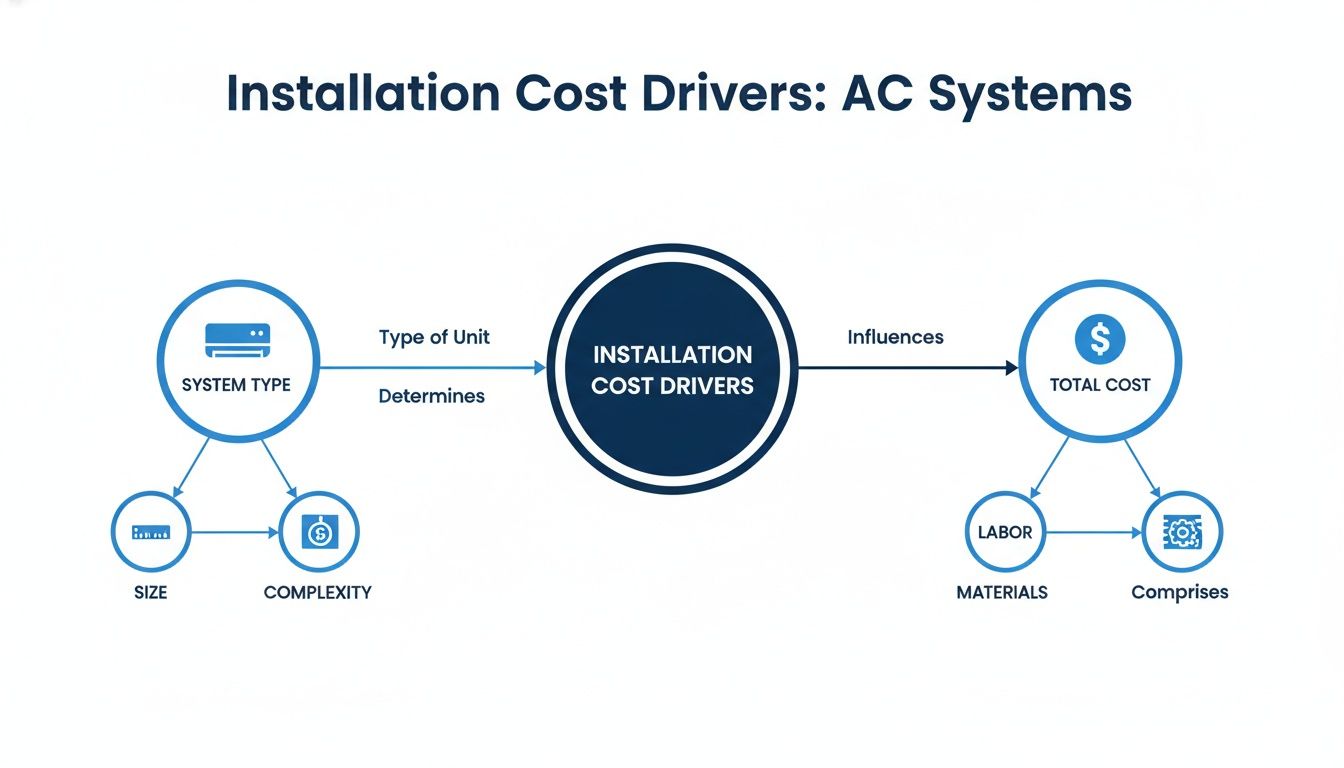
This is a good time to look at what actually drives that initial installation cost. As the diagram below shows, it's a combination of the system type you choose, its size (or capacity), and how complex the job is.
Decoding Energy Ratings and Running Costs
The Zoned Energy Rating Label (ZERL) you see on all air conditioners in Australia is your best tool for comparing models. It tells you exactly how efficient a unit is at both cooling and heating. More stars mean better efficiency and cheaper bills. It also gives you a handy annual energy consumption estimate to help you forecast expenses.
But what does that translate to in real dollars? In Australia, running a reverse cycle system typically costs between $0.30 to $0.40 per hour in cooling mode. For a medium-sized room in a Lake Macquarie home, that could mean an annual running cost of $250 to $500, all depending on how you use it and the unit's efficiency.
Of course, the actual cost will vary based on where you live and your habits. Running an air conditioner to survive a scorching summer in Penrith will naturally lead to higher bills than using it for milder coastal winters in Newcastle.
The takeaway is simple: Don't let the sticker price be your only guide. A higher-efficiency unit is an investment in lower future power bills and long-term comfort.
A correctly sized, high-efficiency system installed by a professional is the best way to keep your energy use in check. It ensures you get the comfort you need without the shock of an eye-watering electricity bill.
To see how your own usage habits affect your wallet, check out our detailed guide on how much running your AC really costs. Making a smart choice now means you'll be comfortable and financially better off for many years to come.
How Location and Home Design Influence Your Final Cost
You might be surprised to learn just how much your postcode can sway the final price of an air conditioning system. The difference between the humid, salt-laced air along the Central Coast and the sharp temperature swings of the Hunter Valley plays a massive part in what system you need and what it will cost you in the long run. Just as important is your home’s specific design, which creates a unique ‘heat load’ that a professional needs to properly calculate.
Let’s get into how your home and its location work together to determine the right air conditioning solution and, ultimately, what you’ll pay for it.
Your Local Climate Really Does Matter
The world outside your window has a direct say in your system’s performance. A unit that works beautifully in one spot might constantly struggle in another, leading to higher power bills and a home that never quite feels comfortable.
Think about trying to cool two very different homes.
- Coastal Homes (e.g., Terrigal, Merewether): Here, the outdoor units have to battle persistent humidity and salty sea air. We always prioritise systems with excellent corrosion resistance and top-notch dehumidification. Without these features, you’re looking at premature rust and that damp, clammy feeling inside, even when the air conditioner is running.
- Inland and Valley Homes (e.g., Hunter Valley, Western Sydney): These areas get the extremes. Think scorching summer days and properly frosty winter nights. A powerful, highly efficient reverse cycle system isn't just a nice-to-have; it's essential for handling both ends of the temperature spectrum without sending your power bills through the roof.
This is exactly why a one-size-fits-all approach is doomed to fail. To get a better handle on this, have a read of our guide on choosing air conditioning for Central Coast homes, where we break down how specific local conditions shape the best approach.
How Your Home’s Design Affects Sizing
Looking beyond your suburb, the actual construction of your house is a game-changer. You can have two homes with the exact same floor area but completely different heating and cooling needs. This is where a professional heat load calculation comes in, and it's a step we take very seriously.
This calculation isn't just a quick guess. It’s a detailed assessment that factors in everything from the size of your windows to the quality of your insulation, ensuring the system we recommend is a perfect match for your space. An incorrectly sized unit is one of the most common and costly mistakes you can make.
Imagine this scenario. A modern, well-insulated home in Lake Macquarie with double-glazed windows might only need a 10kW ducted system to keep the whole house comfortable. Now, take an older, uninsulated brick house of the exact same size in a suburb like Hornsby, with big, single-pane windows. That house could easily demand a 14kW unit to get the same level of comfort. The bigger unit not only costs more to buy but also uses more power every time you turn it on.
Some of the key factors we assess on-site include:
- Insulation: The quality of your ceiling and wall insulation is the single biggest factor in how well your home holds onto cool or warm air.
- Windows: We look at their size, which way they face (north-facing windows are great for winter sun, but west-facing ones get hammered by the summer heat), and whether they're single or double-glazed.
- Ceiling Height: Taller ceilings mean there’s a greater volume of air to condition, which often calls for a more powerful unit.
- House Orientation and Shading: A home that cops the full afternoon sun will need a lot more cooling power than one that’s shaded by trees or other buildings.
Regional climate variations across NSW significantly impact reverse cycle air conditioning running costs, as local conditions directly influence how often and how hard your system needs to work. In areas with cold winters and hot summers, reverse-cycle systems are invaluable for year-round comfort, but this dual usage naturally increases annual expenses compared to cooling-only units. To find out more about these regional cost factors, you can explore further insights on reverse cycle air conditioning expenses in Australia.
Practical Ways To Save Money On Air Conditioning
Knowing the price tag of a new air conditioner is just the start. The real win is knowing how to shrink it. Both on the initial purchase and on your power bills for years to come.
Here’s a tip most people overlook: when you buy makes a huge difference. Trying to get a system installed in the middle of a January heatwave is a recipe for higher prices and long waits. It's peak season, and demand is through the roof.
By simply planning ahead and buying in the off-season, like autumn or spring, you can often find better deals and get your pick of installation dates. It’s a simple timing trick that can save you money before you've even turned the system on.
Trimming Your Upfront Costs
Beyond timing your purchase, there are a few other smart moves you can make to lower that initial investment. A little bit of homework here pays off handsomely.
Keep an eye out for these opportunities:
- Government Rebates: The NSW government frequently offers rebates for installing new, energy-efficient air conditioners. These schemes can take a significant chunk out of your upfront cost, but you have to know they exist and how to apply.
- Manufacturer Promotions: Big brands like Daikin and Mitsubishi Electric often run seasonal cashback offers or special deals. We make it our business to stay on top of these, ensuring our clients don't miss out on saving a few hundred dollars.
This is where good advice really counts. We help our clients navigate the rebate applications and make sure they get every dollar back from manufacturer promos they're entitled to. It's all part of making sure you get the best possible value.
Developing Smart Energy-Saving Habits
Once your new system is up and running, the power to save is literally in your hands. Small, consistent changes in how you use your air con can lead to massive savings on your electricity bills over its lifetime.
Before you even touch the remote, one of the most effective things you can do is improve your home's general efficiency. Simple energy efficiency upgrades like sealing drafts around doors and windows or topping up your insulation mean your air conditioner doesn't have to fight so hard to keep you comfortable.
To help you get started, here's a quick checklist of actions you can take to lower both your purchase price and running costs.
Cost-Saving Checklist For Your Air Conditioner
| Action | Impact Area | Potential Savings |
|---|---|---|
| Buy in the off-season | Upfront Cost | 5-15% on unit & installation |
| Claim government rebates | Upfront Cost | $200 – $1,000+ depending on scheme |
| Look for manufacturer cashback | Upfront Cost | $100 – $400 on average |
| Choose a high-efficiency unit | Running Cost | $100 – $250+ per year |
| Set thermostat to 24°C in summer | Running Cost | Up to 10% for every degree higher |
| Clean filters monthly | Running Cost | 5-15% on energy use |
| Use zoning in ducted systems | Running Cost | 20-40% by not cooling unused rooms |
| Seal drafts & improve insulation | Running Cost | 10-20% by reducing heat load |
This isn't an exhaustive list, but it's a powerful start. Each small action compounds over time, leading to significant savings.
Here are the key habits to lock in for lower running costs:
- Set an Efficient Temperature: In summer, aim for 24°C. It's a comfortable temperature, and for every degree you go lower, you can increase your running costs by up to 10%.
- Clean Your Filters Regularly: A dirty, clogged filter makes your system gasp for air, forcing it to work harder and use more power. A quick clean every month or two keeps it breathing easy.
- Use Zoning Wisely: If you have a ducted system, this is your secret weapon. Closing the vents to rooms you aren't using is a no-brainer. There’s no sense paying to cool an empty guest room.
- Close Doors and Windows: This sounds obvious, but it’s the golden rule. Your air conditioner is designed to work in a sealed space. An open door is like trying to cool the entire neighbourhood.
By combining a savvy purchase with good habits, you can take full control of your air conditioning costs.
Why A Professional Quote Is Your Best Investment
Choosing your installer is every bit as critical as choosing the air conditioner itself. The promise of a cheap, quick job might sound tempting, but it’s how you end up with sky-high power bills, surprise breakdowns, and even genuine safety hazards down the track.
A quality quote isn't just a number scribbled on a piece of paper; it's a detailed plan for a system that will last for years and run efficiently. That’s why a proper professional assessment isn't just another step. It's your best investment in getting the job done right the first time.
What A Quality Quote Should Always Include
When we provide a quote, it’s a commitment we make based on actually understanding your home. It’s about delivering a solution that fits perfectly, not just dropping a box on your doorstep and hoping for the best.
A professional, transparent quote will always include:
- A Detailed On-Site Assessment: A technician needs to see your home. They’ll look at your insulation, window placement, room sizes, and which way your home faces the sun, just as we’ve discussed.
- Clear System Recommendations: The quote should explain why a particular system, brand, and capacity (kW) is being recommended for your specific needs, whether you're in a Sydney apartment or a large Hunter Valley home.
- Full Warranty Details: This is crucial. You need to see the warranty for both the air conditioning unit (from the manufacturer) and the installation itself (a workmanship warranty). This is what gives you complete peace of mind.
This comprehensive approach is the only way to ensure you get the best possible outcome for your reverse cycle air conditioning cost.
The Importance of Licensed and Insured Technicians
In NSW, air conditioning installation is strictly regulated for some very good reasons. Any work that involves refrigerant gas requires an ARCtick licence, while all electrical work has to be done by a licensed electrician who complies with Australian Standards (AS/NZS 3000).
Hiring an unlicensed installer is not only illegal but dangerous. It can void your home insurance, instantly void the manufacturer's warranty on your new unit, and create serious electrical and refrigerant safety risks for your family. A professional quote will always come from a fully licensed and insured business.
At ALC Air, we’ve built our reputation on this. Our team is made up of dual-trade technicians who hold both electrical and refrigeration licences. This ensures every single installation we do, whether it’s on the Central Coast, in Sydney, or across Newcastle, is 100% safe and compliant.
For over 15 years, we’ve stood by our commitment to quality. We offer transparent, fixed pricing with absolutely no hidden surprises.
Ready for a solution designed perfectly for your home? Contact ALC Air today for a free, no-obligation assessment and quote. Call us or fill out our online form, and let our experienced local team show you the difference a truly professional installation makes.
Frequently Asked Questions
We hear a lot of the same questions from homeowners across the Central Coast, Sydney, and Newcastle. Here are some honest answers to the big ones, from whether ducted is really worth the price tag to what the actual difference is between the top brands. This is the practical advice you need to feel confident about your choice.
Is A Ducted System Worth The Extra Cost?
A ducted system is a significant investment, often costing more than double what a multi-head split system does. It’s generally worth it if you own a larger family home and your priorities are whole-home comfort, discreet aesthetics (ceiling vents instead of wall units), and whisper-quiet operation.
However, if you're in an apartment, have limited roof space, or only need to heat and cool a few specific rooms, a multi-head split system offers much better value. It gives you targeted comfort exactly where you need it for a far lower upfront cost.
How Much Should A Basic Installation Cost?
For a basic, straightforward installation of a small single split system (around 2.5kW), the labour component alone typically starts from $600 to $800. This is what we call a 'back-to-back' setup, where the indoor and outdoor units are placed on opposite sides of the same wall with a minimal run of piping.
Anything more complex will add to this price. Running pipes through walls, mounting units on second-storey roofs, or needing new electrical circuits all add labour and materials. This is exactly why a fixed quote based on a proper on-site inspection is so essential.
What's The Real Difference Between Daikin And Mitsubishi Electric?
Honestly, both Daikin and Mitsubishi Electric are premium, tier-one brands. They’re known for their exceptional reliability, quiet operation, and fantastic energy efficiency. The differences you’ll find are often in the finer details of specific models, like advanced air filtration, clever sensor technology, or how their control apps function.
The choice is less about which brand is definitively 'better' and more about which specific model is the right fit for your home's unique needs and your budget. As your installer, we can advise on the ideal unit for your situation, whether you're in a humid coastal suburb like Avoca Beach or an area with temperature extremes like the Hunter Valley.
For a comprehensive understanding of heating, ventilation, and air conditioning, readers can explore more about HVAC systems.
At ALC Air, we believe a transparent quote is the foundation of a great installation. We provide free, no-obligation quotes with fixed pricing, so you know exactly what your reverse cycle air conditioning will cost. No hidden surprises, just clear and honest pricing.