


When your trusty Mitsubishi air conditioner gives up on a scorching hot day, it’s easy to assume the worst. But before you start thinking about a big mitsubishi air conditioning repair bill, take a breath. More often than not, the culprit is something surprisingly simple, something you can likely spot and fix yourself in just a few minutes.
A few quick, safe checks can often save you the time and expense of a call-out. Let's walk through them together so you know what to look for.
What to Check Before You Call for an Aircon Repair
Think of this as a pre-flight checklist. Running through these steps before picking up the phone can help you identify if it's a genuine fault or just a minor hiccup. You don't need any special tools, and these checks are completely safe for any homeowner to perform.
First, let's look at the most common and obvious culprit: power. It sounds almost too simple, but you’d be surprised how often it’s the issue. We'll guide you to make sure the unit is securely plugged in at the wall and the power switch is on.
Next, head over to your home’s switchboard. Scan the circuit breakers for any that have flipped to the 'off' position. A breaker can trip for many reasons, so it's fine to try resetting it once. If it trips again straight away, leave it off. That’s a clear signal of a deeper electrical problem that needs a professional.
Check Your Remote and Outdoor Unit
If the power is fine, the remote control is your next port of call. When were the batteries last changed? Fading batteries are a classic cause of an unresponsive air conditioner. It's a cheap and easy thing to rule out.
Also, double-check the mode. It’s a frequent mistake, especially at the change of seasons, to have the remote set to 'Fan' or 'Heat' when you're desperate for cooling. Make sure it's set to 'Cool', usually shown as a little snowflake icon.
Now, head outside for a quick look at the outdoor unit. Is it being suffocated? Overgrown shrubs, fallen leaves, or even the kids’ toys leaning against it can block vital airflow. When that happens, the unit can overheat and shut itself down as a safety measure. We see this all the time in leafy Central Coast suburbs like Terrigal and Wamberal.
Gently clear away any debris, making sure there's at least 30cm of clear space around all sides of the unit.
To help you follow a logical path, this flowchart visualises the troubleshooting steps.
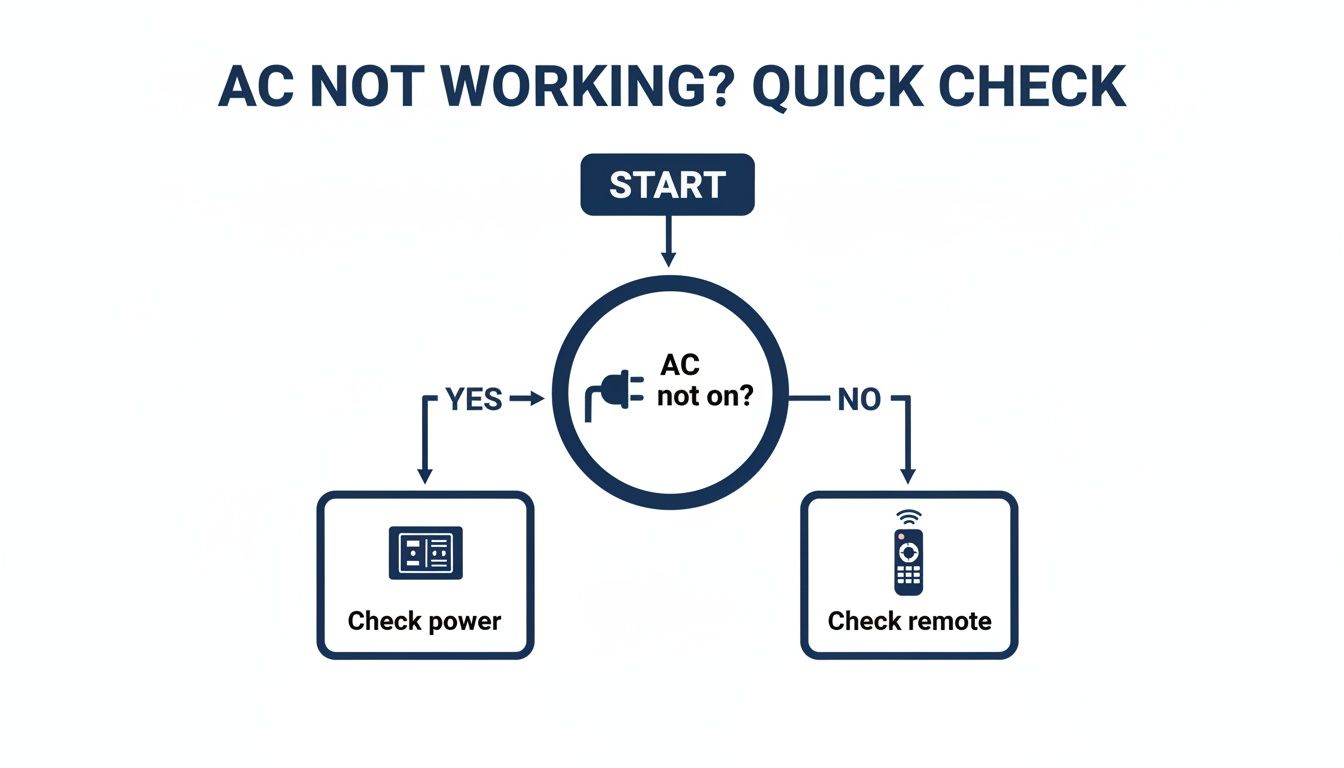
Starting with the simple power checks and moving through to the remote and outdoor unit helps you rule out the easy fixes before assuming there's a major fault.
For a quick reference, here’s a summary of what to check.
Quick Troubleshooting Checklist Before You Call
This table breaks down the most common symptoms and the simple, safe checks you can do yourself.
| Symptom | Potential Cause | What You Can Do (Safely) |
|---|---|---|
| Unit won't turn on | No power | Check if it's plugged in and switched on. Check your switchboard for a tripped breaker. |
| Unit is on, but not cooling | Incorrect remote settings | Confirm the remote is on 'Cool' mode and set to your desired temperature. |
| Remote isn't working | Dead batteries | Replace the batteries in the remote control. |
| Unit turns on, then off again | Blocked outdoor unit | Clear any leaves, plants, or objects from around the outdoor unit (allow 30cm of space). |
| Airflow seems weak | Dirty indoor filter | Check the filter in the indoor unit. If it's dusty, give it a clean according to the manual. |
Following these steps gives you a solid starting point for diagnosing the problem.
If you’ve gone through all these checks and your air conditioner still isn’t playing ball, then it’s definitely time to call in the experts. The information you’ve gathered is incredibly helpful, as it helps us narrow down the problem much faster when we arrive.
It’s also important to consider whether you have a genuine HVAC repair emergency on your hands. After all, a system failing on a 40-degree day in the Hunter Valley carries a lot more urgency than one on a mild afternoon.
Decoding Common Mitsubishi AC Problems and Their Causes
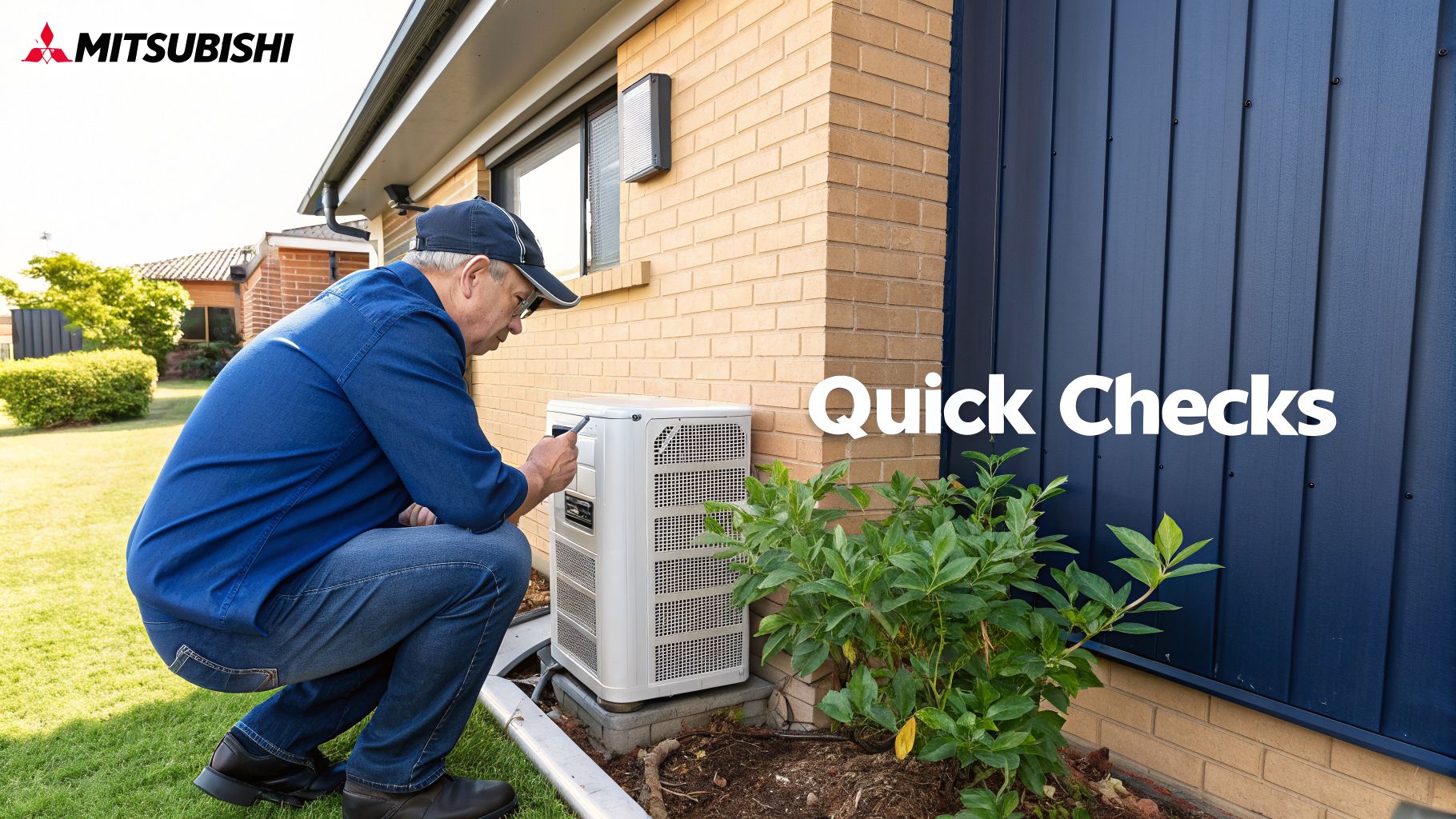
So, you've tried the simple fixes and your air con is still on the fritz. The good news is that the way a system is failing often points our technicians straight to the cause. Paying attention to the specific symptoms means you can give us a clearer picture of what's happening, which really speeds up the whole mitsubishi air conditioning repair process.
Let’s run through some of the most frequent issues we see with Mitsubishi systems across Newcastle, Lake Macquarie, and the wider Hunter region.
My Unit Blows Air, but It’s Not Cold
This is probably the number one call we get, especially during that first real heatwave of summer. If your split system or ducted unit is running and circulating air that feels lukewarm, it usually points to a handful of key culprits.
Sometimes, it’s as simple as a dirty indoor filter or a clogged outdoor coil, both of which choke airflow and stop the system from exchanging heat properly. But a more serious and common cause is a refrigerant leak. Your air conditioner uses refrigerant gas to absorb heat from inside your home and dump it outside. If that gas has leaked out, the system simply has no way to cool.
You can learn a bit more about how we track down and fix these kinds of faults in our general guide to air conditioning repairs.
My Air Conditioner Is Making Strange Noises
Your air conditioner should be a background hum, not something that makes you jump. Different noises can indicate very different problems, so it pays to listen closely to what your system is trying to tell you.
- Grinding or Squealing: This noise often means trouble with the fan motor's bearings in either the indoor or outdoor unit. It’s a mechanical cry for help that you really shouldn't ignore.
- Rattling or Banging: A rattle could be as minor as a loose panel on your indoor unit or some leaves stuck in the outdoor fan. On the other hand, it can also signal a much more serious issue, like a failing compressor.
- Hissing: A hissing or bubbling sound is the classic sign of a refrigerant leak. This is a job that 100% requires an ARCtick licensed technician to handle safely and in line with Australian regulations.
A sudden change in your air conditioner's operating sound is its way of telling you something is wrong. Continuing to run a noisy unit risks turning a small, fixable problem into a major component failure, which is far more expensive to rectify.
Why Is My Indoor Unit Leaking Water?
Seeing water dripping down the wall from your indoor split system is definitely alarming. In almost every case, this is caused by a blockage in the condensate drain line. As your system cools the air, it pulls out humidity, which collects as water and is supposed to drain away harmlessly outside.
Here in coastal areas like Lake Macquarie and Newcastle, the high humidity means your system produces a lot of condensation. If that drain line gets clogged with mould, algae, or dirt, the water has nowhere to go. It backs up and overflows right into your home. A professional clean of the drain line is what's needed to fix this properly and prevent it from happening again.
Why Putting Off Repairs Will Cost You More in the Long Run
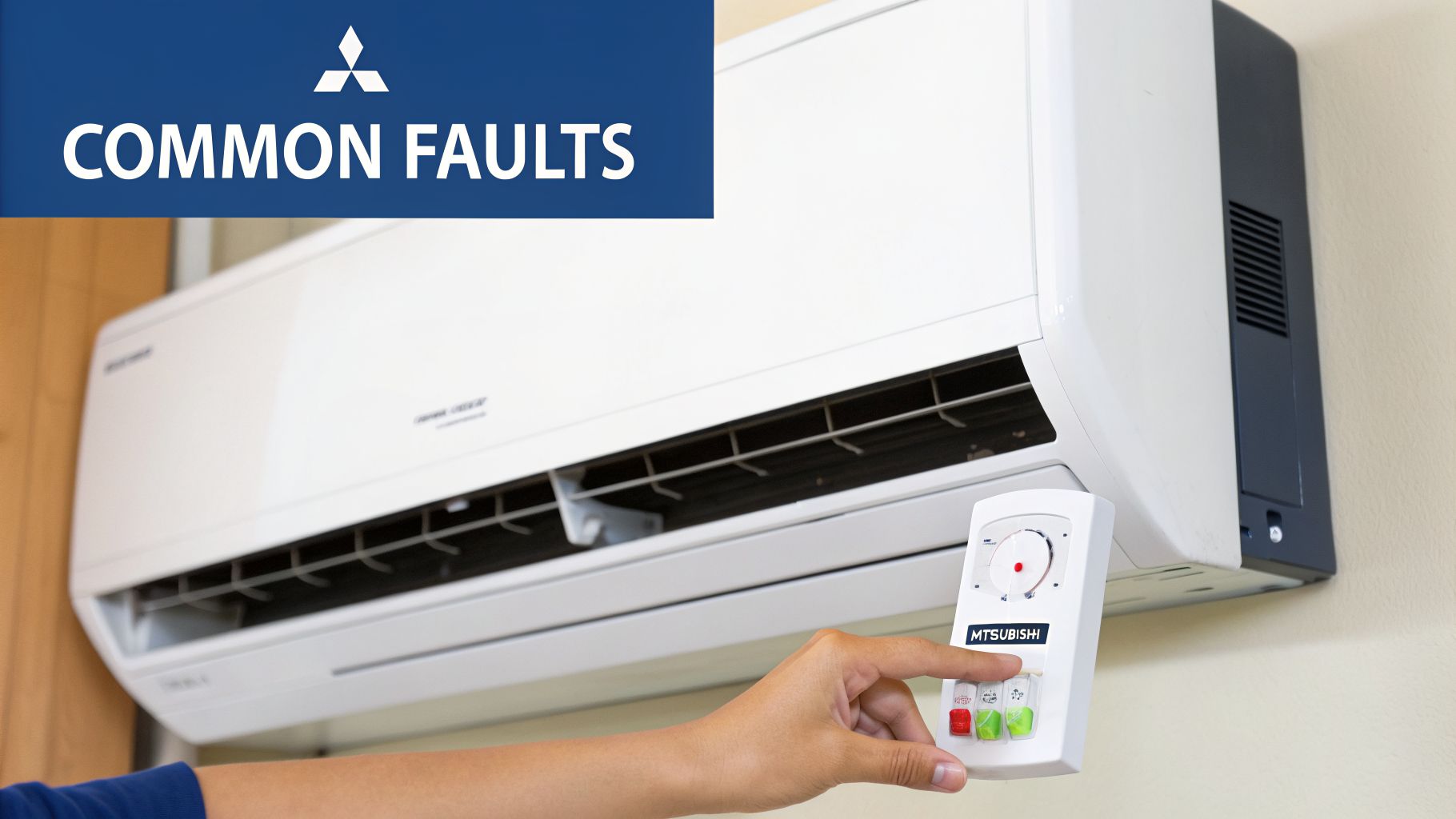
It’s tempting to ignore a small air conditioner problem, especially when it’s not a full-blown breakdown. But from what we see in the field every day, that's a decision that almost always leads to bigger, more expensive issues down the track. A prompt Mitsubishi air conditioning repair isn't just about getting cool again; it's a smart investment in your system's long-term health and your household budget.
Think about a common issue like a dirty outdoor coil. It might not seem urgent, but it forces your entire system to work harder just to keep you comfortable. That extra strain doesn't just shorten the lifespan of crucial parts, it directly inflates your electricity bills. For families in places like Western Sydney during a scorching heatwave, that extra running cost is a very real concern.
Protecting Your Investment from a Catastrophic Failure
We’ve seen it time and time again: a small, unchecked fault quickly spirals into a major disaster. A minor refrigerant leak, for example, might just feel like slightly weaker cooling at first. If you ignore it, the constant loss of refrigerant can cause the compressor, the heart of your air conditioner, to overheat and seize completely.
Replacing a compressor is one of the most expensive repairs you can face. In many cases, it can cost almost as much as a brand-new outdoor unit. A timely repair to fix the leak and regas the system costs a fraction of that price and prevents a catastrophic failure.
It’s a bit like having a slow puncture in your car tyre. You can keep topping it up with air for a while, but eventually, you'll ruin the tyre and potentially the wheel. Fixing the small problem early saves you from a much bigger headache later on.
The Hidden Cost of an Inefficient System
An inefficient air conditioner is a money pit. In Australian homes, heating and cooling can easily account for 20% to 50% of total energy consumption, making any drop in performance a direct hit to your wallet. Even a small fault can cause your electricity bills to creep up month after month.
But it's not just about the money. A struggling system fails to deliver the comfort you paid for. You end up with stuffy rooms, uneven temperatures, and an air conditioner that seems to run non-stop. These are all tell-tale signs that your system is working overtime, not smarter.
Keeping up with regular servicing is the best way to catch these issues before they start. Our guide to AC service and maintenance explains how proactive care prevents many of these problems from ever happening.
Ultimately, calling a licensed professional at the first sign of trouble preserves your system's performance, keeps it running efficiently, and helps you avoid the substantial cost of a premature replacement.
The Professional Mitsubishi Repair Process Explained
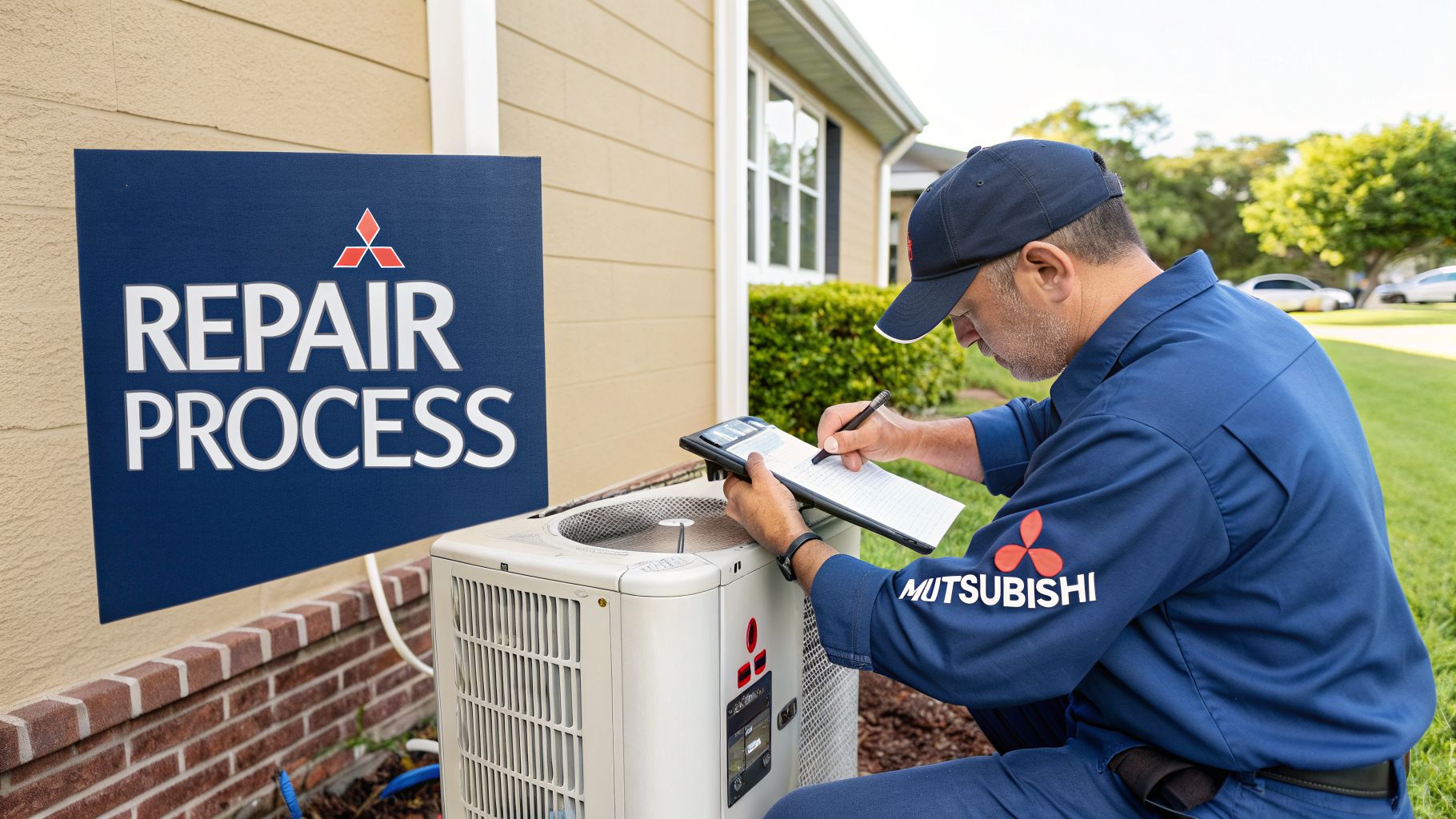
When your Mitsubishi air con gives up, you just want it fixed. But what actually happens when you book a professional repair? We've spent over 15 years refining our process on the Central Coast to make it as transparent and straightforward as possible, because you deserve to know exactly what's going on.
From your first phone call, we'll ask a few targeted questions to get a handle on the problem. When our technician arrives at your property, whether it's a house in Gosford or an apartment in Sydney, they'll introduce themselves and then, most importantly, they'll listen. Hearing your side of the story, what you’ve noticed, what sounds it’s been making, often gives us vital clues that point us in the right direction and speed things up considerably.
The Diagnostic and Quoting Stage
Once on-site, our technician’s first job is to pinpoint the exact fault. This isn't guesswork. It's a methodical process using specialised gear like multimeters to check electrical components and pressure gauges to measure refrigerant levels. They'll work their way through the whole system, from the indoor unit right through to the outdoor compressor, to find the root cause.
Let's say your Mitsubishi split system in your Gosford home (postcode 2250) is leaking water inside. A common problem. Our tech would first check the drain line for a blockage. If that's clear, the next step is to check the refrigerant charge, because a system that’s low on gas can cause the indoor coil to ice up. When that ice thaws, the drain tray overflows.
Crucially, before a single tool is picked up for the repair, we explain the problem to you in plain English. You'll get a fixed-price quote that clearly details the cost of labour and any parts needed. No hidden fees, no nasty surprises. You approve everything upfront.
This approach puts you in complete control. You can make an informed decision without feeling pressured, because you understand both the fault and exactly what it will cost to fix it.
Performing the Repair Safely and Correctly
Once you give us the go-ahead, we get straight to work. For us, safety and compliance are non-negotiable.
If the fix involves refrigerant, our technician will be fully ARCtick licensed. That’s a legal requirement in Australia for anyone handling refrigerant gases, and it ensures the job is done safely, protecting both you and the environment.
Likewise, any electrical work, from replacing a simple capacitor to rewiring a faulty board, must be performed by a licensed electrician. This is to comply with Australian Standards, specifically AS/NZS 3000, which governs all electrical wiring work. We guarantee every electrical repair is safe, compliant, and properly documented.
Our team prides itself on working cleanly and respectfully in your home. We lay down drop sheets to protect your floors and always clean up thoroughly afterwards. Our goal is to leave your home just as we found it, but with a perfectly working air conditioner.
For more details on our services, have a look at our guide on finding an air conditioning service near you.
What Will a Repair Cost? (And What About Your Warranty?)
Let's get straight to the biggest question on everyone’s mind when their air con gives up: what’s this going to cost? There’s no simple, one-size-fits-all number for a Mitsubishi air conditioning repair. The final bill really depends on a few key things that are helpful for you to know before you even get a quote.
The biggest factor, unsurprisingly, is what’s actually broken. A straightforward fix, like replacing a failed capacitor in the outdoor unit, is going to be far less expensive than a major component like the main printed circuit board (PCB) or a compressor motor. The age of your system and how easily we can get the parts also play a role in the total cost.
What’s Actually Included in the Quote
When you get a quote for a repair, you’re not just paying for a new part. The price reflects the technician's time and expertise to figure out what’s wrong in the first place, which often requires specialised diagnostic tools. It also covers the labour to do the repair safely and to strict Australian standards.
This also covers the cost of having licensed and insured professionals in your home. It ensures any electrical work is done by a qualified sparky and that any refrigerant handling is done by an ARCtick certified technician. This is all about protecting you, your home, and your expensive equipment.
Navigating Your Warranty Coverage
Figuring out your warranty can make a massive difference to your repair bill. Mitsubishi air conditioners are known for their longevity in Aussie conditions, with well-maintained split systems often lasting between 10 to 15 years. To back this up, they provide a solid 5-year manufacturer's warranty on both parts and labour, which gives you great peace of mind.
You can read more about why we think their reliability makes them a solid choice in our climate.
It's crucial to know there are two warranties in play here. The first is the manufacturer's warranty from Mitsubishi, which covers faults with the unit itself. The second is the installation warranty from your original installer, which covers problems related to workmanship, things like dodgy wiring or incorrect pipework.
If your system is inside that 5-year window and the fault is a manufacturing defect, the repair should be covered. Simple.
However, if the problem stems from poor installation or a lack of maintenance (like a clogged drain line flooding the indoor unit), it generally won’t fall under the manufacturer's warranty. This is exactly why choosing a reputable installer who offers a proper workmanship guarantee is so important from day one.
Your Mitsubishi Air Conditioning Repair Questions Answered
We get a lot of questions about Mitsubishi air conditioning repairs. It's totally understandable, when your AC plays up, you want clear, straight answers. We've put together some of the most common queries we hear from homeowners to give you some clarity.
How Often Should I Service My Mitsubishi to Prevent Repairs?
We can't stress this enough: you should get your Mitsubishi system serviced at least once a year. It's the single best thing you can do to sidestep expensive repairs.
If you're in a coastal area like Newcastle or anywhere on the Central Coast, that salty air can be brutal on outdoor units and accelerate corrosion. For these homes, we actually recommend a check-up twice a year. Regular servicing isn't just a quick filter clean; it involves checking refrigerant levels, testing all the electrical bits and pieces, and giving the whole system a thorough clean.
This preventative maintenance keeps your unit running at its best, which not only saves you money on your power bills but also helps it last longer.
Is It Worth Repairing an Older Mitsubishi Air Conditioner?
That’s a classic question, and the honest answer is: it depends. Mitsubishi units are built tough and we often see them running perfectly well beyond the 10 to 15-year mark.
If your system is under 10 years old and the problem is a relatively minor part, like a fan capacitor, it’s almost always more cost-effective to repair it.
But if your unit is pushing past 15 years and a major, expensive part like the compressor has failed, we’d have a serious chat about the benefits of an upgrade. A new system will be dramatically more energy-efficient. We always give you a fixed-price quote for the repair and an honest assessment, so you can make the right financial call for your situation. When you're looking for help, knowing the signs of a good tradesperson is key to finding reputable local Mitsubishi AC repair technicians.
The flashing lights on your Mitsubishi indoor unit are actually a good thing, it's the system telling you what’s wrong. The specific sequence and colour of the flashes point to a particular error code. It’s like a built-in diagnostic tool pointing to issues like communication errors or refrigerant problems, which are definitely jobs for a licensed technician.
If you see those lights, it's best to turn the unit off at the isolator switch and give a professional a call. If you can tell us the flashing pattern, it helps us diagnose the problem even faster. And if you’re curious about how Mitsubishi stacks up, you can check out our guide on some of the best air conditioning brands Australia has to offer.
If you're having issues with your Mitsubishi air conditioner, don't let a small annoyance turn into a major headache. Contact ALC Air today for a professional diagnosis and a no-obligation, fixed-price repair quote. https://alcairconditioning.com.au