


Putting in a new reverse cycle air conditioner is a lot more than just screwing a couple of units to the wall. It’s a job that involves careful planning, serious electrical work, and safely handling refrigerant gases. For that reason, it must be performed by a licensed and certified professional.
As a homeowner, your part of the journey starts with figuring out the right type and size of system for your home. From there, a professional site visit is the next step to make sure everything can be installed safely, efficiently, and legally. This guide will help you understand the whole process.
Your Guide to Reverse Cycle Air Conditioning Installation
Welcome to your roadmap for installing a reverse cycle air conditioner. Think of this less as a technical manual and more as a practical guide for homeowners across the Central Coast, Sydney, and Newcastle who want to make a smart, confident decision. We're here to explain the process in plain English.
We'll walk you through the entire process, from getting your head around system types and sizes right through to what actually happens on installation day. We know this is a big investment, and our goal is to give you the information you need to feel confident.
We’ll spend some time on the crucial first steps, like choosing the right size (kW capacity) so you don't end up with sky-high power bills or a system that just can't keep up. You wouldn't want a small unit struggling to cool a large, open-plan living area.
We’ll also dig into the real differences between split systems, multi-head units, and ducted solutions, using realistic scenarios. Let's say you have a family home in Terrigal with huge, west-facing windows. Your needs are completely different to someone living in a modern Newcastle apartment, and your choice of system should reflect that.
Why Professional Installation is Non-Negotiable
Here’s the bottom line: in Australia, it’s illegal for anyone without the proper licences to install a split system air conditioner. This isn't just bureaucratic red tape; it's a job that demands two specific qualifications to ensure safety and compliance.
- A licensed electrician to handle all the wiring according to SafeWork NSW regulations.
- An ARCtick certified technician to manage the refrigerant gases safely.
A professional installation guarantees that all the work meets strict Australian Standards, like AS/NZS 3000 for electrical wiring. It also protects your manufacturer's warranty, which is almost always voided by DIY or unlicensed work. The peace of mind that comes from knowing the job is done right is invaluable. You can read more about why this matters in our guide to reverse cycle heating and cooling.
The Growing Popularity of Reverse Cycle Systems
Homeowners all over NSW are choosing reverse cycle air conditioning for one simple reason: year-round versatility. It provides both cooling in summer and efficient heating in winter from a single unit. In 2021 alone, Australia saw the sale of 1.09 million non-ducted split systems, showing just how popular this solution has become.
This trend has been helped along by programs like the NSW Energy Savings Scheme (ESS), which has supported around 18,000 new high-efficiency air conditioner installations. It simply makes financial sense to upgrade your home's climate control with a trusted local specialist who understands the requirements.
This guide is designed to give you the knowledge you need to navigate the installation process with confidence. From understanding your first quote to knowing what to expect on the day, we'll cover everything you need to get perfect climate control, whether you're in the leafy suburbs of the Hunter Valley or a bustling part of Sydney.
Planning Your Install: From Site Survey to System Choice
Before a single tool comes out of the van, the success of your air conditioning installation is already decided. Proper planning is the difference between years of efficient, reliable comfort and a system that struggles on hot days and costs a fortune to run. This first phase is all about getting the foundations right: a professional site survey, choosing the correct system size, and strategically positioning the units.

Nailing these steps ensures your new reverse cycle air conditioner is perfectly matched to your home and lifestyle, whether you're in a coastal home on the Central Coast or a family house in Sydney's hot western suburbs.
The Professional Site Survey: What We're Actually Looking For
A thorough site survey is much more than a quick look and a measure-up. When we visit your home, we’re assessing a whole range of factors that directly impact system performance and installation safety. This is our chance to understand the unique personality of your property.
Our technician will look at everything from your room dimensions and ceiling heights to window sizes and their orientation. For example, a north-facing living room in Wamberal that gets hammered by the afternoon sun has very different cooling needs to a shaded, south-facing bedroom. We also inspect your home's insulation, as this plays a huge role in how well your home retains precious cool or warm air.
Why This Matters: A detailed site survey is the foundation for an accurate quote and an efficient system. It prevents nasty surprises on installation day and ensures the unit we recommend will actually do the job you need it to do, without working overtime.
We also conduct a crucial check of your electrical switchboard. An older home in Newcastle might not have the capacity for a new, powerful air conditioner, meaning an upgrade by a licensed electrician is needed to comply with AS/NZS 3000 electrical standards. This is a non-negotiable safety step we check upfront.
Getting the System Size Right
Choosing the correct capacity, measured in kilowatts (kW), is arguably the most critical decision you'll make. It’s a common mistake to think "bigger is better," but both undersized and oversized units create real problems.
An undersized unit will run constantly on a scorching summer day in the Hunter Valley, desperately trying to reach the set temperature. This constant operation leads to excessive wear and tear and, you guessed it, shockingly high energy bills.
Conversely, an oversized unit is just as bad. It will cool the room too quickly and then switch off, a process known as short cycling. This constant starting and stopping is horribly inefficient and prevents the system from properly dehumidifying the air, leaving the room feeling cold but clammy—a common complaint in the Central Coast's humid coastal climate.
You can learn more about how to correctly size an air conditioner for your room in our detailed guide.
Strategic Placement of Indoor and Outdoor Units
Where the units go is just as important as how big they are. The goal is simple: maximise performance, minimise noise, and ensure easy access for future maintenance.
Indoor Unit Placement
The indoor head unit should be mounted high on a wall where it can distribute air evenly across the room. We avoid placing it directly above your favourite spot on the sofa where it might create uncomfortable draughts. It also shouldn't be near heat sources like kitchens or in direct sunlight, which can confuse its thermostat and make it run when it doesn't need to.
Outdoor Unit (Condenser) Placement
For the outdoor unit, we need a location that offers a few key things:
- Good Ventilation: It needs plenty of clear space around it to expel heat effectively. Shoving it in a tight corner is a recipe for poor performance.
- A Stable Base: It must sit on a firm, level surface like a concrete slab or sturdy wall brackets. Vibration is the enemy.
- Noise Consideration: We always try to position it away from bedroom windows (yours and your neighbours') to minimise any noise disruption.
Consider this scenario: installing a unit for a small apartment in a Sydney complex often means the balcony is the only option, but we must stick to strict body corporate rules on noise and aesthetics. For a larger home in a suburb like Gosford, we have more options, but still need to consider council regulations and proximity to property lines. Every installation requires a unique, compliant solution.
Navigating Installation Costs and Long-Term Value
Let's talk money. When you start looking at a new reverse cycle air conditioner, the upfront cost is usually the first thing that jumps out. It’s easy to get fixated on that number, but it’s much smarter to see it as an investment in your home's comfort and even its resale value, not just an expense.
The final price tag can swing quite a bit, and knowing what pushes it up or down will help you make a much better decision. The biggest factors are the brand you choose and the capacity (the kW size) of the unit itself. But beyond that, the complexity of the installation is a huge part of the equation.
A simple back-to-back installation, where the indoor unit is mounted on one side of a wall and the outdoor unit is directly behind it on the other side, is the cheapest and most straightforward job. Of course, not every home is that simple. We often see situations that need a more customised approach. A job might involve running longer pipes to tuck the outdoor unit away neatly, or it could require special mounting brackets for a second-storey installation on a Sydney terrace.
If your home has an older switchboard, it might need an electrical upgrade to safely handle the new circuit. That's an extra cost, but it's a non-negotiable safety requirement under AS/NZS 3000. For a really detailed breakdown of all the variables, check out our guide on what it costs to install a split system air conditioner.
Shifting Focus from Upfront Cost to Long-Term Savings
While that initial price is important, the real financial story of your air conditioner plays out over its entire lifespan. This is where choosing a quality, high-efficiency model installed by licensed professionals really pays you back, month after month, on your power bills.
The Big Picture: A quality installation isn't just about getting the unit running. It’s about making sure every part of the system is optimised for peak energy efficiency, which directly leads to lower running costs and a longer life for your air conditioner.
Modern reverse cycle air conditioners are incredibly efficient. In fact, real-world data shows their annual running costs can be surprisingly low, often falling between just $30 to $396 for cooling and $18 to $528 for heating. The exact amount depends on the system's size and how you use it. When you switch from older, less efficient heaters, the savings can be massive.
You can find more detailed insights on these running costs over at Gridless.com.au.
Understanding Inverter Technology
A big part of that efficiency comes down to inverter technology. The easiest way to think about it is like a car's accelerator. Old, non-inverter systems were either off or running at full throttle. An inverter system, on the other hand, has a variable-speed compressor that gently ramps its power up or down to maintain the perfect temperature.
This means it doesn't have to work as hard, which uses significantly less energy. It also gives you much more consistent comfort without the jarring on-off cycles of older models. For anyone living in a climate like the Hunter Valley, where you need reliable performance through scorching summers and chilly winters, this technology is an absolute must-have.
It's also worth keeping an eye on government programs like the NSW Energy Savings Scheme (ESS). These can sometimes offer rebates or other incentives for installing high-efficiency models, which helps take the sting out of that initial investment. By looking at the complete financial picture—from the install price to running costs and potential rebates—you can pick a system that keeps you comfortable without breaking the bank.
What Happens on Installation Day
After all the planning and quoting, the day your new reverse cycle air conditioner gets installed is genuinely the exciting part. So you know exactly what to expect, we’ll walk you through how a professional installation unfolds from the moment we arrive.
Our technicians' focus is on a safe, clean, and compliant process from start to finish. This isn’t just about getting the unit running; it’s about making sure every part of the job meets strict Australian Standards, protecting your home and your new investment.
The journey from initial investment through to long-term benefits hinges on a quality installation.
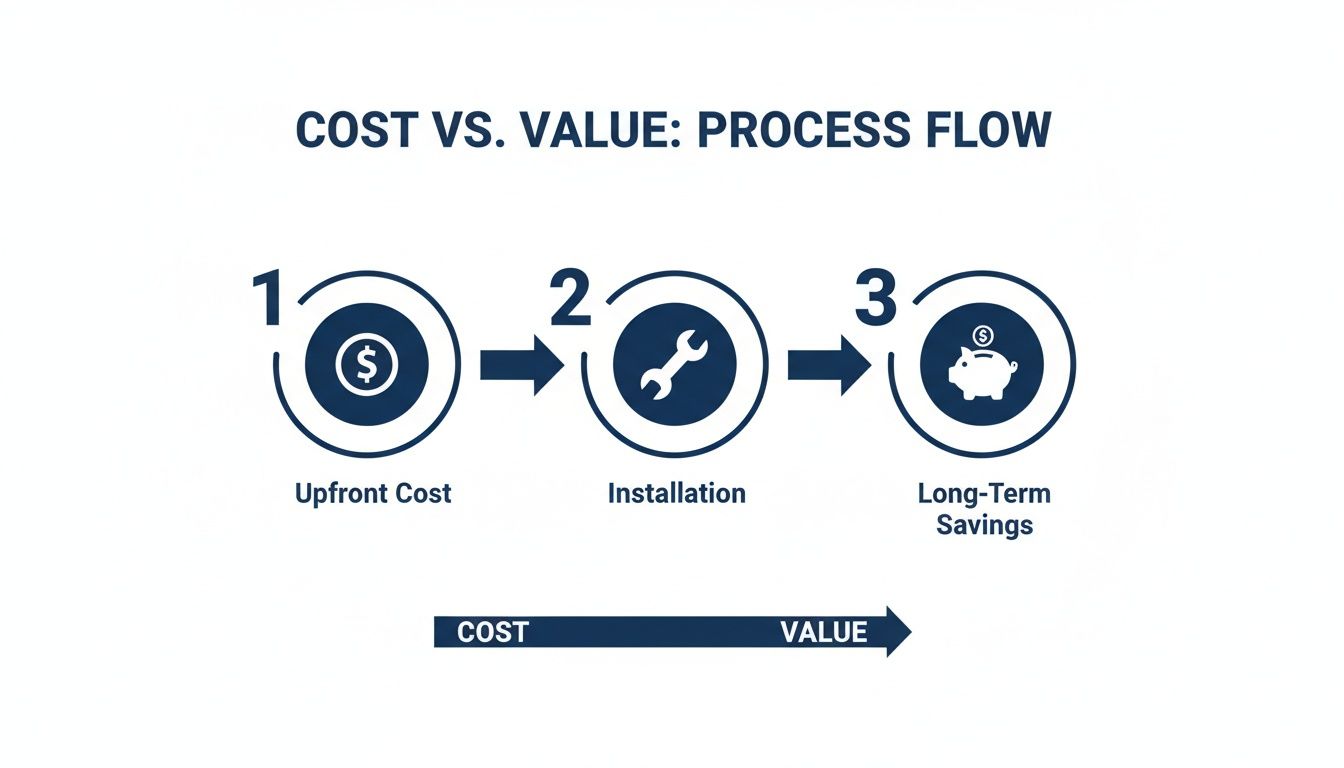
As you can see, while there's an upfront cost, the professional installation is the key step that unlocks those significant long-term savings on your energy bills.
Setting Up the Work Area
The first thing our team will do is greet you and quickly run through the plan, confirming the placement of both the indoor and outdoor units as we discussed during the site survey. We then lay down drop sheets and take every precaution to protect your floors, walls, and furniture.
Safety is non-negotiable. Before any work begins, we'll head to your switchboard and isolate the power to the relevant circuits. This creates a safe environment for everyone in the home throughout the day.
Mounting the Indoor Head Unit
Next up is getting the indoor unit on the wall. We securely fix its mounting plate, making sure it's perfectly level. This might seem like a small detail, but it’s critical for ensuring the unit’s condensate drain works correctly and doesn’t cause water leaks down the track.
With the plate in place, we drill a core hole through the wall. This lets the refrigerant pipes, electrical wiring, and drain hose pass through to the outside. We do this carefully to minimise any mess and seal it properly later to prevent draughts or pests from getting in.
Placing the Outdoor Condenser
While one technician works inside, another will be getting the location for the outdoor unit ready. This usually involves setting down a sturdy base, like a pre-cast concrete slab or PVC mounting blocks, to ensure the condenser is level, stable, and has enough airflow.
If your unit is being wall-mounted, we install heavy-duty brackets designed to support its weight and absorb vibration. Getting this placement right is vital for the system’s performance and for keeping any operational noise to a minimum.
Connecting the System
This is where the specialised skills of our licensed technicians really come into play. We carefully run the copper refrigerant pipes between the indoor and outdoor units, bending them precisely to follow the lines of your house for a neat finish.
After connecting the pipes, we perform a crucial step: pressure testing the lines with dry nitrogen to check for any leaks. Then, we use a high-powered vacuum pump to remove every trace of air and moisture from the pipework. This process, known as evacuation, is essential for the system to run efficiently and is a hallmark of a quality installation.
Only when we're satisfied the system is perfectly sealed and dry do we release the refrigerant gas into the lines. All of this work is done by an ARCtick certified technician, as required by Australian law to handle these gases safely and responsibly.
The Critical Electrical Connection
The final major step is the electrical work, which must be performed by a licensed electrician. Your new air conditioner needs its own dedicated circuit running directly from the switchboard to handle its power load safely.
This is a non-negotiable requirement under Australian Standard AS/NZS 3000. It prevents overloading your home's existing wiring and dramatically reduces the risk of electrical faults or fires. We also install an isolation switch near the outdoor unit for safe future servicing.
The number of Aussies opting for professional installs is growing. In 2022, 1.14 million single split systems were sold, and thankfully, the number of Refrigeration and Air Conditioning Licences grew by 26% between 2016 and 2023. This ensures homeowners in Sydney, Newcastle, and on the Central Coast have access to qualified experts.
Before we move on, let's be crystal clear about why you should never attempt this yourself.
DIY vs Professional Installation: A Safety and Compliance Comparison
Some jobs around the house are great for a weekend project. Air conditioner installation is definitely not one of them. It involves licensed electrical work and restricted refrigerant handling, both of which carry serious risks if done incorrectly.
Here’s a clear breakdown of the difference:
| Task | DIY Attempt (Not Recommended) | Professional Licensed Installer |
|---|---|---|
| Electrical Work | Illegal and extremely dangerous. High risk of fire, electrocution, and voiding home insurance. Fines can be up to $22,000. | Performed by a licensed electrician to AS/NZS 3000 standards. Ensures a safe, dedicated circuit, preventing overload and faults. |
| Refrigerant Handling | Illegal without an ARCtick licence. Risk of releasing harmful greenhouse gases, causing environmental damage, and personal injury. Fines can exceed $100,000. | Handled by a certified technician. Ensures proper pressure testing, evacuation, and charging for peak efficiency and environmental compliance. |
| System Performance | Incorrect pipe flaring, leaks, or moisture in the system will lead to poor performance, high running costs, and premature failure. | Guarantees an airtight, moisture-free system. The unit will perform to the manufacturer's specifications, saving you money on power bills. |
| Warranty | Manufacturer's warranty is voided if not installed by a licensed professional. You have no recourse if the unit fails. | Full manufacturer's warranty on the unit (typically 5 years) and a warranty on the installation workmanship. |
| Tools & Equipment | Requires specialised, expensive tools like vacuum pumps, manifold gauges, and pipe flaring kits that most homeowners don't own. | Uses professional-grade, calibrated tools to ensure every connection is perfect and the system is commissioned correctly. |
In short, the risks of a DIY installation are enormous and the potential savings are tiny compared to the costs of fixing a mistake. Always use a licensed professional.
Commissioning and Handover
With everything connected, it's time for the final checks. We switch the power back on and start the system up, a process known as commissioning. We methodically test all functions—cooling, heating, fan speeds, and louvre direction—to ensure everything is working exactly as it should.
We’ll then give you a full rundown on how to use your new remote control, explain the best settings for efficiency, and show you how to clean the filters to keep it running smoothly. We'll answer any questions you have, clean up our work area completely, and leave you to enjoy your new climate-controlled home.
For a more detailed look at our process, check out our guide on Central Coast air conditioning installation.
What Happens After Installation? Warranty, Maintenance and Efficiency
The tools are packed away and your home is finally comfortable, but our job isn't finished just because the installation is. Getting your new reverse cycle air conditioner up and running is just the first step. Now, it’s all about making sure you get years of reliable, efficient performance from your investment.
To do that, you need to understand your warranties, know how to run the system smartly, and stick to a regular maintenance schedule. These are the keys to long-term comfort and keeping those power bills in check.
Understanding Your Warranties
When you get a professional installation, you’re actually covered by two separate warranties. It's really important to know the difference.
First up is the manufacturer's warranty. This covers the physical unit itself—both the indoor and outdoor components—against any defects from the factory. For the reputable brands we install like Daikin, Mitsubishi Electric, or Fujitsu, this is typically a solid 5-year warranty.
Second, and just as crucial, is the installer's warranty. This is our promise to you, covering the quality of the installation itself. It protects you against any issues that might pop up from the actual labour, like a faulty wiring connection, incorrect pipework, or improper mounting. We stand by our workmanship, and this warranty gives you complete peace of mind.
Key Takeaway: Don't forget, a DIY or unlicensed installation will instantly void your manufacturer's warranty. Using a licensed and insured company like ALC Air is the only way to ensure both your new system and the installation work are fully covered.
Tips for Efficient Operation
Your new reverse cycle system is incredibly efficient, but how you use it day-to-day makes a massive difference to your power bills. A few simple habits can maximise your comfort and minimise running costs, especially during those scorching Sydney summers or chilly Hunter Valley winters.
A great starting point is finding the sweet spot for your thermostat. We recommend aiming for 24-25°C in summer and 18-20°C in winter. Every degree you push it further can increase your energy consumption by up to 10%. It’s about being comfortable, not creating an arctic research station in your living room.
Also, get to know the different modes on your remote. On those sticky, humid days we get on the Central Coast, using ‘Dry’ mode can make a room feel much more comfortable without aggressive cooling. It focuses on pulling moisture from the air, which often uses less energy than the standard ‘Cool’ mode.
Finally, make friends with your timer functions. Setting your air con to switch on 30 minutes before you get home from work is far more efficient than blasting it on full power the moment you walk through the door.
The Real Value of Regular Maintenance
You wouldn't drive your car for years without a service, and your air conditioner is no different. It’s a complex machine that works hard, often in tough conditions like the salty air around Lake Macquarie or the dusty summer winds in regional NSW.
Regular professional maintenance is the single best thing you can do to protect your investment. This isn't just about cleaning a few filters; it's a comprehensive health check for your entire system.
What’s Involved in a Professional Service?
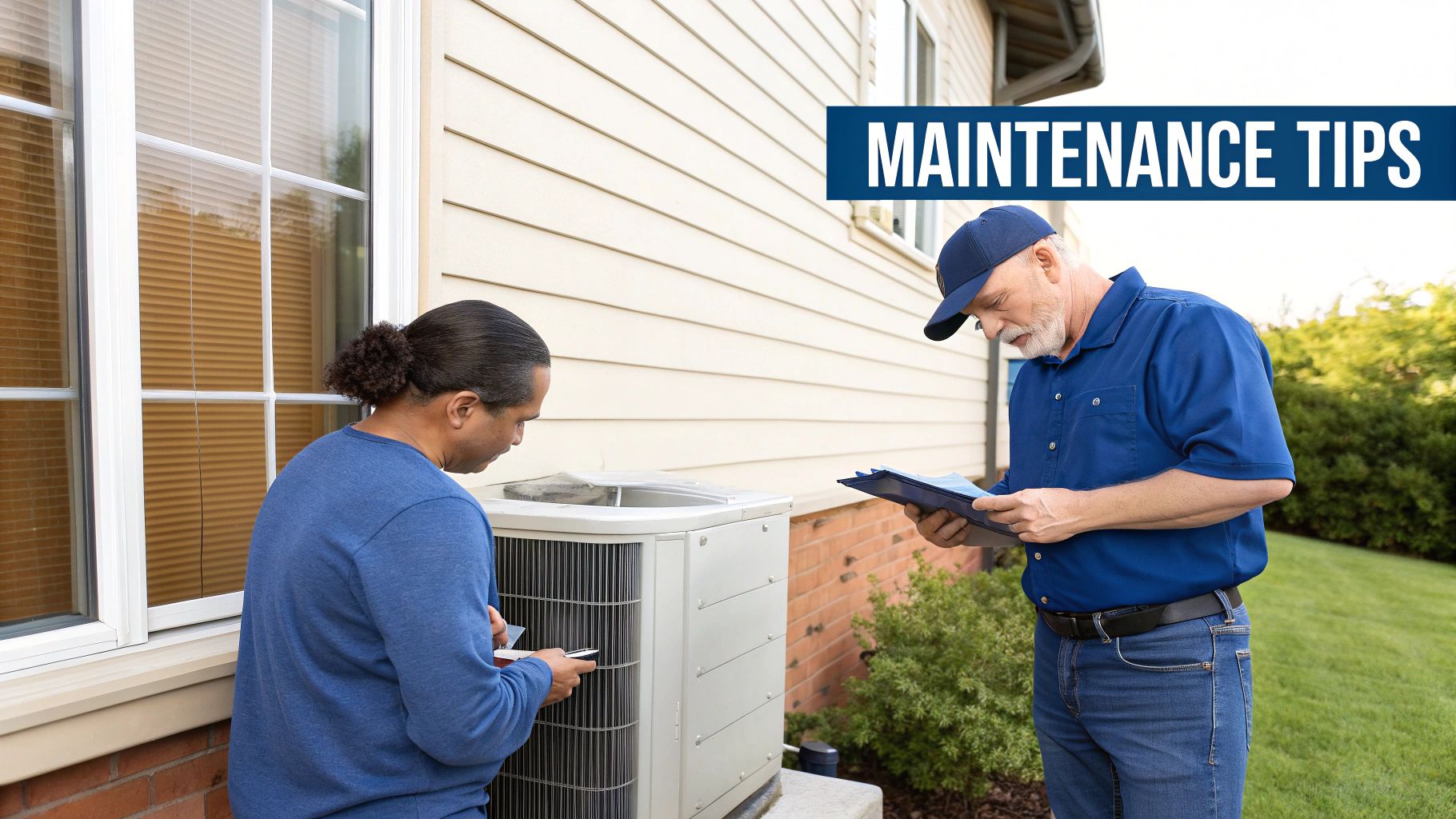
When our technicians come out for an annual service, they do a lot more than just a quick wipe-down. A typical maintenance visit includes a thorough checklist:
- Checking Refrigerant Levels: Low gas is a red flag for a leak and will cripple your system's efficiency and cooling power.
- Cleaning Coils and Components: We give the indoor and outdoor coils a deep clean to ensure they can transfer heat effectively.
- Inspecting Electrical Connections: All wiring and terminals are checked and tightened to ensure they are secure and safe.
- Testing Drainage: We make sure the condensate drain is clear to prevent blockages that can lead to water damage inside your home.
- Assessing Airflow: Our team checks that nothing is obstructing the airflow, ensuring the unit can breathe properly.
This preventative approach keeps your system running at peak efficiency, which you'll see reflected in lower power bills. More importantly, it allows us to spot small issues before they snowball into major, expensive breakdowns. Regular servicing is essential for extending the lifespan of your unit, often helping it last well beyond its official warranty period.
For a deeper dive, you can learn more about what's included in a professional air con maintenance service in our detailed guide.
Your Air Conditioner Installation Questions Answered
Investing in a reverse cycle air conditioner is a big decision for your home's comfort, and it's only natural to have a few questions before you commit. You want to get it right. Here are some straightforward answers to the queries we hear most often from homeowners across the Central Coast, Sydney, and Newcastle.
How Long Will the Installation Actually Take?
For a standard back-to-back installation of a single split system, you can expect the job to take between 3 to 5 hours. This is the simplest setup, where we place the indoor unit on an external wall, with the outdoor compressor unit positioned directly behind it on the outside.
Of course, not every installation is that straightforward. The timeline can stretch out if the job is more complex. Things like tricky access to where the units need to go, long pipe runs to connect units that are far apart, or needing a switchboard upgrade will add extra time. We’ll always give you a clear time estimate with our quote, so you know exactly what to expect on the day.
Does My New Air Con Need Its Own Electrical Circuit?
Yes, it absolutely does. This isn't just a recommendation; it's a critical safety requirement. Under Australian Standard AS/NZS 3000, all fixed-wired air conditioning units must be connected to their own dedicated electrical circuit.
There are no exceptions here. This rule prevents your home's electrical system from being overloaded and dramatically cuts the risk of electrical faults or fires. A licensed electrician has to do this work, and it’s a non-negotiable part of every professional installation we handle.
Expert Tip: If an installer ever suggests connecting your new air conditioner to an existing power point, show them the door. It’s unsafe, non-compliant, and a massive red flag that they are cutting dangerous corners.
What’s the Difference Between Inverter and Non-Inverter?
The main difference lies in how the compressor motor works. A non-inverter air conditioner is either on or off—it runs at full power to reach the desired temperature, then shuts off completely, cycling like this repeatedly.
An inverter unit is much smarter. It has a variable-speed compressor that gently adjusts its power to hold the temperature steady. Think of it like cruise control in your car; instead of slamming on the accelerator and then braking, it makes tiny, constant adjustments to maintain a consistent speed.
This makes inverter models far more energy-efficient, noticeably quieter, and much better at keeping you comfortable. For these reasons, we almost exclusively install inverter models. They simply offer better performance and save you money on running costs in the long run.
Can I Choose Exactly Where My Units Are Placed?
We always do our best to put your units right where you want them, but the final placement has to balance your preferences with technical and practical needs. It’s a mix of aesthetics, performance, and compliance.
For the indoor unit, we need a spot that allows for the best possible airflow, well away from heat sources or direct sunlight that could mess with its thermostat. For the outdoor unit, we need a stable base, plenty of ventilation, and a location where the operational noise won't bother you or your neighbours.
During our initial site visit, our technicians will walk through your property with you, talk through the options, and help find the best, most efficient, and compliant spots for both units.
Ready to get the perfect climate control solution for your home? The team at ALC Air is here to provide professional advice and a free, no-obligation quote to help you get started.