


When your air conditioner gives up on a sweltering Sydney day, the first instinct is to panic. But an HVAC repair emergency calls for a calm head and safe actions, not a frantic attempt at a DIY fix. Before you even think about calling a professional, we've put together a few simple checks you can do to get a handle on the situation and, most importantly, keep everyone safe.
What To Do When Your Air Con Fails
The second your air con dies, especially during a Central Coast heatwave, your number one priority has to be safety. Modern air conditioning units are complex pieces of machinery tied directly into your home's main electrical system, and trying to fix things yourself is a recipe for disaster.
Instead, take a breath and approach it methodically. This isn't about you becoming a technician; it's about gathering some basic clues that will help a qualified professional figure out the problem much faster once they arrive.
Initial Safety and System Checks
First thing's first: head to your switchboard. It's surprisingly common for a power surge or a minor fault to trip the circuit breaker connected to your air conditioner. If you see the switch in the 'off' position, go ahead and try flicking it back on, just once.
Give it a few minutes. If the system kicks back into gear, great. If it trips again straight away, do not reset it a second time. This is a clear sign of a more serious electrical problem that needs a licensed expert to look at. This is a critical safety measure that complies with SafeWork NSW guidelines.
Next, use your ears. Is the unit making any strange noises? A grinding, squealing, or loud banging sound usually points to a mechanical failure, like a seized fan motor or a struggling compressor.
And don't forget your nose. A distinct burning smell, like hot plastic or an electrical fire, is a major red flag. If you smell that, kill the power to the unit at the switchboard immediately and call for emergency help. For a bit more detail on what could be wrong, you can learn more about common air conditioning repairs here.
A circuit breaker that keeps tripping is your system screaming for help. It's a safety mechanism designed to prevent a catastrophic failure. Forcing it to run by repeatedly resetting it can cause permanent damage or even start a fire.
When your AC dies, you need help fast. It might be useful to understand how good service providers make sure they show up when you search for them. If you're interested in the behind-the-scenes of how that works, check out a practical guide to how HVAC companies win in local search. Knowing this can help you connect with the right people quickly when you're in a stressful situation.
Recognising a True HVAC Emergency
Not every air conditioning problem is a full-blown crisis, but some issues demand immediate, professional attention. Learning to tell the difference between a minor annoyance and a genuine HVAC repair emergency can save you from costly damage and keep your family safe.
There are certain red flags you just can't afford to ignore.
Imagine your ducted system in Western Sydney completely gives up on a day where the mercury pushes past 40°C. For a household with elderly family members, young kids, or anyone with a health condition, this isn't just an inconvenience, it's a serious health risk that needs urgent action.
Likewise, any strange smells coming from your vents need to be taken seriously. A strong electrical burning smell is a classic sign of overheating wires or a failing motor, which is a significant fire hazard. Your first move should be to kill the power to the unit at your switchboard, then call a technician immediately.
Critical Signs That Demand an Emergency Call
While poor cooling can be frustrating, some symptoms signal a much deeper problem that could destroy your system or damage your property.
If you hear a loud, metallic grinding or a high-pitched shrieking noise, that’s a clear sign of critical mechanical failure, like a broken motor bearing. If you keep running the unit, you're almost guaranteed to cause irreversible damage. Just turn it off.
Another obvious emergency is visible water leakage around the indoor unit where it shouldn't be, or ice forming on the copper pipes of the outdoor unit. This often points to a refrigerant leak, bad for your system’s health and terrible for the environment. These situations need a licensed technician with an ARCtick certification to handle the refrigerant safely and legally.
For a business, the definition of an emergency is even broader. A commercial refrigeration unit failing in a Newcastle cafe or a Hunter Valley restaurant can mean thousands of dollars in spoiled stock and lost revenue within a matter of hours.
The Challenge of Finding Help in NSW
Adding to the stress, finding prompt help when you need it can be a real challenge in New South Wales. The demand for qualified technicians is incredibly high. Sydney, for instance, is facing a staggering ratio of 13,160 households per home repair service, creating a major bottleneck for emergency responses.
This means that trying to secure an urgent booking during a summer heatwave can feel impossible. Knowing the signs of a genuine emergency helps you communicate the urgency effectively when you finally get someone on the phone. You can learn more about the pressures on NSW repair services to understand just how tight the market is.
How to Prepare for the Technician's Arrival
So, you've made the call and one of our technicians is on the way. Taking just ten minutes to prepare now can make a world of difference. A little bit of prep helps us work faster, pinpoint the problem more accurately, and get your system back up and running with a lot less fuss.
When we arrive for an HVAC repair emergency, the more information we have, the better. Try to have a few key details ready. Knowing the brand of your system (like Daikin, Mitsubishi Electric, or Fujitsu) and its approximate age gives us an immediate head start on what we might be dealing with.
Then, think about the problem itself. What clued you in that something was wrong? Was there a strange noise or an odd smell? Details like, "it started making a loud rattling noise yesterday, 14/03/2024, and now it only blows warm air" are incredibly helpful. This kind of context helps us narrow down the potential causes before we even open the toolbox.
Clear the Way for a Quick Fix
One of the most practical things you can do is make sure we can easily get to both the indoor and outdoor units. A technician's time is precious during an emergency, and minutes spent moving storage boxes, garden furniture, or pot plants can really add up.
For instance, if your outdoor condenser unit is tucked down the side of your house on a narrow Lake Macquarie property, please make sure the path is clear. The same goes for the indoor unit; if it’s in a tight hallway or a cluttered roof space, clearing the area beforehand is a massive help.
Property Manager Tip: If you manage a rental, please double-check that you've given us the tenant's correct contact details and confirmed how we can access the property. Nothing slows down an emergency repair more than a technician arriving on-site with no way to get in.
Gather Your System Information
Having the right details on hand is essential. We've put together a quick checklist to help you gather the essential details our technicians will need to diagnose your HVAC issue faster.
| Your Emergency Call Checklist |
| :— | :— | :— |
| Information to Note | What to Look For | Why It Helps Us |
| System Brand & Model | Find the sticker on the side of the outdoor unit and indoor unit (often on the side or underneath). | Helps us anticipate the specific parts and schematics we might need. |
| A Clear Description of the Fault | What is the system doing, or not doing? (e.g., "Not cooling," "Leaking water," "Making a grinding noise"). | Gives us a strong starting point for our diagnosis. |
| Any Recent Events | Did the problem start after a power outage, a storm, or maintenance work? | This context can point directly to the cause of the failure. |
If you can safely find the model and serial numbers, that's fantastic. It allows us to look up parts and specs before we even arrive.
This simple preparation streamlines the whole process significantly. For more tips on what to look for in a service provider, feel free to check out our guide on how to find a quality air conditioning service on the Central Coast.
What to Expect During Your Emergency Repair
When you call for an HVAC repair emergency, that feeling of uncertainty is the worst. Knowing what happens next can take a lot of the stress out of the situation. From the moment you pick up the phone, our whole process is built around clear communication and getting your system back online as safely and quickly as possible.
We’ll start by giving you a realistic arrival time. Whether you're in a Sydney apartment or a home in the Hunter Valley, our team will keep you in the loop so you aren’t left wondering when help is on the way.
The Diagnostic and Quoting Process
Once our ARCtick certified technician is on-site, their first job is to get to the bottom of what’s gone wrong. This isn't a quick guess; it’s a systematic process of checks to find the root cause of the failure, always making sure every step complies with Australian Standards like AS/NZS 3000 for electrical work.
It's about understanding why a part failed, not just finding the broken component.
A classic example is a failed capacitor on a split system. Sure, we can replace the capacitor, but a good technician knows that could just be a symptom. It might be pointing to a much bigger issue, like a compressor motor that’s struggling and drawing too much current. Our guys are trained to look for the underlying problem to make sure we’re providing a lasting solution, not just a band-aid fix.
Before a single tool is picked up, we’ll give you clear, upfront pricing. You'll get a detailed quote that breaks down the required labour and parts. You approve the full cost before we start, which means you get absolutely no surprises on the final bill.
Common Repairs and Realistic Timelines
The time it takes to complete a repair really depends on the problem. A straightforward part replacement, like swapping out a faulty fan motor at a Central Coast property, might be done in under an hour if we have the part in our van.
More complex issues, however, take more time. Diagnosing and fixing a refrigerant leak, for instance, is a meticulous job that involves pressure testing and careful work to ensure it’s sealed properly. These are the kinds of repairs that must be done correctly by a licensed professional to prevent the same problem from happening again. For a deeper dive into the common issues we handle, you can read more about our comprehensive air conditioner repairs.
It's a tough reality that emergency repairs can be costly. Research shows Australian households in NSW are often paying between $1,200 and $2,800 on average for urgent AC repairs, a cost often inflated by a nationwide shortage of skilled technicians. This makes getting a clear, upfront quote from a reputable provider even more critical. You can get more insights on the rising costs of aircon repairs here.
Preventing Future HVAC Emergencies
The best way to handle an HVAC repair emergency is to make sure it never happens in the first place. Nobody enjoys that sinking feeling when the air con dies on a sweltering afternoon. Proactive care is far less stressful and much more affordable than a panicked, middle-of-the-night call-out. It all comes down to regular, professional maintenance.
Think of it like servicing your car; you don't wait for it to break down on the M1 before getting an oil change. An annual service from a licensed technician is your system's best defence against unexpected failures. During these checks, we spot the small issues, a slightly worn fan belt or a dirty coil, long before they escalate into a catastrophic failure on a 40°C day in Western Sydney.
The Role of Regular Maintenance
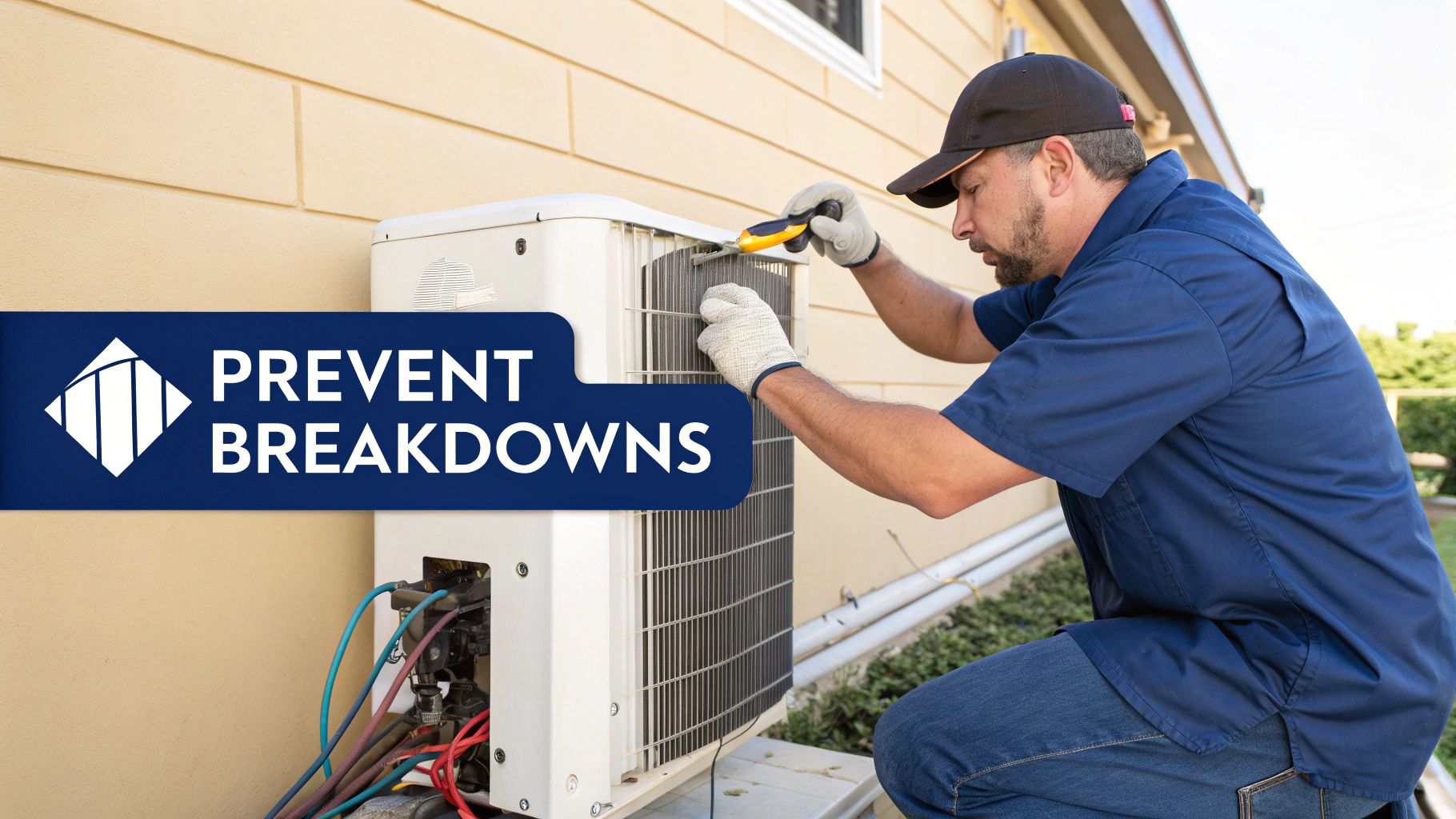
While you can (and should!) handle simple tasks like cleaning or changing the filters every few months, professional maintenance goes much deeper. Our technicians perform crucial safety checks on electrical connections to ensure compliance and prevent fire hazards. We also test refrigerant levels and check for minuscule leaks that sap performance and can eventually destroy your compressor.
For businesses across the Hunter Valley or Newcastle, planned maintenance isn't just a good idea, it's essential. Unplanned downtime from a failed air conditioning or refrigeration unit can mean lost productivity, spoiled stock, and an uncomfortable environment for staff and customers. Regular servicing keeps your operation running smoothly.
This proactive approach is even more critical as extreme weather becomes more common. In NSW, over 10 million residents live in high-risk heat areas, putting immense pressure on cooling systems. It's no surprise that organisations with robust, planned maintenance schedules suffer far fewer critical failures during heatwaves compared to those who wait for a breakdown.
Beyond Just Preventing Breakdowns
A well-maintained system doesn’t just avoid emergencies; it runs more efficiently. Simple as that.
When coils are clean and all the components are working correctly, your air conditioner doesn't have to work as hard to cool your home or business. This translates directly to lower electricity bills, saving you money all year round.
Key Takeaway: Consistent maintenance is an investment, not an expense. It extends the lifespan of your equipment, improves energy efficiency, and provides invaluable peace of mind.
Keeping an eye on broader home service industry trends can also help you find forward-thinking technicians who use modern diagnostic tools designed to catch problems early.
Ultimately, a scheduled service call is a calm, controlled event. An emergency breakdown is the complete opposite. If you'd like to get ahead of the game and set up a regular schedule, you can explore our comprehensive guide to air con maintenance. It's the simplest step you can take to ensure you stay comfortable, no matter what the weather throws at you.
Common HVAC Emergency Questions Answered
When you’re staring at a broken-down air conditioner in the middle of a sweltering Central Coast summer, your mind is probably racing with questions. In a stressful moment like an HVAC repair emergency, getting clear, straight answers is the first step toward getting things sorted. We've pulled together the most common queries we get from homeowners and businesses to give you the information you need, right now.
How Quickly Can You Respond to an Emergency Call?
Our goal is always to get to you as fast as humanly possible. While we can't give an exact ETA without knowing the day's workload and your specific location, from Gosford to Wyong, we absolutely prioritise emergency calls to get a licensed technician to your door.
Being local to the Central Coast for over 15 years gives us an agility that's tough to match with Sydney-based companies. When you call, having key information ready, like what the system is (or isn’t) doing and its model number, helps us prepare and can genuinely speed up the whole process.
Is an After-Hours Emergency Repair More Expensive?
Yes, services outside of standard business hours, including weekends and public holidays, do come with a higher call-out fee. This is standard practice across the industry and reflects the higher labour costs for our on-call technicians who are ready to help when you need them most.
But here’s our commitment to you: we are 100% transparent. When you book the job, we will clearly state the call-out fee and any after-hours rates that apply. You’ll get a clear, upfront quote for the full repair before any work begins, so there are absolutely no hidden costs or nasty surprises on the final bill.
Should I Repair or Replace My Old Air Conditioner?
This is a fantastic question and one our technicians tackle every day. When we come out for an emergency call, our first job is to give you a completely honest, professional evaluation of your system.
If it's a straightforward and cost-effective fix, like replacing a common part, we'll recommend that route. But if your system is over ten years old, needs repairs constantly, requires a very expensive part like a new compressor, or uses an old, phased-out refrigerant, we may advise that a replacement is a smarter long-term investment.
We’ll provide you with a quote for the immediate repair right alongside a separate, no-obligation quote for a new, energy-efficient system. This lets you compare the costs and benefits, helping you make a fully informed decision that fits your budget and future plans. For a better handle on the basics, you can find out more about how an air conditioner works in our detailed guide.
It's worth remembering the running costs. A new inverter split system can be up to 40% more energy-efficient than a model from a decade ago. The savings on your power bills can often help offset the initial investment in a new unit over time.
Do You Handle Commercial Cool Room Failures?
Absolutely. We know that for a business, a commercial refrigeration failure isn't just an inconvenience, it's a critical operational emergency that can't wait. Our specialised technicians have deep experience in diagnosing and repairing a wide range of commercial gear, including cool rooms and freezer rooms for businesses across Sydney, Newcastle, and the Lake Macquarie region.
We give these calls top priority because we understand that every hour of downtime is costing you money in spoiled stock and lost trade. Our team works efficiently to get your essential equipment back down to the right temperature and operating safely, as quickly as possible. We get the urgency and have the expertise to manage these high-stakes repairs.
Facing an unexpected breakdown is stressful, but you don't have to handle it alone. For a fast, reliable, and honest assessment of your HVAC repair emergency, get in touch with the local experts at ALC Air.