


So, what's the real cost of getting a ducted air conditioner installed in Australia? The short answer is it can range from $5,000 for a small, straightforward setup all the way up to $15,000 and beyond for a large home or a more complex job. The final number on the quote depends heavily on your home's size, the power of the system you need, and the specifics of the installation itself.
A Quick Guide to Ducted Air Conditioner Costs
When you start digging into ducted air conditioner prices, you quickly realise you're not just buying an appliance. You're investing in a complete, whole-home comfort solution. Unlike a split system that just tackles one room, a ducted system is designed from the ground up to quietly and efficiently deliver conditioned air right across your property. It’s a significant upgrade for any home, whether you're in Sydney, up on the Central Coast, or out in the Hunter Valley.
That upfront investment covers more than just the indoor and outdoor units. It includes all the ductwork that runs through your ceiling, the controllers, vents, and, crucially, the specialised labour needed to install it all properly and safely. Because every home is different, the price can vary quite a bit.
To give you a clearer picture, let's break it down by property size.
Estimated Ducted Air Conditioner Supply and Installation Costs
This table gives you a solid idea of typical price ranges for a standard ducted reverse cycle air conditioning system in the NSW residential market. These are just estimates, of course, and the final cost will depend on the factors we'll dig into throughout this guide.
| Home Size (Bedrooms) | Typical System Capacity (kW) | Estimated Total Cost (Supply & Install) |
|---|---|---|
| Small (1-3 Bedrooms) | 6 – 10 kW | $5,000 – $9,000 |
| Medium (3-5 Bedrooms) | 10 – 15 kW | $7,500 – $15,000 |
| Large (5+ Bedrooms) | 14 – 25+ kW | $10,000 – $25,000+ |
As you can see, for smaller homes with up to three bedrooms, you're generally looking at a total supply and installation cost between $5,000 and $9,000. For a medium-sized family home, that range often sits between $7,500 and $15,000. Once you get into large or multi-storey properties needing a seriously powerful system, the investment can start from $10,000 and easily climb past $25,000, especially if you need complex duct runs or electrical upgrades.
You can learn more about what drives these numbers in our deep dive on the factors influencing your ducted air conditioner cost.
It's really important to remember these figures are just a starting point. Your final quote will always come down to a professional on-site assessment that takes into account your home’s unique layout, its insulation, and what your family actually needs to stay comfortable.
This initial overview should give you a solid baseline. Now, let's break down exactly what goes into that final price, from the unit itself to the skilled hands required to get it installed safely and correctly.
What Are You Actually Paying For?
When a quote for a new ducted air conditioner lands in your inbox, the final number can look like a pretty big lump sum. But it helps to know exactly where that money is going. You're not just buying a box that blows cold air; you're investing in a complete, integrated system designed to deliver comfort right across your home.
The total cost really breaks down into three core parts: the air conditioning unit itself, all the high-quality materials needed for the install, and the specialised, licensed labour required to put it all together. Miss the mark on any of these, and the whole system suffers.
The Ducted Unit Itself
The heart of your investment is the hardware. This means the two main pieces of equipment: the indoor unit, which usually lives in your roof space, and the outdoor unit, which sits on a solid base outside your home. Think of them as the engine and radiator of your home's climate control.
A big chunk of the unit's price comes down to its capacity (measured in kilowatts or kW) and the brand you go with. A sprawling home in the hot western suburbs of Sydney is going to need a much beefier unit than a small villa in a milder spot like Terrigal. Brands like Daikin, Mitsubishi Electric, and Actron Air all sit at different price points and offer different features, which naturally shapes the final cost.
High-Quality Materials and Components
Next up, you're paying for everything that connects the system and actually gets the conditioned air where it needs to go. This is the 'circulatory system' of your ducted air con, and skimping here is a classic false economy. These materials include:
- Ductwork: This is the network of insulated tubes snaking through your ceiling, carrying air from the indoor unit to every room. Using top-quality, well-insulated ducting might cost a bit more upfront, but it stops the air from losing its cool on the way to the vents, saving you a fortune on running costs down the track.
- Grilles and Vents: These are simply the outlets in your ceilings or walls where the air comes out. The style you choose and how many you need will be factored into the price.
- Controllers and Zoning: Modern systems come with pretty sophisticated controllers, often with Wi-Fi so you can turn the system on before you get home. If you add zoning, the ability to shut off air to rooms you're not using, you're also adding dampers, extra wiring, and a more advanced control panel to the list of materials.
If you want a deeper dive into how all these bits and pieces fit together, our guide explaining what ducted air conditioning is is a great place to start.
Specialised and Licensed Labour
Finally, a significant slice of the cost covers the professional installation. And let's be clear, this is a world away from general handyman work. Installing a ducted system properly requires multiple licensed tradespeople to ensure it’s done safely and meets Australia's strict regulations.
Your installation team must include ARCtick certified refrigeration technicians to handle the refrigerant gases legally and safely, as well as fully licensed electricians to wire the system into your home's power supply. This work has to follow Australian Standards like AS/NZS 3000 for electrical installations. It's completely non-negotiable for safety and compliance.
This expert labour ensures your system isn't just efficient, but also safe for your family and won't instantly void your manufacturer's warranty. It's an investment in genuine peace of mind.
Key Factors That Influence Your Final Quote
When you start getting quotes for a ducted air conditioner, you’ll quickly see that no two are ever the same. This isn't because installers are just picking numbers out of the air; it's because the final price is a complex puzzle, and each piece reflects the unique needs of your home.
Understanding these factors is the key to reading any quote like a pro and knowing exactly what you’re paying for.
The biggest variable, without a doubt, is the system's capacity, which we measure in kilowatts (kW). This isn't just a technical number; it represents the raw cooling and heating power the unit can deliver.
Think about it this way: a large, two-storey home in a hot Western Sydney suburb like Penrith, which gets blasted by the intense afternoon sun for hours, is going to need a much more powerful system than a single-level villa in the milder coastal climate of Terrigal.
Getting this sizing right is absolutely critical. An undersized unit will struggle constantly just to keep up, sending your power bills through the roof. On the other hand, an oversized one will switch on and off too frequently, leading to poor humidity control and wearing itself out prematurely.
This flowchart breaks down the core cost components you'll find in any professional quote.
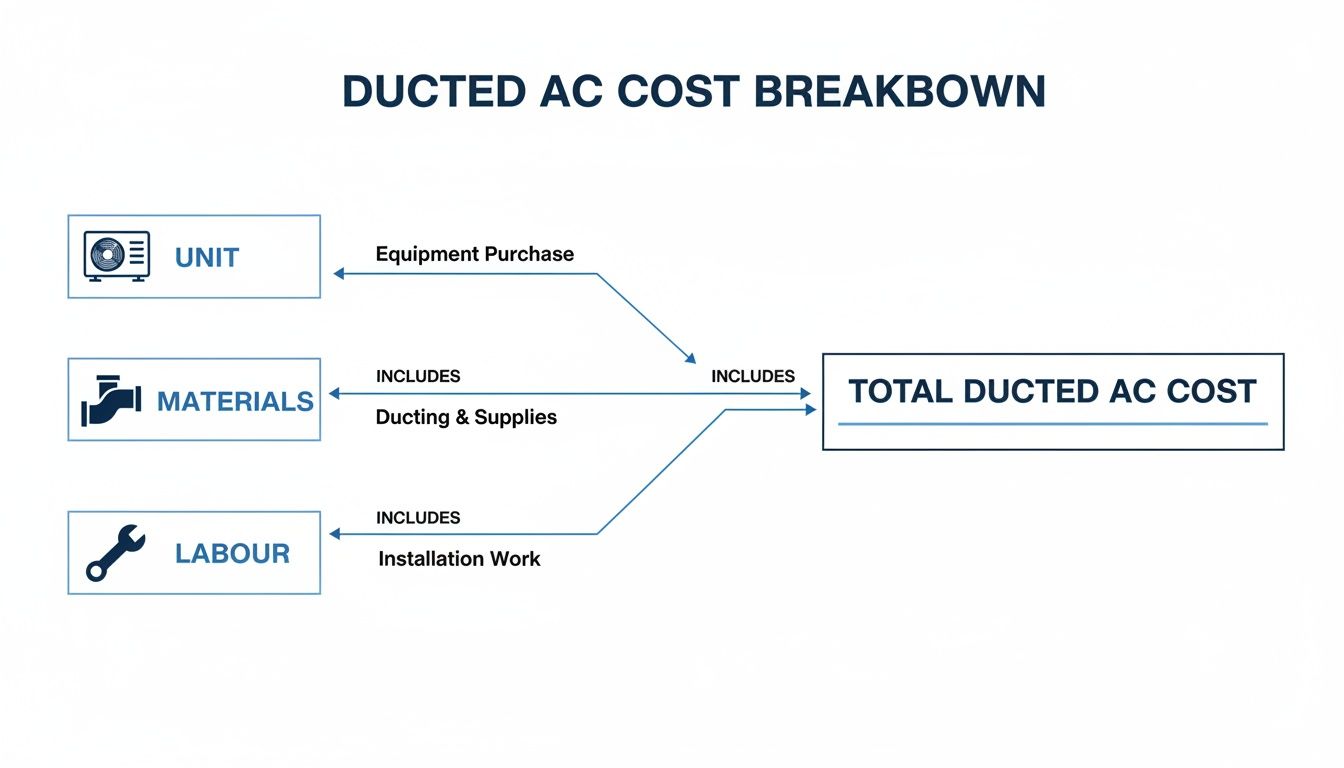
As you can see, the final price is a balance between the physical unit, all the necessary installation materials, and the specialised labour needed to get the job done safely and to Australian Standards.
Zoning and Custom Controls
Beyond the raw power of the system, the level of control you want over your home's climate has a big impact on the cost. This is where zoning comes into play.
Zoning is what allows you to divide your home into different areas that can be cooled or heated independently. For instance, you could run the air con in the living and kitchen areas during the day, then switch it over to just the bedrooms at night. It’s a brilliant way to slash your running costs, but it does add a layer of complexity to the installation.
Each zone needs its own electronically controlled damper inside the ductwork, plus all the extra wiring and a more advanced central controller to manage it all. The more zones you want, the higher the upfront material and labour costs will be. That said, many homeowners on the Central Coast find that a well-designed two or three-zone system easily pays for itself over time through energy savings.
Your Choice of Brand
The air conditioning market is full of different manufacturers, and the brand you choose definitely plays a role in the final price. Trusted, premium brands like Daikin or Mitsubishi Electric often come with a higher price tag, but this is usually justified by their rock-solid reputation for reliability, energy efficiency, and excellent after-sales support.
Other reliable brands might offer a more budget-friendly starting point. It's not just about the name on the box, though. It’s about the technology inside, like the efficiency of the inverter compressor and the quality of the components. Making an informed decision is important, which is why we've put together a guide on the best ducted air conditioning brands to help you compare your options.
Remember: A quality system from a reputable brand, installed correctly, is a long-term investment. Cheaper units might save you money initially but could lead to higher running costs and more frequent repairs down the line.
Installation Complexity and Site Access
The physical layout and construction of your home is another major factor. A brand new home in a developing Newcastle suburb with plenty of roof space and easy access is usually a pretty straightforward installation.
But retrofitting a system into an older home in Lake Macquarie with a low-pitched roof or tight, cramped ceiling cavities presents a real challenge. Difficult access simply means more time and labour are required to run the ductwork and install the indoor unit safely and correctly.
Other complexities that can push the cost up include:
- Property Type: A multi-storey home requires more complex duct runs and might even need scaffolding or specialised lifting equipment.
- Roof Material: A tile roof is often easier and quicker for installers to work with than a metal one.
- Building Materials: Double-brick walls or complex internal structures can make the job of running ducting and wiring much more difficult.
Electrical and Compliance Requirements
Finally, we have to talk about your home's existing electrical system. It absolutely must be able to handle the significant load of a new ducted air conditioner. As part of any proper quoting process, a qualified electrician must assess your switchboard.
If your switchboard is old or simply doesn't have the capacity, it will need to be upgraded to meet current Australian Standards (AS/NZS 3000). This is a non-negotiable safety requirement that protects both your home and your new system. This upgrade, if required, will be a separate but essential item on your final quote, ensuring your installation is fully compliant with SafeWork NSW regulations.
Understanding the Lifetime Running Costs
The price on your installation quote is a big number, but it’s really just the beginning of the story. The true cost of a ducted air conditioner unfolds over its entire 10 to 15-year lifespan. Thinking about these ongoing running costs is crucial for any household budget, as they have a far greater impact than the one-off installation fee.
This is where you’ll hear technical terms like EER (Energy Efficiency Ratio) for cooling and COP (Coefficient of Performance) for heating. Don't let the jargon put you off. In simple terms, these are just like the fuel efficiency rating on a car. A higher number means the system needs less electricity to do its job, which translates directly to lower power bills for you.
How Technology and Efficiency Affect Your Bills
Modern ducted air conditioners almost all use inverter technology. The best way to think of it is like the cruise control in your car. Instead of the compressor constantly switching on at full power and then shutting off completely, an inverter system intelligently adjusts its speed to maintain the temperature you’ve set.
This simple change prevents those massive, wasteful spikes in energy consumption you’d see with older, fixed-speed systems. The result is a much more stable and comfortable indoor climate, all while using significantly less power. A high-efficiency inverter model might cost a bit more upfront, but the year-on-year savings on your electricity bills can be substantial.
So, what does this look like in real terms? For a typical household in NSW, modest use can result in annual running costs between $300 and $1,200. Of course, if you're cooling an entire large home through a hot Sydney summer, those bills can climb higher. Find out more by exploring our detailed breakdown of how much running AC costs.
The Importance of Preventative Maintenance
It’s easy to think of maintenance as just another expense, but it’s actually one of the smartest investments you can make in your ducted system. A regular service isn’t just about cleaning a few filters; it’s a comprehensive health check for your entire system.
Regular, professional maintenance is the single best way to protect your investment. It ensures your system runs at peak efficiency, preventing energy wastage and catching small issues before they turn into costly, inconvenient breakdowns.
During a service, our technicians will:
- Clean filters, coils, and fans to ensure maximum airflow and efficiency.
- Check refrigerant levels and look for any potential leaks.
- Inspect electrical connections to ensure they are safe and secure.
- Test thermostats and controls to confirm they are working correctly.
This proactive approach keeps your system running as it should, honouring the manufacturer's warranty and providing reliable comfort when you need it most. Skipping this step can lead to a slow decline in performance and a steady increase in your running costs over time, which ultimately defeats the purpose of choosing an efficient unit in the first place.
How Your Location Shapes the Cost
The final figure on your quote for a ducted air conditioner is never just about the house itself; it’s deeply connected to where that house is. From the salty air of the Central Coast to the intense summer heat of the Hunter Valley, your specific location presents unique challenges that directly influence the system design, the materials used, and ultimately, the total cost.
Let’s explore a few common scenarios we see across our service areas to show you how this works in the real world. Every property has different needs, and a one-size-fits-all approach simply doesn’t deliver the comfort or efficiency you deserve.
Scenario 1: The Hunter Valley New Build
Imagine a brand-new, four-bedroom family home going up in a growing estate near Cessnock. The biggest challenge here isn't the house itself but the Hunter Valley's climate, which is notorious for its scorching summer days and surprisingly chilly winter nights. That extreme temperature range demands a powerful and highly efficient reverse cycle system.
For a home like this, we'd recommend a system with a higher kilowatt (kW) capacity to handle those peak summer days when the mercury pushes past 40°C. We would also strongly advise a multi-zone setup. This allows the family to cool the main living areas during the day and then switch exclusively to the bedrooms at night, a crucial feature for keeping running costs under control. While the installation is more straightforward in a new build, the need for a more powerful unit and sophisticated zoning will be key factors in the final quote.
Scenario 2: The Sydney Double-Brick Renovation
Now, let's head down to Sydney's leafy North Shore. Picture an older, double-brick house in a suburb like Hornsby, where the owners are tackling a major renovation and want to add ducted air conditioning for the first time. This scenario immediately introduces several complexities that can push up the cost.
Older homes often have tight or tricky roof spaces, which can make running the ductwork a much more time-consuming and labour-intensive job for our technicians. On top of that, the existing electrical switchboard was almost certainly never designed to handle the load of a modern ducted system. This means a mandatory switchboard upgrade by a licensed electrician will be required to comply with AS/NZS 3000 electrical standards, adding a necessary safety-related cost to the project.
Scenario 3: The Central Coast Coastal Home
Finally, let’s picture a two-storey home in a suburb like Avoca Beach on the Central Coast, constantly exposed to humid, salty air. While the climate is milder than the Hunter, the corrosive coastal environment is the main thing we need to worry about here. The focus shifts from raw power to long-term durability.
For this property, the cost will be influenced by the need for specialised materials. We'd specify an outdoor unit with enhanced corrosion-resistant coatings on its coils and casing to protect it from salt damage. The ductwork and fittings inside the roof cavity also need to be high quality to withstand the persistent humidity. So, while the unit's capacity might be smaller than the Hunter Valley example, the investment in more durable, marine-grade components is essential to ensure the system has a long and reliable life.
As these examples show, understanding your local environment is key. A professional assessment will always factor in these regional specifics to design a system that performs efficiently for years to come.
For a more detailed look at pricing in this specific region, check out our guide to air conditioning installation costs on the Central Coast. Each location tells a different story, and the right solution is one that's perfectly matched to its setting.
Choosing the Right Installer for Your Investment
A top-of-the-line ducted air conditioner is only half the story. The skill, experience, and professionalism of the team installing it are just as critical for its long-term performance. Picking the right installer isn't about chasing the lowest price, it’s about finding a genuine partner who will make sure your significant investment provides reliable comfort for years to come.
Think of it like choosing a builder for your home; the quality of their work defines the end result.
So, how do you make a smart choice? It really comes down to asking the right questions and looking for a few non-negotiable credentials that protect you and your home.
Your Essential Installer Checklist
When you start comparing quotes, you need to look beyond the final number on the page. A professional, trustworthy installer will have no problem providing clear proof of their qualifications and business practices. Before you sign anything, make sure you can tick off every single item on this list.
Full Licensing and Insurance: Your installer must hold both a current NSW electrical licence and an ARCtick refrigerant handling licence. This isn't just a suggestion; it's a legal requirement to handle both the wiring and the refrigerant gases safely and correctly. Don't be afraid to ask to see these licences and check that they're current.
Detailed Written Quotes: A vague, one-line quote is a massive red flag. A proper quote should clearly itemise all the costs, including the specific model of the air conditioning unit, all materials like ductwork and controllers, labour charges, and any potential extras like a switchboard upgrade.
Local Experience and Reputation: Look for a company with a proven track record in your area. With over 15 years of experience on the Central Coast and the surrounding regions, we’ve seen first-hand the unique challenges our local climate presents, from Sydney's intense urban heat to Newcastle's corrosive coastal air.
Strong Warranties: A quality installation should always be backed by two separate warranties: the manufacturer's warranty on the unit itself, and a workmanship warranty from the installer. This shows they stand behind the quality of their work and aren't going to disappear if something goes wrong.
Ultimately, choosing an installer is about confidence. You need to feel certain that the team in your home is qualified, insured, and committed to doing the job right the first time, in full compliance with Australian Standards.
If you're ready to invest in whole-home comfort, we're here to help. Our team provides professional, on-site assessments and detailed, no-obligation quotes to give you all the information you need to make the right decision.
Get in touch with ALC Air today to discuss the perfect solution for your home.
Answering Your Ducted Air Con Questions
Even after going through all the details, you probably have a few specific questions still rattling around in your head. That's completely normal. To help clear things up, we’ve put together a few of the most common queries we hear from homeowners across the Central Coast, Sydney, and Newcastle.
Can You Install Ducted Air Conditioning in an Existing Home?
Yes, absolutely. While it’s definitely simpler to install a ducted system during a new build, retrofitting one into an existing home is something our team does all the time. The main thing we need is enough space in the ceiling cavity to run the insulated ductwork and house the indoor fan coil unit.
For a standard single-storey home with a pitched roof, the whole process is usually quite straightforward. If you're in a two-storey house or a property with tight roof access, our installers have clever ways to run ducting through voids or by building discreet bulkheads. The first step is always a thorough on-site inspection to see exactly what’s possible for your home.
How Long Does a Typical Installation Take?
For a standard single-storey home, a complete ducted air conditioning installation usually takes between one and two full days. This gives our licensed technicians enough time to carefully position the indoor and outdoor units, run all the ductwork, install the vents and controllers, and get the electrical work done safely and to Australian Standards.
More complex jobs, like a big two-storey home or a tricky retrofit in an older character property, might stretch into a third day. We always give you a clear, realistic timeline with our quotes so you know exactly what to expect from the get-go.
Is Ducted Air Conditioning More Expensive to Run?
This is a great question, and the answer really depends on how you use it. If you were to cool an entire five-bedroom house with a ducted system versus firing up five separate split systems at once, the ducted system would likely be more energy-efficient and cheaper to run.
But the real game-changer is zoning. By only cooling the areas you're actually using, like the living areas during the day and the bedrooms at night, you can slash your energy consumption. A well-designed zoned ducted system is often one of the most cost-effective ways to get true whole-home comfort.
At ALC Air, we believe an informed decision is the best decision. If you have more questions or you’re ready for a clear, upfront quote tailored to your home, our experienced team is here to help.