


Let’s get straight to it: you want to know how much ducted air conditioning costs. While every home is different, a professionally installed ducted system for a typical three to four-bedroom home in NSW generally lands between $8,000 and $15,000. This isn’t just for the unit itself; that price covers the whole process, from design and materials right through to the final compliance checks.
Your Ducted Air Conditioning Cost Answered Upfront
When you’re thinking about whole-home comfort, the budget is always the first hurdle. Unlike buying a fridge, the price of a ducted system is a mix of three key things: the physical unit, all the materials needed for the job (like ducting, vents, and cables), and the skilled labour of licensed technicians who know what they’re doing.
Here in New South Wales, where we work with families across the Central Coast, Sydney, Newcastle, and Lake Macquarie, prices are shaped by local factors. For a standard 3-bedroom home, you can expect the final installed cost to fall somewhere between $8,000 and $15,000.
Of course, location plays a part. A tricky installation in a two-storey Sydney terrace might push costs towards $20,000 due to access challenges. Meanwhile, a similar job in Newcastle or Lake Macquarie could sit between $7,500 and $18,000. If you want to dive deeper into what drives these numbers, you can learn more about air conditioner installation costs on our blog.
To give you a clearer picture, here’s a general guide to what you might expect based on the size of your home.
Estimated Ducted Air Conditioning Installation Costs by Home Size
This table provides a general guide to installation costs based on the size of your home. We’ve found prices can vary based on factors we’ll discuss in this article.
| Home Size and Type | Typical System Capacity (kW) | Estimated Cost Range (AUD) |
|---|---|---|
| Small 2-3 Bedroom Home / Townhouse (up to 150m²) | 7-10 kW | $7,000 – $11,000 |
| Standard 4 Bedroom Home (150-240m²) | 10-14 kW | $9,000 – $15,000 |
| Large 5+ Bedroom or Two-Storey Home (240m²+) | 14-20+ kW | $12,000 – $20,000+ |
Just a heads-up: These figures are a starting point, not a final quote. The brand you choose, how complex the installation is, and whether your home needs electrical upgrades to meet Australian Standards like AS/NZS 3000 will all influence the final price.
This initial pricing gives you a solid ballpark. Next, we’ll break down exactly what factors can shift these numbers and what goes into your final, fixed-price quote.
What Goes Into Your Final Quote? The 7 Key Factors
Ever wondered why a quote for a ducted system in one house can be thousands of dollars different from a similar-sized home down the street? It’s never about hidden fees. It’s all about the specific details of your home and the system designed to perfectly match it.
The final figure on your quote is a blend of three core elements: the physical equipment, the skilled labour to install it, and all the materials needed to connect it, like ducting and vents. Getting these right is the difference between simply having air conditioning and having the right air conditioning, a system that keeps you comfortable without chewing through electricity.
Let’s break down exactly what shapes that final number.
This diagram gives you a clear picture of how a typical project’s cost is structured.
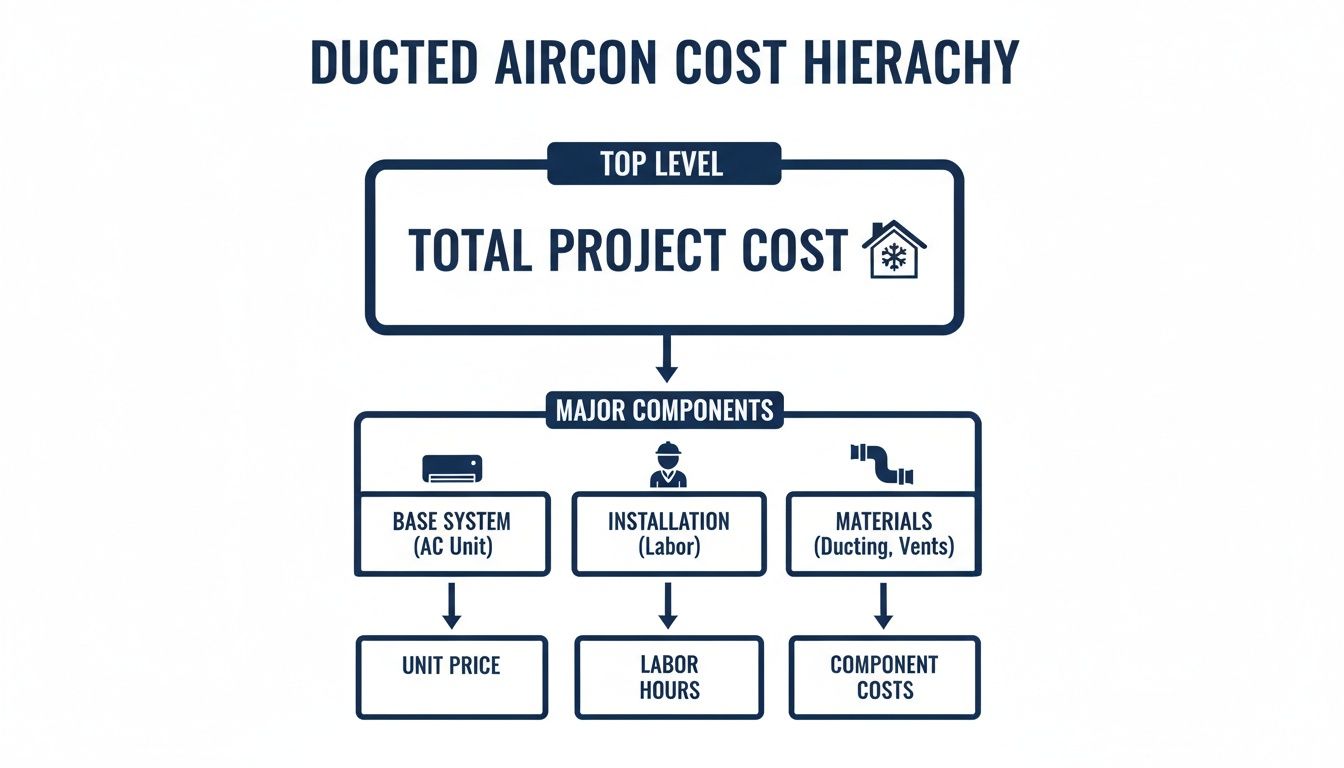
As you can see, the air conditioning unit itself is the biggest piece of the puzzle, followed closely by the specialist labour and the cost of materials.
1. System Capacity (kW)
This is the big one. Capacity, measured in kilowatts (kW), is all about raw cooling and heating power. A large, open-plan home with high ceilings in the Hunter Valley is going to need a much beefier system than a small, well-insulated townhouse in Gosford.
Getting the size right is absolutely critical. An undersized system will run itself ragged on a hot Sydney summer day, never quite hitting the temperature you’ve set and working inefficiently. On the flip side, an oversized unit will constantly switch on and off, wasting a ton of energy and never getting the chance to properly dehumidify the air.
Properly sizing your air conditioner is the first step to years of efficient comfort, something we dive into deeper over on our blog.
2. Brand and Model Choice
Just like with cars or appliances, the brand you choose plays a big part in the cost. We stick with trusted names like Daikin, Mitsubishi Electric, and Panasonic because we know from over 15 years of experience that they’re reliable and offer fantastic after-sales support.
Premium models might come with extra features like advanced air purification, smarter controls, or higher energy efficiency ratings, all of which will influence the initial price of the equipment.
3. Installation Complexity and Your Home’s Layout
The design of your home has a direct impact on the labour involved. A single-storey home with plenty of room in the roof cavity is a much simpler job than a two-storey place in Hornsby with next to no space to work in.
A few things that can add to the complexity and cost include:
- Roof Space: Is it easy to get into and move around? Or is it a tight, tricky space?
- Home Construction: Double brick walls, asbestos materials, or other unique building methods require more time and specialised handling.
- Property Access: Navigating a high-rise apartment block in Newcastle presents different challenges than a suburban house on the Central Coast with easy access.
How Zoning Impacts Comfort and Your Energy Bills

If there’s one feature that truly transforms a ducted system from a simple appliance into a genuinely smart climate solution, it’s zoning. Think about the light switches in your house, you wouldn’t flick on every single light just to read a book in the lounge room.
Zoning applies that exact same common-sense logic to your air conditioning. It’s arguably the single most important feature for managing comfort and running costs.
What Is Air Conditioning Zoning?
In simple terms, zoning gives you control over which parts of your home get cooled or heated. We install a series of mechanical dampers inside your ductwork that can open and close, creating different “zones”.
For example, your main living and kitchen area could be Zone 1, while the bedrooms are grouped into Zone 2. This lets you send conditioned air only where you actually need it. During the day, you can run the air con in the living areas, then at night, switch it over to just the bedrooms.
Without zoning, you’re paying to cool or heat empty rooms. It’s a massive waste of electricity and money. While adding zones does increase the initial installation cost, the long-term savings on your power bills are always worth it.
How Zoning Affects Your Bills and Comfort
The biggest win with a well-designed zoning plan is efficiency. By not wasting energy on unused rooms, your system doesn’t have to work nearly as hard, which can slash your power consumption. In fact, understanding zoning is a key part of figuring out how much it costs to run your air conditioner, because it directly impacts your usage.
Let’s imagine a real-world scenario. You have a two-storey home on the Central Coast where the upstairs bedrooms get absolutely baked by the afternoon sun. With a zoned system, you can direct extra cooling power to those rooms in the evening without turning the downstairs living area into an icebox.
This targeted approach means every family member gets personalised comfort, all while keeping your electricity bills under control.
Why Zoning Matters: A properly zoned ducted system provides tailored comfort for your family and prevents energy wastage. It’s the single most effective feature for managing the running costs associated with whole-home climate control.
Modern systems take this even further with smart zoning controllers. You can manage temperatures in each specific area right from an app on your phone, giving you the ultimate control over both your comfort and your spending.
Looking Beyond Installation at Long-Term Value
The initial investment for a ducted system is a big part of the story, but it’s certainly not the whole book. Smart homeowners across the Central Coast and Sydney know that the true cost of air conditioning includes what you pay to run it, year after year.
A system that’s cheap to install but chews through electricity isn’t a bargain; it’s a long-term financial drain. Thinking about how much for ducted air conditioning really means looking at the total cost of ownership. This includes your future power bills and what it takes to keep the system in peak condition. A high-quality installation today directly leads to lower running costs and fewer headaches tomorrow.
Your System’s Ongoing Running Costs
How much your ducted system adds to your quarterly power bill depends on a few key things. Your home’s insulation plays a huge role; a well-insulated home in Newcastle will hold its temperature far better than an older, draughty one, meaning your reverse cycle air conditioner simply works less.
Your family’s habits are just as important. Do you run the system all day, or only for a few hours in the evening? Do you keep the temperature at a moderate 24°C, or an icy 18°C? Every degree makes a difference. Most importantly, a system with a high energy star rating will always use less electricity to achieve the same level of comfort.
The Value of Professional Maintenance
Just like your car, your ducted air conditioning needs a regular service to run efficiently and reliably. An annual check-up by an ARCtick-certified technician is a small investment that protects a major home asset, stopping small issues from turning into expensive breakdowns.
Regular maintenance is one of the most effective ways to ensure your system has a long and efficient life, as we detail in our guide to the maintenance of your air conditioner.
A professional service involves cleaning filters, checking refrigerant levels, inspecting ductwork for leaks, and ensuring all electrical components are safe and functioning correctly. This routine care ensures your system isn’t working harder than it needs to, which keeps your power bills down.
The long-term benefits are clear. Well-maintained ducted units in NSW can last 15-20 years, compared to just 10 years for neglected ones. That means you avoid unexpected replacement bills that can run into the thousands.
With hourly running costs typically between $0.50 and $1.50 and an annual service from $150-$300, the investment in proper upkeep delivers serious value. A quality installation from a licensed professional not only guarantees performance but also ensures your system is safe, compliant, and built to last.
Putting It All Together: Cost Scenarios for Different NSW Homes
Theory is one thing, but seeing how these factors play out in the real world is where it all clicks. To give you a better feel for how the final price comes together, let’s walk through a few common scenarios we see across the Central Coast, Sydney, and the Hunter Valley.
While we can’t give you a fixed price without seeing your home, these examples show exactly why the answer to “how much for ducted air conditioning?” is never the same twice.
Scenario 1: The Lake Macquarie New Build
Picture a modern, single-storey, four-bedroom home in one of the new estates popping up around Lake Macquarie, like Cameron Park or Morisset. This place is well-insulated, has standard 2.4-metre ceilings, and plenty of room in the roof space. It’s about as straightforward as an installation gets.
The layout is perfect for a simple two-zone setup, one for the open-plan living area and another for the bedroom wing. For a home like this, a system around 12-14 kW would be the sweet spot. With easy access for our team and materials, this job avoids most of the tricky complexities, placing it at the lower end of the typical price range.
Scenario 2: The Two-Storey Sydney Heritage Home
Now let’s head to the city and look at a two-storey heritage terrace in a suburb like Newtown or Paddington. The challenges here couldn’t be more different. The first thing we’d check is the roof space, which is likely cramped and difficult to access, immediately adding to the installation time.
Preserving the home’s original character is non-negotiable, so we have to get creative with placing louvre vents discreetly. Older windows and less effective insulation mean the home has a higher thermal load, probably requiring a more powerful 14-16 kW system. On top of that, the electrical switchboard might need a significant upgrade to comply with current Australian Standards (AS/NZS 3000), adding another layer of cost. All these factors push this project towards the higher end of the spectrum.
Scenario 3: The Central Coast Home with High Ceilings
Finally, let’s imagine a larger, open-plan home in a Central Coast suburb like Terrigal or Wamberal. This house has high, raked ceilings in the main living area and gets hammered by the western sun in the afternoon, all while battling that classic coastal humidity. These factors send the thermal load through the roof, demanding a much beefier system, perhaps in the 16-20 kW range.
To keep the family comfortable without blowing the budget on power bills, a multi-zone system is the only way to go. We’d likely recommend at least four zones: one for the living area, another for the media room, a parents’ retreat, and one for the kids’ bedrooms. The complex roofline and the need for more extensive ductwork add to the job’s complexity. The combination of a higher-capacity system and advanced zoning puts this project squarely in a higher price bracket, reflecting the customised solution needed to get it right.
Why a Professional On-Site Quote Is Essential
You might have come across online calculators or been offered a quick estimate over the phone, but when it comes to figuring out how much for ducted air conditioning, nothing replaces having a qualified technician visit your home. Honestly, a cheap, sight-unseen quote might seem tempting, but it’s one of the biggest risks you can take.
Those rough estimates are notorious for leading to major problems down the track. An installer who hasn’t properly assessed your home might recommend an undersized system that just can’t keep up on a scorching January day, or an oversized one that cycles on and off, wasting a huge amount of energy.
Worse still, you could get hit with unexpected costs halfway through the job when they suddenly “discover” your switchboard needs upgrading or that the roof access is far more complex than they assumed. This is exactly why a professional, on-site assessment isn’t just a good idea, it’s non-negotiable.
Our Free On-Site Assessment Process
We believe in getting it right from the very beginning. That’s why we offer a free, no-obligation site assessment. This isn’t just a quick look around; it’s a detailed evaluation designed to give you a fixed, upfront price with absolutely no nasty surprises.
During our visit, we’ll actually:
- Measure your space accurately to calculate the precise cooling and heating load needed for each and every room.
- Assess your home’s insulation, window orientation, and ceiling height, as these factors massively influence the right system size.
- Inspect your electrical switchboard to make sure it can safely handle the new system and complies with Australian Standards like AS/NZS 3000.
- Discuss your family’s lifestyle and comfort needs to design a zoning plan that works perfectly for how you actually live in your home.
This thorough process is the only way to ensure the quote you receive is genuinely tailored to your property.
The Importance of Licensed and Certified Installers
Choosing a fully licensed and insured company is your single best form of protection. Our technicians hold all the necessary electrical licenses from SafeWork NSW and are ARCtick certified, which is your guarantee that we handle refrigerants safely and in line with strict environmental standards.
At the end of the day, quality installation by an accredited professional is the key to unlocking the long-term performance and efficiency of your new system. If you want to know what to look for in a contractor, our guide on how to find a quality air conditioning service on the Central Coast has you covered.
Still Have Questions About Ducted Aircon Costs?
Even with the main factors laid out, a few specific questions always come up. Here are the answers to the most common queries we hear from homeowners across the Central Coast, Sydney, and Newcastle.
Is Ducted Air Conditioning Actually More Expensive Than Multiple Split Systems?
Looking at the initial, upfront investment, yes, a full ducted system costs more than a single split system. But that’s not the whole story.
The maths starts to flip once you need to cool or heat more than three separate rooms. At that point, buying and installing one ducted system often becomes the more cost-effective option compared to putting in three or four individual split system units.
And beyond the price tag, a ducted system gives you a far cleaner, more seamless look, adds more long-term value to your property, and delivers that unbeatable whole-home comfort.
Can I Get a Rebate for an Energy-Efficient Ducted System?
It’s a moving target, but yes, government incentives and rebate programs do pop up in NSW from time to time. These schemes are designed to encourage homeowners to install high-efficiency air conditioning systems that reduce overall energy consumption on the grid.
Because these programs can change, the best advice is always the most current. During our free on-site assessment, we’ll let you know about any active programs you might be eligible for. We always focus on systems with high energy star ratings to maximise your long-term savings, rebate or not.
How Long Will a Ducted Installation Take?
We know you want your new system up and running with as little disruption as possible. For a standard, single-storey home, our licensed and experienced team can typically complete a full ducted air conditioning installation in just one to two days.
If the project is a bit more complex, like a large two-storey home in Newcastle or a property with tricky roof access, the job might stretch to two or even three days. We’re always upfront about this. Our fixed-price quote includes a clear, realistic timeline so you know exactly what to expect from start to finish.
Ready to get a clear, fixed-price quote tailored to your home? The team at ALC Air provides free, no-obligation on-site assessments to design the perfect system for your needs and budget. Get your free quote today!