


That sinking feeling when a summer electricity bill lands in your inbox? You’re not alone. Most Aussie homeowners know it well, wondering just how much damage the air con has done this time. Understanding what drives these costs is the key to staying comfortable without the bill shock.
The short answer is that running your air conditioner can cost anywhere from 40 cents per hour for a small split system to over $4.50 per hour for a large ducted system. But the real story is in the details, and knowing them can save you a bundle on your next power bill.
Your Air Conditioner Running Costs Demystified
When the summer heat hits the Central Coast or Western Sydney, your air conditioner isn’t a luxury; it’s a lifeline. But figuring out exactly what that comfort costs can feel like guesswork. The final figure on your bill is shaped by more than just how often you reach for the remote.
Think of it like the difference between running a small hatchback and a big V8 ute. Both get you from A to B, but their fuel consumption is worlds apart. Your air conditioner works the same way. The type of system you have, its size (measured in kilowatts or kW), its energy efficiency rating, and even where you live all play a huge role in the final cost.
For example, a zippy 2.5kW split system cooling a bedroom in a Newcastle apartment will sip power compared to a thirsty 14kW ducted system trying to cool a sprawling two-storey home in the Hunter Valley.
The local climate matters, too. The humid, salty air on the Central Coast means a system has to work harder to pull moisture out of the air as well as cool it down, which isn’t the same battle as tackling the dry heat you might get further inland. In this guide, we’ll show you how to calculate your own running costs and give you realistic comparisons, so you can make smarter cooling decisions.
The Key Factors That Determine Your Aircon Bill
Ever wonder why your neighbour’s power bill is so much lower than yours, even though you live in similar homes? It’s not just luck. Your air conditioning bill is a direct result of a few key ingredients all mixed together. It’s a bit like a car’s fuel economy depends on its engine size, your driving style, and the price of petrol.
Getting your head around these factors is the first step to taming your energy usage. Once you know what drives the cost, you can make smarter choices to stay comfortable without the bill shock at the end of the quarter. Let’s break down exactly what goes into the cost of running your air conditioner.
Your System’s Size and Capacity (kW)
The single biggest factor is the cooling capacity of your air conditioner, measured in kilowatts (kW). It’s simple, really. A small 2.5kW unit designed for a bedroom is going to use a lot less electricity than a big 14kW ducted system built to cool an entire house. A bigger engine needs more fuel.
But here’s the catch: bigger isn’t always better. An oversized unit will blast a room with cold air too quickly and then shut off. This constant stopping and starting, known as short cycling, is incredibly inefficient and puts extra wear and tear on the components.
On the flip side, an undersized unit will run flat-out all day, desperately trying to hit the temperature you’ve set and never quite getting there. Nailing the right size is critical for efficiency, which is why a proper assessment of your space is so important. You can learn more about how to understand what size air conditioner your home needs in our detailed guide.
Your Electricity Tariff (cents per kWh)
The next piece of the puzzle is what you actually pay for electricity. You’ll find this on your latest energy bill, measured in cents per kilowatt-hour (kWh). This rate is the direct multiplier for your aircon usage, and it can vary quite a bit between providers and plans here in NSW.
For example, if you run a 5kW system for one hour at full power, it will cost you five times your electricity tariff. If your rate is 32 cents per kWh, that hour of cooling costs you $1.60. But if your neighbour is on a cheaper plan at 28 cents per kWh, they’re only paying $1.40 for that same hour. Those small differences add up fast over a long, hot summer in Sydney or the Hunter Valley.
Why It Matters: Your specific kWh rate is the magic number that turns your air conditioner’s power consumption into a real dollar figure on your bill. Without it, any cost calculation is just a guess.
How Long You Run Your Air Conditioner
This one might seem obvious, but it’s the factor you have the most direct control over. The total number of hours your system is running has a massive impact on your final bill. Running it for eight hours a day will cost exactly twice as much as running it for four.
Consider this scenario: you’re cooling a living room in a Terrigal home that cops the full force of the afternoon sun. On a real scorcher, you might switch it on at midday and leave it running until bedtime. That’s a lot of hours, and even the most efficient system will add up. This is where using timers, smart thermostats, and setting a reasonable temperature (like 24°C) can make a huge difference.
The Energy Efficiency Rating
Finally, how efficiently your system does its job plays a huge role. Modern air conditioners come with an energy rating label that shows stars for both cooling and heating. The more stars, the less electricity the unit needs to produce the same amount of cooling.
A new 7-star inverter split system might use 20-30% less power than an old 2-star unit with the same kW capacity. Inverter technology is the reason for this. It allows the system’s compressor to speed up and slow down as needed, instead of just slamming on and off. Think of it like cruise control in your car; it makes small, constant adjustments to maintain a steady speed without the harsh, fuel-guzzling acceleration.
How to Calculate Your Air Conditioner Running Costs
Ever wondered what your air con is actually costing you when you flick it on during a heatwave? It’s not as mysterious as it sounds. With a simple formula and a couple of numbers you can easily find, you can get a real handle on your running costs and avoid that dreaded bill shock.
Knowing your numbers empowers you to budget properly and make smarter choices about cooling your home, whether you’re in a coastal cottage in Lake Macquarie or a family home in Sydney’s western suburbs.
The Simple Formula for Calculating AC Costs
At its heart, the calculation is refreshingly simple. You just need to multiply how much power your air conditioner uses by what you pay for that power.
The Running Cost Formula:
Power Consumption (in kW) x Electricity Price (in $ per kWh) = Cost Per Hour to Run ($)
This gives you a straightforward cost per hour. From there, it’s easy to figure out what you’re spending per day, per week, or even over a whole summer.
Step 1: Find Your Air Conditioner’s Power Consumption
First, you need to know how much juice your unit draws. You’ll find this on a sticker or compliance plate, usually on the side of the indoor or outdoor unit. Look for a number listed in kilowatts (kW) or watts (W).
If the number is in watts, just divide it by 1,000 to get the kilowatts. For example, a unit that pulls 2500W is a 2.5kW system. This number tells you the maximum power the air con will use when it’s working its hardest.
Step 2: Find Your Electricity Price
Next up is your electricity tariff. Grab your latest power bill (the paper or digital version) and look for a section called “usage charges” or similar. You’re looking for a price listed in cents per kilowatt-hour (c/kWh).
This rate can change depending on your energy retailer and your plan, but it’s the key number that turns power usage into a real dollar figure. For our examples here, we’ll use a typical NSW rate of $0.32 per kWh.
Putting It All Together: A Practical Example
Let’s run the numbers for a real-world scenario. Imagine you have a common 7kW split system cooling the living area of your home in Terrigal, and your electricity rate is $0.32 per kWh.
Here’s how the formula works for its maximum cost:
- 7 kW (Power Consumption) x $0.32 (Electricity Price) = $2.24 per hour
So, at full power, a 7kW split system costs approximately $2.24 per hour to run. Let’s say you run it for four hours on a sweltering afternoon.
- $2.24 (Cost Per Hour) x 4 Hours = $8.96 for the day
This simple maths gives you genuine insight into your spending. It’s worth remembering that modern inverter systems are clever. Once the room hits your set temperature, the compressor eases off and uses a lot less power. So, while our calculation gives you the maximum cost per hour, your actual running cost will often be lower.
Comparing Costs: Split System vs Ducted vs Portable AC
When it comes to your power bill, not all air conditioners are created equal. The type of system you choose for your NSW home has one of the biggest impacts on what it costs to run, season after season. Let’s put the three most common options—split systems, ducted systems, and portable units—head-to-head.
Each is built for a different job, and knowing their strengths and weaknesses is the key to keeping your energy bills in check.
Split System Air Conditioners
You’ve seen these everywhere. A split system is that familiar unit on the wall of a living room or bedroom, connected to a compressor unit outside. They are masters of efficiency when it comes to cooling a single room or a specific zone. Because they focus all their effort on one area, they don’t waste a cent cooling empty parts of the house.
For example, a modern 2.5kW inverter split system in a Gosford bedroom might only draw around 0.6kW of power once it gets the room to a comfortable temperature. This targeted cooling makes them a brilliant and cost-effective solution for most households.
Ducted Air Conditioning Systems
Ducted air conditioning is the whole-home approach, delivering cool air to multiple rooms through discreet vents in the ceiling. It’s the ultimate in comfort and clean aesthetics, but it naturally uses more power because it’s cooling a much larger space.
A typical ducted system for a four-bedroom home on the Central Coast could have a capacity of 10-14kW. While modern systems have clever zoning features that let you switch off air to certain areas, the overall energy draw is always going to be higher than a single split system. We dig into the full financial picture in our guide to understanding the costs of ducted air conditioning.
Portable Air Conditioners
Portable units seem like a quick fix; you can grab one from a store and have it running in minutes. But that convenience comes at a huge cost when it comes to efficiency. By a wide margin, they are the least energy-efficient option you can choose.
These units really struggle to cool even a small room and have to run flat-out almost constantly. Worse, their exhaust hose actually pumps warm air back into the room, making them fight a losing battle against the heat. A portable AC will use almost as much power as a split system but deliver far less cooling, making its hourly running cost incredibly high for the comfort it provides.
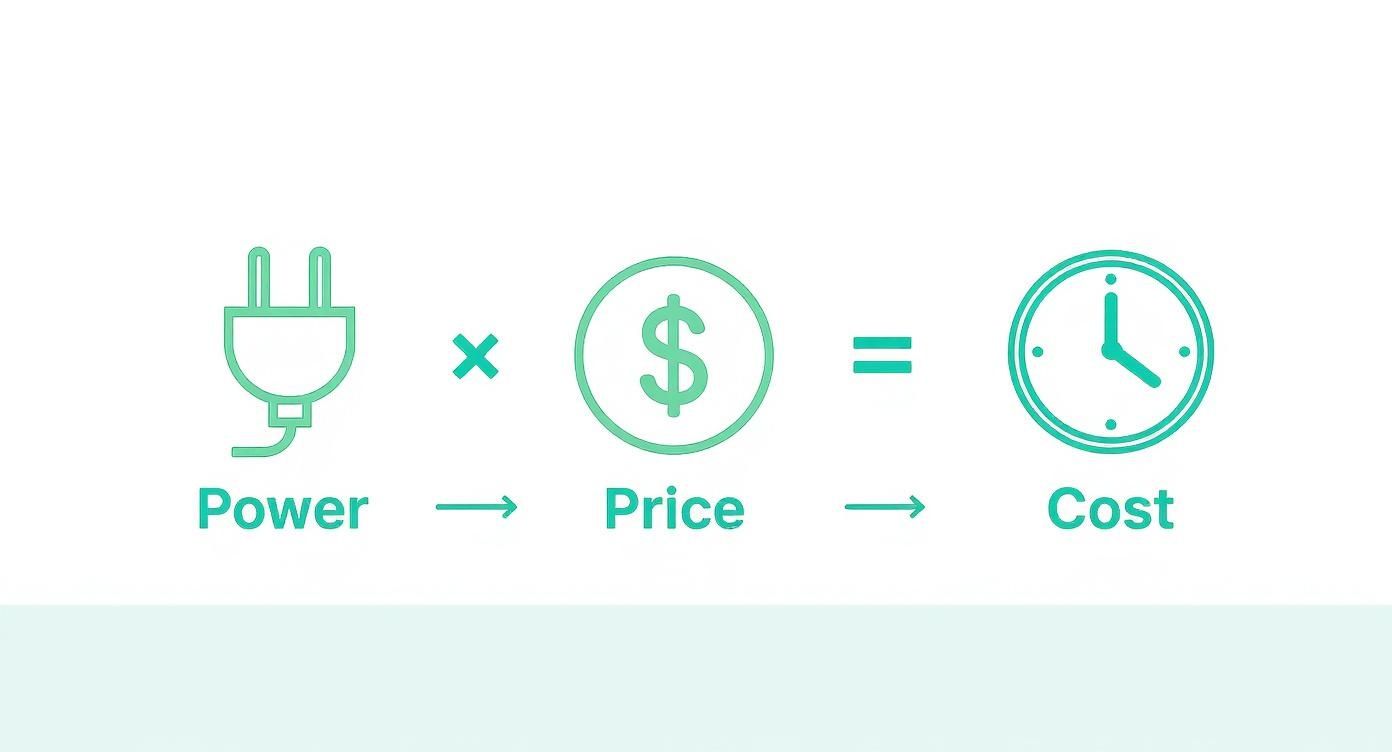
The formula makes it crystal clear: the higher a unit’s power draw, the faster the cost clock spins. It’s the perfect illustration of why system efficiency is so crucial.
Estimated Running Cost Comparison: AC System Types
To give you a clearer idea of how the numbers stack up, here is a simple comparison table. This shows what you can typically expect to pay per hour based on an average NSW electricity price of 32 cents per kWh.
| AC System Type | Typical Capacity | Estimated Cost Per Hour |
|---|---|---|
| Split System (Small) | 2.5 kW | $0.40 – $0.80 |
| Split System (Large) | 7.0 kW | $0.88 – $2.24 |
| Ducted System (Whole Home) | 14.0 kW | $1.76 – $4.48 |
| Portable AC Unit | 2.0 kW | $0.64 – $0.80 |
You’ll notice a range in the costs. That’s because modern inverter systems are smart; they use less power once the target temperature is reached. The higher figure represents the cost when the unit is working at full capacity, like when you first turn it on during a scorching afternoon. The key takeaway here? A portable unit can cost nearly as much per hour as a small split system while providing significantly less cooling power.
Seasonal Running Costs: Summer vs Winter
Running your air conditioner isn’t just a summer expense. With reverse cycle systems common in homes across Sydney and the Hunter Valley, many of us rely on them for winter warmth too. Understanding the difference in usage between seasons helps you budget for your energy bills all year round.
Summer Cooling Costs
In summer, your air con’s job is to battle external heat from the sun and high ambient temperatures. On the Central Coast, it also fights high humidity. This means on a 35°C day, your system has to work very hard to maintain a comfortable 24°C inside. You might run it for 6-8 hours a day, particularly in the afternoons and evenings. Over a 90-day summer, this intensive use adds up quickly, especially for larger ducted systems.
Winter Heating Costs
In winter, a reverse cycle system works by extracting heat from the cold outside air and transferring it inside. This process is highly efficient, often much cheaper than traditional electric heaters. However, on very cold mornings in places like the Hunter Valley, the system may need to work harder or use a supplementary element to get up to temperature. Winter usage patterns are often shorter, perhaps a few hours in the morning and a few in the evening, leading to a different cost profile than the long, continuous use in summer.
Practical Tips to Reduce Your Air Conditioning Costs
Knowing what your air conditioner costs to run is the first step, but the real goal is to bring that number down. Thankfully, you don’t need to sweat it out just to save a few dollars. We’ve gathered some of the most effective strategies our technicians recommend to homeowners across the Central Coast and Sydney to help them run their systems more efficiently.
These aren’t complicated technical fixes. They are simple, practical adjustments you can make to your daily habits and home environment that will make a noticeable difference on your next electricity bill.
Optimise Your Thermostat Settings
One of the easiest wins is setting your thermostat smartly. Many people think they need to set their air con to a chilly 18°C to feel cool, but this just forces the unit to work flat out. The sweet spot for both comfort and efficiency is usually around 24°C to 25°C. Every degree you raise the temperature can reduce your cooling costs by up to 10%. It’s a small change that makes a massive financial impact.
Instead of cranking the temperature way down when you get home to a hot house, try pre-cooling. Set your system to come on at a moderate temperature about 30 minutes before you arrive. This lets it gently bring the temperature down rather than going into overdrive to combat all that built-up heat.
Keep Up With Regular Maintenance
Your air conditioner is like any piece of complex machinery; it needs a bit of care to run at its best. A neglected system has to work much harder to do its job, which means it uses more power and costs you more money. The single most important task you can do yourself is cleaning the filters on your indoor unit every month during heavy use.
Clogged filters are the number one cause of poor airflow and inefficiency. They literally restrict the air movement, forcing the fan motor to strain and reducing the system’s cooling power. For a deeper clean and a full system health check, a professional service is essential. If you want to know what you can handle yourself and when it’s time to call in the experts, check out our handy guide on split system air conditioner maintenance.
Reduce Your Home’s Heat Load
Your air conditioner is in a constant battle against heat seeping into your home. The less heat it has to fight, the less it has to run. Simple changes here can make a huge difference, especially for homes in Sydney’s western suburbs or the Hunter Valley that face that intense afternoon sun. Here are a few ways to stop heat at the source:
- Use Blinds and Curtains: Keep them closed during the hottest parts of the day, particularly on west-facing windows.
- Seal Drafts: Check for gaps around windows and doors. Sealing these leaks stops hot air from getting in and cool air from getting out.
- Improve Insulation: Good ceiling insulation is your home’s best defence against the heat, keeping the cool air inside where it belongs.
Use Your System and Home More Strategically
Small adjustments to how you use your air con and home can lead to big savings. Pairing your air conditioner with a ceiling or pedestal fan is a highly effective strategy. The fan helps circulate the cool air more evenly, creating a wind-chill effect that makes the room feel several degrees cooler. This allows you to set the thermostat higher without sacrificing any comfort.
Straight Answers to Your AC Running Cost Questions
We get it; thinking about air conditioning costs can be a bit confusing. To clear things up, here are the answers to the questions our technicians hear most often from homeowners across the Central Coast and Sydney. This is the straightforward advice you need to get a real handle on your system.
How much does it cost to run a split system for 8 hours?
This really depends on the size of your unit and what you’re paying for power. Let’s use a real-world example. A common 2.5kW unit in a bedroom, with an electricity rate of about 32 cents per kWh, will probably cost you between $3.20 and $6.40 to run for eight hours overnight.
If you’re cooling a bigger, open-plan living area with a 7kW system, you’d be looking at something closer to $7.04 to $17.92 for that same eight-hour stretch. Keep in mind, though, that modern inverter models are smart; they ramp down their power use once the room hits your set temperature, so your actual cost is often lower than this top-end estimate.
How much does it cost to run aircon all day?
Running a medium-sized 5kW split system for 24 hours straight could cost between $15 and $38, depending on how hard it has to work. For a large 14kW ducted system, the 24-hour cost could be as high as $33 to $107. This is why it’s so important to only cool the areas you’re using and to switch the system off when you’re out.
Is it cheaper to leave aircon on all day or turn it on and off?
This is a great question, and the answer comes down to the technology in your air conditioner. For modern inverter systems, it’s almost always more efficient to set a comfortable, steady temperature (like 24°C) and just let it run. Inverter technology lets the compressor slow right down, using just a tiny bit of power to tick over and maintain the temperature.
On the other hand, constantly switching an older, non-inverter unit off and on forces it to go full-throttle every single time it starts up. That cycle of stopping and starting can chew through more power overall. Of course, if you’re heading out for most of the day, it’s always best to switch any system off completely.
How much electricity does reverse cycle heating use in winter?
Reverse cycle air conditioners are actually one of the most efficient ways to heat your home. Instead of creating heat from scratch like an old-school electric heater, they cleverly move existing heat from the outside air to the inside. Because of this process, their power usage for heating is surprisingly similar to their cooling usage.
For example, a 5kW system that costs you between 64 cents and $1.60 per hour to cool your home in summer will cost roughly the same to heat it in winter. This makes them significantly cheaper to run than traditional electric heaters. Their year-round use also has an impact on how long air conditioners last, as they’re often working through both summer and winter.
Your Local Experts in Long-Term Efficiency
Figuring out running costs is one thing, but making sure your air conditioner is efficient from day one is just as important. That all comes down to a quality installation by a local team who knows what they’re doing. A correctly sized and well-placed unit will always be cheaper to run than one that isn’t right for your space.
For over 15 years, our licensed and ARCtick certified technicians have been designing and installing energy-efficient cooling solutions for homes right across the Central Coast, Sydney, and Newcastle. We take the time to understand your specific needs, because we know a humid coastal home in Wamberal has different challenges to a home dealing with the dry heat of the Hunter Valley.
We ensure every installation is a perfect match for your home and meets all relevant Australian Standards, like AS/NZS 3000 for electrical safety. This isn’t just about ticking boxes; it’s about guaranteeing performance, your family’s safety, and getting real, long-term value from your investment. Our focus isn’t just on the setup; it’s about maximising your system’s efficiency to keep those running costs down for years to come. Thinking about a new system involves more than the purchase price. To make a smart choice, you have to weigh the initial expense against the ongoing running costs. You can find out more by reading our guide to air conditioning installation costs on the Central Coast.
Ready to find an energy-efficient cooling solution that fits your home and budget? The team at ALC Air provides expert advice and free, no-obligation quotes to help you make the smartest choice. Get in touch with us today to stay comfortable without the bill shock.