


It’s the question we hear all the time, right before a classic Aussie summer kicks in: what’s this air con actually going to cost me to run? You want to stay cool, but you don't want a nasty surprise on your next power bill.
As a starting point, a typical 3.5 kW split system will cost you around $0.34 per hour. If you run that for about eight hours a day, you’re looking at roughly $81 a month. But let's be honest, that's just a ballpark figure. Your real-world costs are going to be a different story.
Your Aircon Running Costs Answered
The final number on your power bill hinges on your specific system, how well your home holds its temperature, and of course, what you’re paying for electricity. Think of it this way: cooling a small, well-insulated bedroom in a Gosford apartment is worlds away from cooling a huge, open-plan living area in a sun-drenched Hunter Valley home.
Getting a handle on these variables is the real secret to staying comfortable without getting a shock when your bill arrives. Electricity rates can vary quite a bit across NSW. While the average might be around $0.31 per kilowatt-hour (kWh), many people in Sydney and on the Central Coast are paying closer to 35.3c/kWh. That difference adds up fast, especially when you remember that heating and cooling can easily make up a huge chunk of your home’s total energy use.
This chart gives you a quick visual on how those hourly costs can stack up over a day and a month.
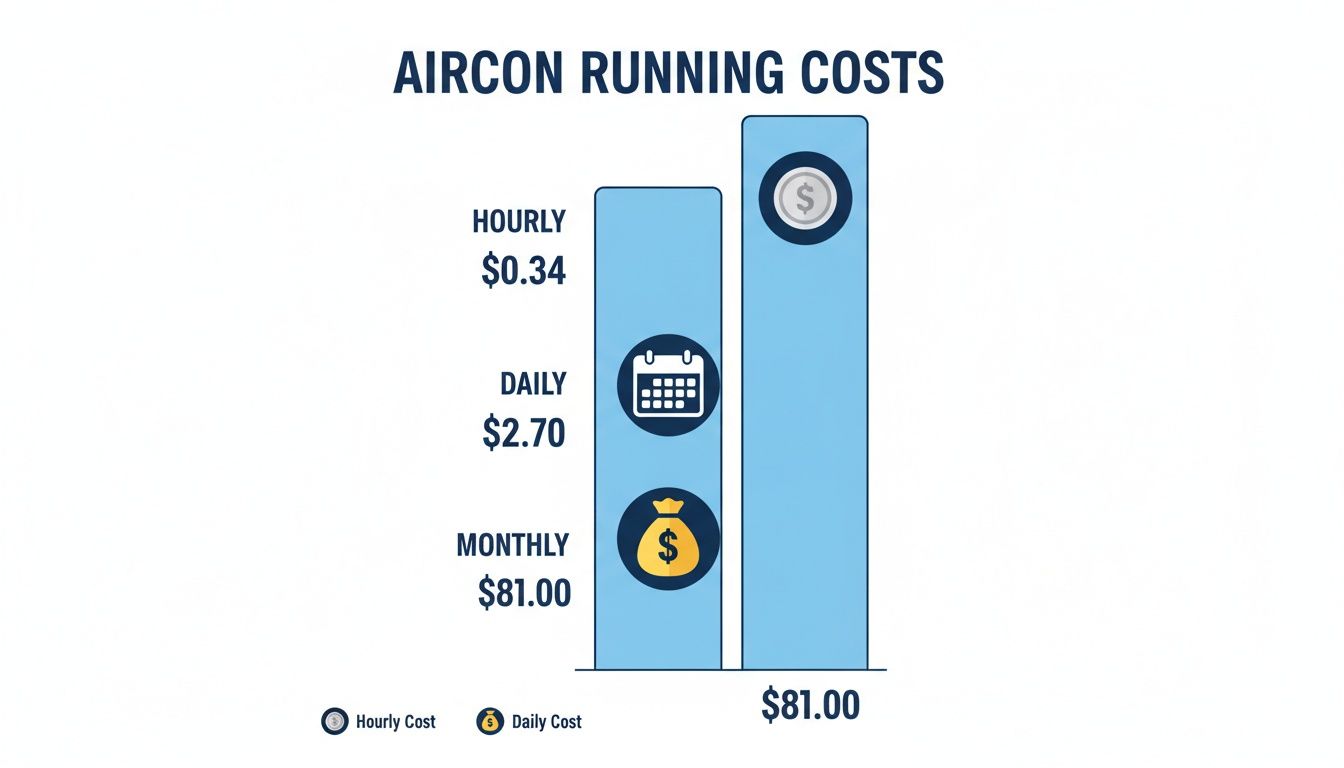
As you can see, even a small hourly cost quickly turns into a significant monthly expense. The trick isn’t to avoid using your air con, but to run it smartly. A well-maintained unit in an insulated space will deliver comfort for a fraction of the cost of an old, struggling system. Regular servicing is a massive part of this, as it directly impacts its long-term performance and how long do air conditioners last.
So, let's dive into the factors that really drive these costs and, more importantly, what you can actually do about them.
Estimated Air Conditioner Running Costs in NSW
To give you a clearer picture, we've put together a quick table. It shows the estimated running costs for some of the most common air conditioner sizes we install across the Central Coast, Sydney, and Newcastle. These numbers are based on an average NSW electricity rate of $0.35 per kWh.
| System Type and Size | Estimated Cost Per Hour | Estimated Cost Per Day (8 hours) | Estimated Cost Per Month (30 days) |
|---|---|---|---|
| Small Split (2.5 kW) | $0.25 – $0.30 | $2.00 – $2.40 | $60 – $72 |
| Medium Split (5.0 kW) | $0.45 – $0.55 | $3.60 – $4.40 | $108 – $132 |
| Large Split (7.0 kW) | $0.60 – $0.75 | $4.80 – $6.00 | $144 – $180 |
| Small Ducted (10.0 kW) | $0.90 – $1.10 | $7.20 – $8.80 | $216 – $264 |
| Medium Ducted (14.0 kW) | $1.20 – $1.50 | $9.60 – $12.00 | $288 – $360 |
| Large Ducted (18.0 kW) | $1.60 – $2.00 | $12.80 – $16.00 | $384 – $480 |
Keep in mind, these are just estimates to help you plan. The actual cost will always depend on the specific factors we're about to cover.
The Four Key Factors That Drive Your Aircon Bill
Ever looked at your power bill after a hot month and wondered why it’s so much higher than your neighbour’s? It’s rarely just one thing. Four key factors work together to determine how much it costs to run your aircon, and understanding them puts you back in control.
It all comes down to a simple combination: your unit's power draw, your electricity price, how long you run it for, and how efficiently it works. Getting a handle on these four pillars is the first step to mastering your cooling budget.
1. Power Consumption (kW)
Every air conditioner has a power consumption rating, measured in kilowatts (kW). Think of this as the raw electrical muscle the unit needs to operate at full tilt. You can usually find this number on the compliance sticker on the side of both the indoor and outdoor units.
For example, a smaller 2.5kW split system designed for a bedroom might only consume around 0.7kW of electricity. In contrast, a large 14kW ducted system built for a whole house could draw over 4kW. This rating is the foundation of any cost calculation.
2. Your Electricity Tariff ($/kWh)
Your electricity retailer charges you for power in kilowatt-hours (kWh). This is simply the price you pay for using one kilowatt of power for one hour. This rate can vary significantly depending on your provider and plan, especially across areas like Sydney, Newcastle, and the Central Coast.
A quick look at your latest power bill will show you your exact rate, often listed as cents per kWh. It might not seem like much, but a small difference in this tariff can have a huge impact on your final bill over a long, hot summer.
3. Hours of Use
This one's the most obvious factor and the one you have the most direct control over. Running your air conditioner for two hours a day versus ten hours a day will make a massive difference to your bill. No surprises there.
But it pays to think about your family's actual lifestyle. Are you cooling an empty house all day, or just using it in the evenings to make sleeping more comfortable? Your daily habits directly translate into dollars and cents. The way your system works also plays a part; you can learn more about the cooling cycle and how an aircon works to better understand its energy use.
4. Energy Efficiency (Star Rating)
Finally, we have the energy efficiency star rating. This is just like the fuel efficiency sticker on a new car. A unit with more stars uses less electricity to produce the same amount of cooling power.
An air conditioner with a high star rating might have a slightly higher purchase price, but it can save you hundreds of dollars in running costs over its lifespan. It’s a classic case of investing a little more upfront to achieve significant long-term savings. For instance, two different 7kW systems might provide the exact same cooling power, but a modern 5-star model will be far cheaper to run than an older 2-star unit. This efficiency is critical, especially when you're dealing with the humid coastal climate of the Central Coast or the intense summer heat of the Hunter Valley.
How to Calculate Your Aircon Running Costs
It’s one thing to talk about efficiency in theory, but let's get practical. You can actually work out a pretty good estimate of your air conditioner's running costs yourself with a simple formula. This puts you in control, giving you a clear idea of what to expect on your next power bill.
The formula is surprisingly straightforward:
Power Consumption (kW) × Hours of Use × Electricity Cost ($/kWh) = Total Running Cost
To see how this plays out in the real world, let’s crunch the numbers for two common scenarios. First, we'll look at a small split system keeping a bedroom cool on the Central Coast. Then, we’ll scale up to a ducted system cooling a family home in the Hunter Valley. You'll see exactly how the costs stack up depending on the system you’re running.
Scenario 1: A Central Coast Bedroom Split System
Picture this: you've got a modern 2.5kW split system in your master bedroom in Umina Beach. It's the right size for the room and you mainly use it to take the edge off those sticky, humid summer nights so you can get some decent sleep.
Here’s how we break down the calculation:
- Power Consumption: A 2.5kW system like this typically draws about 0.7 kW of electricity while it's actively cooling.
- Hours of Use: You run it for about 8 hours each night.
- Electricity Cost: Let's say your current electricity rate on the Central Coast is $0.35 per kWh.
Plugging those numbers into our formula: 0.7 kW × 8 hours × $0.35/kWh = $1.96 per night.
Over a 90-day summer, that one bedroom unit would add roughly $176.40 to your electricity bills. It really shows how even a small, efficient unit can have a noticeable impact when you use it consistently.
Scenario 2: A Hunter Valley Ducted System
Now for a different setup. Imagine a family in a larger home in Maitland, where a 10kW ducted air conditioning system is essential for dealing with the intense Hunter Valley summer heat. This system is cooling multiple rooms and runs for a decent chunk of the day. For bigger spaces like this, getting the size of the unit right is absolutely critical, which is something we cover in our guide on sizing an air conditioner.
Let's see how the costs look for this larger system:
- Power Consumption: A 10kW ducted unit might consume around 3.5 kW of power when it's running.
- Hours of Use: The family runs it for 6 hours a day to keep the main living areas comfortable.
- Electricity Cost: Their rate is also $0.35 per kWh.
Applying the same formula: 3.5 kW × 6 hours × $0.35/kWh = $7.35 per day.
Projected over that same 90-day summer, the running cost for this ducted system comes in at around $661.50. As you can see, the jump in cost is significant. It’s why things like effective zoning, good insulation, and overall system efficiency become so incredibly important in larger family homes.
These examples prove that figuring out your aircon running costs isn't some dark art. Once you understand your system's power draw and your own usage habits, you can accurately predict its impact on your budget. That knowledge lets you make much smarter decisions about how and when you use it.
How Your Home and Habits Affect Cooling Costs
The air conditioner itself is just one piece of the puzzle. How much it actually costs you to run has just as much to do with your home’s unique quirks and your family’s daily habits. These factors are the hidden drivers behind your power bill, and getting your head around them is the key to keeping your cooling expenses under control.
Think of your air conditioner as the engine and your home as the car body. A powerful engine in a leaky, un-aerodynamic car will still chew through fuel. It's the exact same principle here. Your home's insulation, window quality, and even which way it faces the sun can dramatically change how hard your system needs to work.
The Impact of Your Home's Construction
Your home's ability to hold onto cool air is the single biggest factor dictating your running costs. A well-insulated home in the Hunter Valley, for instance, will stay cool for hours, letting the aircon switch off and take a break. An uninsulated brick box, however, is constantly leaking cool air, forcing the system to run flat-out just to keep up.
This is especially true for things like:
- Insulation: Good quality ceiling and wall insulation basically turns your home into a giant Esky, trapping the cool air inside. Without it, you're pretty much trying to cool the entire neighbourhood.
- Draughts and Leaks: Gaps under doors, around old window frames, and through forgotten wall vents are like open invitations for hot air to wander in. Sealing these up can make a genuinely surprising difference.
- Sun Exposure: A house in Sydney's western suburbs with huge, west-facing windows cops a massive amount of heat in the afternoon. This 'solar gain' forces the air conditioner to work much, much harder than a home with shaded windows or a better orientation.
How Your Daily Habits Drive Up Costs
Beyond the physical structure of your home, the way you actually use your air conditioner plays a massive role in the final bill. Small, consistent habits can add up to huge savings or expenses over a summer. It’s no surprise that Australian households are projected to spend a collective $3.1 billion on air conditioning during the 2024-2025 summer. The good news is that smarter habits are making a difference, with millions of households already cutting back their energy use. You can discover more insights about these national energy trends on finder.com.au.
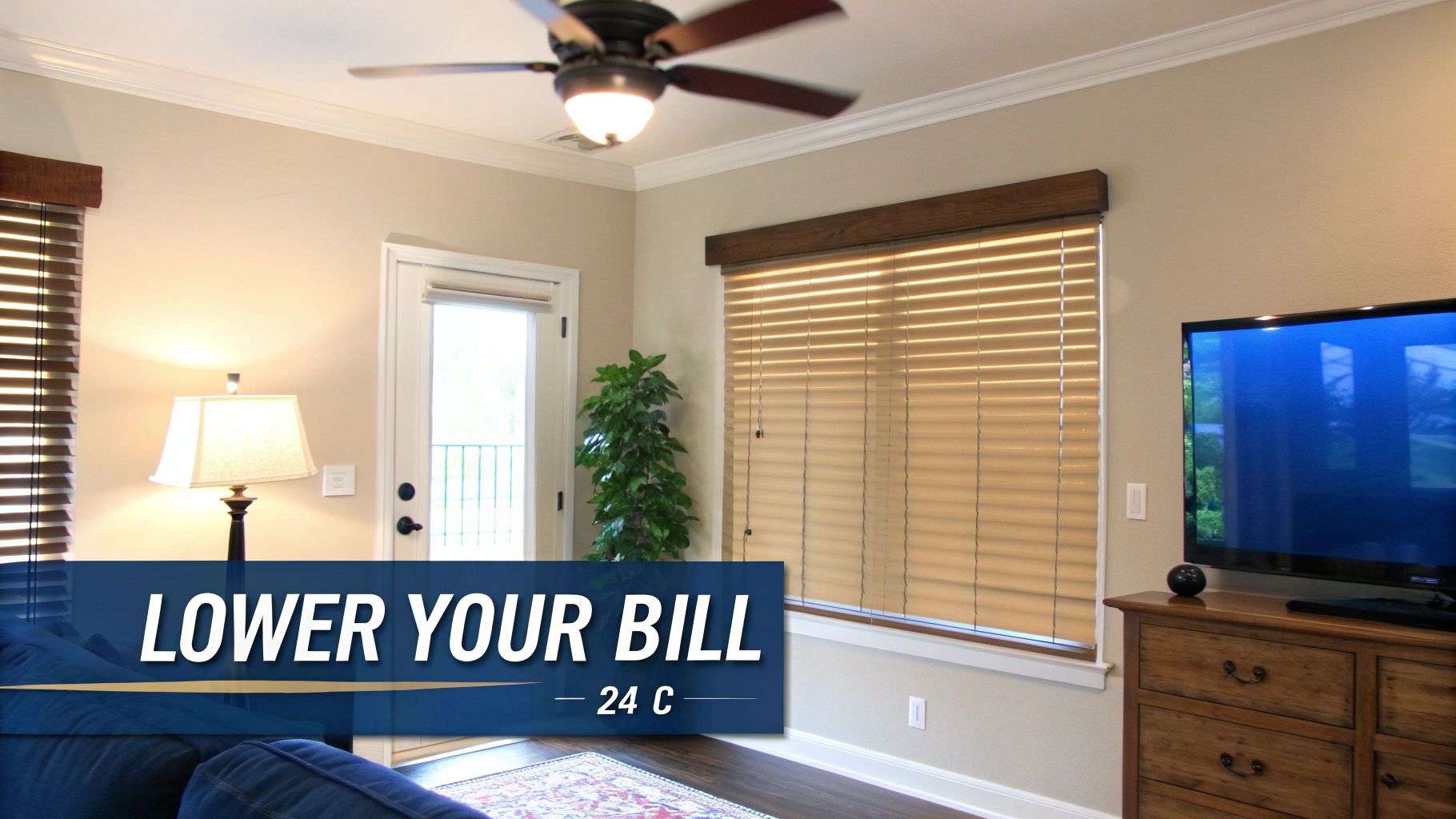
One of the biggest culprits we see is setting the thermostat way too low. A single degree change on your thermostat can alter your aircon running costs by up to 10%. Setting it to a comfortable 24°C instead of a frosty 18°C can slash your power consumption without you even noticing the difference in comfort.
This is where just being mindful comes into play. Running the aircon in an empty house or forgetting to close doors to unused rooms are common ways energy just gets thrown away. Simple actions, like closing the curtains against the afternoon sun or using a ceiling fan to help move the cool air around, let you feel just as comfortable at a higher, much more economical thermostat setting.
The Critical Role of Maintenance
Finally, never underestimate what a bit of regular maintenance can do for your running costs. A dirty, clogged air filter forces the system's fan motor to work much harder to pull air through, which directly ramps up its power draw.
Think of it like trying to breathe through a dusty cloth. The effort required is so much greater, and for your air conditioner, that extra effort translates directly into a higher power bill. Cleaning or replacing your filters every few months is one of the easiest and most effective things you can do to keep your system running efficiently and your bills in check.
Choosing the Right System to Minimise Future Costs
It’s easy to get fixated on the purchase price when you’re thinking about the cost of a new air conditioner. But here’s a piece of advice from years in the field: the cheapest unit to buy is almost never the cheapest one to run. Making a smart, informed decision upfront is the single best way to keep your future electricity bills in check and save thousands of dollars over the life of the system.
This is all about investing in long-term efficiency, not just grabbing a short-term bargain. The right system for your home will deliver consistent comfort without having to work overtime, and that’s the real secret to keeping running costs low. Whether it's a split system for a granny flat in Newcastle or a ducted solution for a large family home in Lake Macquarie, the principles of smart selection are exactly the same.
Matching the System Type to Your Home
First things first, you need to choose the right type of air conditioner for your space. Each system is designed for a specific job, and getting this wrong is a fast track to high power bills. For instance, trying to cool a whole house with several individual split systems can be far less efficient than a single, correctly zoned ducted system.
Making the right choice from the start is crucial. A well-chosen system not only lowers your running costs but also provides better comfort and lasts longer because it isn't constantly under stress. It’s the difference between a system that works efficiently and one that just works hard.
Here are the main options on the table:
- Split Systems: Perfect for cooling a single room or a specific area, like a living room or master bedroom. They are efficient and affordable for targeted cooling.
- Multi-Split Systems: These connect multiple indoor units to a single outdoor unit. They offer individual room control and are a great solution for apartments or homes where ductwork isn't practical.
- Ducted Air Conditioning: The ideal choice for whole-home climate control. A central unit distributes cool air via ducts, letting you cool multiple rooms or zones at once with maximum efficiency.
Our guide on choosing the best air conditioner for your home dives deeper into these options to help you decide.
The Goldilocks Rule: Why Sizing is Crucial
Getting the system size (its kW capacity) right is absolutely essential. This isn't a case of ‘bigger is better’. An oversized unit will blast the room with cold air, cool it down too quickly, and then shut off. This process, known as short cycling, is incredibly inefficient. The constant starting and stopping uses a huge amount of power and puts massive wear and tear on the compressor.
On the other hand, an undersized unit will run constantly at maximum power, desperately trying to reach the temperature you’ve set. On a hot day, it will never get there, leaving you uncomfortable while it chews through electricity. The correctly sized unit, however, is the ‘just right’ option. It will cool the space efficiently and then tick along quietly, maintaining the temperature with minimal effort.
Inverter Technology: The Secret to Modern Efficiency
If there’s one feature you need to look for to manage running costs, it’s inverter technology. Think of it like the accelerator pedal in your car. Older, fixed-speed air conditioners were either on (full power) or off, there was no in-between. An inverter system, however, can adjust the speed of its compressor motor.
Once your room reaches the right temperature, an inverter unit slows right down, using just enough energy to maintain it. This completely avoids the power-hungry stop-start cycle of older models and can cut your running costs by up to 50%. This efficiency gain has been a real improvement. Between 2000 and 2012, as air conditioner ownership in Australia nearly doubled, it was these improvements in energy efficiency that helped manage the growth in energy demand. You can read the full research about these efficiency gains.
Honestly, investing in an inverter model is a non-negotiable for anyone serious about keeping their power bills down.
Practical Tips to Reduce Your Aircon Bill Today
Knowing how your air conditioner uses power is one thing, but putting that knowledge into practice is how you actually save money. You don't need to sweat through summer just to keep your electricity bill under control. By adopting a few smart habits, you can make a real dent in your aircon running costs without sacrificing comfort.
These aren't complicated technical fixes. They are simple, actionable strategies that anyone can start using today. From being smarter with your thermostat to making friends with your ceiling fan, each tip helps your system work more efficiently, not harder.
Find Your Temperature Sweet Spot
One of the easiest wins is being realistic with your thermostat. It’s tempting to crank it down to a chilly 18°C on a scorching day, but your system has to work incredibly hard, and use a ton of power, to get there.
Setting your thermostat to a comfortable but sensible 24°C is widely seen as the ideal balance between comfort and energy efficiency. Remember this: every single degree you increase the temperature can slash your running costs by up to 10%. You’ll barely feel the difference, but you will definitely see it on your power bill.
Make Friends with Your Ceiling Fan
Your ceiling fan and air conditioner are a powerful team. A fan uses just a tiny fraction of the electricity your aircon does, but it makes a huge difference to how cool you feel.
The fan circulates the cool air produced by your aircon, creating a gentle wind-chill effect on your skin. This simple trick allows you to set your thermostat a few degrees higher, say, 25°C or 26°C, while feeling just as comfortable as you would at 22°C. It’s a smart way to keep costs down by letting the air conditioner do less of the heavy lifting.
Block Out the Afternoon Sun
That beautiful afternoon sun streaming through your windows also brings a massive amount of heat into your home. This is particularly true for homes in Sydney’s western suburbs or the Hunter Valley that have large west-facing glass doors or windows.
This extra heat forces your air conditioner to run longer and harder just to maintain the set temperature. The solution is simple: close your blinds or curtains during the hottest part of the day. This physical barrier can block a surprising amount of solar heat, keeping your rooms cooler and giving your air conditioner a much-needed break.
Use Timers and Smart Controls
Most modern air conditioners come with timers, sleep modes, or even Wi-Fi controls you can manage from your phone. These features are your best friends for cutting down on wasted energy.
Instead of running the aircon all night, set a timer for it to turn off a few hours after you’ve fallen asleep. You can also program it to switch on half an hour before you get home from work, so you walk into a cool house without having paid to cool an empty one all day. Using these smart features ensures you only use the system when you actually need it.
Don't Neglect Professional Servicing
Finally, one of the most effective ways to guarantee efficiency is through regular professional maintenance. Over time, dust and debris build up on coils and clog filters, forcing the system to work much harder to cool your home.
A clean, well-maintained air conditioner can be up to 15% more efficient than a neglected one. This isn't just about preventing breakdowns; it's about ensuring the unit is running at its peak performance, just as the manufacturer intended. An annual service by a licensed technician makes sure all components are clean, refrigerant levels are correct, and the system is operating safely. If you’d like to understand what’s involved, our guide to professional air conditioning maintenance explains the benefits in more detail. It’s a small investment that pays for itself in lower running costs and a longer system lifespan.
Still Have Questions About Aircon Running Costs?
We’ve covered a lot of ground, but it’s the practical, day-to-day questions that often come up when you’re thinking about your power bill. Here are some of the most common queries we hear from homeowners across the Central Coast, Sydney, and Newcastle.
Is It Cheaper to Leave Aircon on All Day?
This is a great question, and the answer depends on your system. With a modern inverter air conditioner, it’s almost always more efficient to set a comfortable temperature (say, 24°C) and just let it run. Inverter technology is smart; once the room is cool, the system slows right down and sips power to maintain the temperature.
If you’re still using an older, non-inverter unit, constantly turning it on and off forces it to blast at maximum power every single time. That cycle of stopping and starting often chews through more energy than just leaving it on.
Does Dry Mode Use Less Electricity?
Yes, absolutely. Running your aircon in ‘Dry’ or ‘Dehumidify’ mode uses significantly less power than the standard ‘Cool’ setting. The system’s focus shifts from aggressively chilling the air to simply pulling moisture out of it.
This is a real help on those humid, sticky days we get all along the coast. Reducing the humidity makes the air feel much cooler and more comfortable, and it does it for a fraction of the cost.
How Much Can Regular Maintenance Save Me?
Proper, professional maintenance can boost your air conditioner's efficiency by 5% to 15%. Think about it: a system with clogged filters and grimy coils is trying to breathe through a straw. It has to work much harder, drawing more power and driving up your bill just to do its job.
An annual service from an ARCtick licensed technician is one of the smartest investments you can make. It ensures the unit runs exactly as the manufacturer designed it to, saving you money and helping it last years longer.
Ready to take control of your cooling costs with a system that's perfectly matched to your home? The team at ALC Air has over 15 years of experience providing energy-efficient solutions across the Central Coast, Sydney, and Newcastle. Contact us today for a free, no-obligation quote and expert advice.