


Figuring out exactly how much your air con adds to your power bill can feel like a bit of a guessing game. Is it really the biggest energy hog in your home? How much does one sweltering afternoon in the Hunter Valley actually set you back?
The good news is that working out a realistic estimate is surprisingly straightforward once you know what to look for. For a quick idea, a common split system air conditioner in a Sydney home will typically cost somewhere between $0.36 and $0.70 per hour to run.
Let’s break down how you can calculate this for your own system so you can feel more in control of your power bills.
Your Quick Guide to Air Con Running Costs
The most important term you'll see on your power bill is the kilowatt-hour (kWh). This is simply the unit of energy your electricity provider uses to charge you for power consumption.
Think of it this way: if you run a 1kW appliance for a full hour, you’ve used one kilowatt-hour of electricity. Your power bill shows your "tariff," which is the rate you pay for each kWh you use.
The Basic Formula for Running Costs
To get a handle on your air con's running costs, you only need three pieces of information, and we can help you find them.
- System Power Consumption (in kW): You’ll find this on the unit’s specification sticker.
- Hours of Use: A simple estimate of how long you run the system each day.
- Your Electricity Tariff (in cents per kWh): Just check your latest power bill for this rate.
Multiply these three numbers together, and you've got your daily running cost. It's as simple as that.
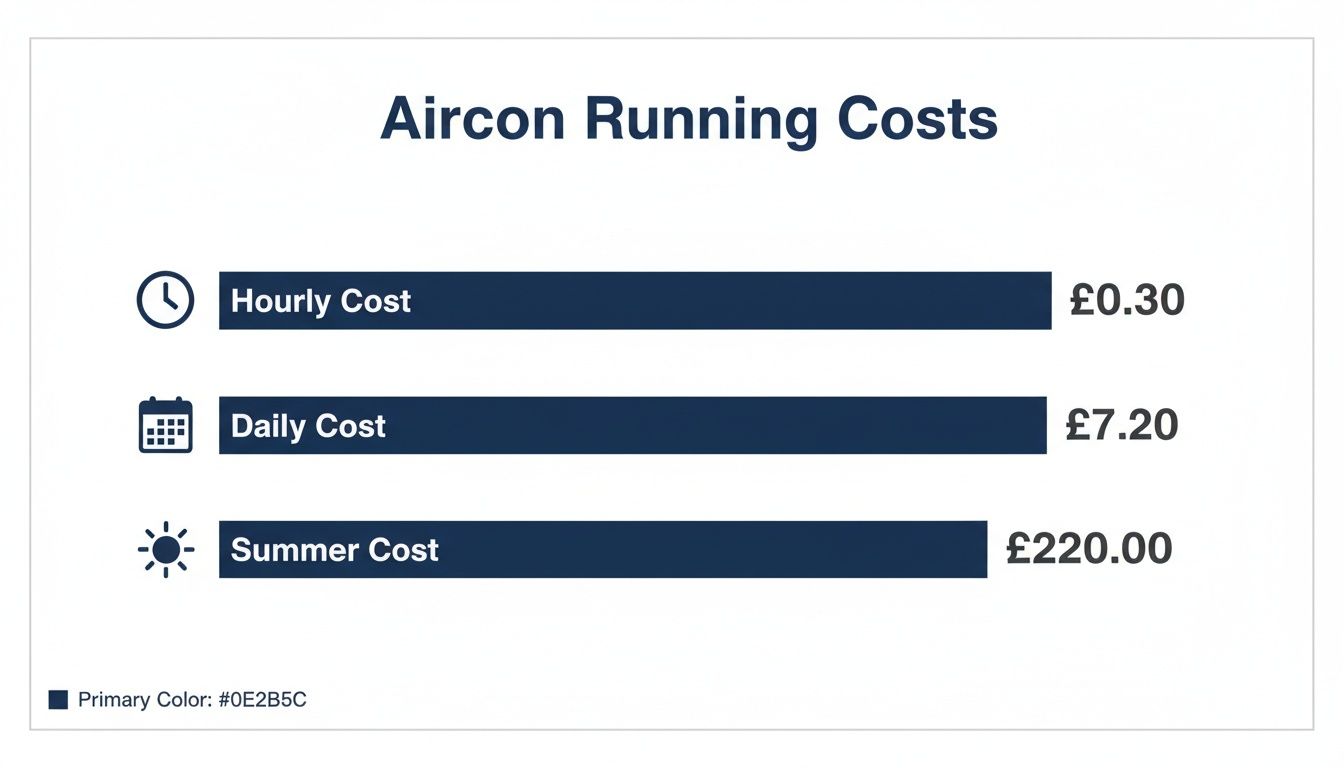
To give you a clearer picture, this table shows some realistic running costs for different system sizes, from hourly to seasonal.
Estimated Air Conditioner Running Costs at a Glance
This table gives a quick estimate of hourly, daily (based on 8 hours of use), and seasonal (90 days) running costs for different air conditioner sizes. These figures are based on an average NSW electricity tariff of $0.32/kWh.
| System Size (Cooling Capacity) | Approximate Hourly Cost | Approximate Daily Cost (8 Hours) | Approximate 90-Day Summer Cost |
|---|---|---|---|
| Small Split System (2.5kW) | $0.24 – $0.32 | $1.92 – $2.56 | $172 – $230 |
| Medium Split System (5kW) | $0.48 – $0.64 | $3.84 – $5.12 | $345 – $460 |
| Large Split System (7kW) | $0.67 – $0.89 | $5.36 – $7.12 | $482 – $640 |
| Small Ducted System (10kW) | $0.96 – $1.28 | $7.68 – $10.24 | $691 – $921 |
| Large Ducted System (14kW) | $1.34 – $1.79 | $10.72 – $14.32 | $964 – $1,288 |
As you can see, even small hourly costs can add up significantly over a 90-day summer. This is why choosing an efficient system is so important for keeping those power bills in check.
Real-World Cost Scenarios
Let's put this into a real-world context. A standard split system in an average Australian home costs between $0.36 and $0.70 per hour at current electricity rates.
For a small 2.5kW unit perfectly suited to a bedroom, you're looking at the lower end of that scale. However, a larger 7kW unit needed for a main living area in a Central Coast home will push that cost up closer to the higher end.
If you’re running a 10kW ducted system to cool multiple rooms, you could be looking at costs of around $1.40 to $1.70 per hour.
If you're curious about the mechanics behind all this, you can learn more about how an air conditioner works in our detailed guide.
The Three Key Factors Driving Your Air Con Bill
While that simple formula gives you a good starting point, understanding why your air con bill looks the way it does really comes down to three main things. Getting your head around these is the key to managing your running costs so you can stay comfortable without the shock of a massive power bill.
It all boils down to the system you're running, your daily habits, and the electricity plan you're on. Let’s look at how each one plays a huge part in what you actually pay each month.

1. Your Air Conditioner's Size and Type
The first and most obvious factor is the machine you’re actually using. The energy difference between a small split system and a massive ducted unit is night and day, and getting the right size for your space is the foundation of efficiency.
Picture this scenario. Cooling a small bedroom in a Newcastle apartment might only need a 2.5kW split system. It’s a small unit designed for a specific, enclosed space, and it will sip power to keep that room comfortable.
Now, compare that to a large two-storey family home out in the Hunter Valley, where summer heat can be relentless. That property would need a much more powerful 14kW ducted system to cool the entire house. This system has a far bigger appetite for power and will naturally cost more to run per hour, even when it's working perfectly.
A system that's too big or too small for the job will be inefficient and expensive, which is why getting a professional to size it for your specific home is so important.
2. Your Usage Habits and Lifestyle
How and when you use your air con has a massive impact on your final bill. Your daily routine and what temperature you find comfortable are just as important as the system’s specifications.
For example, think of a family living in a west-facing home in Penrith, one of Sydney's real hot spots. If they crank their air con from midday until late at night to fight off that intense afternoon sun, their daily running hours will stack up fast, leading to a hefty bill.
Now, consider a household on the Central Coast that mainly uses their system for a few hours in the evening just to take the edge off before bed. Their daily usage is way lower, and their costs will reflect that. Your lifestyle is what determines the "hours of use" part of the cost equation.
On top of that, your thermostat setting plays a huge role. Setting it to a frosty 18°C forces the unit to work much harder than a comfortable 24°C, potentially adding up to 10% to your energy use for every single degree. Regular filter cleaning and professional servicing also make sure your system is running at its best. Neglecting it is a sure way to drive up your costs, which you can read more about in our guide to aircon servicing and maintenance.
3. Your Electricity Tariff and Plan
Finally, the rate you actually pay for your electricity is the last piece of the puzzle. This isn't a fixed number across NSW; it changes between energy retailers and can even depend on what time of day you’re using the power.
A major factor here is understanding your electricity plan, especially when you use your air conditioner. Many providers have "time-of-use" tariffs, where electricity costs more during peak demand hours (usually afternoons and evenings) and less during off-peak times. Knowing your peak and off-peak electricity tariffs can help you make much smarter decisions.
Firing up your system during that peak afternoon period will cost you a lot more per hour than running it late at night. By getting a handle on these three things, your system, your habits, and your tariff, you can take real control of your air conditioning costs.
Calculating Costs for Different Air Con Systems
Now that you know the basic formula, let's get practical and apply it to the kinds of systems we install across the Central Coast and Sydney every day. Knowing what to expect in running costs helps you choose a system that fits both your home and your budget, so you don't get a nasty surprise on your first summer power bill.
We'll run through some real-world scenarios for the most common setups: the trusty split system for cooling a single room, and the powerful ducted system for whole-home comfort. Breaking down the numbers will show you what an air con actually costs to run in different situations.
Split System Running Costs: A Realistic Scenario
Split systems are the go-to choice for cooling specific areas, like a lounge room or master bedroom. They’re efficient, effective, and offer great value.
Let's picture a typical, open-plan living area in a Terrigal home that gets a lot of afternoon sun. A properly sized 7kW split system would be a perfect fit here. Based on its power input and current electricity rates, you could expect this unit to cost you somewhere between $0.70 and $0.90 per hour when it's running flat out to cool the room down.
But here’s the thing: it won't always be running at maximum power. This is where modern technology makes a huge difference to your energy bills.
The Power of Inverter Technology
Almost all modern air conditioners use inverter technology, and understanding this is the key to seeing why they're so efficient. Think of an old, non-inverter air con like a light switch, it’s either 100% on or 100% off. It blasts cold air until it hits the target temperature, then shuts down, only to repeat the cycle with another energy-guzzling startup.
Inverter technology works more like the cruise control in your car. It gets you to your desired temperature quickly, then eases off, running continuously at a much lower power level just to maintain it. This clever process avoids the constant stop-start energy spikes, which can slash your running costs by 30% or more.
This smarter operation means your 7kW unit won't be drawing maximum power all the time, which brings its average hourly cost down significantly.
Ducted System Running Costs: A Whole-Home Example
For those needing to cool an entire house, a ducted system is the ultimate solution. These systems are bigger and more powerful, so their running costs are naturally higher, but clever use can make them surprisingly economical.
Take a typical family home in a Sydney suburb like Hornsby, which would likely need a 12kW ducted system. At full tilt, this unit could cost between $1.20 and $1.60 per hour. While that sounds like a lot, you rarely need to cool the entire house at once.
This is where zoning comes into play. A well-designed ducted system divides your home into different zones, maybe separating the bedrooms from the living areas. By only switching on the zones you're actually using, you can dramatically cut your expenses. Cooling just the living area during the day or only the bedrooms at night means the system isn't working nearly as hard, bringing that hourly cost right down.
For a deeper dive into these two popular options, check out our guide comparing ducted air conditioning vs split systems.
In NSW's balanced climate, a typical 5-8kW split system for a large living area draws about 2.3kW of power, costing roughly $0.82 per hour. This scales up for 10-12kW ducted setups, which might cost around $1.26 per hour for the whole home.
To get a better handle on how your air con contributes to your overall electricity bill, it’s helpful to understand the general principles of how to calculate energy consumption in your home. This knowledge empowers you to manage your entire household's energy footprint more effectively.
The Hidden Factors That Can Really Inflate Your Running Costs
That simple calculation based on your air con’s specifications is a great starting point, but it doesn't paint the whole picture. Your home is a complete system, and a bunch of other factors can force your air conditioner to work much harder and longer than it should, quietly adding hundreds to your power bill.
Getting a grip on these hidden influences is the key to understanding what your air con really costs to run. Let's dig into the common culprits we see in homes from the Central Coast to the Hunter Valley that can blow out your cooling expenses without you even noticing.
Your Home's Thermal Envelope
The first place to look is your home's ability to actually hold onto the cool air you're paying for. A poorly sealed house is like trying to fill a bucket with a hole in it; your air conditioner is constantly fighting a losing battle to replace the cool air that’s leaking out.
Several key things contribute to this problem:
- Poor Insulation: Inadequate ceiling or wall insulation is a huge one, especially in older homes around Newcastle or Lake Macquarie. It allows the summer heat to just radiate straight into your living spaces, forcing your air con to run non-stop just to keep up.
- Single-Glazed Windows: A massive amount of heat blasts through glass. Single-glazed windows, particularly those facing west in suburbs like Penrith, basically act like giant radiators, pushing your system into overdrive every hot afternoon.
- Draughty Doors and Windows: Those small gaps around door and window frames might seem minor, but they add up to a constant flow of warm air sneaking into your home. This forces your system to work so much harder just to maintain the temperature you've set.
Basically, your air conditioner isn't just cooling the air inside; it's also fighting a constant war against the heat penetrating your home's shell. Improving your insulation and sealing up draughts is one of the single most effective ways to lower your running costs.
Where Your Outdoor Unit Is Placed Matters
The spot where your outdoor unit (the condenser) gets installed has a direct and significant impact on its efficiency and, therefore, your power bill. This is the part of the system that does the hard work of dumping the heat from inside your home into the outside air.
Imagine this scenario: an outdoor unit is installed on a concrete slab right where it gets blasted by the direct western sun all afternoon. That unit is trying to expel heat into an already scorching environment, which makes it work dramatically harder and chew through more power.
An outdoor unit needs good airflow and a bit of shade to do its job efficiently. A condenser baking in the sun has to work much, much harder than one placed in a shaded, well-ventilated spot on the south or east side of a property. This simple choice during installation can make a noticeable difference to your running costs, year after year.
Your Thermostat Setting and Daily Habits
Your own habits are one of the biggest variables in the whole equation. The temperature you punch into the remote can have a surprisingly massive effect on your energy consumption.
It’s tempting to crank the thermostat down to an icy 18°C on a scorching day, but that's a very expensive habit. For every single degree you lower the temperature, you can increase your running costs by up to 10%.
Setting it to a more comfortable and realistic 24°C will still keep you perfectly cool while being far, far more energy-efficient.
The Hidden Cost of Neglected Maintenance
Finally, one of the most common and easily avoidable problems is simply a lack of basic maintenance. Your air conditioner's filters are its first line of defence, trapping all the dust and junk floating around in the air.
When these filters get clogged with grime, airflow is restricted. This forces the system's fan motor to work harder and seriously reduces the unit's ability to cool your home, meaning it has to run for longer just to achieve the same result. A clogged filter can slash your system's efficiency by up to 15%.
Regularly cleaning or replacing your filters is a simple five-minute job that has a direct and immediate impact on your power bill. You can learn more by reading our guide on how to clean a ducted air conditioner filter the right way.
How Professional Sizing and Installation Minimise Lifetime Costs
Choosing the cheapest quote for an air conditioning installation might feel like a savvy move upfront, but it’s often a decision that costs you far more in power bills for years to come. Getting the system size and installation right from day one is the single most important factor in managing your running costs over the unit's entire life. It’s an investment in long-term efficiency, not just a purchase.
When an air conditioner isn't the right fit for your home, its performance suffers badly. An undersized unit will run flat out, constantly struggling to reach the temperature you've set. This non-stop operation absolutely chews through electricity and puts huge strain on the components.
On the flip side, an oversized unit will "short cycle"—blasting cold air too quickly, shutting off, and then firing up again moments later. This constant stop-start cycle is incredibly inefficient and causes premature wear and tear.
This is where the expertise of a licensed and ARCtick certified team becomes invaluable. A qualified technician doesn't just guess what size you need; they perform a detailed load calculation to ensure the perfect fit for your home.

The Importance of a Proper Load Calculation
A proper load calculation is a methodical assessment that considers every single factor influencing your home's cooling needs. It’s a lot more involved than just measuring the floor area of a room.
Our technicians analyse several key elements:
- Room dimensions and ceiling height to figure out the total volume of air that needs cooling.
- Window size and orientation, paying special attention to north or west-facing glass that lets in that intense afternoon sun.
- Local climate conditions, whether it's the humid coastal air of the Central Coast or the dry, extreme heat of the Hunter Valley.
- Your home's insulation levels in the ceiling and walls, which dictates how well it holds onto that precious cool air.
By looking at all these variables together, we can recommend a system with the precise kW capacity to cool your space efficiently without wasting a cent on energy. You can get more details on this process in our guide about how to size an air conditioner for your room.
Why Quality Installation is Non-Negotiable
Even the most perfectly sized, high-efficiency system will run poorly if it isn't installed correctly. A professional installation is about more than just mounting units on the wall; it's about optimising the entire system for peak performance and safety, following Australian Standards like AS/NZS 3000 for electrical work to the letter.
A licensed installer makes sure refrigerant levels are charged correctly, a critical step for efficiency. They also ensure the indoor and outdoor units are positioned for the best possible airflow and that all electrical connections are safe and compliant. This meticulous approach guarantees your system runs exactly as the manufacturer intended, keeping your bills low and preventing costly breakdowns.
With Australians spending a staggering $12.4 billion on air conditioning energy bills in a single year, the financial impact of inefficient systems is enormous. It highlights just how crucial it is to invest in efficient reverse cycle units that are correctly sized and professionally installed. Investing in a quality setup is simply the smartest way to manage your energy costs over the life of your air conditioner.
Frequently Asked Questions About Air Con Running Costs
We hear the same questions from homeowners all the time, whether they're in Sydney, up in Newcastle, or right here on the Central Coast. Getting your head around an air conditioning bill can be tricky, so we've put together some straight answers to help you get a handle on your energy use.
Is It Cheaper To Leave My Air Con on All Day?
With modern inverter systems, it’s generally more efficient to set a comfortable temperature, say 24°C, and just let it run. The inverter technology works a bit like cruise control in your car, it gently adjusts its power to hold that temperature steady.
Constantly turning an older, non-inverter unit on and off is a different story. Those systems create huge power spikes every time they start up, which chews through electricity. That said, if you're heading out for several hours, it's always best to switch any system off completely.
How Much Can I Save with a New Energy Efficient Model?
The savings can be genuinely significant. When you upgrade from an old, power-hungry unit to a new high-efficiency model, you can expect to slash your cooling energy use by 30-50%.
For a typical family in the Sydney region, that could easily translate to saving several hundred dollars every year. With electricity prices always on the rise, the time it takes for a new, efficient unit to pay for itself is often much shorter than most people think.
Does Heating Cost More Than Cooling?
Not necessarily. In fact, reverse cycle air conditioners are incredibly efficient at heating. This is because they aren't creating heat from scratch like a bar heater does; instead, they cleverly move existing heat from the outside air into your home.
A system with a high Coefficient of Performance (COP) can produce 3 to 5 units of heat for every one unit of electricity it consumes. Given the mild winters we get across coastal NSW, this is often the cheapest way to keep your home warm.
What Is the Most Important Thing I Can Do to Keep Costs Low?
Without a doubt, it's regular maintenance. This is the single most effective thing you can do.
Just cleaning your filters every few months is a simple job that can boost your unit's efficiency by up to 15%, which makes a massive difference to your bill. Beyond that, a professional service from a licensed technician is crucial. They'll clean the coils, check refrigerant levels, and make sure everything is running safely and efficiently. A well-maintained unit simply costs less to run and lasts a lot longer.
Ready to get control of your air conditioning costs with an efficient, professionally installed system? The team at ALC Air provides expert advice and free, no-obligation quotes to find the perfect solution for your home or business.