


When you switch on your air conditioner on a sweltering Central Coast summer day, it feels like magic. But it’s not actually creating cold—it’s moving heat. Your aircon acts like a powerful heat sponge, soaking up warmth from inside your home and dumping it outside, all thanks to a special fluid called refrigerant. This process is known as the refrigeration cycle, and it’s the secret behind how every single air conditioner works.
The Secret to Cool Air: How Your Aircon Really Works
Ever wondered how that crisp, cool air actually flows out of your split system on a 35-degree day in Western Sydney? It all comes down to a clever, continuous four-stage process that manipulates basic physics to make your home comfortable. The entire cycle is designed to do one job: grab heat from one place (your living room) and release it somewhere else (your backyard).
This process is surprisingly efficient, especially in modern systems. Given that heating and cooling can account for around 40% of an average Aussie household's energy bill, we believe understanding how this cycle works is the key to using your system efficiently and keeping those power bills in check.
Your Aircon's Four Key Stages
At the heart of your air conditioner is the refrigeration cycle, which depends on that special refrigerant fluid. This substance has a unique ability to change from a liquid to a gas and back again at different temperatures and pressures, absorbing and releasing a huge amount of heat along the way.
It’s a constant loop, ensuring consistent cooling for as long as your system is running.
Most modern units in Australia are reverse cycle, which simply means they can run this process in both directions. In winter, they absorb the small amount of heat available in the cold outside air and bring it inside to warm your home. It's an incredibly effective way to manage your climate year-round. You can dive deeper into how reverse cycle heating and cooling works in our dedicated guide.
This diagram shows the basic flow of heat during the cooling cycle.
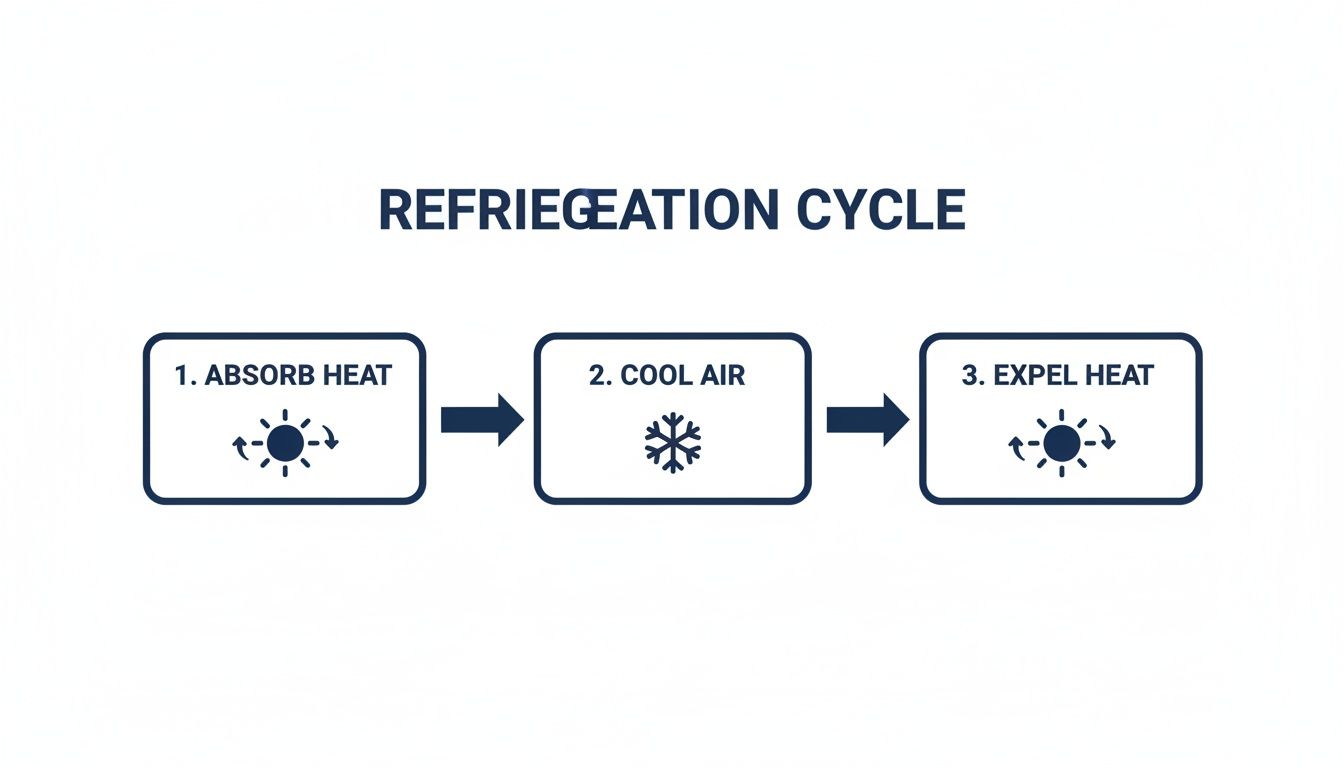
As you can see, it’s all about heat transfer. The system absorbs the unwanted warmth from your indoor air, processes it through the refrigeration cycle, and then expels that heat outdoors, leaving your home perfectly cool.
The Four Key Stages of Your Air Conditioner's Cooling Cycle
To make this even clearer, let's break down exactly what's happening at each point in the cycle. Think of the refrigerant as a tiny heat-delivery truck, constantly picking up a load of heat inside your house and dropping it off outside.
| Stage | What Happens to the Refrigerant | Location |
|---|---|---|
| 1. Evaporation | A cold, low-pressure liquid absorbs heat from your indoor air and boils into a gas. | Indoor Unit (Evaporator Coil) |
| 2. Compression | The gas is squeezed, dramatically increasing its temperature and pressure. | Outdoor Unit (Compressor) |
| 3. Condensation | The hot, high-pressure gas releases its heat to the outside air, turning back into a liquid. | Outdoor Unit (Condenser Coil) |
| 4. Expansion | The high-pressure liquid passes through a tiny valve, causing it to rapidly cool and drop in pressure. | Between Outdoor & Indoor Units |
This four-step journey repeats over and over, continuously pumping heat out of your home. It’s a simple but brilliant process that keeps you comfortable no matter how hot it gets outside.
Meet the Hardworking Parts Inside Your Air Conditioner
To really get your head around how your aircon works, you need to meet the key players. Don't think of it as one single machine, but as a team of four critical parts working in perfect sync to shift heat from where you don't want it to where it doesn't matter. It’s like a relay race, where each component hands off the refrigerant to the next in a continuous, powerful cycle.
This team is split between the indoor unit on your wall and the outdoor unit humming away in your yard. Together, they run the four stages of the refrigeration cycle we just talked about, keeping your home comfortable whether it’s a scorching summer day in Newcastle or a chilly winter morning on the Central Coast.
The Indoor Champion: The Evaporator Coil
The whole process kicks off inside your home at the evaporator coil. Tucked away in the indoor unit, this network of copper tubes is where the cooling magic really happens. As your system’s fan pulls in warm air from your room, it blows it across these incredibly cold coils.
Inside those coils, the low-pressure liquid refrigerant is primed and ready. The warmth from your room's air is all it needs to boil and evaporate into a gas, think of it like water turning to steam on a hot pan. In doing so, it acts like a sponge, soaking up a huge amount of heat and humidity from the air. The now-chilled, drier air is then pushed back into your room, creating that refreshing cool you feel.
The Powerhouse: The Compressor
Once the refrigerant has done its job and turned into a gas, it travels through pipes to the outdoor unit. This is where it meets the heart of the system: the compressor. This is the hardworking engine of your air conditioner, and its one and only job is to take that cool, low-pressure gas and squeeze it. Hard.
This compression process dramatically boosts the refrigerant’s pressure and temperature, turning it into a very hot, high-pressure gas. By packing all that heat it just collected from your living room into a much smaller space, the compressor makes it much easier to get rid of. That humming noise you hear from the outdoor unit? That’s the sound of the compressor doing the heavy lifting.
The Heat Exchanger: The Condenser Coil
Still in the outdoor unit, that hot, high-pressure gas now flows into the condenser coil. It looks a lot like the evaporator coil inside, but it does the complete opposite job. As the super-hot gas zips through its tubes, a big fan pulls in the cooler outside air and blows it across the coil.
This is the moment of release. The refrigerant dumps all the heat it absorbed from inside your home out into the atmosphere. As it sheds its heat, the refrigerant condenses back into a high-pressure liquid. This is exactly why you feel warm air blowing from your outdoor unit, it's the unwanted heat from your house being successfully kicked out.
Why It Matters: Efficient heat exchange here is vital. If your outdoor unit is clogged with leaves, dirt, or blocked by shrubs, it can't release heat properly. This forces the compressor to work much harder, driving up your power bills and putting the whole system at risk of a breakdown.
The Final Step: The Expansion Valve
The final team member is the expansion valve, a tiny but absolutely critical component that gets the refrigerant ready for its journey back inside. The high-pressure liquid refrigerant from the condenser is forced through this very narrow opening, causing a sudden, massive drop in pressure.
This rapid depressurisation makes the liquid refrigerant intensely cold again, much colder than the air inside your home. It’s now perfectly prepped to return to the evaporator coil and start the entire heat-absorbing cycle all over again. This constant loop is what allows your air conditioner to deliver continuous, reliable cooling.
Split, Ducted, and Reverse Cycle: What's the Difference?
When you start looking for an air conditioner in Australia, you'll quickly run into three key terms: split systems, ducted systems, and reverse cycle. Understanding what these actually mean is the first step to choosing the right solution for your home, whether that's a Sydney apartment, a family home on the Central Coast, or a larger property in the Hunter Valley.
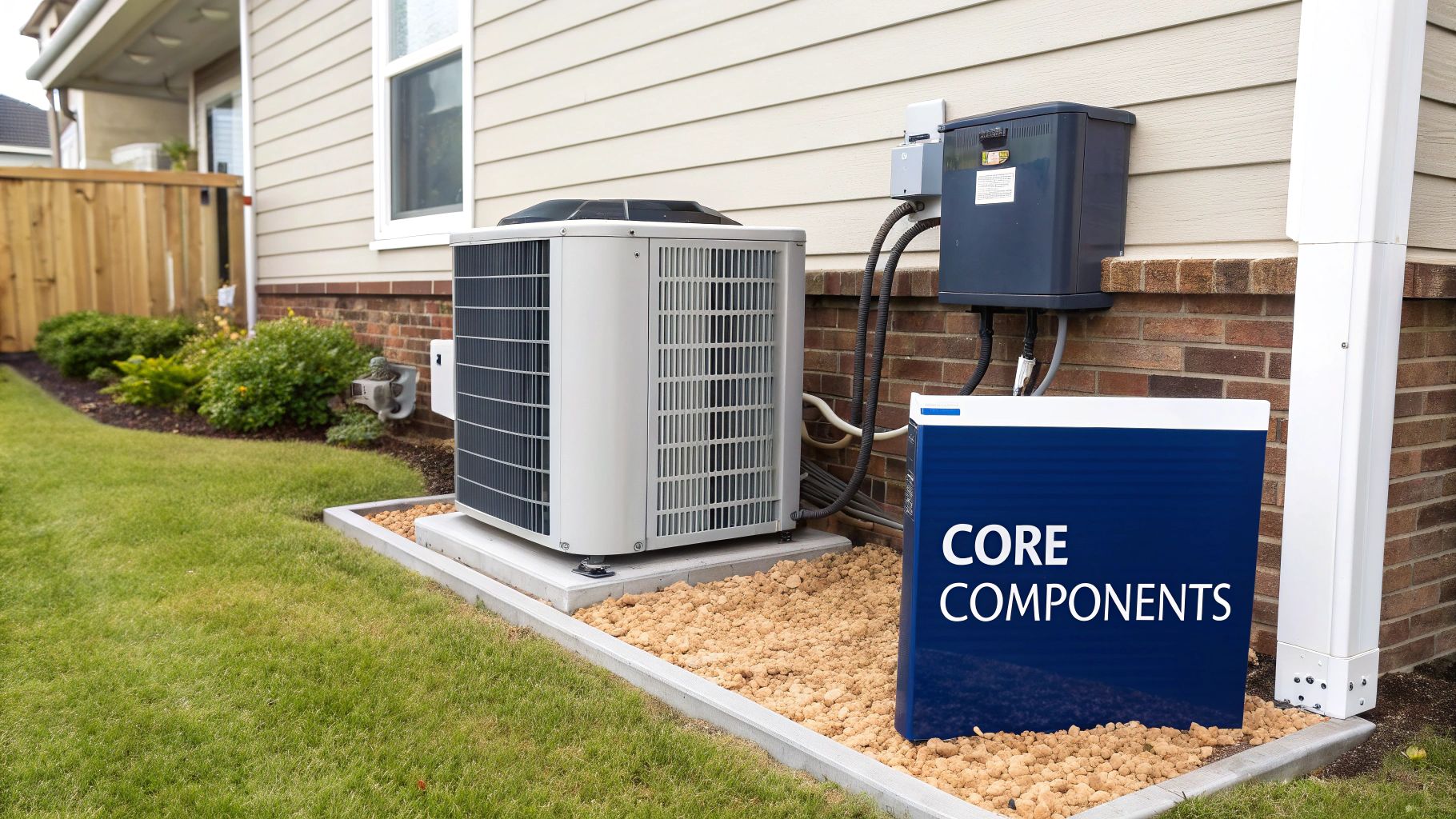
A split system is probably what you picture when you think of an air conditioner. It's that sleek indoor unit mounted high on a wall, connected by pipes and wiring to a separate, boxy outdoor unit. These systems are brilliant for cooling or heating a single room or a specific open-plan area, giving you targeted comfort exactly where you spend your time.
A ducted system, on the other hand, is the whole-home solution. The central unit is usually tucked away in the roof space or under the floor, completely out of sight. From there, a network of insulated ducts channels conditioned air to discreet vents in multiple rooms, offering seamless, zoned climate control for your entire house.
What Does "Reverse Cycle" Actually Mean?
This is a common point of confusion. Reverse cycle isn't a separate type of air conditioner; it’s a crucial feature that most modern systems in Australia now have. It simply means the unit can both cool in summer and heat in winter.
By reversing the refrigeration cycle we talked about earlier, the system can cleverly absorb warmth from the cold outside air and efficiently pump it inside to keep you cosy. This dual functionality is why it's the go-to choice for year-round comfort.
Split Systems: The Targeted Solution
Split systems are the perfect answer when you need to tackle a specific area. Let's say you've got that west-facing master bedroom in a Terrigal home that gets absolutely blasted by the afternoon sun, or the main living area where the family gathers.
Because they only treat one zone at a time, they are generally cheaper to install and can be very energy-efficient when used correctly. The flexibility is a huge plus, too. You can start with one unit in a key area and easily add more to other rooms down the track if your needs or budget change. This makes them a great fit for apartments, smaller homes, or for sorting out those specific problem spots in a larger house.
Why It Matters: Choosing the right size, or kilowatt (kW) capacity, is absolutely critical for a split system. An undersized unit for a large room in Lake Macquarie will struggle to keep up on a scorching day, while an oversized one will constantly switch on and off, wasting energy. A professional assessment ensures you get the perfect fit for your space.
Ducted Systems: The Whole-Home Approach
If you're building a new home or planning a major renovation on the Central Coast, a ducted system is often the ultimate climate control solution. It offers a clean, unobtrusive look, with only small, subtle grilles visible in the ceiling or floor of each room. No bulky wall units in sight.
This gives you complete control over your home's climate, often with the ability to create different temperature ‘zones’ for living areas and bedrooms, so you're not wasting energy cooling empty rooms.
While the upfront installation cost is higher than a single split system, it can be a more effective and efficient way to condition a large family home. It delivers consistent, even temperatures everywhere, finally getting rid of those annoying hot and cold spots.
Split System vs Ducted Air Conditioning at a Glance
Deciding between a targeted solution and a whole-home system can be tough. This table breaks down the key differences to help you see which approach might be a better fit for your property and lifestyle.
| Feature | Split System Air Conditioner | Ducted Air Conditioner |
|---|---|---|
| Best For | Cooling/heating individual rooms or specific open-plan areas. Great for apartments, smaller homes, or adding to existing homes. | Whole-home cooling and heating with a consistent temperature throughout. Ideal for new builds and larger family homes. |
| Installation Cost | Lower initial investment. Typically requires a smaller upfront cost per unit. | Higher initial investment. Is a more significant project for the entire home. |
| Aesthetics | Visible indoor unit mounted high on the wall in each room. | Virtually invisible, with only discreet vents in the ceiling or floor. The central unit is hidden in the roof space. |
| Control | Each unit is controlled independently, allowing for different temperatures in different rooms. | Centralised control, often with the ability to create 'zones' to manage different areas of the house separately. |
| Flexibility | Very flexible. You can install one unit now and add more later as your budget allows or needs change. | Less flexible. It's an all-or-nothing installation that needs to be planned for the entire home from the start. |
| Running Costs | Highly efficient for single-room use. Costs can add up if you need to run multiple units at once to cool the whole house. | Can be more efficient than running multiple splits if cooling the whole house. Zoning is key to managing running costs. |
Ultimately, there's no single "best" choice, it all comes down to your home's layout, your budget, and how you live. For a deeper dive into the pros and cons, check out our guide on split system vs ducted air conditioning.
Why Energy Ratings and Running Costs Matter So Much
Choosing an air conditioner is about more than its immediate cooling power; it’s a long-term investment in your home's comfort and your electricity bills. When you look at a new unit, that star rating label isn't just for show. It’s a government-regulated guide to its energy efficiency, and it has a direct impact on your wallet.
Put simply, more stars mean lower running costs for the same level of cooling or heating. A high-efficiency unit might have a slightly higher purchase price, but it can save you hundreds of dollars on power bills over its lifespan, especially during a prolonged heatwave in Sydney’s western suburbs or the Hunter Valley.
Decoding the Numbers on the Label
When you look at an air conditioner's specifications, you’ll see several key numbers. It's easy to get them mixed up, but we find that understanding what they mean is crucial for making a smart choice.
The first and most prominent number is the kilowatt (kW) capacity. This measures the unit’s output, its ability to add or remove heat from a space. It is not a direct measure of how much electricity it uses. A 7kW system for a large living room in Newcastle provides more cooling power than a 2.5kW unit for a small bedroom.
The real indicators of efficiency are the technical ratings that sit behind the star label. These are:
- EER (Energy Efficiency Ratio) for cooling.
- COP (Coefficient of Performance) for heating.
These numbers tell you how many kilowatts of cooling or heating the unit produces for every one kilowatt of electricity it consumes. A higher EER and COP mean you're getting more bang for your buck.
Why Higher Efficiency Pays for Itself
Let’s consider this scenario. Imagine you're choosing between two 6kW split systems for your family home on the Central Coast. One is a cheaper model with a 3-star energy rating and a COP of 3.5. The other is a premium model with a 5-star rating and a COP of 5.0.
The Difference in Action: The 5-star unit produces 5kW of heat for every 1kW of electricity it uses. The 3-star unit only produces 3.5kW of heat for the same 1kW of electricity. Over a cold winter, that difference adds up to significant savings.
Investing in the higher-efficiency model means it will pay for the initial price difference through lower power bills over several years. This is especially true in areas with extreme temperatures, where your system will be working hard for months on end. If you want to understand more about these expenses, our guide on how much running an AC costs breaks it down even further.
Achieving this rated efficiency isn't just about the unit you buy; it's also about how it's installed. A poorly installed system, even a high-end one, will never perform as it should. Professional installation by a licensed and ARCtick certified technician ensures the system is correctly sized, positioned, and commissioned to meet the manufacturer's specifications, guaranteeing you get the performance and savings you paid for.
Keeping Your Aircon Healthy with Proper Maintenance
Like any hardworking machine, your air conditioner needs a bit of regular care to perform at its best and sidestep those costly, inconvenient breakdowns. When you understand how the system works, you can see exactly why maintenance is so important. A little proactive care ensures every part of the refrigeration cycle is running efficiently, which saves you money and keeps you comfortable all year round.
The single most important job you can do as a homeowner is to regularly clean or replace the filters in your indoor unit. It's a simple task that makes a massive difference.
When filters get clogged with dust and debris, they choke the system, severely restricting airflow. This forces the fan motor to work much harder just to pull air across the evaporator coil, leading to higher power bills and a noticeable drop in cooling performance.
Common Problems and When to Call a Professional
Even with the best care, you might notice your system isn't behaving quite right. Knowing the warning signs can help you decide when it’s time to call in an expert before a small issue becomes a major failure.
Here are a few common issues you might come across:
- The unit just isn't cooling properly: This can point to a few different problems, but a refrigerant leak is a very common culprit. If your system is low on refrigerant, it simply can’t absorb and move enough heat out of your home.
- Strange noises from the outdoor unit: Grinding, squealing, or loud clanking sounds are definite red flags. These often indicate a problem with the fan motor or the compressor itself. Ignoring these noises can lead to a complete component failure, which is a far more expensive fix.
- Water dripping indoors: Your unit naturally produces condensation as it works, but that water is meant to drain away safely outside. If you see water pooling or dripping inside, it usually means the drain line is blocked. This needs to be cleared by a professional to prevent water damage to your walls and floors.
While it’s tempting to try and fix things yourself, it’s critical to know where the legal and safety boundaries are. For a deeper dive into what to look for, our comprehensive guide to air conditioning maintenance is an excellent resource.
Why DIY Repairs Can Be Dangerous and Illegal
In Australia, the rules are crystal clear: any work involving refrigerants or your system’s electricals must be done by a licensed and ARCtick certified technician. This isn’t just a friendly recommendation; it's the law, put in place to protect both you and the environment.
Refrigerants are specialised chemicals, and handling them requires specific training and equipment. Without the right gear, it’s not only illegal but genuinely unsafe.
Important Safety Warning: Attempting to handle refrigerant or perform electrical work on your air conditioner without a licence is a serious offence. It instantly voids your warranty, poses a significant risk of electrocution, and can lead to heavy fines from authorities like SafeWork NSW.
Your air conditioner is a complex piece of equipment hard-wired into your home’s high-voltage electrical system. For your own safety, and to make sure your system runs efficiently for years to come, always trust a licensed professional for any servicing or repairs that go beyond basic filter cleaning.
The Importance of Professional Sizing and Installation
You can buy the most advanced, energy-efficient air conditioner on the market, but if it's the wrong size for your space or installed poorly, you'll never get the performance or savings you paid for. Getting the size right isn't just a recommendation; it's absolutely non-negotiable for an aircon system that works well and lasts.
An undersized unit will be forced to run constantly on hot days, desperately trying to keep up. This not only fails to cool your home properly but also puts immense strain on the compressor, leading to premature wear and tear and an early replacement. It's a false economy.
On the other hand, an oversized unit is just as problematic. It will blast the room with cold air, reach the set temperature too quickly, and then switch off. A few minutes later, it clicks back on again. This constant on-off process is known as 'short cycling'.
The Problems With Short Cycling
Short cycling is incredibly inefficient because the compressor uses a huge surge of power every single time it starts up. This process also prevents the system from running long enough to properly dehumidify the air, leaving you with that cold but clammy, damp feeling. Over time, the repeated stress on components from constant starting and stopping can lead to costly breakdowns.
Why It Matters: Proper sizing ensures your system runs in longer, more efficient cycles. This delivers stable temperatures, manages humidity properly, and maximises the lifespan of your unit, saving you from unnecessary repair bills and sky-high running costs.
The Professional Difference: A Heat Load Calculation
So, how do we get the size just right? A professional installer performs what's known as a heat load calculation. This is a detailed assessment that goes far beyond simply measuring the floor area of a room. It's a critical step that tailors the system to your specific home and local climate.
Our technicians consider a whole range of factors, including:
- Room dimensions, including the height of your ceilings.
- The size, type, and orientation of windows and doors (a west-facing window lets in a lot more heat!).
- The quality and type of insulation in your walls and ceiling.
- The local climate and its unique challenges.
For example, the humid, salt-laden coastal air on the Central Coast requires a different sizing approach compared to the dry, intense summer heat experienced in the Hunter Valley. A home in Terrigal with large, west-facing windows needs a more powerful solution than a shaded home in a leafy Newcastle suburb. For a comprehensive look at this process, we explain everything you need to know about sizing an air conditioner in our detailed guide.
Safety, Compliance, and Your Peace of Mind
Beyond getting the size right, the installation itself has to meet strict Australian Standards to be safe, legal, and keep your manufacturer's warranty valid. In Australia, any person installing, servicing, or handling the refrigerants in an air conditioner must hold an ARCtick licence. It’s the law.
Furthermore, because an air conditioner is a fixed appliance wired directly into your home’s electrical system, the work must be performed by a licensed electrician. This ensures the installation complies with safety standards like AS/NZS 3000, which governs all electrical installations in Australia.
Hiring an unlicensed installer is not only dangerous but illegal, and it will immediately void your warranty, leaving you with no protection if something goes wrong. Always, always insist on seeing both licences before any work begins. It’s your home, and your safety is not worth the risk.
Common Aircon Questions We Hear Every Day
As experts in air conditioning across the Central Coast, Sydney, and Newcastle, we field a lot of the same questions from homeowners. Here are some straightforward, no-nonsense answers to the things we get asked most often.
How Long Should My Air Conditioner Last?
You can realistically expect a quality split or ducted system to last between 10 to 15 years, provided it was installed professionally and you keep up with annual servicing.
Keep in mind that local conditions play a part. The salty air in coastal suburbs like Terrigal can be tough on outdoor units, and the big temperature swings in the Hunter Valley make systems work harder. Regular maintenance is what gets you closer to that 15-year mark.
Why Is My Aircon Running but Not Cooling?
This is easily the most common call-out we get. If the fans are blowing but the air isn’t cold, the most likely culprit is a refrigerant leak. When the refrigerant level drops, the system loses its ability to transfer heat out of your home.
Other possible causes are a seriously clogged indoor filter that’s choking the airflow, or an issue with the outdoor unit, like a dirty condenser coil or a failing compressor. Whatever you do, don't try to handle refrigerant issues yourself. It's a job that legally requires a licensed ARCtick technician.
What Does the 'Dry Mode' on My Remote Actually Do?
Think of 'dry mode' as your secret weapon against that sticky, humid feeling common on the Central Coast and in Sydney, especially on days when it’s not brutally hot. Instead of just blasting cold air, this setting focuses on pulling moisture out of the room.
It does this by running the fan at a lower speed, which gives moisture more time to condense on the cold indoor coil and drain away. The result is a much more comfortable, less "clammy" feeling in your home, and it uses less power than full-on cooling mode.
A lot of people think cranking the temperature down is the only way to beat humidity. Often, running the 'dry mode' for an hour is a far more effective, and energy-efficient, way to get comfortable.
Is It Cheaper to Leave My Aircon on All Day?
In almost every case, no. It’s more energy-efficient to switch your air conditioner off when you’re out and turn it back on when you get home.
Modern inverter systems are fantastic at getting a room to the right temperature quickly without that massive, old-school power surge. Leaving it running all day means it’s in a constant battle against the heat seeping in through your windows, walls, and roof, which is a big waste of electricity.
Ready to make sure your air conditioning is running at its absolute best? The team at ALC Air has over 15 years of hands-on experience giving honest advice and delivering quality installations across the Central Coast, Sydney, and Newcastle. For a free, no-obligation quote and a system sized perfectly for your home, get in touch with our friendly experts today.
https://alcairconditioning.com.au