


Ever wondered how one system can cool or heat your entire home so evenly and quietly? That's the magic of a ducted air conditioning system. It’s a complete climate control solution, providing consistent comfort from a single, central unit. Unlike a split system that only handles one room at a time, a ducted setup ensures every corner of your house stays at that perfect temperature.
How Do Ducted Air Conditioning Systems Actually Work?
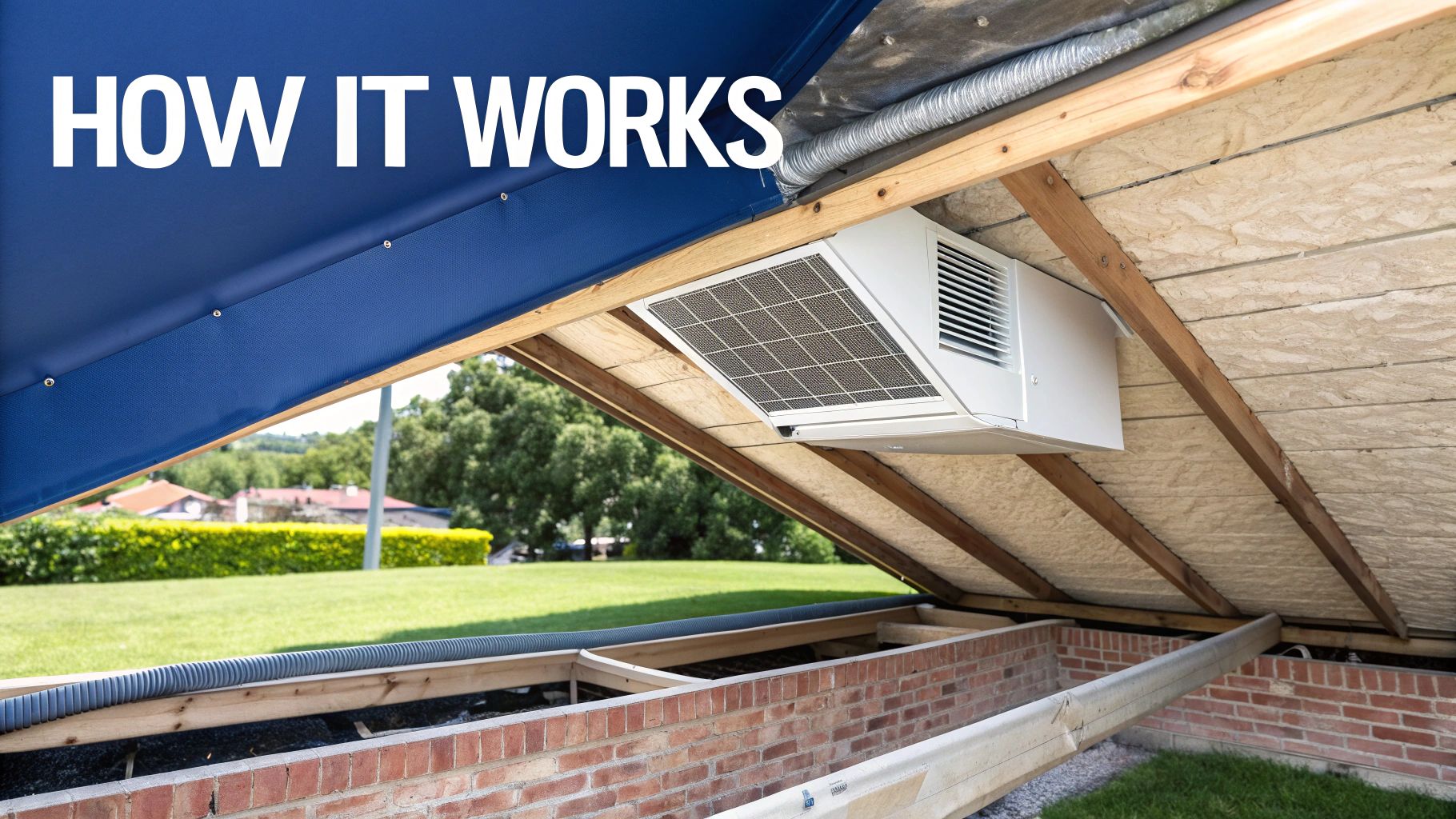
Think of a ducted air conditioner as your home's respiratory system. The indoor unit, usually tucked away out of sight in your roof space or under the floor, is like the lungs. This central unit works in tandem with a quiet outdoor unit to either cool or heat the air.
This conditioned air is then gently distributed throughout your home via a network of insulated ducts. It essentially 'breathes' comfort into each room through discreet vents or louvres in your ceiling or floor. This integrated design is why the system operates so quietly and maintains such a consistent temperature from one room to the next.
For homeowners everywhere from the Central Coast to Sydney's western suburbs, it represents a real investment in whole-home comfort and property value. In fact, ducted systems are the go-to choice for complete climate control across New South Wales. Recent data shows that NSW is the biggest market for ducted aircon in Australia, with new installations making up around 40% of the market and replacements accounting for the other 60%. You can see the full breakdown in this comprehensive HVAC market report by Energy NSW.
The Key Components of the System
Knowing the main parts helps you understand how it all comes together. A typical ducted system includes:
- The Indoor Unit: This is the heart of the operation, containing the fan coil that heats or cools the air. We install this powerhouse out of sight in your roof.
- The Outdoor Unit: This unit houses the compressor and condenser coil. It’s responsible for releasing heat outside when you're cooling, or absorbing it from the outside air when you're heating.
- Ductwork: Think of these insulated pipes as the arteries, carrying the conditioned air from the indoor unit to every room you want to control. Good insulation is vital here to prevent energy loss.
- Vents and Louvres: These are the subtle outlets in your ceilings or floors where the air flows into each room. A larger return air grille is also installed (usually in a central hallway) to draw air back into the system to be re-conditioned.
This continuous cycle of air circulation is what makes ducted air conditioning so effective. If you're curious about the nuts and bolts of the cooling and heating process, you might find our guide on how an air conditioner actually works interesting. Ultimately, this single, cohesive setup not only delivers incredible comfort but also keeps your home looking great by hiding all the operational parts from view.
The Real Benefits of a Ducted System
When you're weighing up air conditioning options, it’s easy to get bogged down in technical specifications and installation costs. We encourage you to step back and think about the long-term liveability a system offers. A ducted aircon system is more than just another appliance; it’s a fundamental upgrade to how your home feels and what it’s worth. Let's look at the real-world advantages you'll actually notice.
Genuine Whole-Home Comfort
The biggest and most obvious benefit is achieving consistent, whole-home comfort. Unlike a split system that creates a bubble of cool air in one room while the rest of the house swelters, a ducted system gets rid of those frustrating hot and cold spots for good.
Imagine a scorching summer day in the Hunter Valley. With a ducted system, you can set the entire house to a comfortable 22 degrees, and that’s what you get. From the living room in your Newcastle home to the upstairs bedrooms, the temperature is even. This even air distribution means no more family arguments over who gets to sit in front of the air conditioner. It just creates a seamless, comfortable environment everywhere.
Superior Aesthetics and Interior Design
One of the things our clients love most about ducted air conditioning is how little you see of it. Because the main indoor unit is tucked away in your roof cavity and the air travels through hidden ductwork, your interior design remains clean and completely untouched.
There are no bulky wall units dictating where your furniture goes or disrupting a feature wall. All you see are discreet, minimalist louvres in the ceiling or floor. This lets you place furniture and artwork exactly where you want, without designing your room around a big white box. For homeowners in style-conscious areas of Sydney or the Central Coast, maintaining that clean aesthetic is a massive plus.
Quiet Operation for a Peaceful Home
Peace and quiet are priceless in any home. The noisy parts of a ducted system, the fan and compressor, are located either in your roof space or outside your home. This clever design means the system's operation is incredibly quiet inside.
You get all the comfort of perfectly conditioned air without the constant hum or whirring that comes with other types of air conditioners. This near-silent airflow is a major benefit for light sleepers, families with young children, or anyone who just values a calm, tranquil home. It’s a level of quiet comfort you really have to experience to appreciate.
Increased Property Value
Finally, a professionally installed ducted system is a significant asset that can genuinely boost your property's value. In competitive real estate markets like those across the Central Coast (postcodes 2250-2264), Newcastle, and Sydney, premium features are what make a house stand out from the crowd.
Ducted air conditioning is widely seen as a high-end, desirable inclusion. It appeals directly to potential buyers who are looking for a home with modern comforts already built-in. It’s not just an expense; it’s a smart, long-term investment in your property's market appeal and resale potential.
Choosing Between Ducted Aircon and Split Systems
Deciding on the right air conditioning is a common crossroads for homeowners, but it doesn't need to be confusing. The best system for you really comes down to your property, your budget, and how you actually live in your home. There’s no single right answer, only what’s right for your family.
Think of it this way: a split system is like a spotlight, perfect for targeted relief. It’s fantastic for cooling or heating a single room or a small, defined area like a studio apartment in Sydney or the main living area of a granny flat. It solves a specific comfort problem very efficiently.
A ducted aircon system, on the other hand, is the go-to solution for complete, whole-home climate control. It’s designed for larger family homes with multiple rooms that all need to be kept comfortable.
When is Ducted the Right Call?
Let's imagine a real-world scenario. You've got a four-bedroom house in Lake Macquarie, and the children use their rooms for homework and relaxing. In summer, the western-facing bedrooms become almost unbearable in the afternoon sun. A fully zoned ducted system gives you total control, letting you cool just the living areas during the day and then switch to cooling only the bedrooms at night.
This level of seamless control is where ducted aircon systems truly shine. You invest in one central unit that manages the temperature everywhere, maintaining your home’s aesthetic and adding significant long-term value.
If you find your home has stubborn hot or cold spots that a single air conditioner just can't fix, that's a massive clue that a ducted system is the upgrade you need. The decision tree below shows a simple path to achieving that elusive whole-home comfort.
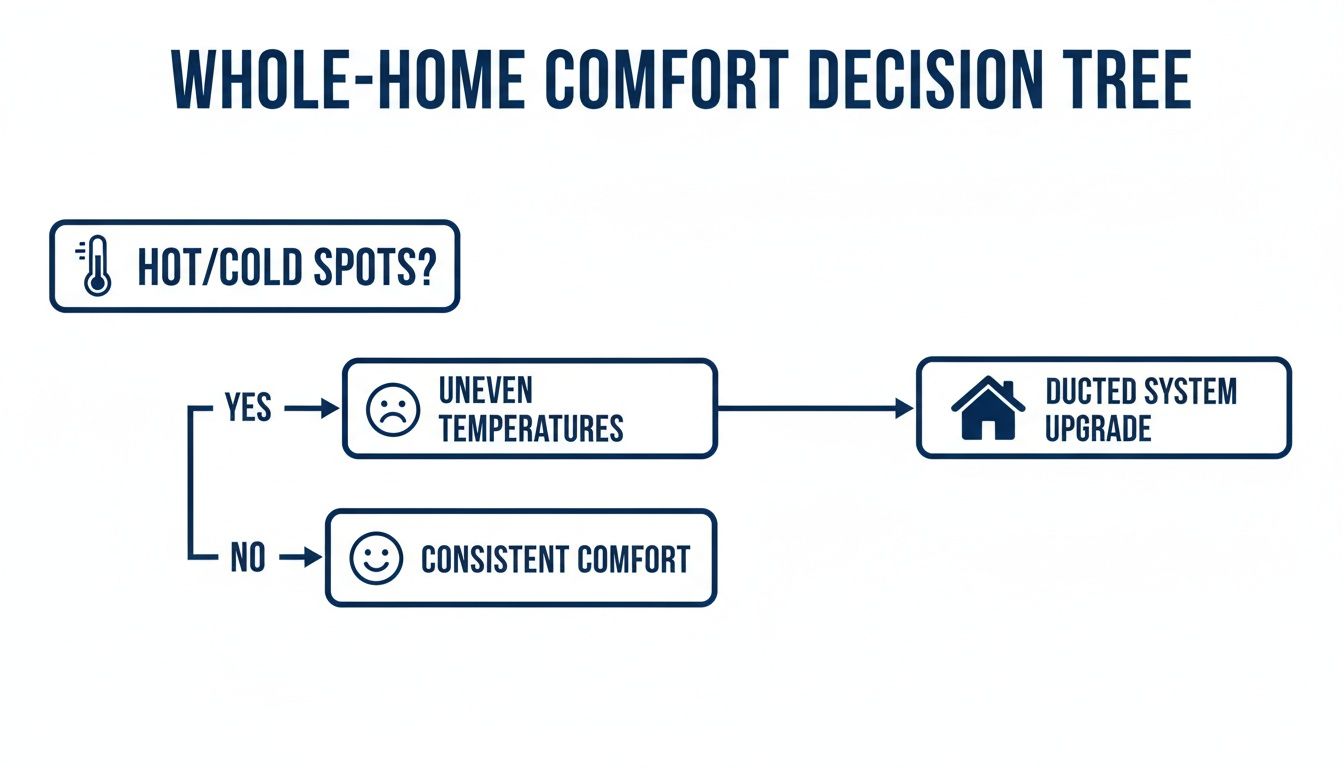
As you can see, the journey from inconsistent temperatures to a perfectly balanced home often leads directly to a ducted solution.
A Side-by-Side Comparison
To help you see the differences at a glance, we’ve put together a straightforward comparison table. This breaks down the key factors like cost, running expenses, aesthetics, and noise levels. Our goal isn't to push one system over the other, but to give you the practical knowledge to decide what’s truly right for your home.
Ducted Aircon vs Split System at a Glance
| Feature | Ducted Air Conditioning | Split System Air Conditioning |
|---|---|---|
| Coverage | Provides consistent temperature control for an entire home. | Cools or heats a single room or a specific, small area. |
| Installation Cost | Higher initial investment due to complexity and materials. | Lower initial cost, as it's a simpler, localised installation. |
| Running Costs | Can be more efficient for whole-home use, especially with zoning. | Very efficient for a single room but costly if multiple units run. |
| Aesthetics | Virtually invisible, with only discreet vents showing. | Requires a visible, wall-mounted indoor unit. |
| Noise Levels | Extremely quiet operation as the main unit is hidden away. | Indoor unit is quiet, but still audible within the room. |
| Property Value | Significantly increases the resale value of a property. | Adds some value, but is not considered a premium feature. |
Ultimately, choosing between these two fantastic options comes down to scale and purpose. Are you trying to fix a comfort issue in just one room, or are you looking to create a perfectly temperate environment throughout your entire home?
For a deeper dive, you can read our detailed comparison of ducted air conditioning vs split systems to get all the information you need before making a call.
Getting The Details Right: Zoning, Sizing, and Efficiency
Let's dive into some of the technical but absolutely essential parts of a ducted air conditioning system. Getting these details right is the difference between a system that runs beautifully and one that constantly struggles, costing you a fortune in the process.
Three concepts work together to deliver perfect comfort without outrageous power bills: zoning, sizing, and efficiency. Understanding how they connect empowers you to choose a system that’s genuinely matched to your home and lifestyle. It’s not just about cooling or heating; it’s about doing it intelligently.
What Is Air Conditioning Zoning?
In simple terms, zoning lets you divide your home into different climate areas that you can control independently. Think of it like having multiple light switches instead of one master switch for the entire house. You might create a ‘living areas’ zone and a separate ‘bedrooms’ zone.
This means you only cool or heat the parts of the house you're actually using. During the day, you might only have the system running in your living and kitchen zone. Then at night, you can switch it off there and turn on the bedroom zone, keeping you comfortable while you sleep without wasting a cent on empty rooms.
Zoning is a massive energy saver and is fundamental to modern ducted aircon systems. Leading manufacturers we partner with, like Actron Air and Fujitsu, have systems that can slash 20-40% off energy bills compared to older, non-zoned models. This efficiency is a big deal as NSW pushes for better standards under the Energy Savings Scheme (ESS), and it's a key reason the Australian HVAC market is growing so strongly.
Why Correct System Sizing Is So Crucial
Next up is ‘sizing’. This refers to the heating and cooling capacity of the air conditioner, which we measure in kilowatts (kW). Getting this right is non-negotiable for both performance and running costs. It’s a common mistake to think bigger is always better, but that’s definitely not the case.
A ducted system that’s too small for your home will constantly struggle to reach the set temperature, running flat out for long periods. On the flip side, a system that’s too big will cool or heat the space too quickly and then switch off. This process, called 'short cycling', is massively inefficient and causes unnecessary wear and tear on the components.
Correctly sizing a system is a technical process that demands a professional assessment. We don't just guess; we perform a detailed heat load calculation that considers all the unique factors of your home.
Factors that influence system sizing include:
- Total floor area of the rooms you want to condition.
- Ceiling height, as higher ceilings mean more air volume to treat.
- Window size and orientation – a large, west-facing window in a Terrigal home lets in far more afternoon heat than a small, south-facing one.
- Insulation quality in your ceiling, walls, and under the floor.
- Local climate, from the humid coastal conditions on the Central Coast to the extreme heat of the Hunter Valley.
Getting this calculation right ensures your system runs efficiently, keeps you comfortable, and lasts for its full expected lifespan. If you want to dig deeper into this, check out our guide on sizing your air conditioning correctly.
Understanding Energy Efficiency and Inverter Technology
Finally, let's talk about efficiency. Modern ducted systems are built around inverter technology, which is a huge leap forward from the old, clunky start/stop systems. An inverter system is a bit like the cruise control in your car.
Instead of the compressor slamming on at 100% capacity and then shutting off completely, an inverter allows the compressor to vary its speed. Once your room gets close to the desired temperature, it slows right down and runs continuously at a lower power level just to maintain it. This avoids the constant power spikes of starting and stopping, making it far more energy-efficient and a whole lot quieter.
This efficiency is what the energy rating label on all appliances reflects. The more stars, the more efficient the unit is, meaning lower running costs for you. When you combine a high-efficiency inverter system with smart zoning, you get the ultimate setup: whole-home comfort without the shocking power bills.
What to Expect During the Installation Process
Knowing what’s going to happen on installation day can make the whole experience feel a lot smoother and less disruptive. A professional installation is much more than just connecting a few pipes; it’s a carefully choreographed process to make sure your new ducted system performs perfectly for years to come.
We’ll walk you through the typical journey, from our first visit to the final handover, so you know exactly what to expect. It all starts long before our vans pull up at your house.
Step 1: The On-Site Assessment and System Design
Before any tools come out, our first job is to visit your home for a proper assessment. This isn't just a quick look around. We'll measure rooms, get up into your roof cavity to check the space, and chat with you about your family’s lifestyle to design a system that’s a perfect match for your property.
This is the stage where we map out the entire ductwork layout and decide on the best zoning configuration to maximise efficiency and comfort. This design phase is absolutely crucial. A poorly planned system will lead to drafts, hot spots, and unnecessarily high power bills.
If you’re curious about how these details influence the final price, our guide on what ducted air conditioning installation costs is a great place to start.
Step 2: Positioning the Indoor and Outdoor Units
On the first day of the install, our main task is getting the core components in place. The indoor unit, often called the fan coil, is usually installed in your roof space. We’ll find a spot that provides the best airflow distribution and, just as importantly, allows for easy access for future servicing.
Next, we position the outdoor unit (the condenser) on a solid, level base outside. We always think about things like noise, airflow clearances, and visual appeal to find the best possible spot that won't annoy you or your neighbours.
Step 3: Running the Ductwork and Electricals
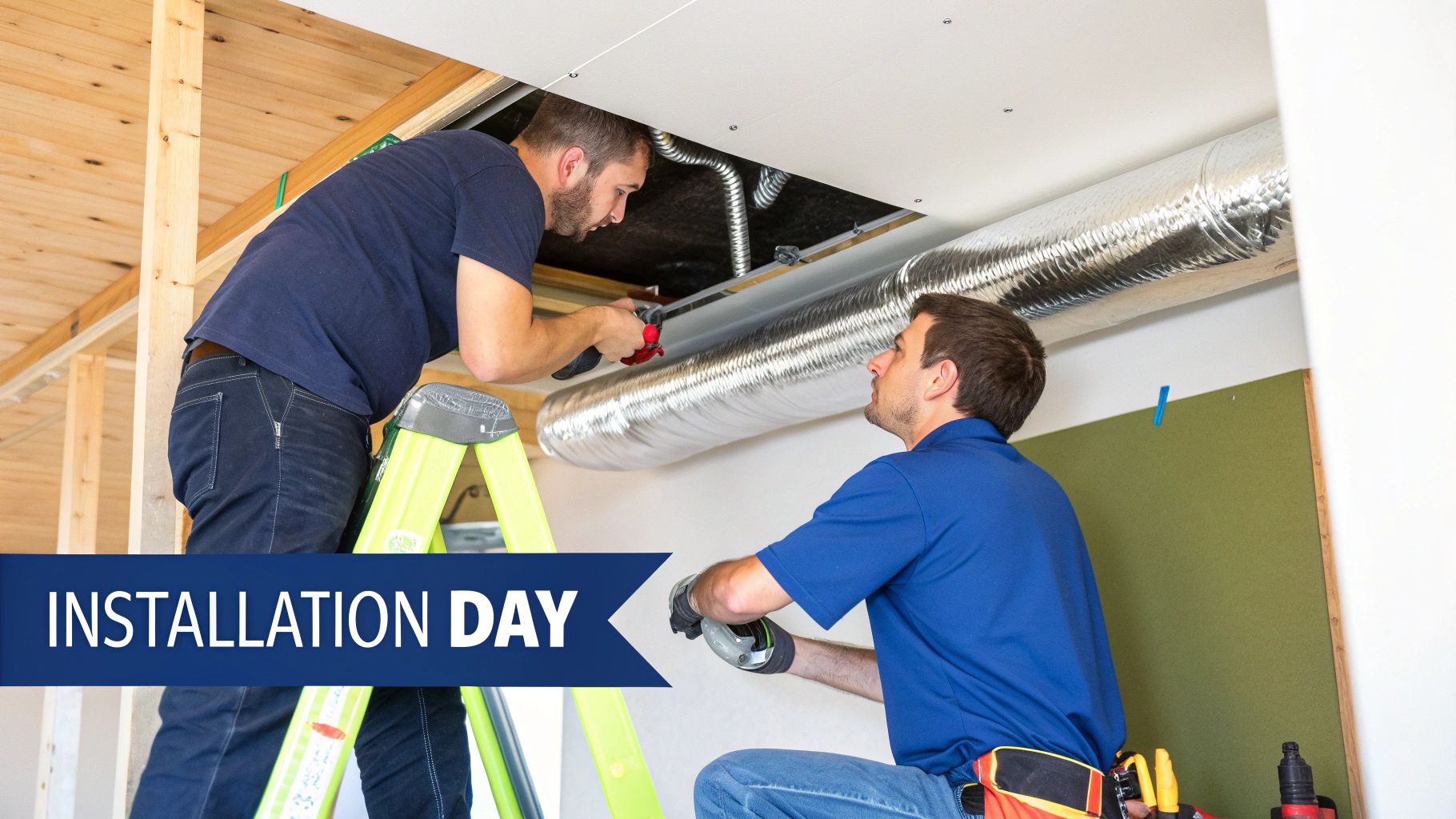
With the main units in position, our technicians get to work routing the flexible, insulated ductwork through your ceiling. Each duct is carefully run from the indoor unit to the precise locations we marked for the ceiling vents (or diffusers). We take a lot of care here to ensure every connection is sealed tight to prevent precious cool air from leaking into your roof space.
At the same time, our licensed electrician will be running all the necessary wiring. This involves connecting the indoor and outdoor units and running a dedicated power circuit from your switchboard. This is serious work, and all electricals must comply with Australian Standard AS/NZS 3000, a job strictly for qualified professionals.
Step 4: Commissioning and Handover
Once everything is connected, it’s time to "commission" the system. This is the final quality check where we start it up, test the refrigerant pressures, measure the airflow to each zone, and make sure the controller is communicating perfectly with the unit.
The very last step is the handover. We’ll walk you through how to use your new controller, show you how to set up zones, program timers, and answer any questions you have. We don’t pack up and leave until you feel 100% comfortable driving your new system.
For a standard single-storey home, the whole process is usually wrapped up in one to two days.
Keeping Your System Running Efficiently
A ducted aircon system is a significant investment in your home's comfort. Like any valuable piece of machinery, it needs a bit of care to perform at its best. Looking after it properly is the key to protecting that investment, ensuring it runs efficiently for years and saves you a bundle on power bills and potential repair costs.
The good news is that this isn't complicated. A few simple habits, combined with a professional annual service, will keep everything in top condition. You'll get clean, healthy, and perfectly conditioned air right through your home.
Simple Tasks You Can Do Yourself
One of the most effective things you can do is regularly clean the return air filter. This is that large grille you see in the ceiling, usually in a central hallway, that draws air back into the system to be cooled again. Over time, it gets clogged with dust, pet hair, and all sorts of airborne gunk.
When that filter is blocked, your system has to work much, much harder to pull air through. That directly cranks up your energy consumption and puts a real strain on the fan motor. By simply giving this filter a clean every few months with a vacuum or a gentle wash, you make a massive difference to your indoor air quality and how efficiently the whole system runs.
The Value of Professional Annual Servicing
While cleaning the filter is a great start, there's just no substitute for a thorough professional service at least once a year. Think of it as a proper tune-up for your home’s climate control. Our licensed technicians perform a whole series of critical checks that homeowners simply can't do themselves.
During a professional service, our ARCtick certified technicians will check refrigerant levels, clean indoor and outdoor coils, inspect ductwork for leaks, and test all electrical components to ensure they are safe and compliant with Australian Standards.
This kind of proactive care is about more than just dodging costly breakdowns. It directly translates to lower running costs, healthier air for your family to breathe, and a much longer lifespan for your unit. For a deeper dive into what’s involved, our complete guide to air con maintenance covers all the important details.
Beyond keeping your ducted system optimised, incorporating broader Smart Tips for Saving Electricity at Home can lead to significant savings on your overall utility bills. Think of us as your long-term partners in ensuring the comfort and efficiency of your Central Coast or Sydney home.
Common Questions We Hear About Ducted Systems
Choosing a new air conditioner is a big decision, and it’s completely normal to have a list of questions. After more than 15 years of installing ducted systems in homes across the Central Coast and Sydney, we've pretty much heard them all. Here are the answers to the questions that come up most often.
So, What Does a Ducted System Actually Cost?
This is always the first question, and the honest answer is: it really depends. The final price tag isn't just about the unit itself. It's a combination of the system's size (its kW capacity), the brand you go with, and how complex the installation will be in your specific home.
A large, two-storey home in Newcastle will naturally need a more powerful and intricate system than a single-storey villa in Gosford, and the price will reflect that. But it's better to think of it as a long-term investment in your home's comfort and value. A well-designed, professionally installed system delivers amazing comfort and can be surprisingly efficient to run, offering real value over its entire life.
Can I Get Ducted Aircon Installed in My Existing Home?
Yes, absolutely. While it’s a bit easier to install ducted during a new build or a major renovation, retrofitting a system into an existing home is something we do all the time. Our technicians are pros at navigating the unique challenges of established properties.
The main thing we need is enough space in your ceiling cavity or under the floor to fit the indoor unit and run the insulated ductwork. This is exactly why a proper site inspection is the first, non-negotiable step. We need to get into your roof space and physically assess your home’s structure to design a ducting layout that’s both effective and as minimally disruptive as possible.
What Is the Best Ducted Aircon Brand?
The "best" brand really comes down to your specific needs, your home’s layout, and your budget. There’s no single brand that’s the perfect fit for every single home. What works brilliantly for a sprawling rural property in the Hunter Valley might be total overkill for a modern duplex on Sydney's northern beaches.
At ALC Air, we only install brands we know and trust for their reliability, performance, and solid after-sales support.
We regularly recommend and install systems from industry leaders like Daikin, Mitsubishi Electric, and Actron Air. These brands have a proven track record in tough Australian conditions, offering fantastic energy efficiency, quiet operation, and strong warranties.
Our job is to listen to what you need and recommend a system from one of these trusted partners that will give you years of reliable comfort. We focus on matching the right technology to your home, so you can be confident in your choice for the long run.
Ready to find the perfect ducted aircon system for your home? The team at ALC Air is here to provide professional advice and a free, no-obligation quote. Let's create a comfortable environment for your family, no matter the season. Get in touch with us today!