


Deciding between ducted and split system air conditioning is one of those big calls you make for your home’s comfort, and it’s something you’ll live with for years. In a nutshell, a split system is your go-to for controlling the temperature in a single room or a specific zone, and it comes with a much friendlier upfront price tag. On the other hand, a ducted system offers a seamless, whole-home solution, delivering consistent air through discreet vents, but you’ll be looking at a higher initial investment.
Understanding the Core Differences
When you’re weighing up ducted air conditioning vs a split system, you’re really choosing between two different philosophies: targeted climate control versus a comprehensive, whole-house approach. The right decision hinges on your property’s layout, how your family lives in the space, and of course, your budget. This choice is a big deal for homeowners right across NSW, whether you’re in a new build in the Hunter Valley or an established family home on the Central Coast.
A split system is made up of two main components: an indoor head unit that gets mounted on a wall, and an outdoor compressor unit. They’re connected by pipes that carry refrigerant gas back and forth. Because the setup is pretty straightforward, installation is quicker and far less invasive, making it a super popular choice for existing homes or for cooling a specific problem area, like a master bedroom or a west-facing living room in suburbs like Penrith or Kellyville.
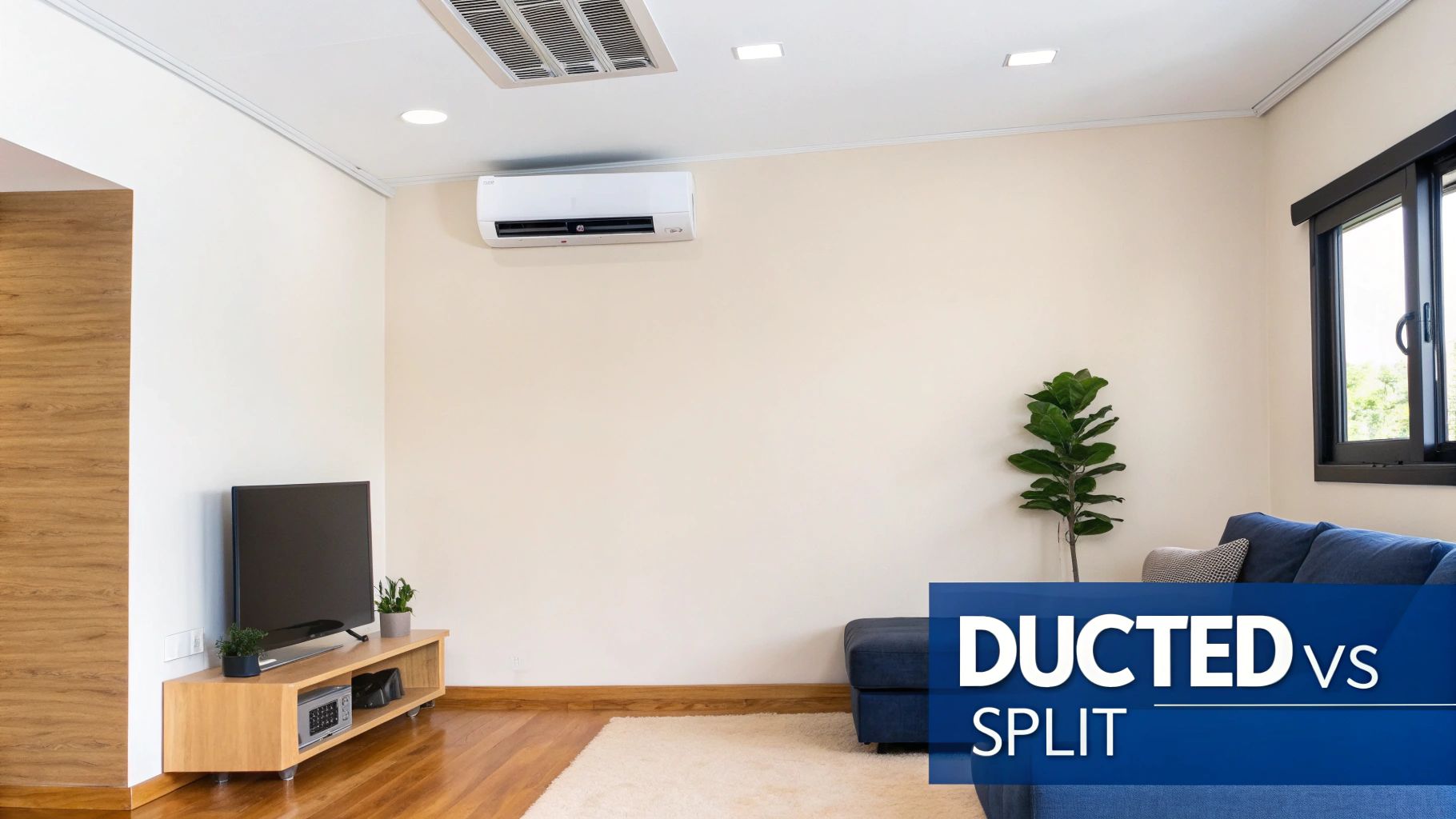
Ducted systems work from a totally different playbook. They use a central indoor unit, usually tucked away in your roof space, which conditions all the air before distributing it throughout the house via a network of insulated ducts. This conditioned air flows into each room through subtle vents or louvres, offering a much more discreet and integrated look.
At a Glance: Ducted vs Split System
To make things a bit clearer, let’s look at the main characteristics of each system. This will help you see how they stack up against each other for your specific needs.
For example, a ducted system offers a premium, whole-home solution perfect for a new family home being built in Lake Macquarie. The installation can be integrated from the start, providing an invisible and highly effective climate control system.
In contrast, a split system is the ideal answer for a single-level apartment in Newcastle where you primarily need to cool the main living area. It’s a cost-effective and practical solution for targeted comfort.
| Feature | Ducted Air Conditioning | Split System Air Conditioning |
|---|---|---|
| Best For | Whole-home heating and cooling, new builds, major renovations. | Single rooms, specific zones, apartments, or smaller homes. |
| Upfront Cost | Higher, as it involves extensive ductwork and a larger central unit. | Lower, as it’s a smaller system with a less complex installation. |
| Aesthetics | Very discreet, with only small ceiling or floor vents visible. | A visible indoor unit is mounted on the wall. |
| Control | Centralised control, often with the ability to create different temperature zones. | Individual control for the room where the unit is installed. |
| Installation | More invasive and complex, requiring access to roof or underfloor space. | Simpler and quicker, typically completed within a day. |
| Property Suitability | Best suited for medium to large family homes. | Ideal for apartments, studios, and targeted cooling in larger houses. |
The popularity of split systems in Australia is absolutely undeniable. To put it in perspective, sales of single split system units hit a massive 1.14 million units in 2022 alone. This really highlights their position as the go-to choice for so many Aussie households needing effective, targeted climate control. If you’re interested in the data, you can read more about trends in the Australian AC market on Climate Control News.
Analysing Upfront and Long-Term Costs
When you’re weighing up ducted vs. split system air conditioning, the price tag is often the first thing people look at. But the real cost goes far beyond the initial purchase price. To get a true picture, you need to think about the total cost of ownership – that’s the upfront investment, the installation labour, and what you’ll be paying on your power bills for the next 10 to 15 years.
The most obvious difference is the initial outlay. A split system is significantly cheaper to buy and install. It’s designed to cool a single room, so the unit is smaller and the installation is a much simpler job. This makes it a go-to choice for homeowners who just need to cool a specific area, like the main living room in a Terrigal townhouse or a master bedroom in a Charlestown home.
Ducted systems, on the other hand, are a much bigger upfront investment. The central unit is more powerful, and the installation is a major job that involves running a network of ducts through your ceiling or under the floor. This complexity means you’re not just paying for the unit and materials, but for the extensive skilled labour required to put it all together.
Breaking Down the Initial Installation Costs
When we talk about installation, it’s more than just hanging a unit on the wall. For any reverse cycle air conditioner in Australia, the work must be carried out by a licensed electrician with ARCtick certification. This is a non-negotiable legal requirement to ensure the system is safe and complies with Australian Standards like AS/NZS 3000. This is something SafeWork NSW takes very seriously.
For a split system, the installation is pretty straightforward. But for a ducted system, the costs are higher for a few key reasons: the extensive ductwork needed to reach every room, the structural considerations of navigating roof trusses and existing wiring, and potential electrical upgrades. A powerful ducted unit can be a heavy load on your home’s electrical system and might require a switchboard upgrade or even a three-phase power connection, especially for larger homes in areas like the Hunter Valley.
The total upfront cost of a ducted system can easily be several times that of a single, high-quality split system. While that’s a big number, you have to weigh it against the benefits of whole-home coverage and the clean, seamless aesthetic it provides. For a more detailed look at what goes into the final price, you can learn more about ducted air conditioner costs on our blog.
Evaluating Long-Term Running Expenses
Upfront cost is just the beginning; running costs determine how affordable the system really is over its lifespan. While a single split system is very efficient for cooling one room, your costs can add up quickly if you install multiple units to cool an entire house and run them all at once.
Picture a four-bedroom family home in Warners Bay during a summer heatwave. Firing up four separate split systems to keep the whole house cool could chew through a serious amount of electricity. In contrast, a modern, zoned ducted system lets you direct the cool air where you need it, cooling just the living areas during the day and switching to only the bedrooms at night. This offers much more efficient whole-home climate control.
Cost Factor Breakdown: Ducted vs Split System
This table gives a clearer picture of how the various costs stack up, from the day of installation to your quarterly power bills.
| Cost Factor | Ducted System | Split System |
|---|---|---|
| Upfront Purchase Cost | High. A major investment covering a powerful central unit, ducts, vents, and controls. | Low. Affordable for a single unit, with costs multiplying if you need to cool multiple rooms. |
| Installation Cost | High. A complex, multi-day job requiring significant labour for ductwork and electrical setup. | Low to Moderate. Relatively simple, often completed in half a day for a single unit. |
| Running Cost (Single Zone) | N/A – Ducted systems are designed for multi-zone cooling. | Very Low. Extremely efficient for cooling a single, targeted space. |
| Running Cost (Whole Home) | Moderate to High. Can be very efficient with smart zoning, but expensive if cooling the entire house at once. | High. Running 3-4 separate units simultaneously can use more power than a single, efficient ducted system. |
| Maintenance Cost | Moderate. Requires annual professional servicing and regular filter cleaning (usually one central filter). | Low. Each unit needs its filter cleaned monthly and an annual service, but repairs are isolated to one unit. |
Ultimately, while split systems often have lower annual running costs for typical households, it all comes down to how you use them.
Research from sources like TTV Heating and Cooling often shows that for a medium-sized house, a multi-split setup can be cheaper to run per year than a basic, un-zoned ducted system. For a home around 160 square metres, a multi-split might cost about $90 per year to operate, whereas a simple ducted system could be closer to $125 annually. These figures really highlight how targeted, room-by-room cooling can lead to real savings on your power bills.
Comparing Cooling Performance and Energy Efficiency
How well an air conditioner actually cools your home and what it costs you on your power bill are the two things that really matter. Performance isn’t just about raw power; it’s about smart, efficient climate control that suits your home and our local NSW climate. Whether you’re dealing with the sticky humidity on the Central Coast or the dry summer heat of the Hunter Valley, we can help you find the right fit.
A split system is built for a single space, making its cooling performance focused and incredibly effective for that one area. Its power, measured in kilowatts (kW), is matched directly to the room’s size, making it a very efficient choice for targeted cooling.
In contrast, a ducted system uses a larger, more powerful central unit to cool the entire house. Its performance is all about delivering consistent, even temperature control across multiple rooms at once. This whole-home approach is fantastic for preventing the “hot and cold spots” you can get when trying to cool a large, open-plan area with a single split system.
Understanding Kilowatt Capacity
Choosing the right kW capacity is critical. Think of it like a car engine: too small, and it will struggle constantly, burning through energy without ever getting the job done. Too big, and it’ll turn on and off frequently, a process called short-cycling, which wastes power and causes unnecessary wear and tear.
A small 2.5kW split system might be perfect for a bedroom in a Newcastle apartment, but it wouldn’t make a dent in a large, open-plan living area in a Sydney home. For that space, you’d likely need a larger 7kW or 8kW system. Ducted systems, on the other hand, start where the big splits leave off, often ranging from 10kW up to 25kW or more to handle the cooling load of an entire house. Getting this sizing right is absolutely a job for a professional.
How Inverter Technology and Energy Ratings Work
Modern air conditioners, both ducted and split, almost always use inverter technology. An inverter acts like a smart accelerator for the compressor motor. Instead of just slamming on at full power and then switching off, it constantly adjusts its speed to maintain your desired temperature. This clever process avoids those energy-guzzling startups and can cut your running costs by up to 30% compared to older, non-inverter models.
When you’re comparing units, you’ll also see the Zoned Energy Rating Label. This government-mandated sticker shows a star rating out of 10 for both heating and cooling, tailored to different climate zones in Australia. The more stars, the more energy-efficient the unit is, meaning it costs less to run. A high-efficiency unit can save you hundreds of dollars over its lifetime.
The Strategic Power of Ducted Zoning
Zoning is perhaps the single biggest performance advantage a ducted system has. It lets you divide your home into different “zones” that can be controlled independently. For example, you can create a “Day Zone” for your living, kitchen, and dining areas, and a “Night Zone” for the bedrooms.
Consider this scenario: during a hot summer day in the Hunter Valley, you can run the air con in just the Day Zone while the bedrooms are empty. Then, at night, you can switch off the Day Zone and cool only the bedrooms. This simple habit stops you from wasting a huge amount of energy cooling empty rooms. Advanced systems even let you set different temperatures in each zone, giving you ultimate control over your home’s comfort and power bills.
Installation Realities and Home Aesthetics
Beyond the numbers on your power bill, the practical side of getting an air conditioner installed and how it looks in your home are huge factors. A split system installation is a completely different beast to a ducted one, and the choice impacts everything from how long your house is a work site to the final look of your rooms.
A split system installation is usually a pretty straightforward affair. The job involves mounting the indoor unit on a wall and connecting it with pipes and wires to the outdoor compressor. For a standard, back-to-back installation in a home in Wyong or Hornsby, our licensed technicians can typically have you up and running in a single day. It’s minimally invasive and gets you cool, fast.
In contrast, putting in a ducted air conditioning system is a much bigger project. It requires clear, safe access to your roof space or underfloor area to run a whole network of insulated ducts. This makes it a perfect choice when you’re building a new home or in the middle of a major renovation when ceilings and walls are already open and accessible.
Comparing Installation Complexity
Trying to retrofit a ducted system into an existing home is definitely possible, but it comes with more headaches. Our team has to carefully navigate roof trusses, existing electrical wires, and plumbing that might be lurking in the roof cavity. This complexity naturally stretches the installation timeline out over several days and adds to the final labour costs.
For instance, installing a ducted system in an older Newcastle home with a cramped roof space demands meticulous planning. It’s a significant undertaking compared to the simple task of adding a split system to a single bedroom. For a deeper dive into what influences the final price, our guide on air conditioning installation costs on the Central Coast has some really valuable insights.
The core difference is scale: a split system is a targeted, one-day job. A ducted installation is a comprehensive, multi-day project that becomes part of your home’s very structure. Both absolutely require fully licensed and ARCtick certified professionals to ensure they comply with Australian Standards like AS/NZS 60335 for appliances.
Aesthetics and Visual Impact
How your air conditioner looks is often just as important as how it feels, and this is where ducted systems have a clear advantage. They offer a minimalist, almost invisible appearance. Once the work is done, the only things you’ll see are the subtle, sleek grilles set flush with your ceiling or floor. The system just disappears, preserving your home’s interior design.
Split systems, while getting sleeker every year, still add a visible appliance to your room. Modern units from brands like Daikin and Mitsubishi Electric are slim and stylish, but there’s no getting around the fact that they become a permanent fixture on your wall. The placement of this unit is also dictated by performance needs, meaning it might not always end up in the most aesthetically pleasing spot.
Which System Suits Your Home and Lifestyle?
Choosing between ducted air conditioning and a split system isn’t about which is “better” in general. It’s about which is better for you. Your home’s layout, your family’s daily routine, and even your future plans all come into play. The right choice is always situational, matching the technology to your real-world needs.
To help get you started, our simple decision guide below can point you in the right direction.
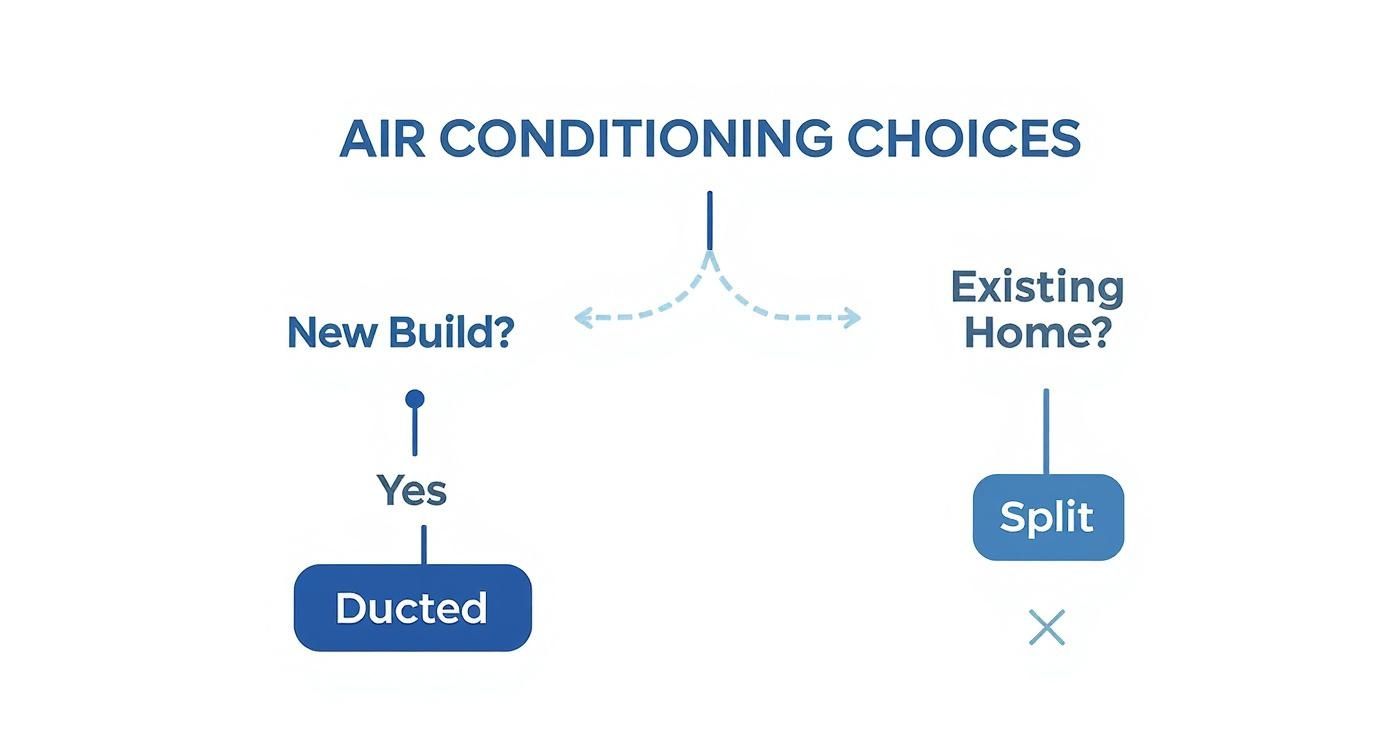
As the guide shows, ducted systems are often a natural fit for new builds where they can be planned from the start, while split systems offer a practical solution for existing properties. But there’s a bit more to it than just the age of your home.
Scenarios for a Split System
A single split system is often the most logical and budget-friendly choice in a few key situations. It really shines when you need targeted climate control rather than blanketing the whole house.
Let’s say you’re in a Sydney or Newcastle apartment; body corporate rules and space constraints often make a split system the only viable option. Or perhaps you have a home office in Gosford that gets blasted by the afternoon sun. A split system solves that specific problem without wasting energy on the rest of the house. It’s also great if the budget is tight, giving you immediate relief in the room you use most.
When to Choose a Ducted System
A ducted system is a whole-home investment that delivers a superior level of comfort and a completely integrated look. It’s the premium choice for homeowners who want consistent temperatures everywhere and a seamless aesthetic.
You should seriously consider a ducted system if you’re building a new home, as installing during construction is far more cost-effective. Imagine you’re building in Lake Macquarie or the Hunter Valley; integrating the system from the start adds significant value. It’s also ideal for large families using multiple rooms, as a properly zoned system is often more efficient than running several split systems at once.
For tailored advice on what works best locally, you might find our guide on choosing air conditioning for Central Coast homes useful. It offers insights into managing our specific coastal conditions.
Finding a Licensed Installer for a Quality Job
Choosing between ducted and split systems is a big decision, but it’s only half the battle. Your choice of system is only as good as the person who installs it. The performance, safety, and lifespan of your new air conditioner completely depend on the quality of their workmanship.
Hiring a fully licensed and insured professional isn’t just a good idea; it’s a legal requirement in Australia and your best protection against future headaches. An incorrect installation can lead to a whole host of issues, from poor cooling and rattling noises to serious electrical faults. That’s why you have to verify an installer’s credentials. Don’t be shy about asking to see their licences.
What to Look for in an Installer
When you’re getting quotes, it’s vital to make sure you’re dealing with a legitimate and qualified tradesperson. Here are the non-negotiables: a valid Electrical Licence from NSW Fair Trading, ARCtick Certification for handling refrigerants, and Public Liability Insurance to protect you and your property.
You can verify a licence on the Service NSW website to be sure. These credentials ensure all work complies with critical Australian Standards like AS/NZS 3000 for electrical installations, guaranteeing your system is both safe and efficient.
Hallmarks of a Quality Installation
A professional job is easy to spot when you know what to look for. A meticulous installer will do a thorough assessment of your home before recommending a system. They’ll correctly size the unit’s kW capacity for your space, considering factors like room volume, window orientation, and insulation.
Imagine you’re cooling a two-storey home in Terrigal with afternoon western sun; this requires a totally different solution to a single-level property in a leafy Newcastle suburb. A great installation is one you barely notice. Electrical work will be neat, pipework will be secured properly, and the outdoor unit will be positioned on a stable base to minimise vibration and noise.
Critical Questions to Ask Your Installer
Before you commit, arm yourself with the right questions. The answers will reveal a lot about an installer’s experience and professionalism.
Consider asking things like: “What brands do you specialise in and why?”, “How do you determine the right size system for my home?”, and “What warranties do you provide on your workmanship?” You might also ask, “Do you have experience with coastal installations in areas like the Central Coast, and how do you protect units from salt corrosion?” Partnering with an experienced, licensed expert like the team at ALC Air guarantees your new system will perform exactly as it should for years to come.
Your Questions Answered
We know choosing between ducted air conditioning and a split system brings up a lot of questions. To help you feel more confident, here are answers to some of the most common queries we hear from homeowners across the Central Coast, Sydney, and Newcastle.
Can I Install Ducted Air Conditioning in an Existing Home?
Yes, in most cases you can absolutely retrofit a ducted system into an existing home. The main requirement is having enough space in your ceiling cavity or under the floor for the insulated ductwork to run. A professional installer has to perform an on-site assessment to check for structural beams and other potential roadblocks.
How Much Noise Do Ducted and Split Systems Make?
Modern air conditioners are engineered for quiet operation. With a split system, the noisy compressor unit lives outside, which means the indoor head unit is typically whisper-quiet. Ducted systems are also exceptionally quiet indoors, as the main fan coil unit is concealed in the roof space. The only sound you’ll hear is the gentle whisper of air from the vents.
Which System Is Better for Managing Allergies?
Both systems can be highly effective for allergy sufferers, as long as they are maintained correctly. Ducted systems often have an edge here because they can incorporate advanced, whole-home filtration options. For either system, regular filter cleaning and professional annual servicing are essential for maintaining healthy indoor air quality.
What Is the Typical Lifespan of Each System?
With professional installation and a consistent maintenance schedule, you can expect both ducted and split systems to last somewhere between 10 to 15 years. Local climate conditions, like the corrosive salt air common on the Central Coast, can influence longevity. Following the manufacturer’s recommended service schedule is the single best way to maximise the life of your air conditioning investment.
Ready to find the perfect air conditioning solution for your home in NSW? The team at ALC Air has over 15 years of experience helping homeowners across the Central Coast, Sydney, Newcastle, and Lake Macquarie. We provide expert advice and quality installations to ensure you get a system that’s perfectly sized for your needs and budget. Get your free, no-obligation quote today.