


Think of your home's climate control working behind the scenes, like a quiet, invisible force keeping every single room perfectly comfortable. That's the real magic of a well-installed ducted air conditioning system in a Sydney home. It’s a complete solution designed to give you seamless, consistent temperatures all year round, whether you're dealing with a scorching summer heatwave or a crisp winter morning.
What Is Ducted Air Conditioning?
At its core, a ducted air conditioning system is a whole-of-home climate solution that cools or heats your entire property from one central point. It’s a world away from a split system, which uses a visible unit on the wall to treat just one room. We've designed a ducted system to be almost completely hidden from view.
The system works using a central indoor unit, which we tuck away discreetly in your roof space or sometimes under the floor. From there, a network of insulated ducts runs through the ceiling cavity, delivering conditioned air to each room through subtle, streamlined vents. The outdoor unit, known as the condenser, sits outside to do the heavy lifting of expelling heat from the home.
How It Works for Sydney Homes
Let's get practical. Think about the common frustrations in a typical Sydney home. Maybe you've got a west-facing living room in Penrith that becomes an oven in the afternoon, while the bedrooms on the other side of the house are still quite cool. A ducted system completely solves this by distributing air evenly, getting rid of those annoying hot and cold spots for good.
The single biggest advantage of a ducted system is its ability to create a totally uniform climate throughout your property. It treats your home as one cohesive space, making sure every corner is just as comfortable as the next.
This makes it the perfect investment for family homes where lots of different rooms are being used at the same time. This setup is particularly well-suited to the huge variety of homes you see across Sydney, from postcode 2000 to 2999. Whether you're in a big single-storey home in the Hills District or a multi-level terrace in the Inner West, we can tailor the system to your home's specific layout. The only parts you'll ever see are the sleek vents and a central wall controller, giving you a clean, high-end look that doesn't mess with your interior design.
If you're still weighing up your options, getting your head around the main differences between system types is a great first step. To help out, we've put together a detailed guide exploring ducted air conditioning vs split systems. It's the perfect read if you're just starting your research.
Weighing the Pros and Cons of a Ducted System
Deciding whether a ducted system is right for your Sydney home is a big call. It’s a significant investment, and while it offers an incredible level of comfort, it’s not the perfect fit for every property or budget.
Let's be honest, the benefits are compelling, especially if you're looking for a seamless, whole-home solution. It’s about more than just cooling; it’s a genuine upgrade to your home’s liveability.
The Clear Advantages for Sydney Homeowners
One of the first things people fall in love with is the aesthetics. A ducted system means you can finally say goodbye to those bulky, wall-mounted units. Instead, you get sleek, minimalist grilles in the ceiling or floor that blend right into your home's decor. For homeowners in style-conscious areas from the Inner West to the Northern Beaches, this clean finish is a massive drawcard.
Then there's the whisper-quiet operation. The noisy parts, the compressor and fan, are tucked away outside or in the roof space. The only sound you hear inside is the gentle whoosh of air. This is an absolute blessing for light sleepers or anyone who just values a peaceful home.
The infographic below really nails the core benefits.
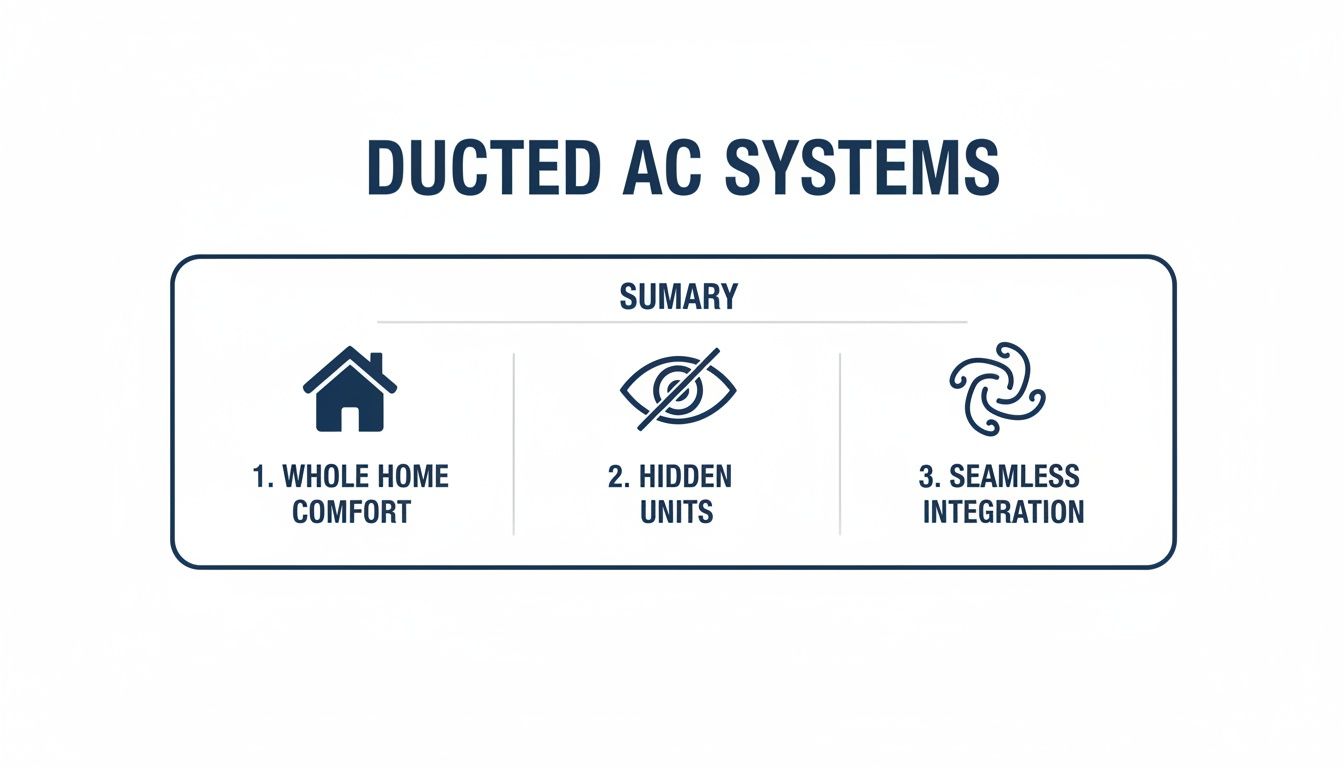
Beyond day-to-day comfort, a professionally installed ducted system can also increase your property's value. It’s seen as a premium feature that immediately appeals to potential buyers looking for a home with modern, integrated comforts.
And don't forget energy efficiency. Modern systems use clever inverter technology and zoning, which lets you cool or heat only the areas you're actually using. This is key to managing those quarterly power bills.
Important Considerations and Drawbacks
Of course, it’s not all sunshine and perfectly chilled rooms. There are a few important factors on the other side of the coin. The biggest hurdle for most people is the upfront cost. The initial supply and installation of a ducted air conditioning system is considerably higher than buying several individual split systems. It's a much larger, more complex job that needs specialised planning and licensed technicians.
The installation itself is also more involved. It requires careful planning and, critically, access to your roof cavity or the space under your floor to run the whole network of ducts.
For a ducted system to be a viable option, your property must have adequate and accessible space in the ceiling or under the floor. This can sometimes be a deal-breaker in older Sydney terraces or apartments with limited cavity space.
This structural requirement is the first thing any professional installer will check. Think about the difference between a modern build in Kellyville versus a heritage-listed terrace in Paddington. The installation complexity and feasibility can vary dramatically. You really need to weigh the long-term benefit of seamless comfort against the initial investment and your home’s physical limitations.
To help you compare the two main options side-by-side, we've put together a simple table. It breaks down the key differences between a central ducted system and having multiple split systems installed throughout your home.
Ducted Air Conditioning vs Multiple Split Systems
| Feature | Ducted Air Conditioning | Multiple Split Systems |
|---|---|---|
| Aesthetics | Virtually invisible, with only discreet grilles showing. | Bulky indoor units mounted on the wall in each room. |
| Coverage | Provides even, consistent temperature across the entire home. | Cools or heats only the specific rooms where units are installed. |
| Noise Level | Whisper-quiet operation inside the home. | Each indoor unit produces some fan noise. |
| Upfront Cost | Higher initial investment ($10,000 – $25,000+). | Lower initial cost per unit ($2,000 – $4,000 each). |
| Property Value | Generally seen as a premium feature that adds value. | Less impact on property value. |
| Control & Zoning | Centralised control with the ability to create zones. | Individual control for each room, but no central management. |
| Installation | More complex, requires roof or underfloor space. | Simpler installation, requires wall space and outdoor placement. |
Ultimately, the choice comes down to what you value most. If your priority is a sleek, quiet, whole-home solution and you have the budget and the right kind of property, ducted is hard to beat. If you're looking for a more affordable, room-by-room approach, multiple split systems might be the smarter way to go.
How to Size and Zone Your System for Sydney's Climate
Getting the sizing and zoning right is the single most important part of a ducted air conditioning installation. It’s the difference between genuine comfort and constant frustration. Get it wrong, and you'll end up with a system that either struggles to keep up on hot days or chews through electricity for no good reason.
Think of it like choosing an engine for a car. You wouldn't drop a small hatchback engine into a LandCruiser and expect it to tow a boat up a hill. The same logic applies when you’re air conditioning your Sydney home. The system needs the right amount of power for the job.
Demystifying System Sizing and kW Capacity
When we talk about the "size" of a system, we're not talking about its physical dimensions. We mean its cooling and heating capacity, which is measured in kilowatts (kW). A higher kW rating means a more powerful system designed for a bigger space.
Getting this number right is absolutely critical. An undersized system is one that’s too small for your home. On a blistering summer day, it will run flat out, non-stop, desperately trying to hit the temperature you’ve set. It will struggle, burn through excessive energy, and wear itself out much faster. Imagine trying to cool a large, open-plan home in Penrith on a 40-degree day with a system built for a small apartment; it just won't cope.
On the flip side, an oversized system is just as bad. It will blast the space with cold air too quickly and then shut off, a process we call "short cycling." This constant starting and stopping is horribly inefficient, puts a huge strain on the components, and fails to properly dehumidify the air, leaving you with that cold, clammy feeling. It’s a massive waste of money.
To find the perfect kW capacity, a professional installer needs to do a proper heat load calculation. This goes way beyond just looking at a floor plan.
Key factors we consider include:
- The total floor area you want to condition.
- Ceiling height and the overall volume of the rooms.
- The size and orientation of your windows, especially those big west-facing windows that bake in the afternoon sun.
- The quality of your insulation in the ceiling, walls, and under the floor.
- Local climate realities, like the intense dry heat in Sydney's western suburbs versus the milder, more humid conditions closer to the coast.
The goal is to pick a system that can handle the absolute peak of a Sydney summer without being so ridiculously powerful that it wastes energy on milder days. A perfectly sized system is the foundation of an efficient and comfortable home.
The Power of Smart Zoning
Once you’ve got the right-sized unit, the real magic of ducted air con comes from zoning. Zoning lets you divide your home into different areas that you can control independently. This is where you make massive savings on your running costs.
Think about a typical two-storey home in Blacktown. During the day, the family is mostly downstairs in the kitchen and living areas. At night, everyone’s upstairs in the bedrooms. Without zoning, you’d be forced to cool or heat the entire house, 24/7.
With a properly zoned system, you can create a ‘Day Zone’ for the downstairs living spaces and a ‘Night Zone’ for the upstairs bedrooms. This means you only send conditioned air where you actually need it, when you need it. During the day, you can switch the bedroom zone off completely. At night, you do the opposite and turn off the living area zone. This simple strategy slashes your energy consumption because you're not paying to cool empty rooms, one of the biggest energy-wasters in un-zoned homes. For a deeper dive, our guide on how to properly size an air conditioner for your space offers even more detail.
This approach transforms your ducted air con from a simple appliance into a smart climate management system that’s perfectly matched to your family’s lifestyle.
Understanding the True Cost of Ducted Air Conditioning
When you start looking at ducted air conditioning in Sydney, it's easy to get fixated on the initial price tag. But the real cost isn't just the supply and installation quote. It’s a mix of that upfront investment and what it will cost you to run the system over the next 15-20 years.
Getting a clear picture of both sides of the coin helps you make a smart, long-term decision for your home and your wallet. After all, this is a significant investment, and no one likes surprise expenses down the track. The total cost is shaped by a few key variables, and it’s definitely not a one-size-fits-all scenario. Any professional quote will be based on a detailed assessment of your home’s unique layout and needs.
Key Factors That Determine Upfront Costs
The price of a ducted system can vary wildly from one home to another. Consider this scenario: a straightforward installation in a new single-storey home in Liverpool is going to be far less complex than retrofitting a system into a two-storey heritage terrace in Newtown with practically zero roof space.
Here are the main things that will shape the final price on your quote:
- System Size (kW Capacity): Bigger homes with more rooms simply need a more powerful unit with a higher kilowatt (kW) rating. More power means a higher price tag.
- Brand and Model: Just like cars, air conditioning brands like Daikin, Mitsubishi Electric, and Actron Air all have different price points, features, and reputations.
- Number of Zones and Outlets: The more independent temperature zones you want and the more ceiling vents you need, the more it adds to the labour and material costs.
- Installation Complexity: A home with easy roof access, plenty of space for ductwork, and a modern switchboard is a dream job. Tricky access, tight spaces, or older wiring will naturally increase the labour involved.
Potential Additional Expenses
Sometimes, installing a powerful ducted system means your home's electrical setup needs a bit of a boost to handle the new load safely. This isn't an optional extra; it's a critical part of a compliant and safe installation that meets Australian Standards like AS/NZS 3000.
One of the most common additional costs is a switchboard upgrade. If your current electrical board is old, full, or uses outdated fuses, a licensed electrician must upgrade it. This ensures your home can safely run the new air conditioning circuit without risk. It’s a non-negotiable safety measure.
Long-Term Running Costs and Energy Efficiency
The upfront price is only the beginning of the story. How much your system costs to run month after month is hugely influenced by your home's thermal performance. Learning how to improve home insulation and save money can dramatically reduce the workload on your air conditioner, which is a real advantage in Sydney's climate.
A well-insulated home holds its temperature better, meaning your system doesn't have to work nearly as hard to keep you comfortable. That translates directly into lower power bills. Choosing a unit with a high energy star rating might cost more initially, but it pays you back year after year. A more efficient system uses far less electricity to deliver the same level of comfort, a crucial factor with Sydney's ever-rising energy prices. For a complete financial breakdown, our detailed article explores the typical cost of ducted air conditioning in much greater depth.
What to Expect During the Installation Process
Thinking about getting a ducted system installed can feel a bit daunting. It’s a bigger job than hanging a split system on the wall, but a professional team makes the whole experience smooth and straightforward. It’s a carefully planned process designed to integrate a complex system into your home with as little fuss as possible.
It all starts well before any tools come out of the van. The first step is a detailed on-site assessment where a technician visits your home. We'll measure up floor areas, get into the roof cavity or underfloor space to check what we're working with, inspect your electrical switchboard, and have a proper chat about your lifestyle. This is where the real design work happens. We map out the best spots for the indoor and outdoor units and plan the most efficient path for all the ductwork.
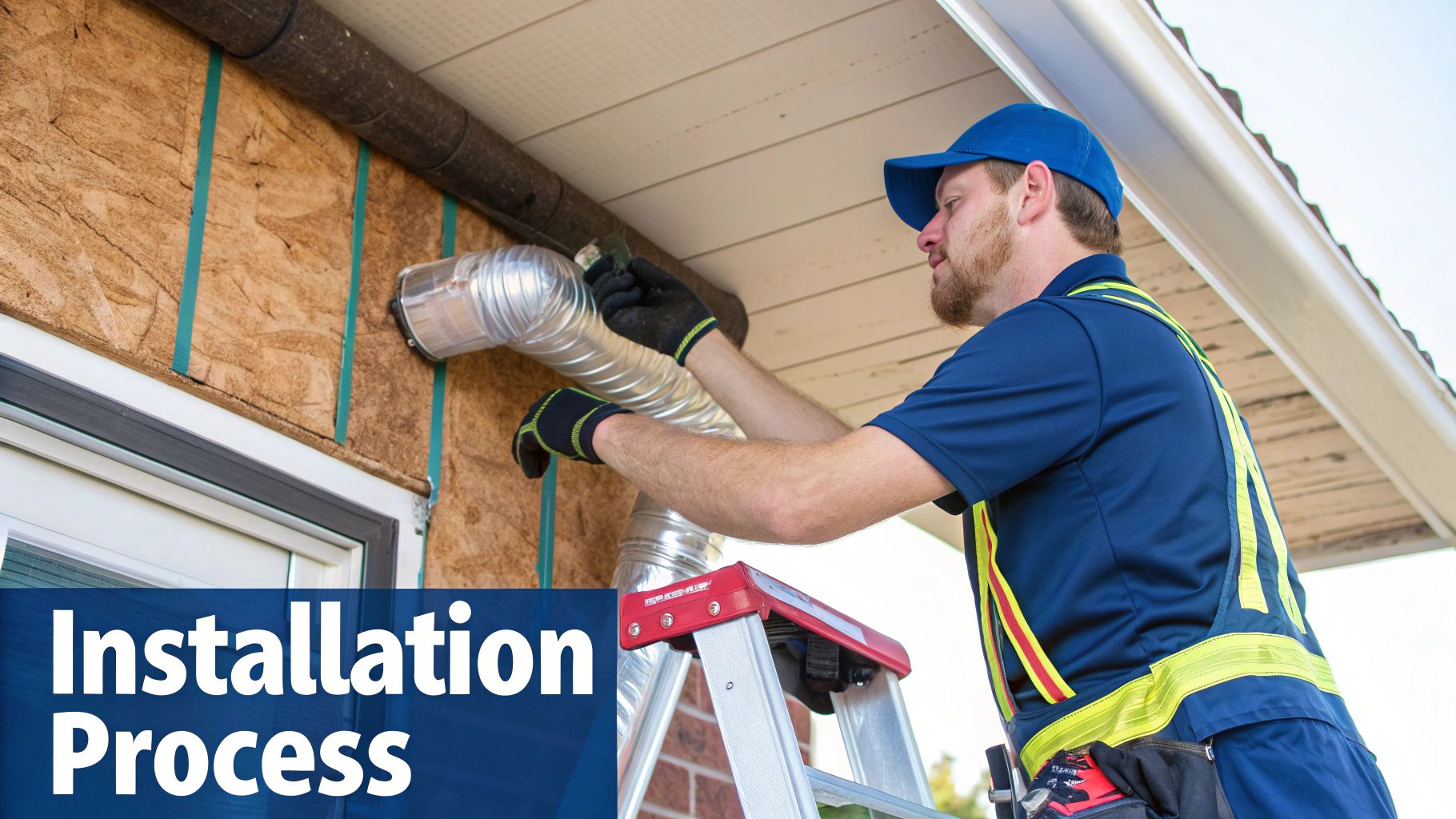
Key Stages of the Installation
Once the design is locked in and you’ve given the quote the green light, we schedule the installation. The process follows a logical sequence to make sure everything is done correctly, safely, and efficiently. First up, we position the main components. The indoor unit, sometimes called the fan coil, is securely installed in your roof space. At the same time, the outdoor condenser unit is placed on a solid, level base, usually a concrete slab, in a spot with good airflow that meets Sydney’s local council regulations.
Next, our licensed technicians get to work running the flexible ductwork through your ceiling or sub-floor. This is a game of precision. We connect the ducts from the indoor unit to the exact locations marked for each outlet, making sure every single join is perfectly sealed. Any air leaks here would seriously hurt the system's performance and efficiency. Once the ducts are in, we cut neat openings in your ceiling to fit the vents or grilles.
Electrical Work and Final Commissioning
With the physical parts in place, the crucial electrical work begins. This is a job that must be done by a licensed electrician who also holds an ARCtick certification. That’s the legal requirement for anyone handling refrigerants in Australia. They’ll run the wiring between the units, connect the system to your switchboard, and install the zone controllers and main thermostat.
All electrical work must strictly follow Australian Standards (AS/NZS 3000) and SafeWork NSW regulations. For the safety of your home and family, this is completely non-negotiable and a hallmark of any reputable installer.
The final stage is what we call commissioning. We power up the system for the first time, test every single function, check the airflow to each zone, and make sure the refrigerant pressures are spot on. Then, we’ll walk you through how to use your new controller, showing you how to set temperatures, manage your zones, and program schedules. We don’t pack up and call it a day until you’re 100% comfortable operating your new system. A quality installation is fundamental to getting the most out of your investment, and you can learn more about what goes into the overall ducted air conditioning installation cost in our detailed guide.
How to Choose the Right Sydney Installer
Getting the ducted system itself is only half the battle. Who you choose to install it is just as important, if not more so. A top-of-the-line system installed poorly will never perform the way it should, and you’ll be left with high power bills and a home that’s still uncomfortable. Vetting your installer is the single most important thing you can do to protect your investment.
In a market as busy as Sydney's, it’s tough to sort the seasoned experts from the fly-by-nighters. The right company won’t just sell you a box; they’ll design a system that genuinely fits your home and how you live in it. Their quote should be detailed and itemised, breaking down the costs for the unit, ductwork, labour, and any electrical work. If all you get is a vague, one-line estimate, that’s a massive red flag.
Verifying Licences and Insurance
This is non-negotiable. It's the first and most critical check you need to make. Installing ducted air conditioning in NSW involves both electrical wiring and handling refrigerants, two highly regulated trades that demand proper licensing for safety. There are absolutely no exceptions.
Before you even think about accepting a quote, ask the installer to show you proof of these two essential licences:
- A current NSW Electrical Contractor Licence: This is your proof they are legally allowed to handle the electrical connections required to power your system safely.
- An ARCtick Licence: This is a federal requirement for any technician handling refrigerants. It ensures they’re trained to work with these substances safely and in a way that doesn’t harm the environment.
A professional installer will have these on hand and won't hesitate to show you. It’s also wise to ask for a certificate of currency for their public liability insurance. This protects you and your home in the rare event something goes wrong during the installation.
Look for Proven Local Experience
Sydney isn't just one city; it's a collection of dozens of unique suburbs with different climates and building styles. A home on the humid Northern Beaches has very different needs to a sprawling house in the dry heat of Penrith, or a terrace house in the Inner West.
This is where deep local experience becomes invaluable. An installer who has worked across Sydney for years will understand the specific challenges of your area. They'll know the local council quirks, the common construction types, and how to design a system that can handle a southerly buster in Cronulla just as well as a scorching summer afternoon in Parramatta.
The demand for this kind of expertise is huge. In fact, New South Wales is the biggest market for ducted air conditioning in the country, making up around 40% of all national sales. This shows just how many Sydney homeowners are looking for a comprehensive climate solution from a trusted local professional. You can read more about this trend and its impact on the NSW energy market.
Don’t be afraid to ask an installer about their experience with homes just like yours, in your part of Sydney. A company with a long track record of successful projects in your area is a pretty good sign you’re dealing with someone who knows exactly what they’re doing.
Common Questions We Hear About Ducted Systems in Sydney
When you’re looking at a whole-home solution like ducted air conditioning, it’s only natural to have a few questions floating around. To help you get a real-world feel for how these systems work, we’ve put together answers to the queries we hear most often from Sydney homeowners.
How Often Does My Ducted System Need to Be Serviced?
We strongly recommend a professional service for your ducted system at least once a year. Think of it as preventative care, not just a check-up. The ideal time is in spring, just before the summer heat really settles in.
This annual service is crucial for keeping your system running efficiently, maintaining healthy air quality, and catching small problems before they turn into expensive, mid-summer breakdowns. A licensed technician will check everything from refrigerant levels and electrical connections to the health of your ductwork. For homes in Sydney's coastal suburbs like Cronulla or Manly, we sometimes suggest more frequent checks just to keep an eye on the corrosive effect of salt air on the outdoor unit.
Are Ducted Air Conditioners Noisy?
One of the best things about modern ducted air conditioning in Sydney is just how quiet it is. The components that make the most noise, the compressor and fan, are all housed in the outdoor unit, well away from your living spaces.
The indoor unit is tucked away in your roof space or under the floor, which muffles what little sound it makes. All you should ever hear inside is the gentle, consistent whisper of air coming from the ceiling vents. If you ever notice any rattling, buzzing, or loud humming, that’s a clear signal that it’s time to book a service.
Can I Get Ducted Air Con in My Existing Home?
Absolutely. While it’s often simplest to install during a new build or a major renovation, retrofitting ducted systems into existing Sydney homes is incredibly common. It's a fantastic upgrade that adds significant value and comfort to older properties right across the city. The main thing you need is enough accessible space in your ceiling cavity or under the floor to run the network of ducts. Any professional installer will do a thorough site inspection first to make sure your home is suitable and map out the best way to get the job done with minimal disruption.
Can I Control the Temperature in Each Room?
This is where the magic of zoning comes in. Zoning lets you group rooms together and control them independently, which is a real advantage for energy savings. You might have a 'Living Area' zone for the day and a 'Bedrooms' zone for the night, for example. To keep it all working efficiently, it's also a great idea to learn how to clean your ducted air conditioner filters.
Standard zoning lets you turn these areas on or off as needed. But more advanced systems can give you individual temperature control for each specific zone. This delivers the ultimate flexibility, allowing you to blast the air con in the kitchen while you cook without wasting a cent cooling an empty lounge room.
Ready to enjoy whole-home comfort designed specifically for your Sydney property? The team at ALC Air is here to help. We offer a free, no-obligation quote and on-site assessment to map out the perfect ducted system for your needs.