


So, what’s a ducted air conditioning system actually going to cost? Let's get right into it. The honest answer is that there’s no single price tag. A professional ducted air conditioning installation in a typical NSW home can range anywhere from $9,000 to over $25,000.
It's helpful to think of it less like buying a fridge and more like a custom project for your home. We find the final cost depends entirely on your property's layout, its size, and what you need to keep your family comfortable year-round.
Typical Ducted Air Conditioning Installation Cost Ranges in NSW
To give you a clearer picture, here are some typical cost ranges you might expect for homes in areas like the Central Coast, Sydney, and Newcastle. Keep in mind these are guide prices. Every home is different, and a proper quote from a licensed technician is the only way to get an exact figure.
| Home Size and Type | Typical System Capacity (kW) | Estimated Installation Cost Range (AUD) |
|---|---|---|
| Small Home (e.g., 2-3 bed villa) | 8-10 kW | $9,000 – $13,000 |
| Medium Home (e.g., 3-4 bed house) | 12-14 kW | $12,000 – $18,000 |
| Large Home (e.g., 4-5+ bed house) | 14-18 kW | $16,000 – $22,000+ |
| Two-Storey Home (complex install) | 16-20+ kW | $18,000 – $25,000+ |
As you can see, the size of your home is a major factor, but it's just one piece of the puzzle. The final figure on your quote will be shaped by several other important elements.
The Initial Price Range Explained
Across Australia, ducted air conditioning installation can range anywhere from $7,000 to $25,000. Here in NSW, particularly in regions like Sydney, the Central Coast, and Newcastle, we tend to see costs fall between that $9,000 and $25,000 mark. This reflects the diverse mix of properties we work on, from compact townhouses in Hornsby to larger family homes in Terrigal.
To get a complete picture of pricing, it’s useful to understand how to estimate construction costs, as this covers everything from the initial planning stages right through to the final installation.
Why Is There Such a Wide Range?
So, why the big difference in price? It really comes down to a handful of key variables that we’ll dig into. Things like the size and capacity of the system you need, the brand you go with, how many "zones" you want for individual room control, and even how tricky it is to run the ductwork through your roof.
If you're new to this kind of system, our guide on what is ducted air conditioning is a great starting point. Each of these components plays a part in the final price, ensuring you get a system that’s perfectly matched to your home for the best possible efficiency and comfort.
Seven Key Factors That Determine Your Final Installation Cost
Getting your head around a ducted air conditioning quote is the key to understanding its real value. It’s a lot more than just the price of the unit itself. Think of it like a custom build. Every component and decision plays a part in the final investment and how well the whole thing works for your family.
Several core elements come together to shape your final price. Each one is crucial for making sure your system runs efficiently, is reliable, and is perfectly matched to your home, whether you're in the humid coastal suburbs of the Central Coast or the hotter western parts of Sydney.
This diagram breaks down the total cost into three main buckets: the system itself, the complexity of the installation, and the specific needs of your home.
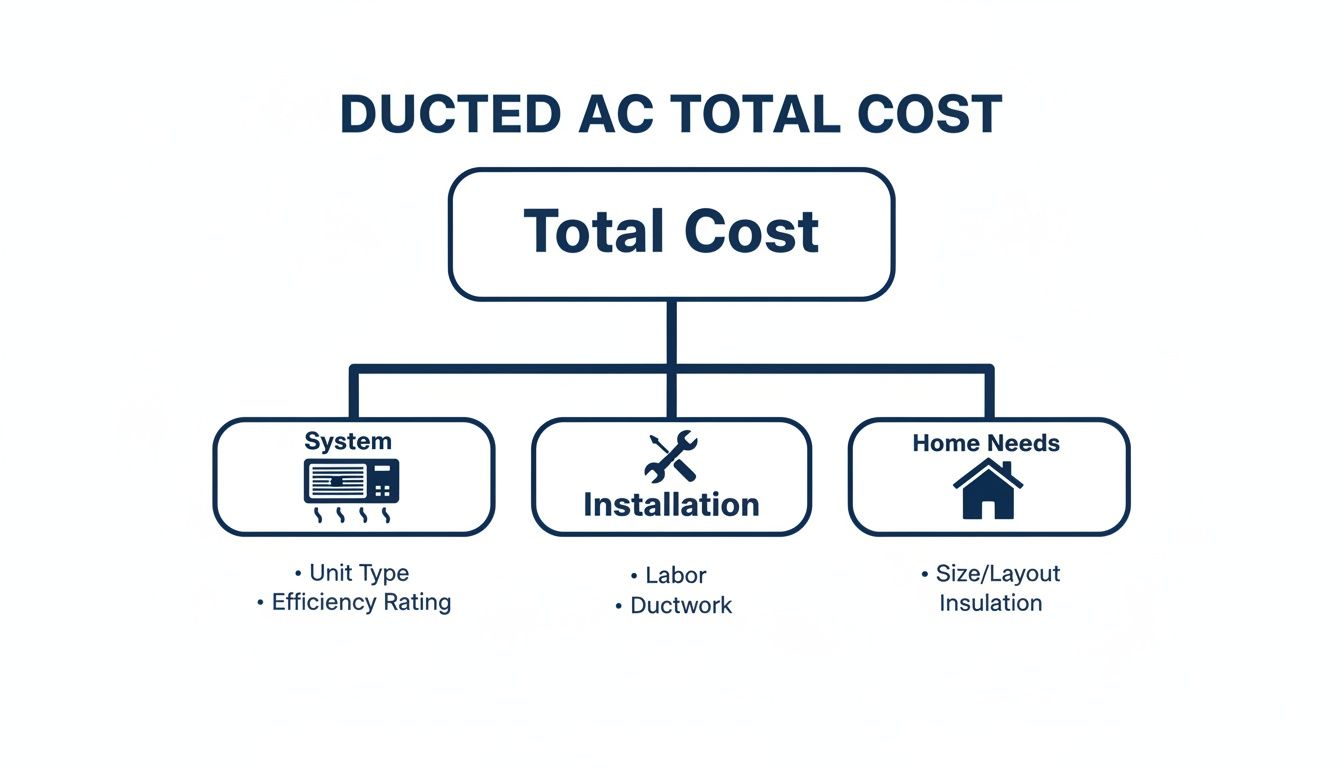
As you can see, the final price is a balance between these areas. The labour and specific challenges of your home often influence the cost just as much as the hardware.
1. System Size and Capacity (kW)
The single biggest factor is the system's capacity, which we measure in kilowatts (kW). This isn't about physical size; it's about raw cooling and heating power. Think of it like a car engine. A large, two-storey home in Hornsby needs a more powerful engine to perform well compared to a small villa in Terrigal.
An undersized system will struggle on hot days, running flat out without ever hitting the temperature you’ve set. On the flip side, an oversized system will constantly switch on and off, which is incredibly inefficient and puts unnecessary wear and tear on the components. Nailing the capacity is critical, which is why we have a helpful guide on how to use our air conditioning unit calculator to get a reliable starting point.
2. Brand and Energy Efficiency
Let’s be honest, not all brands are created equal. Premium brands like Daikin or Mitsubishi Electric often have a higher upfront cost, but you’re paying for rock-solid reliability, advanced features, and superior energy efficiency. This can lead to genuine savings on your power bills over the system's life.
More budget-friendly brands can still do the job, but they might not offer the same long-term performance or low running costs. The choice really comes down to balancing your upfront budget with your long-term operating expenses.
3. Zoning Requirements
Zoning is what gives you independent temperature control in different parts of your house. It means you can switch off the air con in unused guest rooms or have different temperatures for the upstairs bedrooms and the downstairs living area.
Each "zone" needs its own thermostat and motorised dampers inside the ductwork, which adds to the material and labour costs. A simple single-zone system for an open-plan living area will be significantly cheaper than a complex six-zone system for a large family home in Newcastle.
4. Ductwork Complexity
The "ducts" in ducted air conditioning are the veins of the system. They are a network of insulated tubes that carry conditioned air from the central unit to each room. The complexity of running this ductwork has a major impact on the final cost.
A single-storey home with plenty of room in the roof is relatively straightforward. However, a two-storey house, a home with a flat roof, or a property with tight roof access in older suburbs of the Hunter Valley presents a much bigger challenge for our technicians. To get a fuller picture of the factors that influence your final quote, it's worth reviewing detailed guides on air duct installation costs and considerations, which cover materials and other crucial details.
Why Roof Space Matters: A challenging installation in a cramped or cluttered roof space simply takes more time, specialised labour, and careful planning. All of this has to be factored into the quote, because safety and compliance with Australian Standards are our absolute top priorities.
5. Controller and Technology
Even the type of controller you choose affects the price. A standard wall-mounted controller gives you basic functions, while more advanced smart controllers offer Wi-Fi connectivity, app control, and can even link up with your home automation systems. These premium controllers add convenience and can help you use energy more efficiently, but they do come at a higher cost.
6. Property Access and Location
This is a simple one. How easily can our team get to the areas where the indoor and outdoor units need to be installed? A hard-to-reach roof space or an outdoor unit that has to be mounted on a second-storey wall bracket will require more time and potentially specialised equipment, adding to the labour cost.
7. Electrical Switchboard Upgrades
Modern ducted systems draw a fair bit of power. Many older homes, especially in established areas of Sydney or the Central Coast, have switchboards that just aren't equipped to handle that kind of load safely.
A licensed electrician has to assess your switchboard. If it needs an upgrade to comply with AS/NZS 3000 electrical standards, this will be an additional cost. It’s a non-negotiable step to ensure your home's electrical system is safe and can support your new air conditioner without any risk.
Breaking Down the Quote: System vs Labour Costs
When a professional quote for a ducted air conditioning system lands in your inbox, it’s more than just a single number at the bottom of the page. It's a detailed breakdown of two distinct parts: the cost of the system hardware itself, and the cost of the skilled labour needed to get it installed safely and correctly. Getting your head around these two halves of the equation is the key to seeing where the real value lies.
First up, you’ve got the physical equipment. This covers the big-ticket items like the indoor fan coil unit (the part that sits in your roof space) and the outdoor condenser unit. But it also includes all the supporting gear that makes it work, the flexible ducting, the ceiling grilles or louvres, and the central wall controller.
The Cost of the System Hardware
The price tag on the hardware can swing pretty wildly depending on the brand you go with. Well-established names like Daikin, Mitsubishi Electric, and Actron Air often carry a higher initial cost. You’re essentially paying a premium for their track record of reliability, advanced tech, and top-tier energy efficiency, which can mean lower running costs over the life of the system.
Energy efficiency ratings are another big player here. A system with a higher star rating might cost more upfront, but it's engineered to sip electricity rather than guzzle it to achieve the same cooling or heating. This means you could see some serious savings on your power bills down the track. This is a smart long-term investment whether you're in the scorching western suburbs of Sydney or the humid coastal parts of Gosford.
The Value of Professional Labour
The second, and equally critical, part of your quote is the labour cost. This isn’t just paying for someone to do the heavy lifting; it’s an investment in genuine expertise, safety, and compliance. Every installation must be carried out by a licensed and insured technician who holds an ARCtick certification. This is a non-negotiable legal requirement in Australia for anyone handling refrigerants.
This labour component covers a technician's extensive training, insurance, and the specialised tools needed to do the job right. It also accounts for the time it takes to deliver a quality installation that meets strict Australian Standards, like AS/NZS 60335 for appliance safety. A simple job in a single-storey Lake Macquarie home might take a day. But a complex install in a two-storey house with tricky roof access in Newcastle could take much longer, and the labour cost will naturally reflect that.
Why You Shouldn't Cut Corners on Labour: Choosing an installer based on the cheapest labour price is a huge risk. Unlicensed work can instantly void your manufacturer's warranty, create serious electrical hazards, and leave you with a poorly performing system that costs you a fortune in the long run.
The cost of this skilled labour has also been shaped by the wider economy. Recent industry analysis shows that technician costs, which include vehicle and tool expenses, have risen significantly. This is partly due to inflationary pressures and a general spike in demand for new air conditioning installations. You can read more about these local market trends to get a better sense of the factors affecting pricing.
Ultimately, a detailed, professional quote should clearly separate the costs for the system and the labour. This transparency lets you see exactly what you're paying for: high-quality equipment and the professional expertise needed to make it perform at its best for years to come.
How Sydney and NSW Costs Compare Across Australia
When you’re looking into the cost of ducted air conditioning, it helps to see the bigger picture. Prices aren't the same everywhere in Australia, and understanding why can help you make sense of a local quote for your home on the Central Coast, in Sydney, or around Newcastle.
Generally speaking, NSW sits at the higher end of the national price range. This isn't just a random fluke; it's driven by a few key local factors that shape the cost of doing business and delivering a high-quality, compliant installation in our part of the world.
Why Are NSW Costs Often Higher?
One of the biggest drivers is simply the higher cost of living and labour in major hubs like Sydney. Skilled, licensed technicians command higher rates here than in some other capital cities, and that’s reflected in the labour component of your quote. We make sure our team is paid fairly for their expertise because it’s essential for a safe and reliable job.
Property complexity also plays a huge part. Consider the difference between installing a system in a new build out in the Hunter Valley versus a heritage terrace house in Inner West Sydney. Denser urban areas often mean trickier access, body corporate rules, and more complicated logistics, all of which demand more time and careful planning from our team.
Finally, demand is consistently high across NSW. From the scorching summer heat in Sydney’s western suburbs to the year-round humidity on the Central Coast, good air conditioning is seen as essential. This high demand can also influence the overall market pricing for both the systems themselves and the skilled labour needed to install them. To get a better handle on these local factors, you can dive deeper into how much ducted air con costs right here.
A Look at National Price Ranges
To put our local market into context, it’s useful to see how typical installation costs stack up across the country. While every project is different, you can definitely see regional patterns in what people pay.
Here’s a rough guide to give you an idea of the landscape.
Ducted Air Con Installation Cost Comparison Across Australia
| City | Typical Cost Range (AUD) |
|---|---|
| Adelaide | $7,000 – $16,000 |
| Melbourne | $7,500 – $18,000 |
| Perth | $7,500 – $19,000 |
| Brisbane | $7,000 – $17,000 |
| Sydney | $9,000 – $25,000+ |
This comparison highlights that Sydney's typical range often positions NSW as one of the more premium markets for ducted installations.
It also shows why getting a quote from a local expert who truly understands the specific conditions and costs in your area, whether it’s Gosford, Hornsby, or Newcastle, is so important. A price that seems standard in another state might not account for the realities of installing a system properly and safely, right here in NSW.
Thinking Beyond Installation to Long Term Running Costs
The upfront ducted air conditioning installation cost is a significant investment, but it’s only the beginning of the story. A system that seems like a bargain initially can quickly become a financial headache if it’s expensive to run month after month.
Smart buyers look beyond the installation quote and consider the total cost of ownership over the system's entire life. This means factoring in your future electricity bills, which are directly influenced by the system’s design and efficiency. The cheapest upfront price is rarely the most economical choice over a 10 to 15-year lifespan.
The Power of Energy Efficiency
When you compare ducted systems, you’ll see an energy star rating. A system with more stars might have a higher purchase price, but it's engineered to use significantly less electricity to achieve the same level of comfort.
Imagine you're choosing between two cars. One is cheaper but has poor fuel economy, while the other costs more upfront but sips fuel. Over several years of driving, the more fuel-efficient car often works out to be the cheaper option. A high-efficiency air conditioner can lead to substantial savings on your power bills, especially during a scorching summer in Sydney’s western suburbs or a chilly winter in the Hunter Valley.
How Smart Features Reduce Running Costs
Modern ducted systems come with clever technology designed to minimise energy consumption without sacrificing comfort. Understanding these features helps you see how a quality system pays for itself.
- Inverter Technology: An inverter is like a cruise control for your air conditioner. Instead of the compressor abruptly turning on and off all day, it gently adjusts its speed to maintain the set temperature. This avoids constant energy spikes, resulting in a more efficient and quieter operation.
- Zoning: Why cool or heat the entire house when you’re only using the living room? Zoning allows you to turn off airflow to unused areas. This simple feature drastically reduces the workload on your system, which in turn cuts down your running costs.
A well-designed system isn't just about power; it's about control. By only conditioning the spaces you're using, you ensure not a single dollar of your energy bill is wasted on empty rooms. This is the key to managing long-term expenses effectively.
The Role of Regular Maintenance
Finally, don't overlook the importance of professional maintenance. A yearly service by a licensed technician ensures your system runs at peak efficiency. Clogged filters and dirty coils force the unit to work harder, consuming more power to produce the same result.
Regular servicing not only keeps your running costs down but also helps identify small issues before they become major, expensive repairs. It's a small annual investment that protects your much larger one. For a deeper look into operational expenses, our guide explores how much air conditioning costs to run in more detail.
How to Choose the Right Air Conditioning Installer
Picking the right installer for your ducted air conditioning system is just as crucial as choosing the right brand. A flawless installation by a qualified professional is the single best way to protect your investment and make sure your system runs efficiently for years to come. The quality of the install genuinely affects everything from your power bills to how long the system will last.
Making the right choice means asking the right questions. It’s about looking beyond the price on the quote and verifying the credentials, experience, and professionalism of the company you’re about to trust with your home.

Verifying Licences and Insurance
Before you do anything else, you absolutely must confirm the installer holds the correct licences. This is non-negotiable. It’s about your safety, your home, and staying on the right side of the law. In NSW, air conditioning work involves both electrical and refrigeration trades, so your installer needs to be fully qualified in both.
Ask to see their:
- Contractor Licence: Issued by NSW Fair Trading, this proves they are a legitimate, registered business.
- Electrical Licence: Any technician connecting your system must be a licensed electrician. This is a legal requirement under Australian Standards (AS/NZS 3000).
- ARCtick Licence: Anyone who handles refrigerants in Australia is legally required to hold this licence.
- Proof of Insurance: They must have current Public Liability insurance. This covers any accidental damage to your property during the installation.
The Importance of Local Experience
An installer with deep local experience brings invaluable knowledge to the job. A team that has spent years working across the Central Coast, Sydney, and Newcastle understands the specific challenges our region throws at them. They get it.
They know how to account for the corrosive, salty air in coastal suburbs like Gosford and how to approach tricky installations in the older character homes you find all through Newcastle.
This local know-how ensures they recommend the right system and materials for your specific environment, which is a huge part of maximising your system's lifespan. For more guidance, our detailed article explains how to find quality air conditioning service on the Central Coast and what to look for in a local expert.
The Dangers of Unlicensed Installers
You’ll almost certainly come across quotes that seem too good to be true, often offered as ‘cash deals’. These are nearly always from unlicensed installers, and trying to save a few dollars here can lead to disastrous consequences.
A Warning on 'Cash Deals': An unlicensed installation will instantly void your manufacturer's warranty on a brand new system. Even worse, it creates a massive risk of electrical faults, refrigerant leaks, and poor performance, leaving you with absolutely no legal recourse when things go wrong.
A professional company will always provide a detailed, written quote that itemises every cost. They stand by their work with an installation warranty and ensure every part of the job complies with SafeWork NSW regulations and Australian Standards.
Choosing a reputable, licensed installer isn't just a good idea; it's the only way to guarantee a safe, reliable, and efficient ducted air conditioning system for your home.
Answering Your Questions About Ducted Air Con Costs
When you're thinking about a big home improvement like ducted air conditioning, it's totally normal to have a list of questions about the whole process and the investment. We've pulled together the most common things we get asked by homeowners across the Central Coast and Sydney to give you some clear, straight-up answers.
How Long Does a Typical Installation Take?
This is usually the first thing people want to know. For a standard, single-storey home, a complete ducted air conditioning installation typically takes one to two full days. Our team is pretty efficient, and we always aim to cause as little disruption to your life as possible.
Of course, some things can stretch that timeline out a bit. A bigger or more complex house, like a two-storey place in Newcastle with tricky roof access, might need a bit more time. Likewise, if your home’s electrical switchboard needs an upgrade to handle the new system safely, that will add to the project's duration. We’ll always give you a clear, realistic timeframe in our initial quote so you know exactly what to expect from the start.
Is It Cheaper to Install During a New Build?
Yes, without a doubt. Putting a ducted system in while your new home is still under construction is almost always cheaper. The biggest reason is just simple accessibility. When the walls are still open frames and the roof space is clear, our technicians can run all the ductwork and wiring far more easily and quickly.
This cuts down on the total labour hours needed, which has a direct impact on the final installation cost. It also lets us integrate the system more seamlessly into the building's design, making sure every duct and vent is perfectly placed for the best possible performance right from day one. Planning for your air conditioning early in the build is just a smart financial move.
Are There Financing Options Available?
We get it, a new ducted system is a significant investment for any household. To make this crucial upgrade more manageable, many reputable installers, including us, can help you find flexible payment solutions.
These usually come from trusted financing partners who specialise in home improvement loans. It allows you to break the total cost down into smaller, more manageable monthly payments. That way, you can get the comfort of whole-home climate control without feeling the big upfront financial squeeze. It's always worth asking about these options when you're getting a quote.
Your home's comfort is a long-term investment in your family's quality of life. Exploring different payment avenues can make achieving that comfort much more manageable, ensuring you get the best possible system without compromising your budget.
Making an informed decision is the first step towards enjoying year-round comfort. Getting your head around these key parts of the installation process ensures there are no surprises down the track.
Ready to find the perfect climate control solution for your home? The team at ALC Air has over 15 years of experience providing expert advice and quality installations across the Central Coast, Sydney, and Newcastle. Get in touch for a free, no-obligation quote and let us design a system that fits your home and budget perfectly.