


When you're starting to budget for whole-home climate control, the cost of a ducted air conditioning system is a pretty significant number. You can expect to invest anywhere from $6,000 for a small home to well over $20,000 for a large, multi-storey property. That price tag covers both the hardware and, crucially, the professional installation, which is a big part of the final quote. We're here to walk you through what that number really means for your home.
Understanding the Typical Cost of Ducted Air Conditioning
Deciding to go with a ducted system is a major investment in your home's comfort, whether you're dealing with the humid coastal air on the Central Coast or the drier heat of Western Sydney. The final price is always a mix of two things: the physical unit itself and the skilled labour needed to install it safely and correctly.
For example, putting a ducted system into a standard three-bedroom home in Newcastle isn't just a matter of plugging something in. It involves careful planning to make sure every single room gets consistent, balanced airflow.
As a general rule, the bigger and more complex your home's layout is, the more powerful the system needs to be, which pushes the price up. The total cost is split between the equipment and the installation fees, covering everything from the licenced electrical work to carefully placing every centimetre of ducting.
Price Ranges by Home Size
Your home’s size is the biggest single factor that will determine the initial cost of a ducted system. Let's break down some real-world numbers so you have a clearer idea of what to expect.
A small two-bedroom apartment might start at around the $6,000 to $9,000 mark. A more typical three or four-bedroom family home usually lands in the $9,000 to $14,000 bracket. For those larger homes with multiple levels or sprawling open-plan layouts, costs can easily climb past $20,000. We dive deeper into all the variables in our comprehensive air conditioning installation costs on the Central Coast guide.
To give you a clearer picture, here’s a quick overview of what you can expect to pay based on your home's size.
Estimated Ducted Air Conditioning Costs by Home Size
| Home Size / Type | Typical System Capacity (kW) | Estimated Total Cost (Unit + Installation) |
|---|---|---|
| Small Apartment / 2-Bed Unit | 6 – 8 kW | $6,000 – $9,000 |
| Small Home / 3 Bedrooms | 8 – 12 kW | $9,000 – $12,000 |
| Medium Home / 4 Bedrooms | 12 – 16 kW | $12,000 – $16,000 |
| Large Home / 5+ Bedrooms | 16 – 20+ kW | $16,000 – $22,000+ |
| Two-Storey or Complex Layout | 18 – 25+ kW | $18,000 – $25,000+ |
This table shows how the investment scales up pretty directly with the size of the property you need to cool and heat. It's a useful starting point for your budget.
This visual guide also shows the typical cost brackets you can expect.
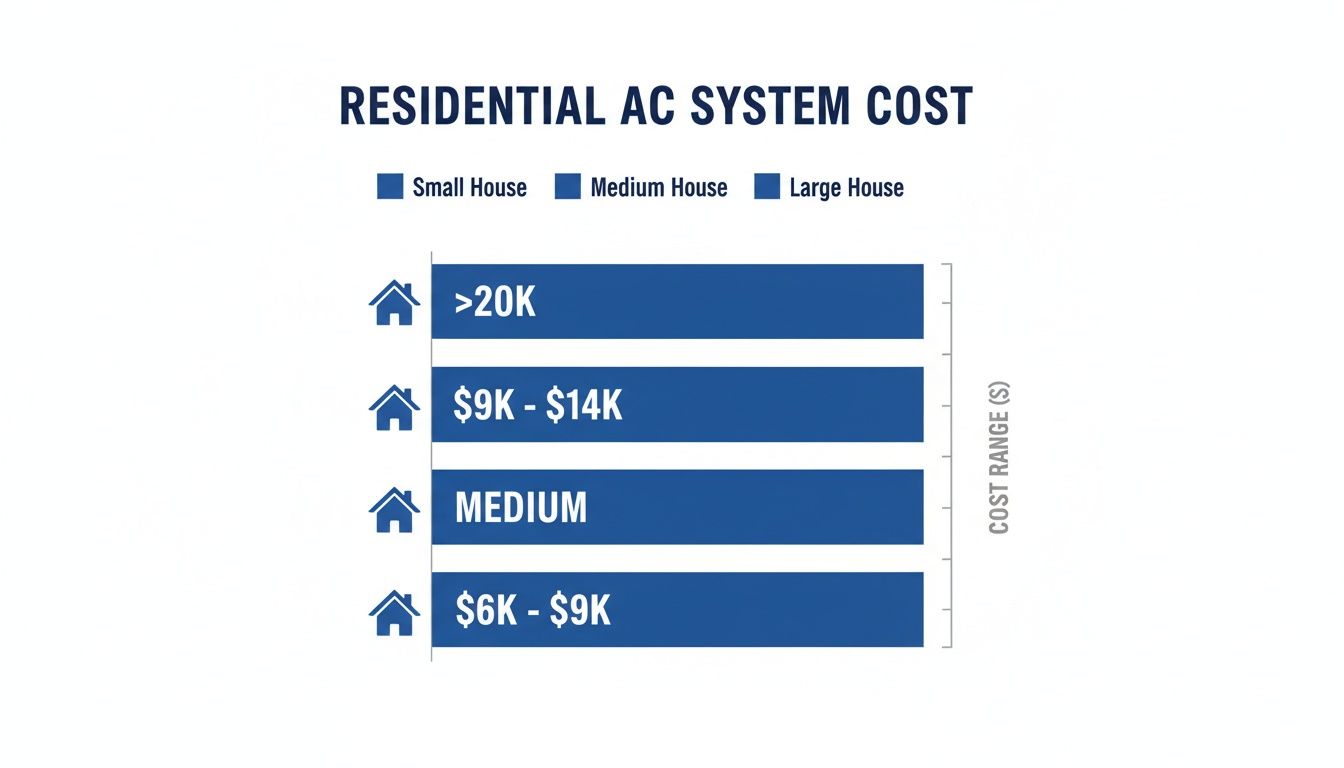
As the chart illustrates, it’s a simple equation: the more space you need to condition, the larger the system and the bigger the investment. Independent research confirms that in a competitive market like Sydney, the total cost for a standard ducted system can range from $12,000 to $20,000, with a huge chunk of that being allocated to the professional installation itself. You just can't skimp on the labour if you want the system to work efficiently for the next 15 years.
What Are You Actually Paying For in a Quote
When a quote for a ducted air conditioning system lands in your inbox, it's easy to get laser-focused on that final number. But to really compare offers and understand what you're investing in, you need to look past the total and see what's actually inside. A professional quote is a package deal, combining essential, high-quality equipment with highly skilled, licenced labour.
Unpacking that quote reveals a whole list of critical hardware. You've got the indoor fan coil unit (the workhorse that's usually tucked away in your ceiling space), the powerful outdoor condenser unit, the entire network of flexible or rigid ducting that moves the air around, and the vents or louvres that deliver it into each room. You’ll also see line items for zoning hardware like dampers and the central controller that puts you in command of your home's climate.
The Equipment Breakdown
Every single piece of hardware plays a crucial role, and this is where quality really makes a difference. The ducting, for instance, has a massive impact on airflow and overall efficiency. If it’s poorly sealed or made from cheap, low-grade material, it can leak precious cool air straight into your roof cavity, which is a fantastic way to waste energy and drive up your power bills.
It's the same story with the vents. Their design influences how quietly and evenly air is spread throughout your rooms. While it’s always tempting to save a few dollars on cheaper components, investing in quality parts from trusted brands like Daikin or Mitsubishi Electric is a smart move. It means better performance day-to-day and a much longer lifespan for your entire system.
The Importance of Professional Labour
Beyond the physical gear, a big chunk of your ducted air conditioning cost is for the professional labour to put it all together. This is where a cheap quote can really come back to bite you. Installing a ducted system isn't just about connecting a few pipes; it's a complex job that legally requires a team of certified professionals.
First up, a licenced electrician must handle all the wiring to make sure it complies with Australian Standards (AS/NZS 3000). This is a non-negotiable safety requirement that protects your home and your family. On top of that, the system’s refrigerant lines have to be installed and charged by a refrigeration mechanic holding an ARCtick certification. This is the law, ensuring refrigerant gases are handled safely and responsibly. This detailed, multi-trade work is a world away from the simpler requirements you'd find when looking at the [installation cost for a split system air conditioner](https://alcairconditioning.com.au/blog/installation-cost-for-split-system-air- conditioner/).
The complexity of the job itself can vary wildly from one house to the next. A single-storey brick home in Newcastle with a big, open roof space is a relatively straightforward installation. Contrast that with a modern two-storey build in Gosford with tight access and a complicated roofline. That job will demand more labour hours, specialised equipment, and careful planning, which will all be reflected in the final quote. A quality installer sees these challenges coming and plans for them to deliver a seamless result.
Key Factors That Influence Your Final Installation Price
When you start comparing quotes for a new ducted system, you'll quickly notice that prices can swing quite a bit, even between similar-looking homes in the same neighbourhood. It's a common source of confusion, but there's a good reason for it. The final ducted air conditioning cost isn't just a number pulled from a catalogue; it's a careful calculation based on several key factors unique to your property.
Understanding these variables helps you see exactly where your money is going and why one quote might be higher or lower than another.
The biggest ticket item, without a doubt, is the size and layout of your home. A sprawling single-storey home in the Hunter Valley needs a completely different system than a compact two-storey townhouse in Sydney. The total floor area, ceiling height, and the number of rooms you want to cool all directly impact the system's required capacity, which we measure in kilowatts (kW).
Getting this size right is non-negotiable for both comfort and efficiency. Go too small, and the system will struggle on hot days. Go too big, and you'll waste money on a unit that cycles on and off too frequently. You can learn more by reading our guide to correctly sizing your air conditioner.
Zoning and Home Efficiency
Another major influence on your final price is zoning. A basic ducted system is an "all-or-nothing" deal—it cools or heats your entire home to one temperature. Zoning, on the other hand, is the smart upgrade that divides your home into different sections, giving you independent climate control over each area.
Think about it: you could cool just the living areas during the day while everyone's up and about, then switch to cooling only the bedrooms at night.
While adding zones does increase the upfront cost, it pays you back over time with significant savings on your energy bills. Why waste power cooling empty rooms? This efficiency is why most people investing in ducted systems today consider zoning an essential feature.
Your home’s existing insulation and energy efficiency also play a big part. A well-insulated home with double-glazed windows is like an Esky—it holds its temperature far better. This often means you can install a slightly smaller, less expensive unit that won't have to work nearly as hard to keep you comfortable, saving you money on both the installation and running costs.
Access, Brand Choice, and Electrical Needs
The nitty-gritty of your property’s construction is also a huge factor. The ease of access to the roof space, for instance, is a major consideration for our installation team. A spacious, easily accessible roof cavity makes running the ducts straightforward. A tight, cluttered, or difficult-to-access space? That requires more time, more specialised labour, and naturally, that adds to the cost.
Of course, the brand of the system you choose will impact the final price tag. Premium brands like Daikin and Mitsubishi Electric often come with a higher initial cost. But what you're paying for is their reputation for rock-solid reliability, top-tier performance, and excellent manufacturer warranties, making them a wise long-term investment.
Finally, we always have to assess your home's switchboard and electrical capacity. Many older homes, especially in established areas across the Central Coast and Newcastle, have electrical panels that just weren't built to handle the load of a powerful, modern air conditioning system.
If needed, a mandatory switchboard upgrade isn't just about ticking a box; it's about ensuring your new system is compliant with Australian Standards like AS/NZS 3000 and, most importantly, keeping your family safe.
Thinking Beyond Installation: The Ongoing Running Costs
The upfront price of your new ducted system is a big part of the budget, but it's really just the first chapter of the story. To get the full picture of your ducted air conditioning cost, you need to think about what it will add to your quarterly electricity bill. The good news is, modern systems are built with efficiency at their core, which helps keep those ongoing expenses in check.

Two features have the biggest impact on your power consumption: the Energy Star Rating and inverter technology. The star rating gives you a simple, government-backed way to compare the efficiency of different models. Inverter technology, on the other hand, acts like cruise control for your air conditioner. It allows the compressor to gently ramp up or down to precisely match the cooling or heating needed, which slashes power usage compared to older stop/start systems.
Estimating Your Power Bills
So, what does this actually mean for your wallet? The exact hourly running cost is a moving target, changing with the outside temperature, your thermostat setting, and your local electricity tariff. For instance, cooling a home during a 40-degree heatwave in Western Sydney will naturally use more power than just maintaining a comfortable 22 degrees on a mild day on the Central Coast.
On average, an efficient ducted unit can cost anywhere from $0.25 to over $3.45 per hour to run, depending on the conditions and the system's size. Modern inverters can cut energy consumption by as much as 30% compared to older fixed-speed models, making a huge difference to your bills over summer. You can dive deeper into these variables in our detailed guide on how much it costs to run your air conditioner.
Key Takeaway: While a highly efficient system might have a higher initial price tag, the long-term savings from lower running costs almost always make it the smarter financial choice over the life of the unit.
The Value of Routine Maintenance
Finally, one of the most overlooked aspects of running costs is maintenance. A small investment in regular upkeep protects your system and keeps it running at peak efficiency, just like servicing your car.
You can easily do some of these tasks yourself, like cleaning the return air filter every few months. A clogged filter makes the entire system work harder to pull in air, and research shows dirty filters can increase your running costs by up to 20%.
Beyond that, scheduling a professional annual service is crucial. Our licenced technicians will check refrigerant levels, clean the coils, test all the electrical components, and make sure the whole system is running safely and efficiently. This preventative care not only keeps your power bills down but also helps catch small issues before they snowball into major, expensive repairs.
How to Save Money on Your Ducted Air Conditioning System
While a ducted system is a significant investment for your home, there are some smart ways to manage the total cost without sacrificing comfort. The key is to think long-term, ensuring the money you spend delivers real value for years to come.
One of the most effective strategies starts right at the beginning: choosing a high-efficiency system. A unit with a higher energy star rating might cost a little more on the initial quote, but it can genuinely save you hundreds of dollars on your power bills every single year. It’s a classic case of spending a bit more now to save a lot more later.
Optimise Your Home for Efficiency
Another powerful tool for managing costs is smart zoning. By dividing your home into distinct areas, like living spaces and bedrooms, you can heat or cool only the parts of the house you’re actually using. Why pay to cool an empty guest room? This simple feature can dramatically reduce your system’s running time and your power consumption.
Improving your home's thermal performance also makes a huge difference. You can help your air conditioner work smarter, not harder, by taking a few simple steps:
- Improving insulation: Topping up the insulation in your ceiling and walls is one of the best things you can do. It helps keep all that conditioned air right where you want it—inside.
- Sealing drafts: Take a look around your windows and doors. Those little gaps and cracks might not seem like much, but they let precious cool or warm air escape.
These small improvements mean your system doesn't have to fight as hard against the extreme temperatures we see across the Hunter Valley or Western Sydney.
Smart Timing and Regular Upkeep
Believe it or not, timing your installation can lead to savings. The peak of summer and the dead of winter are the busiest times for installers, for obvious reasons. By scheduling your installation for the off-peak seasons, like autumn or spring, you may find better availability and potentially more competitive pricing.
Finally, consistent upkeep is absolutely key to long-term savings. Following a simple air conditioning maintenance schedule keeps your unit running at its best, preventing energy waste and helping you avoid expensive repairs down the track. It's also worth keeping an eye out for any NSW Government rebates or schemes, which sometimes pop up for homeowners installing energy-efficient systems.
Choosing the Right Installer for Your Ducted System
You could buy the best, most expensive air conditioner on the market, but if the installation is substandard, it will struggle from day one. This is a point that gets missed far too often: the quality of the installation workmanship is just as important as the quality of the unit itself. Getting this part right is absolutely critical.
A cheap quote can be incredibly tempting, but it often comes at a hidden price. A poor installation can lock you into years of high energy bills, inadequate cooling, and even premature system failure. Ensuring your investment is safe, compliant, and built to last starts with hiring the right team for the job.
Verifying Licences and Qualifications
Before you even start comparing quotes, the first step is to verify an installer’s qualifications. In NSW, this is a complete non-negotiable for safety and compliance. Any reputable company you deal with must hold both a full contractor electrical licence and an ARCtick refrigerant handling licence.
Crucial Tip: Always ask to see physical proof of these licences. The wiring must be performed by a licenced electrician to meet Australian Standards (AS/NZS 3000), and only an ARCtick certified technician can legally handle the refrigerant gases. This isn't just red tape; it's what protects your home, your warranty, and your family.
What to Ask a Potential Installer
Getting a detailed, itemised quote is essential for properly comparing your options and avoiding nasty surprises down the track. Once you have a quote in hand, don't be afraid to ask a few questions to understand exactly what you're paying for.
Here are some key questions worth asking:
- What warranties do you provide on your workmanship? This is completely separate from the manufacturer's warranty on the unit. It shows they stand behind the quality of their own installation work.
- How did you calculate the system size for my home? A good installer will walk you through their load calculation process, explaining how they considered your home's size, layout, insulation, and even window orientation.
- Which brands do you specialise in and why? This is a great way to gauge their experience. Are they recommending a brand for its proven reliability and performance, or just because it's cheap?
Choosing an installer with a strong local reputation, like our team with over 15 years of hands-on experience on the Central Coast, gives you accountability and long-term support. A quality installation is the foundation of an efficient and reliable ducted air conditioning system. It’s the one area you don’t want to cut corners.
A Few Common Questions We Hear About Ducted Air Con Costs
When you're making a big investment in your home's comfort, it's natural to have questions. To help you feel more confident, we've put together answers to some of the queries we hear most often from homeowners budgeting for a new ducted system.
Is Ducted Air Con Really That Much More Expensive Than Split Systems?
Upfront, yes. A single ducted system is a significantly bigger investment than installing a single split system. But that comparison can be a bit misleading.
The real question is what it costs to cool your entire home. If you start adding up the cost of installing three, four, or even five individual split systems to cover all your bedrooms and living areas, that total cost can quickly creep up and get surprisingly close to a ducted solution. With ducted, you get a far more seamless, whole-home result without multiple units hanging on your walls.
How Much Extra Will Zoning Add to the Bill?
Zoning is probably the most popular and practical upgrade for a ducted system, letting you control different areas of your home independently. As a ballpark, adding this feature typically adds between $2,000 and $4,000 to the initial installation. The final figure just depends on how many zones you want to create.
While it's an extra cost at the start, the long-term savings on your power bills are substantial. Think about it – you're only paying to cool or heat the rooms you're actually in, not wasting energy on empty bedrooms during the day.
How Long Will My House Be a Work Site for the Installation?
The timeline really comes down to the specifics of your property. For a standard single-storey home in a suburb like Umina Beach or Toukley where we have good roof access, our team can often have the entire installation wrapped up in just one to two days.
Things can take a bit longer for more complex jobs. A two-storey home or a property with a tricky roof structure in one of Sydney’s denser suburbs might stretch the timeline out. Any professional installer worth their salt will give you a clear, realistic timeframe as part of their detailed quote so you know exactly what to expect.
Ready to get a clear, fixed-price quote tailored specifically to your home? The team at ALC Air has over 15 years of experience designing and installing ducted systems across the Central Coast, Sydney, and Newcastle. Get your free, no-obligation quote today!