


So, you're asking the big question: what's it really going to cost to get a split system air conditioner installed? You want a straight answer, and you deserve one. When we help homeowners across NSW, we find that for a standard installation in places like the Central Coast, Sydney, or Newcastle, you’re typically looking at a total cost of somewhere between $1,800 for a small bedroom unit and over $4,800 for a powerful system to handle your main living area. That final price is a mix of two things: the air conditioner itself and the all-important installation labour, which usually makes up $1,000 to $1,200 of the total bill.
Your Guide to Split System Installation Costs in NSW
Getting a clear picture of installation costs is the first step in making a smart choice for your home's comfort. The final price isn't just one number; it's shaped by the unit's size, the brand you choose, and the unique layout of your home. Let's start with a common scenario. For homeowners wanting to cool a small bedroom or home office, say, a space around 10-20 square metres, a compact 2.5kW unit is usually the perfect fit. Fully supplied and installed, this will generally set you back between $1,800 and $2,500.
This chart gives you a quick visual of how the investment grows with the size of the unit you need.
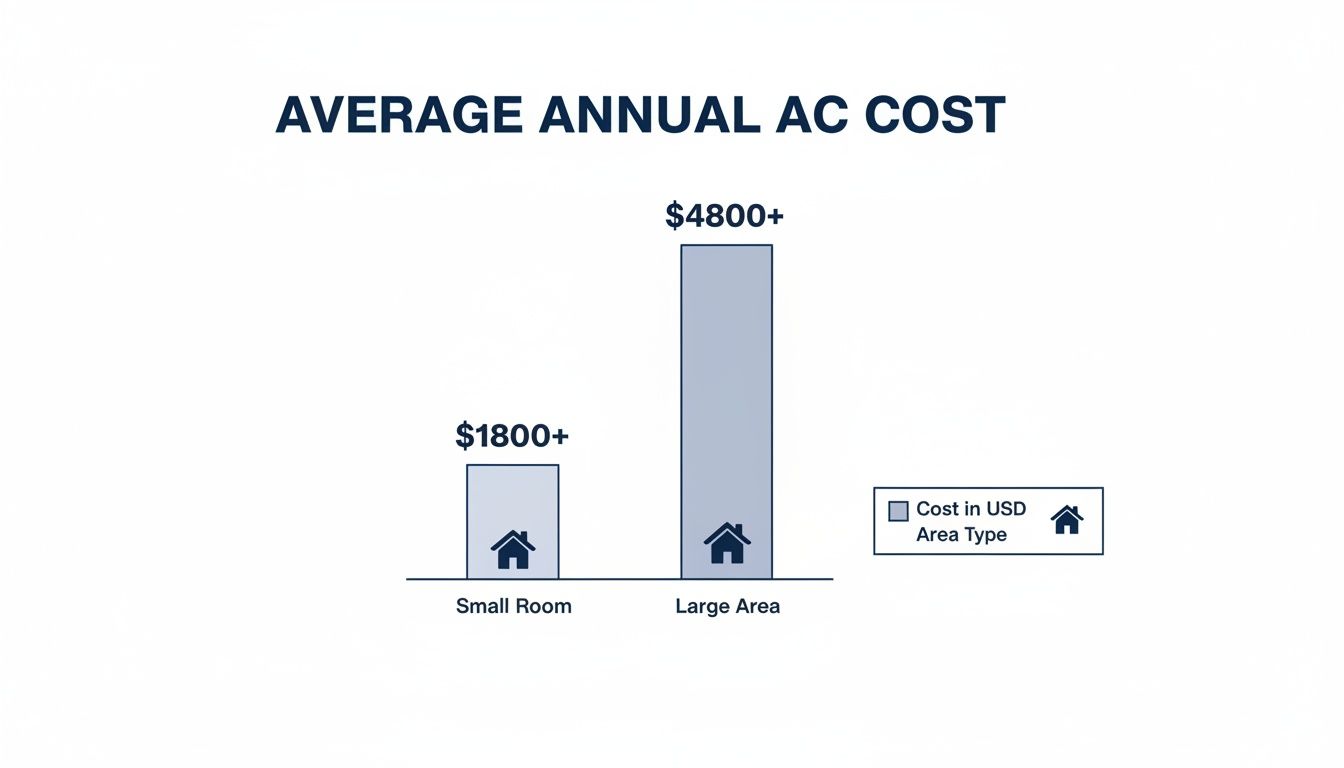
As you can see, the bigger the space, the more cooling power you need, and the higher the investment. It’s also a good idea to see if you can get any help with the cost. Check out our guide on current air conditioner rebates to see if you're eligible for any incentives.
Why Professional Installation is Non-Negotiable
It can be tempting to hunt for a cheaper installer or even think about a DIY job to save a few hundred dollars. But this is one area where cutting corners can lead to serious headaches. A professional installation isn't just about screwing a unit to the wall. It’s a regulated trade in Australia that legally requires two specific licences to be done safely.
First, your installer absolutely must be a licensed electrician. They’re the only ones qualified to handle the wiring and safely connect the system to your switchboard, as required by the Australian Standard AS/NZS 3000. Second, they need an ARCtick certification to handle the refrigerant gases. These gases are potent, and releasing them is harmful to the environment.
Hiring someone without these licences isn't just risky. It poses a real fire or electrical hazard and instantly voids the 5-year manufacturer warranty on your brand-new system. When a unit is installed correctly, it runs more efficiently, uses less electricity, and will last a whole lot longer. When you get a quote from a reputable company like ALC Air, you're investing in long-term reliability and safety.
Decoding Your Quote: What You’re Actually Paying For
Getting an air conditioning quote can feel a bit like trying to read a foreign language. But once you know the lingo, it all boils down to two key parts: the cost of the unit itself and the cost of getting a professional to install it properly. Let's pull apart a typical quote so you know exactly where your money is going.
The Air Conditioning Unit Itself
The first big chunk of your cost is the physical split system. This price isn't just plucked out of thin air; it’s directly tied to a few key things that determine how well it works, how long it lasts, and what it costs you to run long-term.
The brand is a huge one. Well-known names like Daikin, Mitsubishi Electric, and Fujitsu usually have a higher price tag. You’re not just paying for the logo on the front; you're investing in decades of engineering, proven reliability in tough Aussie climates, and solid local support for parts and warranties down the track.
Next up is the system's kW (kilowatt) capacity. Think of this simply as its cooling and heating muscle. A small 2.5kW unit perfect for a bedroom in a Gosford apartment will naturally cost less than a powerful 8.0kW system designed to cool a big, open-plan living area in a Newcastle family home.
Finally, energy efficiency plays a massive role. Units with higher star ratings use clever inverter technology to run more efficiently, which can save you a small fortune on your power bills over the system's life. They might cost a bit more upfront, but the long-term savings are where you really win.
The True Cost of Professional Labour
This is where homeowners often get tripped up by those "too good to be true" quotes. The labour part of a professional quote covers so much more than just a couple of hours of work. It’s a complete service that guarantees your system is safe, compliant, and performs at its absolute best.
Your installation cost also covers high-quality materials built to last. This means using the right grade of copper piping for refrigerant lines, the correct electrical cabling to handle the load, and sturdy mounting brackets and drainage solutions. A suspiciously cheap quote almost always means corners are being cut on these essentials, which can lead to refrigerant leaks, poor performance, or even dangerous electrical faults. When looking over a quote, it can be helpful to see how AC professionals manage estimates and invoicing to keep their pricing accurate and transparent.
Ultimately, the labour charge reflects the skill, time, and care needed to do the job right. It ensures your system is positioned for the best possible airflow, connected correctly for electrical safety, and commissioned to run at peak efficiency from the moment it's switched on. Paying for this expertise is the best way to protect your investment and ensure your family's comfort and safety. For more details on what a standard installation involves, check out our guide on the split system air conditioner installation cost.
The Hidden Factors That Influence Your Final Quote
Ever received a couple of quotes for the same air conditioner and wondered why the final numbers were so different? It almost always comes down to the specifics of your home. While a "back-to-back" installation is the simple baseline, many homes need a more customised approach, and these variables are what separate a standard job from a complex one.
Beyond the Back-to-Back Standard
A back-to-back installation is the simplest and cheapest setup. This is where the indoor head unit is mounted on an external wall, and the outdoor compressor unit sits directly behind it on the ground. Simple, right? But not every home layout allows for this.
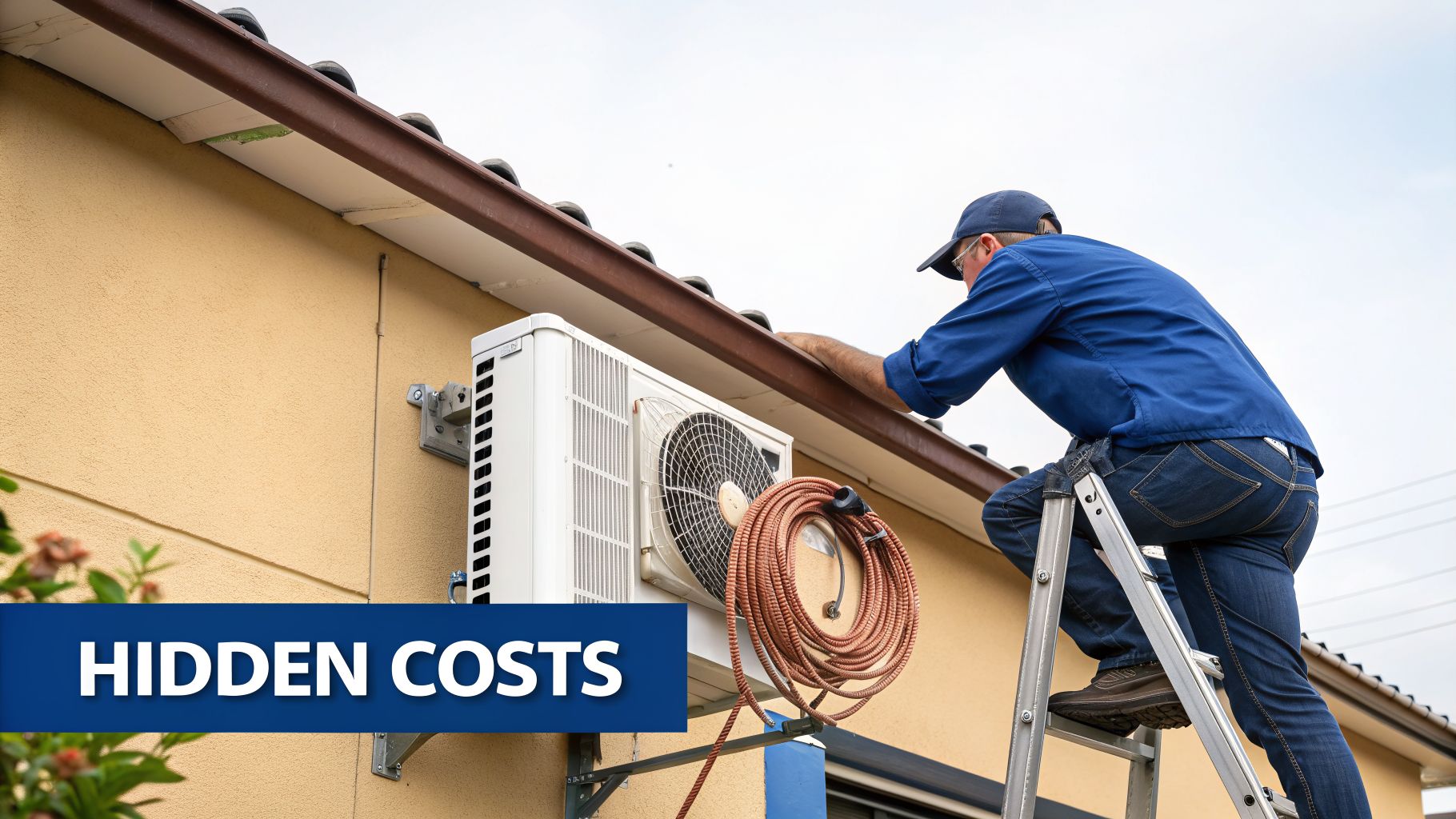
Imagine you live in a townhouse in Newcastle where the only spot for the outdoor unit is around the side of the building, not directly behind the living room. This is where extra costs creep in. Your installer needs to run longer lengths of copper piping and electrical cabling to connect the two units. This extra material and labour is typically charged per metre, so a longer run will naturally push the quote up. We see this all the time in Sydney apartments or homes with strict body corporate rules about where units can be placed.
The Challenges of Height and Access
The physical location of the units can have a huge impact on the labour involved. For instance, putting a split system on the second storey of a home in Terrigal presents a very different set of challenges compared to a ground-floor job.
Working at heights demands extra safety gear, like harnesses and sometimes even scaffolding, to meet SafeWork NSW regulations. Setting all that up takes time and specialised equipment. The simple act of getting a heavy outdoor unit into a tricky spot adds to the labour hours, which you'll see reflected in your quote.
Electrical and Drainage Requirements
Modern air conditioners are powerful appliances and almost always need their own dedicated electrical circuit to run safely and efficiently. During our on-site assessment, a licensed electrician will check your switchboard. If your home is older or the board is already maxed out, you might need an upgrade to meet Australian Standards. This is a critical safety step to prevent overloading your home's entire electrical system.
Drainage is another key detail. The indoor unit produces condensation as it works, and that water needs to drain away. Using gravity is the cheapest and most reliable method, but it's not always an option. If the indoor unit is on an internal wall far from an outside wall, a small device called a condensate pump might be needed. This little pump actively pushes the water away through a small tube, adding an extra component and cost to the installation. For a deeper dive into system placement, our guide on how to choose the right size air conditioner for your room offers some valuable insights.
Choosing the Right System Size for Your Space
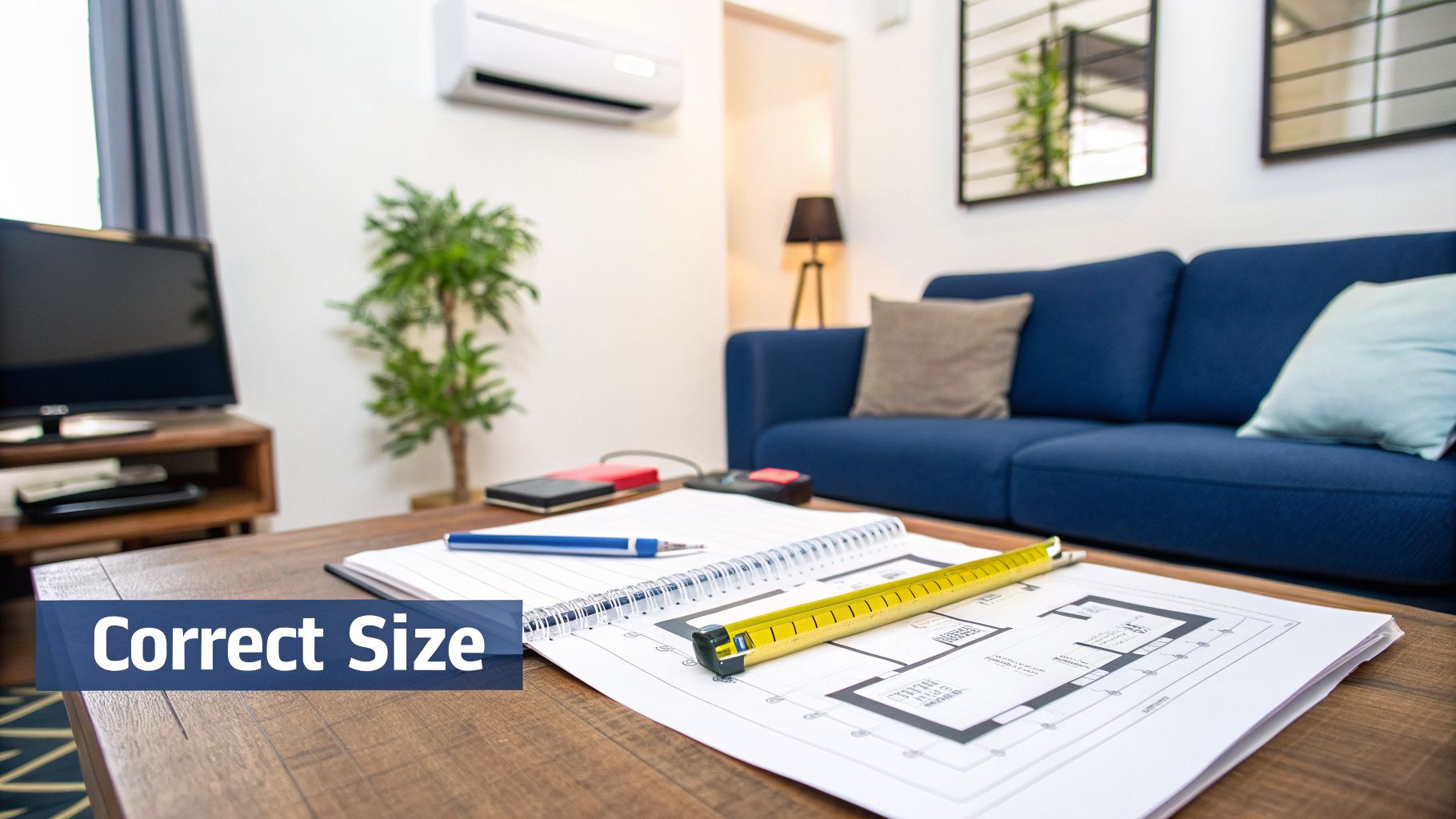
Getting the size of your split system right is probably the single most important decision you'll make. It has a direct impact on not just the upfront cost, but your family's comfort and your power bills for the next ten or fifteen years. Mess this up, and you're in for a world of frustration. It’s definitely not as simple as just grabbing the biggest unit you can afford.
Let's quickly talk about what "size" actually means. We measure it in kilowatts (kW), which is basically the unit's cooling or heating muscle. It tells you how much heat the system can pump out of a room in an hour. A bigger number means more power, but more power isn't always the right answer.
The Problem with Oversizing
It’s a common myth that a bigger air con will cool your room faster and better. In reality, an oversized system is a clumsy, inefficient beast. It blasts the room with arctic air, hits the thermostat temperature way too quickly, and then switches off. This constant on-off process is called short cycling.
When a system short cycles, it never runs long enough to do one of its most critical jobs: pulling humidity out of the air. This can leave your room feeling cold but unpleasantly clammy, a feeling anyone on the humid Central Coast knows well. Even worse, it puts massive wear and tear on the compressor, shortening the unit's lifespan and guzzling electricity every single time it fires up.
The Dangers of Undersizing
Going too small is just as bad. Imagine trying to cool a big, open-plan living room in a Penrith home that gets hammered by the western sun all afternoon. If your air con is undersized, it will run flat out, non-stop, without ever actually getting the room down to a comfortable temperature.
This constant, frantic operation means your electricity meter will be spinning like a top, sending your power bills through the roof. The system's components will be under relentless strain, leading to premature breakdowns and expensive repair bills down the track. You'll have paid good money for an air conditioner that simply can't do its job when you need it most.
Factors That Determine the Right Size
Figuring out the right kW capacity involves way more than just the square metres of your floor. A proper, professional assessment looks at a whole range of factors specific to your home:
- Room Dimensions: We look at the total volume of the space: length, width, and ceiling height.
- Sunlight Exposure: A west-facing room in the Hunter Valley that cops the afternoon sun needs a lot more cooling power than a shaded, south-facing room.
- Windows and Glass: The amount of glass, its orientation, and whether it's double-glazed makes a massive difference to heat gain.
- Insulation: Good ceiling and wall insulation is your air con's best friend. It dramatically reduces the cooling load.
- Local Climate: The dry, intense heat of Western Sydney requires a different calculation to the milder, humid climate cooled by sea breezes in Newcastle.
As a real-world example, a mid-range 5.0kW split system is often a great fit for medium living areas around 30-40 square metres. Based on what we see locally, this size typically costs between $2,400 to $3,300 for the unit and a standard installation in places like Sydney and Lake Macquarie. Out of that total price, the labour component can range from $600 to $1,500, depending on how complex the job is. To get a more tailored idea for your own rooms, have a look at our detailed guide and play around with our air conditioner room size calculator.
Why Professional Installation Is a Non-Negotiable Investment
When you see a tempting offer for a cheap cash install or start searching for DIY videos, it’s completely understandable to want to save a few hundred dollars on the cost of getting your new split system on the wall. But this is one area where cutting corners can backfire, costing you thousands in the long run.
A professional installation isn't just a service; it's an absolute must for your safety, your home's performance, and your long-term peace of mind. The rules around air conditioning in Australia are strict for a very good reason. Installing a split system isn't a simple handyman job. It involves complex electrical wiring and the handling of potent refrigerant gases. Both of these tasks are heavily regulated, and for your own safety, you want someone who knows exactly what they're doing.
The Two Licences Your Installer Must Have
Here in NSW, any legitimate air conditioning installation legally requires two separate, government-issued licences. There are absolutely no exceptions to this rule. First, all the electrical work, from running a new circuit from your switchboard to connecting the final wires, must be done by a fully licensed electrician. This is mandated by Australian Standard AS/NZS 3000 and enforced by bodies like SafeWork NSW. Incorrect wiring isn’t just a minor mistake; it’s a leading cause of house fires and electrical shocks.
Second, the technician must hold a valid ARCtick refrigerant handling licence. The gases inside your air conditioner are powerful greenhouse gases. An unlicensed person can easily release them into the atmosphere, causing serious environmental damage. The ARCtick scheme ensures technicians are properly trained to handle these substances safely, which protects both the environment and your system's performance.
Protecting Your Manufacturer's Warranty
Here’s the part that often gets overlooked in the rush to save a buck: your manufacturer’s warranty is completely dependent on a compliant, professional installation. Every major brand, from Daikin to Mitsubishi Electric, explicitly states in their warranty terms that the system must be installed by a licensed and qualified technician. Attempting a DIY installation or hiring an unlicensed person will instantly void your 5-year manufacturer's warranty. If the unit fails, even due to a clear manufacturing defect, you'll be left to cover the full cost of repairs or replacement yourself.
A professional installation is your only guarantee that your investment is protected. The compliance certificate from a licensed installer is your proof, ensuring the manufacturer will honour their warranty if something goes wrong. When looking for a contractor, it pays to choose a reputable professional installer with a solid track record and positive customer feedback. The upfront saving from a cheap install is quickly wiped out by the enormous financial risk you take on. For a detailed look at what our process involves, you can learn more about our professional split system air conditioner installation.
Your Split System Installation Questions Answered
When you're thinking about a new split system, a bunch of questions usually pop up. With over 15 years of installing air conditioners in homes across the Central Coast, Sydney, and Newcastle, we've pretty much heard them all. Here are the clear, straightforward answers to the ones we get asked the most.
How Long Does a Typical Split System Installation Take?
For a standard, no-fuss installation, you can expect us to be in and out in about 3 to 5 hours. This is the usual timeframe for a simple "back-to-back" setup on a single-storey house. Now, if the job is a bit more involved, it can take up a full day. Things like installing a unit on a second floor, running extra-long pipes, or discovering your switchboard needs an upgrade to handle the new load will add time. We'll always give you a realistic timeframe in your quote so you know exactly what to expect.
What Is a Back-to-Back Installation?
Great question. This is the most common and wallet-friendly way to install a split system. It simply means the indoor unit on your wall is mounted directly opposite where the outdoor unit sits on the ground outside. This setup keeps the copper piping and electrical cables as short as possible, which helps keep both labour and material costs down. Most standard quotes you'll see from installers are based on this simple, efficient configuration.
Do I Need to Get My Switchboard Upgraded?
It’s definitely a possibility, and something we see a lot, especially in older homes. A modern split system is a powerful appliance and, for safety, it needs its own dedicated circuit. This stops it from tripping the power every time it kicks in. During our site visit, our licensed electrician will take a good look at your switchboard. If it needs an upgrade to meet Australian Standards (AS/NZS 3000), we’ll explain exactly why and include it in your quote. This isn't an upsell, it's a critical safety step to protect your home and family.
What Warranties Come With My New System?
This is one of the best parts about using a professional installer. You get protected from two different angles, which gives you real peace of mind. First, you get the manufacturer's warranty on the unit itself, which is typically a full 5 years for parts and labour from all the top brands we supply. On top of that, you get our own installation warranty, which is our promise that the work we do is top-notch and built to last.
Ready to find out exactly what it would cost to get your home comfortable? The team at ALC Air is here to help with a free, no-obligation quote designed specifically for your space.