


When you're thinking about a new air conditioner, the first question on everyone's mind is always the same: what's it really going to cost? For a standard split system air conditioner in NSW, you can expect the total price to start somewhere between $1,200 and $2,000. That's for a smaller 2.5kW unit, including both the system itself and the professional installation for a straightforward job. Of course, that figure can climb depending on the size and brand of the unit, and how tricky the installation is.
Your Quick Guide to Split System Installation Costs
Let's break down what you're likely to invest to keep your home comfortable. The final bill always comes down to two main things: the price of the air conditioning unit you choose, and the cost of the professional labour to get it installed safely and correctly. Thinking about them separately helps you see exactly where your money is going.
Here in New South Wales, where we at ALC Air look after homes across the Central Coast, Sydney, Newcastle, and Lake Macquarie, a basic 2.5kW split system for a ground-floor room is one of the most affordable ways to beat the summer heat. That typical $1,200 to $2,000 price tag gets you the unit, professional labour from a licensed installer, and all the basic piping.
What it usually doesn't include is any major electrical work. If your switchboard is a bit old or you need a new dedicated circuit for the air con, you might need to budget an extra $200 to $800.
Of course, the purchase price is just the first step. You also need to think about what it will cost to run month after month. To get a handle on the long-term expenses, check out our guide on how much running an AC costs.
It's also worth noting that prices can vary a lot depending on where you live. For anyone reading this from outside our area, digging into local pricing is key. For example, you can find local insights for Abilene, TX which shows how much market rates can differ from place to place.
Estimated Total Installation Costs by System Size
To give you a clearer starting point, we've put together a quick reference table. It shows the typical all-in price ranges you can expect for different sized split systems in a standard NSW home, covering both the unit and the installation.
| System Size (kW) | Ideal For | Estimated Total Cost Range |
|---|---|---|
| 2.5kW – 3.5kW | Standard bedrooms or a small home office (up to 25 sq. metres) | $1,500 – $2,500 |
| 5.0kW – 6.0kW | Medium-sized living areas or larger open-plan spaces (30-50 sq. metres) | $2,200 – $3,800 |
| 7.0kW – 9.0kW | Large, open-plan living and dining areas (50-75 sq. metres) | $3,000 – $5,500+ |
Think of this table as your ballpark guide. The final price will always depend on the specific unit you choose and the unique layout of your home, but this gives you a solid idea of what to budget for.
Decoding Your Quote: What You’re Actually Paying For
When a quote for a new air conditioner lands in your inbox, it's natural to skip straight to the bottom line. But that final number is a story made up of a few key parts, and understanding them helps you see the real value in a professional installation and compare quotes fairly.
Think of it less as buying a box that blows cold air and more as investing in a complete comfort system for your home. The total cost is a combination of the unit itself, the skilled labour from licensed professionals, and the essential materials that bring it all together.
The Air Conditioning Unit Itself
The single biggest slice of the pie is the air conditioner. The price tag on the unit can vary quite a bit, and it’s driven by a few important factors.
- Brand and Quality: We work with trusted brands like Daikin, Mitsubishi Heavy Industries, and Actron Air for a simple reason: they have a proven track record for reliability in tough Australian conditions. While a lesser-known brand might look cheaper upfront, premium brands deliver long-term value through better durability, performance, and warranty support when you need it.
- Capacity (kW): The cooling and heating power of a unit, measured in kilowatts (kW), is a major cost driver. A 2.5kW unit perfect for a bedroom in a small Terrigal home will naturally cost less than a powerful 8.0kW system designed to handle a large, sun-drenched open-plan living area in the Hunter Valley.
- Energy Efficiency: That star rating isn't just for show. Air conditioners with higher star ratings cost more to buy, but they can shave a significant amount off your electricity bills over the years. In the long run, a more efficient unit is often the smarter financial choice.
Professional Labour and Installation Expertise
The second key component is the cost of professional labour. This isn't just a few hours of work; it’s your peace of mind. You’re paying for the expertise, licensing, and safety compliance that a proper, legal installation demands.
A licensed technician with an ARCtick certification is legally required to handle refrigerants, while a licensed electrician must carry out all the wiring to meet Australian Standard AS/NZS 3000. This isn't just red tape, it ensures your installation is safe, your manufacturer's warranty remains valid, and you don’t risk voiding your home insurance.
This part of the quote covers the time it takes for our qualified team to:
- Carefully position and mount both the indoor and outdoor units.
- Drill the wall penetration for all the piping and cables.
- Run the copper pipes that carry the refrigerant gas.
- Connect all the electrical wiring safely and to code.
- Insulate the pipework properly to stop energy loss and condensation.
- Pressure test the whole system to make sure there are no leaks.
- Commission the unit to confirm it’s running perfectly.
Essential Materials and Components
Finally, your quote includes all the high-quality materials needed to connect and secure your system. These are the unsung heroes that ensure your air conditioner performs reliably for years to come.
This covers everything from the copper piping and electrical cabling to the wall or ground-mounted bracket for the outdoor unit and the pipe insulation. Using cheap, low-grade materials is a recipe for disaster, it can lead to refrigerant leaks, electrical faults, and poor performance. That's why we only use components that meet or exceed Australian standards.
This chart gives you a quick visual on how the system's size affects the overall cost.
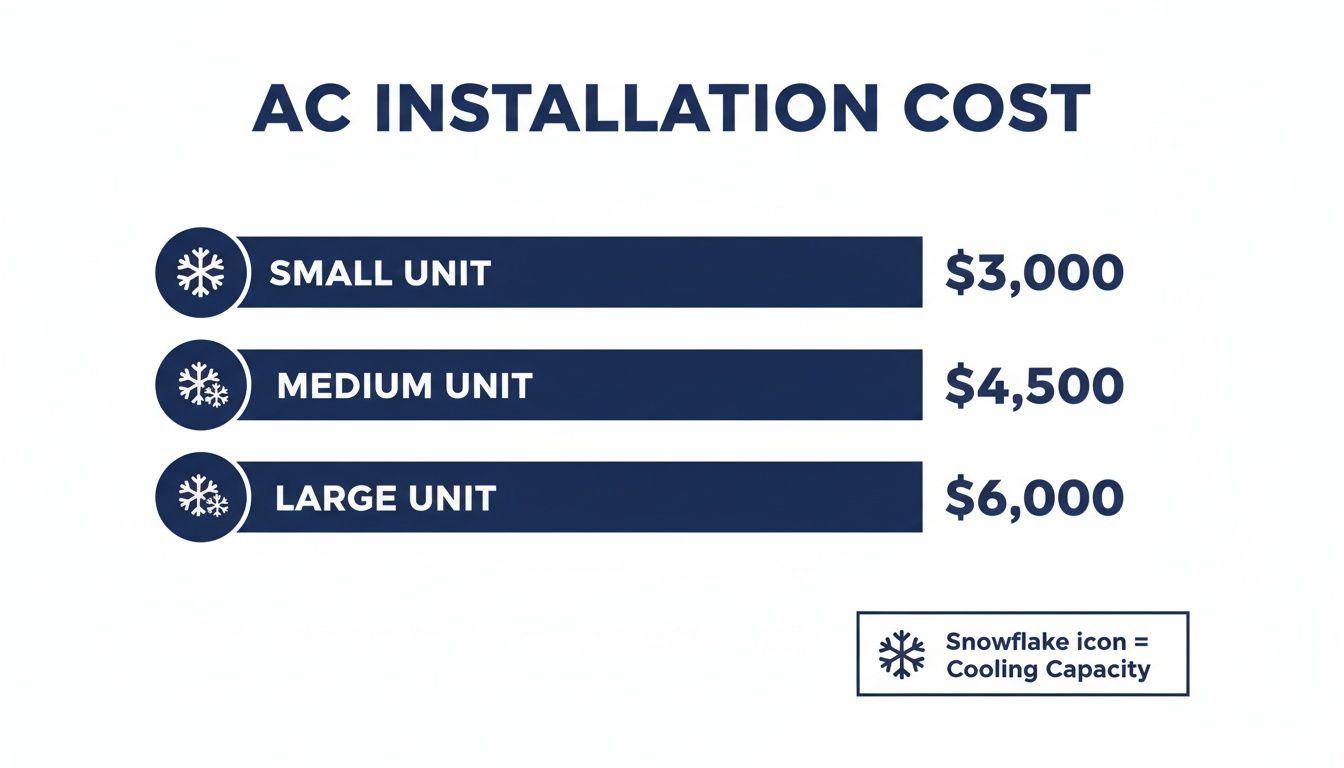
As you can see, the jump in cost isn't just for a bigger machine; it also reflects the extra labour and materials often needed for a larger, more powerful installation.
In NSW, you can expect total supply and installation costs for a reverse cycle split system to range from $1,795 to over $4,815. This wide range covers everything from a basic 2.5kW bedroom setup to a more complex 7kW installation for a living area. You can discover more insights about these pricing breakdowns on trustedtradienetwork.com.
By understanding these three core components, the unit, the labour, and the materials, you can read any quote with confidence, knowing exactly what you're paying for.
Uncovering Potential Extra Costs and Installation Variables
When we provide a quote for the cost to install a split system air conditioner, our starting point is what we call a "back-to-back" installation. This is the industry term for the simplest, most straightforward setup imaginable. The indoor unit goes on an external wall, and the outdoor unit sits on the ground directly behind it. Quick, clean, and cost-effective.
But let's be realistic. Homes, especially around Sydney, the Central Coast, and Newcastle, are rarely that simple. Many properties have unique layouts, older wiring, or access challenges that make a standard back-to-back install impossible. Understanding these variables upfront is the best way to avoid surprises and see why a proper, onsite quote is so important.
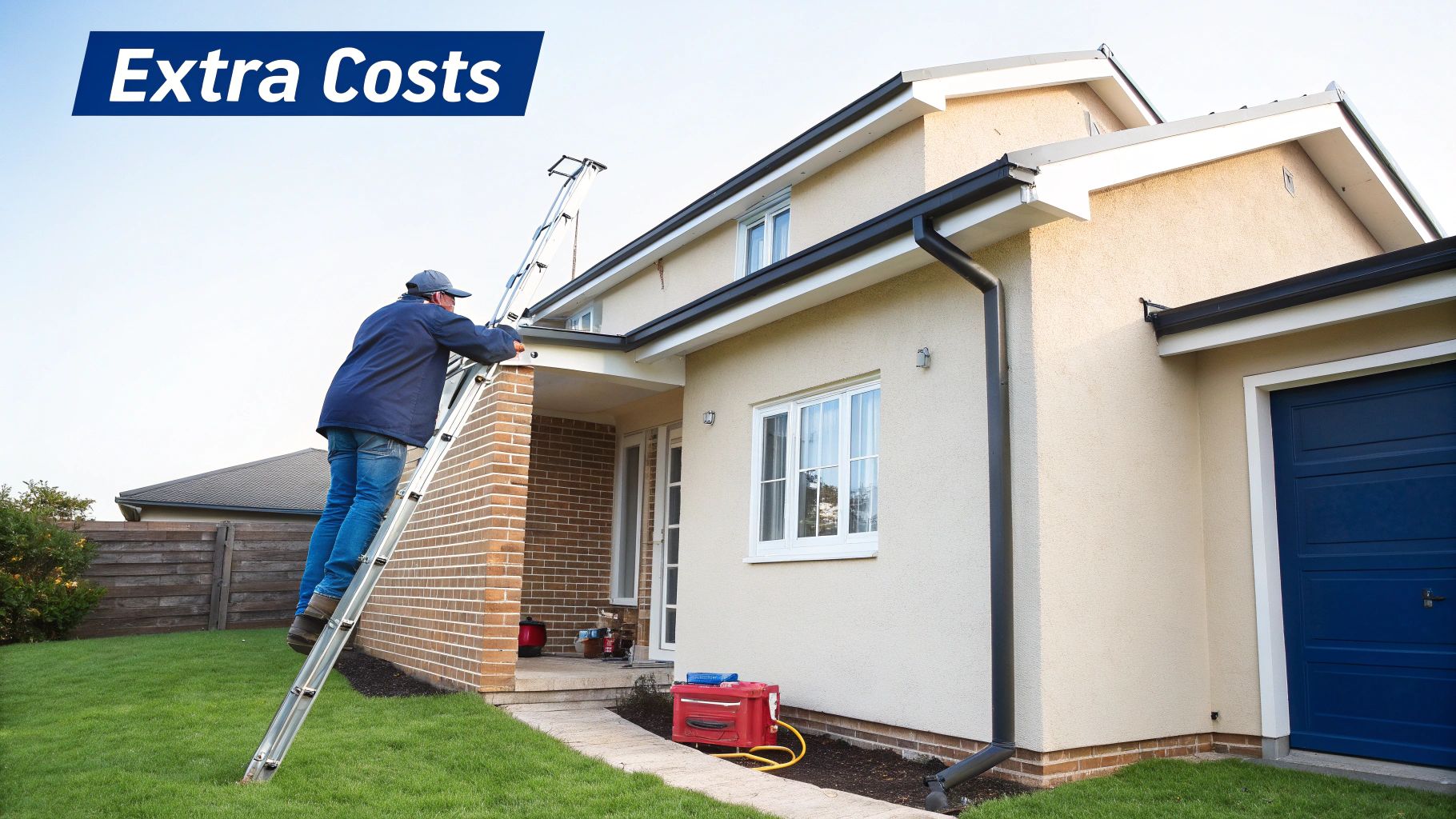
What If a Back-to-Back Install Won't Work?
The ideal setup isn't always practical or what you want aesthetically. You might prefer the indoor unit on an internal wall, or maybe the best spot for the noisy outdoor unit is around the side of the house, far from your deck. No problem, but it does change the job.
When the units are further apart, we need to run longer copper pipes and electrical cabling to connect them. This adds to material costs and, more significantly, the labour involved. Routing pipework discreetly through a roof cavity or under the floor of a home in Lake Macquarie takes a lot more planning and physical work than drilling a single hole through a wall. You can get a better sense of these different setups in our guide to the split system air conditioner installation process.
Will Your Switchboard Handle It?
Your home's electrical system is the lifeblood of your air conditioner. Modern split systems, especially the powerful ones needed for our summers, draw a lot of power. To operate safely and without tripping your breakers, they need their own dedicated circuit. This isn't a recommendation; it's a non-negotiable requirement under Australian electrical safety standards (AS/NZS 3000).
Many older homes, particularly in heritage areas of Newcastle or older Sydney suburbs, still have outdated switchboards with old-school ceramic fuses. These boards often lack the capacity or the modern safety switches (RCDs) legally required for a new air conditioner.
An electrical switchboard upgrade isn't just an "extra cost", it's a critical safety measure. It protects your new system, your home, and your family from potential electrical hazards.
If our licensed electrician finds that your switchboard isn't up to the task, an upgrade will be necessary. While it does add to the budget, the peace of mind you get from having a modern, safe electrical system is invaluable.
Tricky Access and Structural Hurdles
Where we can physically place the units also plays a big role in the labour costs. Bolting an outdoor unit onto a second-storey wall bracket, squeezing one onto a tight apartment balcony, or hoisting it onto a flat roof all require extra gear, safety harnesses, and often two technicians instead of one.
Think about the difference between a ground-floor job at a new estate in Gosford versus a second-storey installation on a Paddington terrace. The latter means working at heights, navigating tight spaces, and potentially drilling through double brick, which takes much longer than timber or fibro. These access challenges add time and complexity, which is naturally reflected in the final cost.
Common Factors That Can Increase Installation Costs
To give you a clearer picture and help you budget, it’s useful to see what a "non-standard" installation might involve. These are the most common variables that can add to your quote.
| Additional Cost Factor | Typical Price Impact (AU$) | Why It's Necessary |
|---|---|---|
| Extra Pipe Length | $40 – $70 per metre | For non "back-to-back" installs where units are far apart. |
| Wall Mounting Brackets | $100 – $200 | Needed to elevate the outdoor unit off the ground or mount it to a wall. |
| Condensate Pumps | $250 – $400 | Required when gravity can't drain condensation away from the indoor unit. |
| Difficult Access Surcharge | $200 – $500+ | For jobs requiring ladders, scaffolding, or extra safety measures (e.g., second storey). |
| Core Drilling (Concrete/Brick) | $150 – $300 | Drilling through solid brick or concrete takes more time and specialised tools. |
| Removal of Old System | $150 – $250 | To safely decommission, degas, and dispose of an old air conditioning unit. |
As you can see, every home is a unique puzzle. That's why we always insist on a proper site inspection before giving you a fixed, final price. It’s the only way to ensure there are no hidden costs or nasty surprises on installation day.
Why the Right System Size Matters for Your Home
Picking the right size air conditioner is easily one of the most critical decisions you'll make, and it directly hits your wallet, both upfront and on every power bill for the next decade. It’s a classic mistake to think "bigger is better," but with air conditioning, that’s just plain wrong. Getting the size wrong is an expensive error, setting you up for years of high bills and mediocre comfort.
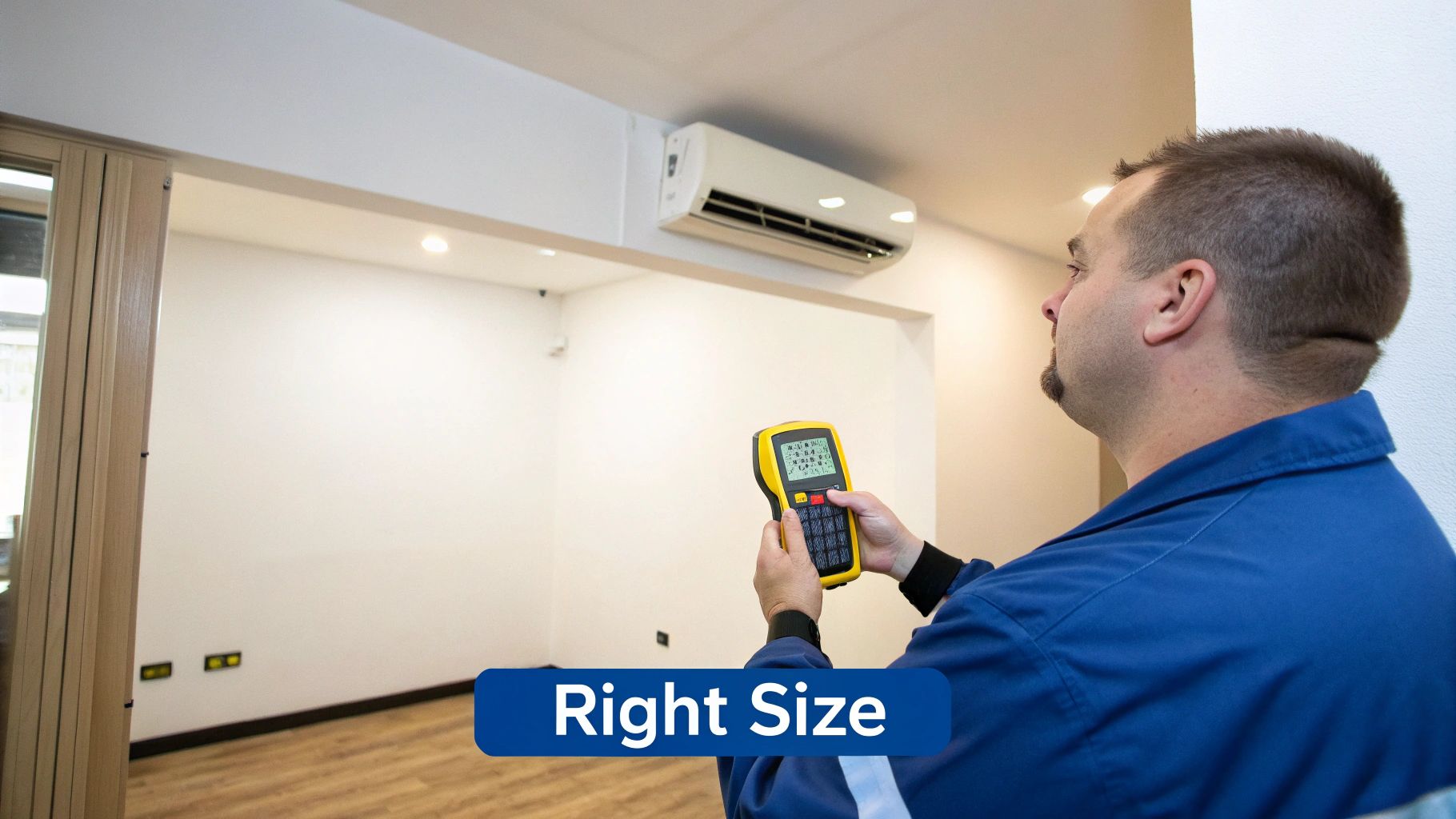
Let's pull back the curtain on how professionals size a system. We want to demystify how we calculate the right kilowatt (kW) capacity for your home so you can see the real value in a proper assessment over pure guesswork.
The Problem with an Undersized System
If your air conditioner is too small for the room, it's like trying to fill a bucket with a hole in it. The unit will run flat out, non-stop, just trying to get close to the temperature you've set on the remote.
This constant operation means it never gets a break. The result? Your electricity bills will be way higher than they should be, and on a scorching summer afternoon in Sydney's west, the room will probably never feel truly cool. All that extra work also causes excessive wear and tear, shortening the unit's lifespan.
The Hidden Dangers of an Oversized System
This is the trap many people fall into, assuming a more powerful unit will cool the room faster. An oversized system is actually worse. It blasts the room with so much cold air so quickly that it hits the target temperature in a few minutes and then just shuts off.
This process is known as "short cycling," and it's incredibly inefficient. The system's compressor has to constantly start and stop, which chews through a huge amount of energy, much more than a correctly sized unit that runs smoothly and consistently.
More importantly, an oversized system doesn't run long enough to do one of its most critical jobs: dehumidification. In the humid coastal air of Lake Macquarie or the Central Coast, this leaves the room feeling cold but clammy and uncomfortable.
How We Calculate the Perfect Size
A professional sizing calculation goes way beyond just looking at the square metres of a room. It’s a detailed assessment of all the things that contribute to the heat load in your specific home. This is the only way to make sure your system is perfectly matched to your needs.
Our technicians will look at:
- Room Dimensions: We measure the length, width, and ceiling height to get the total volume of air we need to treat.
- Window Size and Orientation: A big, west-facing window in a Hunter Valley home cops far more brutal afternoon sun than a small, south-facing one.
- Insulation: We check the quality of your ceiling and wall insulation, because this dramatically affects how well your home holds onto cool air.
- Local Climate: We factor in the specific conditions of your area, from the intense dry heat of the Hunter to the persistent humidity along the Newcastle coastline.
- Shading and Sunlight: We look at external shading from trees, eaves, or even neighbouring buildings that might block the sun.
By analysing all these variables, we can accurately nail down the right kW capacity for your room. Getting this right means you’re not paying for a system that’s too powerful, nor are you installing one that will struggle to keep up. For a deeper dive, you can learn more about how to determine what size split system you need in our comprehensive guide. This knowledge is the key to efficient, effective comfort for years to come.
Understanding Labour Costs and Professional Installation
It's a question we hear all the time: "I've bought the unit myself, can I just install it and save a few hundred dollars?" While we admire the DIY spirit, when it comes to air conditioning, the answer is a firm and absolute no. Professional installation isn't just a friendly recommendation; in Australia, it's a legal, safety, and performance requirement.
The labour component in your quote is so much more than just paying someone to hang a unit on the wall. Think of it as an investment in expertise, compliance, and the long-term health of your system. It's your best defence against a world of future headaches, from refrigerant leaks and water damage to poor performance and unnecessarily high power bills.
The Legal and Safety Non-Negotiables
Here in Australia, air conditioning installation is strictly regulated, and for very good reason. Trying to install a system yourself isn't just risky, it's illegal. It can have serious consequences for your safety, your home insurance, and your warranty.
Two key sets of laws come into play:
- Electrical Work: An air conditioner is a high-power appliance. Any hard-wired electrical connection must be performed by a licensed electrician. This is mandated by the Australian Standard AS/NZS 3000, which governs all electrical installations. Getting the wiring wrong is a serious fire hazard.
- Refrigerant Handling: The gases inside an air conditioner are potent substances. By law, only technicians holding a national ARCtick license from the Australian Refrigeration Council can handle them. This ensures gases aren't illegally released into the atmosphere and that the system is charged correctly for peak efficiency.
Crucially, your manufacturer’s warranty and your home insurance policy will almost certainly be voided if the system is not installed by a fully licensed and qualified professional. An unlicensed installation puts all the risk squarely on your shoulders.
What Does a Professional Installation Actually Involve?
So, what are you paying for during that typical four-to-eight-hour installation window? It's a precise, multi-step process that guarantees your system runs perfectly from day one. Our technicians methodically work through a detailed checklist, covering everything from positioning the units for optimal airflow to running the copper piping and electrical cabling neatly and securely.
A huge part of the job is pressure testing the refrigerant lines to ensure there are no microscopic leaks, a common failure point in cheap, rushed installations. Finally, we "commission" the system, which means running it through all its functions to confirm everything is working exactly as the manufacturer intended. You can learn more about the specifics in our detailed guide on the split system air conditioner installation journey.
The cost for this expert labour varies with the job's complexity. For a standard, back-to-back installation of a 2.5kW to 3.5kW wall-mounted unit, you can expect the labour to be in the $700 to $800 range. This can climb to $800 to $1,000 for larger 7kW to 9kW systems.
These figures can jump significantly for more complex jobs. Think multi-storey homes in Newcastle or heritage properties around Sydney requiring difficult access or long pipe runs. Here, labour alone can reach $1,500 to $2,500.
Ultimately, paying for professional installation isn't an "extra cost", it’s a core part of your total investment in your home's comfort and safety. It’s the difference between a system that works, and one that works well for the next 10-15 years.
How to Get a Reliable Quote and Choose Your Installer
Now that you’ve got a handle on what shapes the cost, the next step is finding the right person for the job. Choosing your installer is just as critical as choosing the right air conditioner. A great installation means your system runs efficiently and safely for its entire lifespan, while a poor one can lead to headaches and extra costs down the track.
The goal isn't just to find the cheapest price. It's to find a local expert who delivers real value and peace of mind. That means looking for credentials, transparency, and a solid reputation for quality work.
From Rough Estimate to Firm Quote
It’s really important to know the difference between a quick estimate over the phone and a detailed, fixed quote. A rough price can give you a ballpark idea, but it’s based on a whole lot of assumptions about your home. It can't possibly know if you have an older switchboard, tricky access for the outdoor unit, or the best wall to mount the indoor unit on for perfect airflow.
A reliable, locked-in quote only comes after a proper onsite assessment. This is where a technician comes to your home, measures the space properly, inspects your electrical system, and talks through the best options for your specific needs, whether you're in a coastal home in Terrigal or a suburban house in Hornsby. This process makes sure the price you get is the price you pay, with no nasty surprises. To ensure a high-quality installation and avoid future issues, it's crucial to understand the best practices for selecting an MEP contractor.
What to Look For in an Installer
When you start comparing companies, there are a few non-negotiables you should check off before you even think about committing. These credentials are your best protection, ensuring a safe, compliant, and professional job.
Your installer must hold both a valid electrical license and an ARCtick license. Don't be afraid to ask to see them. This is your number one safeguard against dodgy work and protects your warranty.
On top of that, make sure any installer you consider has comprehensive public liability insurance. This protects you and your property in the unlikely event something goes wrong. Finally, look for genuine local reviews and a strong reputation in your community, whether it's on the Central Coast or in Sydney's suburbs. You can find more practical advice in our guide to finding split system installation near me.
Asking the Right Questions
Before you give anyone the green light, make sure you have clear answers to a few key questions. Any true professional will be happy to answer them, it’s a sign they’re transparent and stand behind their work.
Ask about the warranties they offer. You should get two: one from the manufacturer for the unit itself (usually five years), and a separate installation or workmanship warranty from the installer. Understanding both gives you total confidence in your investment. A clear, itemised quote and the right professional partner are your final steps to enjoying cool, reliable comfort for years to come.
Common Questions About Split System Costs
When you're planning a new air conditioner, a lot of questions pop up, especially around the cost. We get asked these all the time, so we've put together some straightforward answers to the most common queries. This should help you feel more confident as you start planning.
How Much More Is a Reverse Cycle System Than a Cooling-Only Model?
Here's the thing: in Australia, finding a cooling-only split system is actually pretty rare these days. The vast majority of units we install are reverse cycle, giving you brilliant cooling in summer and seriously efficient heating in winter. The price difference for the unit itself is usually tiny, often less than $200.
When you think about our NSW climate, from those crisp Central Coast winters to chilly Sydney evenings, the ability to heat your home efficiently makes a reverse cycle system a much smarter investment for year-round comfort. Best of all, the installation cost is exactly the same, whether it's reverse cycle or cooling-only.
Can I Save Money by Buying the Unit Myself?
It can feel like a savvy move to buy the unit from a retailer and just hire a technician for the labour, but we generally advise against it. When you source the air conditioner through your installer, you're not just getting a unit; you're getting their professional recommendation, access to trade pricing, and the assurance it's the right model for your space.
More importantly, it keeps the warranty simple. If something goes wrong down the track, there's no finger-pointing between the manufacturer and the installer. One company is responsible for the entire job, from the unit to the workmanship. That single point of contact can save you a massive amount of stress and hassle if an issue ever comes up.
How Long Does a Typical Split System Installation Take?
For a standard, back-to-back installation on a single-storey home, our technicians are usually in and out in about four to six hours. That gives them enough time to properly position both the indoor and outdoor units, run all the piping and electrical connections, and most importantly, pressure test and commission the system to make sure it’s running perfectly.
Of course, some jobs are more complex and take a bit longer. If we need to run extensive piping, access a tricky second-storey wall, or do extra work on your switchboard, it might take a full day. We’d rather take the time to do it right than rush the job.
Are There Any Government Rebates I Can Get?
Yes, from time to time the NSW Government offers rebates or incentives for installing high-efficiency air conditioning systems through its energy-saving schemes. These programs can change, and the eligibility rules shift, so your best bet is to always check the official NSW Energy Saver website for the most up-to-date information.
You can also just ask our team when you request a quote. We keep on top of these schemes and can let you know if the system you're looking at qualifies for any rebates.
Ready to get a clear, fixed price for your home? The team at ALC Air provides detailed, no-obligation quotes based on a proper onsite assessment. Contact us today to schedule your free consultation.