


So, you're thinking about ducted air conditioning for your home. It's the ultimate upgrade for whole-home comfort, but the first question on everyone's mind is always the same: "What's it going to cost?"
The short answer is that a full ducted air conditioning installation in NSW typically lands somewhere between $8,000 and $20,000+. This isn't just for the unit itself; that price covers the whole job – the indoor and outdoor units, all the ductwork and vents, and the professional labour to get it all working perfectly.
The final figure really depends on your home's size, its layout, and how many 'zones' you want to set up for targeted cooling and heating. We're here to explain how all those pieces fit together.
Your Quick Guide to Ducted Air Conditioning Costs
Getting a handle on the investment is the first logical step towards whole-home comfort. The final price tag for a ducted system isn't just one number; it's a combination of several key factors we customise to your specific property. Whether you're in a single-storey home in Gosford or a two-storey place on Sydney's northern beaches, the same principles apply.
We can break the main cost drivers down into three buckets:
- The System Itself: This is the hardware – the indoor and outdoor units. The brand you choose (like Daikin or Mitsubishi Electric) and the system's power, measured in kilowatts (kW), are big factors here. A larger home simply needs a more powerful—and therefore more expensive—unit to cool and heat the space effectively.
- Installation Complexity: This covers all the labour and materials needed to fit the system. Things like your home's age, how much space is in the roof, and whether it's a single or multi-storey property all influence the time and materials required for the job.
- Zoning and Features: Zoning is what lets you control the temperature in different parts of your home independently, a bit like light switches for air con. A basic single-zone system is the most affordable starting point, but adding multiple zones for bedrooms and living areas adds to the initial cost while boosting your long-term energy efficiency.
For homeowners right across the Central Coast, Sydney, and Newcastle, installing a ducted system is a significant upgrade. The cost reflects the scale of the project, which involves careful planning and licensed electrical work to ensure everything is safe and up to Australian Standards.
It's a bigger upfront investment than a single split system, no doubt about it. But the payoff is seamless, quiet, and efficient climate control for your entire home. You can learn more about how it stacks up by reading our guide comparing central air conditioning to other systems.
Estimated Ducted Air Conditioning Cost Ranges in NSW
To give you a clearer picture, here’s a quick look at typical price ranges for fully installed ducted systems based on home size and location. Remember, these are estimates and can vary based on the specific factors of your property.
| Home Type and Size | Central Coast and Newcastle Range | Sydney Metro Range | Key Cost Influences |
|---|---|---|---|
| Small Home (2-3 Bed) | $9,000 – $14,000 | $10,000 – $15,000 | Simple layout, good roof access, basic zoning. |
| Standard Home (3-4 Bed) | $13,000 – $18,000 | $15,000 – $20,000 | Moderate complexity, multi-zone setup, brand choice. |
| Large Home (4-5+ Bed) | $17,000 – $25,000+ | $19,000 – $28,000+ | Two-storey, complex roof space, premium features. |
As you can see, the location and complexity play a big role. The key takeaway is that the "right" price depends entirely on getting a system that's perfectly matched to your home and how you live in it.
Decoding Your Ducted Air Conditioning Quote
When you get a quote for ducted air conditioning, it’s not just a single price tag. It's a detailed breakdown of a major home improvement project. Think of it less like buying an appliance off the shelf and more like a custom installation service tailored to your home. A professional quote shows you exactly where every dollar of your investment is going.
The total cost is a package deal: high-quality equipment, all the necessary materials, and the skilled, licensed labour required to bring it all together. Each part is critical for a system that doesn't just work on day one, but runs efficiently and safely for years to come. Let's pull apart what you'll see on a typical quote.
The Heart of the System: The Indoor and Outdoor Units
The biggest chunk of your upfront cost is the hardware itself. This covers both the indoor unit (the fan coil, which usually gets tucked away in your roof space) and the outdoor unit (the condenser). The price of these is directly tied to their capacity, measured in kilowatts (kW).
Getting the capacity right is everything. It’s like picking the right size engine for a car. Go too small, and the system will struggle constantly, leading to sky-high power bills and a house that’s never quite cool enough. Go too big, and it will switch on and off too frequently (a process called 'short cycling'), which wastes a ton of energy and puts unnecessary wear on the components.
For a typical three or four-bedroom home in the Hunter Valley or Central Coast, a system around 12-14kW is often the sweet spot, but this always depends on a proper heat load calculation for your specific house.
We regularly install leading brands like Daikin and Mitsubishi Electric because they invest heavily in reliability and efficiency. While their units might cost more initially than some lesser-known brands, they deliver superior performance, quieter operation, and much better long-term value. For context, the equipment alone for a premium brand like Mitsubishi Electric often falls between $5,500 and $7,500. You're paying for quality engineering that lasts.
This diagram shows how these core components fit together in a typical quote.
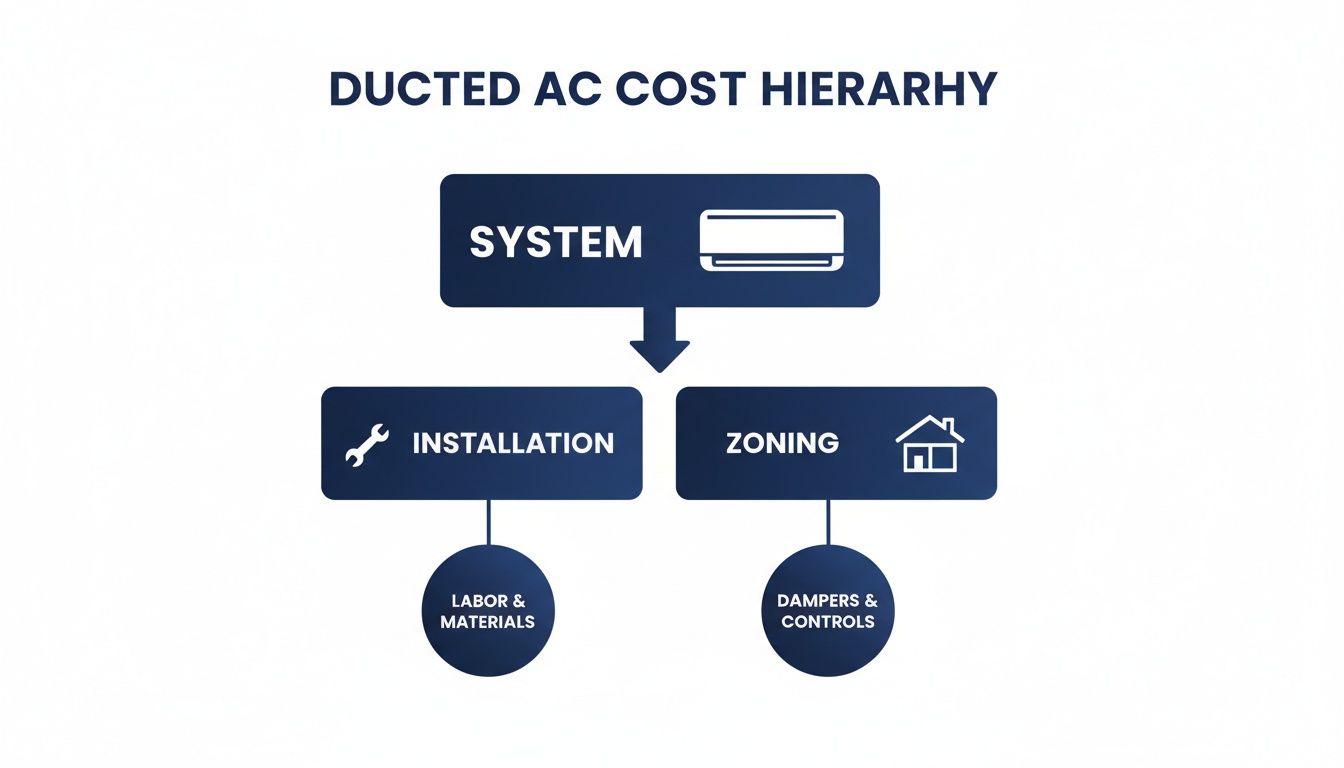
As you can see, the final price is a blend of the physical system, the skilled work and materials needed to install it, and any advanced zoning features you decide to add.
Behind the Scenes: Materials and Skilled Labour
Beyond the big metal boxes, a good portion of the cost covers the materials and expert labour needed to connect everything up. Honestly, this is where the skill of the installer makes a massive difference to your system's performance and lifespan.
The key materials involved include:
- Ductwork: This is the flexible, insulated tubing that carries the conditioned air from the indoor unit to each room. The quality and R-rating (its insulation value) of the ducting is vital for efficiency; cheap, poorly insulated ductwork means you’re paying to cool your roof space.
- Vents and Grilles: These are the outlets (or louvres) in your ceiling where the air comes out, plus the main return air grille where air is drawn back into the system to be re-cooled.
- Zone Controllers: If you opt for zoning, this part of the quote covers the electronic dampers that go inside the ducts and the central controller (often a wall-mounted tablet) that lets you direct airflow to specific areas.
The labour component is just as crucial. Our ARCtick certified technicians spend a lot of time carefully planning the duct layout in your roof space, making sure there are smooth runs with no kinks or tight bends that would restrict airflow. This meticulous work, along with positioning the outdoor unit correctly for proper ventilation and future service access, is what separates a professional job from a cheap one that will cause headaches down the track.
Essential Electrical Work and Compliance
Finally, every ducted air conditioning system needs dedicated electrical work, and this absolutely must be done by a licensed electrician. It's a non-negotiable part of a compliant installation and is essential for the safety of your home and family.
Your new system requires its own dedicated circuit running directly from your switchboard. This gives it a stable power supply and stops it from overloading your home's existing circuits when it kicks in. All this work has to stick to strict Australian Standards, specifically AS/NZS 3000. This line item on your quote covers the electrician’s time, the new circuit breaker, and all the wiring needed to power up your system safely and legally.
When we map out a quote for a ducted air conditioning system, we’re not just pricing up a box from a warehouse. We’re designing a complete climate solution tailored specifically to your home. This is precisely why a quote for a modern, single-storey place in Terrigal will look quite different from one for a classic two-storey house in Newcastle.
Every home has its own quirks and personality, and these unique characteristics directly shape the final cost. The obvious one is the overall size of your home — a bigger floor plan simply needs a more powerful system, more ductwork, and more labour to get it all installed. But it goes much deeper than just square metres. The number of floors, the layout of the rooms, and even the materials your home is built from all play a part in how we solve the installation puzzle and what it will cost.
Single Storey vs Two Storey Homes
The cost difference between installing a system in a single-storey versus a two-storey home is one of the biggest variables we see. In a single-storey home, our technicians usually have clear, straightforward access to the roof space. This lets us run all the ductwork efficiently and makes the whole process more predictable.
Two-storey homes are a different beast altogether. To get that beautifully conditioned air to the ground floor, we have to run ‘dropper’ ducts down through walls or voids between the levels. This takes more careful planning, extra materials, and a fair bit more labour time to make sure the job is done neatly without messing with your home's structure.
Consider this scenario: installing a system in a 180 square metre single-storey brick home in Gosford is a pretty standard job for us. Take that same 180 square metre floor plan and make it a two-storey weatherboard house in Adamstown Heights, Newcastle, and now we’re carefully routing ductwork between floors, which naturally adds to the labour component of the quote.
Roof Space and Property Access
The space we have to work in is another massive factor. A home with a generous, easily accessible roof cavity lets our team work safely and get the job done quickly. On the other hand, a tight or cluttered roof space, which is common in older homes or those with unique architectural designs, can really slow things down.
Limited room to move means more time spent carefully manoeuvring equipment and long lengths of ducting, which translates directly to higher labour costs. Property access is a simple, practical consideration too. A house on a steep block in Lake Macquarie or in a packed Sydney suburb with no parking can add logistical headaches and time to the job.
The Impact of Regional Climate and Building Materials
Where your home is located in NSW also plays a huge role in figuring out the right system and, therefore, the cost. We don't just sling in air conditioners; we engineer solutions that are a perfect match for your local environment.
A system that’s ideal for the dry heat of the Hunter Valley may not be the best choice for the humid, salty air of the Central Coast. Proper system selection and sizing are crucial for both performance and long-term running costs.
For example, a coastal home in suburbs like Bateau Bay or Forresters Beach is under constant attack from salty air, which can eat away at metal components. For these properties, we always recommend outdoor units with special corrosion-resistant coatings. It adds a little to the initial cost, but it dramatically extends the life of the unit, saving you a fortune in the long run.
In contrast, a home out in Sydney’s western suburbs like Penrith or Blacktown has to deal with brutal summer heat. These conditions demand a system with a higher cooling capacity to keep the home comfortable without being pushed to its limits 24/7.
The way your home is built matters, too. A well-insulated brick home will hold its temperature far better than an older, uninsulated fibro cottage, which directly impacts the size of the system you'll need. Taking the time to learn more about correctly sizing your air conditioning is a smart first step in getting your head around these variables.
Why Zoning and Smart Features Are Worth the Investment
When you’re looking at the cost of a ducted air conditioning system, it’s easy to focus on just the main unit and the installation price. But modern systems are far more intelligent than the old on-or-off appliances of the past. The real value—and the serious long-term savings—comes from smart features that give you precise control, and the most important of these is zoning.
Zoning completely changes how you use your air conditioning. Think of it like the light switches in your house. You'd never flick on every single light just to read a book in the living room; that would be a huge waste of electricity. A basic, single-zone ducted system is exactly like having one giant light switch for the whole house—it’s either all on or all off.
Zoning fixes this by installing electronic dampers inside the ductwork, letting you create separate ‘zones’ for different parts of your home. This means you can choose to cool only the living areas during the day and then switch to just the bedrooms at night. Simple.
The Power of Individual Room Control
A standard single-zone system is the most affordable way to get into ducted air conditioning. But adding a multi-zone setup, while it does increase the initial cost, is where the real magic happens. This requires extra components like dampers, sensors, and a more advanced central controller, which can add a few thousand dollars to the total price depending on how many zones you create.
However, that upfront investment starts paying for itself from the first power bill. By not heating or cooling empty rooms, you can slash your system's running costs.
Let's say you have a typical family in a four-bedroom Newcastle home. They can zone their main living and kitchen area separately from the bedrooms. During the day, they only run the system in the living zone, which means the air conditioner isn’t working hard to cool three empty bedrooms. It’s targeted, efficient, and much more comfortable.
This approach saves a substantial amount on your power bills each year, easily justifying the initial outlay.
Inverter Technology: The Efficiency Standard
Another key feature that impacts both cost and performance is inverter technology. While it’s now standard in most quality systems, it’s worth understanding why it’s so critical. An old, non-inverter system works like a sledgehammer: it runs at full power until the room hits the right temperature, then shuts off completely. When the temperature drifts up, it slams back on at 100% power again.
This constant stopping and starting is incredibly inefficient and puts a huge strain on the components.
In contrast, inverter technology works more like a car's cruise control. It gently ramps up to the required power and then smoothly adjusts its speed to maintain a consistent temperature. The compressor just ticks along quietly in the background.
This means the system runs more quietly, uses significantly less energy, and provides a much more stable and comfortable indoor climate. While inverter systems have a slightly higher purchase price, their efficiency makes them the only sensible choice for long-term savings. The best air conditioner for your home will always be one that balances upfront cost with ongoing efficiency, and inverter technology is central to that equation. You can learn more by exploring our guide on what makes the best air conditioner for a home.
Smart Controllers and Optional Upgrades
To get the absolute most out of your zoned, inverter-driven system, you can add advanced smart controllers. Options like MyAir provide a sophisticated wall-mounted tablet and a smartphone app, giving you ultimate control over your home's climate from absolutely anywhere.
These premium controllers allow you to adjust the airflow to individual rooms with incredible precision, set complex schedules, and monitor your energy usage in real-time. While they do add to the initial investment, they offer a level of convenience and fine-tuned control that many homeowners find invaluable. This is especially true for busy families or anyone who loves integrating everything into their smart home setup.
What About the Long-Term Running Costs?
The quote for a new ducted system is just chapter one of the ownership story. To make a really smart decision, you have to look beyond the installation price and think about what it’s going to cost you month after month, year after year.
These long-term costs really boil down to two things: your electricity bill and the cost of keeping the system in good health. Understanding these helps you budget properly so your air con remains a brilliant asset, not a surprise financial headache.
Your Electricity Bills and Energy Efficiency
Let's be clear: the single biggest ongoing cost for any air conditioner is the electricity it uses. A modern, professionally installed ducted system with inverter technology is surprisingly efficient, but how much you actually pay depends on its energy rating and, crucially, how you use it.
When you look at a new unit, you’ll see the Zoned Energy Rating Label (ZERL). This gives it a star rating for different climate zones across Australia. Think of it like the fuel economy sticker on a new car.
A higher star rating means the system uses less power to deliver the same amount of cool or warm air. A five-star unit will likely have a higher price tag than a three-star one, but it could easily save you hundreds of dollars on your power bills every single year. With NSW energy prices seemingly always on the rise, choosing the most efficient model you can afford is a savvy investment.
To really get a handle on these expenses, it pays to know what you're looking at on your power bill. There's a fantastic guide on understanding electricity bills that can help you pinpoint where your money is going.
Why Annual Servicing Is an Investment, Not an Expense
It’s always tempting to skip the annual service to save a few dollars, but this is almost always a false economy. Professional maintenance isn't just about cleaning a filter; it’s a vital health check for your entire system. Treat it like a regular tune-up for your car—it keeps everything running smoothly and catches small issues before they become big, expensive problems.
During a service, our licensed technicians will:
- Check refrigerant levels to ensure the system is cooling and heating effectively.
- Clean coils and components, clearing blockages that force the system to work harder.
- Inspect all electrical connections for safety, making sure they comply with standards like AS/NZS 3000.
- Test zoning dampers and thermostats to confirm they're all responding correctly.
A system that misses its regular service can lose a huge chunk of its efficiency in just a couple of years. This means it has to run longer and harder to cool your home, which you'll see reflected directly in your power bills.
On top of that, most manufacturers require proof of regular professional servicing to keep your warranty valid. A small annual fee protects your investment and saves you from potentially massive repair bills down the track. This simple bit of proactive care ensures your system runs at its best, lasts longer, and gives you complete peace of mind.
We've put together a more detailed guide that breaks down exactly how much air conditioning costs to run in NSW, which covers all these factors in greater detail.
Choosing the Right Installer Is Non-Negotiable
You can buy the best, most expensive ducted air conditioning system in the world, but if the installation is sloppy, it’s not going to perform. Simple as that. Your choice of installer is arguably the most critical decision you'll make in this entire process, directly impacting your system's efficiency, its lifespan, and the final cost. A quality installation is your best guarantee of performance and peace of mind.
This is about much more than just connecting pipes and wires. A great installer designs the ductwork layout for optimal airflow, correctly calculates the system size for your home’s specific needs, and ensures every component is fitted to meet strict Australian Standards. This is the stuff that prevents future headaches like noisy operation, uneven cooling, and those sky-high energy bills you were hoping to avoid.
What to Look for in a Quality Installer
When you’re comparing quotes, don’t just look at the bottom line. You need to verify the credentials of the business doing the work. In Australia, anyone handling the refrigerant gas in an air conditioner must hold an ARCtick licence. This is a legal requirement, not a nice-to-have, and proves they are qualified to handle these substances safely.
On top of that, a ducted system needs its own dedicated electrical circuit. This means the company must either employ licensed electricians or hold an electrical contractor licence themselves. This ensures all wiring is compliant with AS/NZS 3000—a non-negotiable for the safety of your home. Never be afraid to ask for proof of these licences and their public liability insurance.
A reputable installer will be completely transparent about their qualifications and insurance. If a company gets cagey about providing these details, consider it a massive red flag. Hiring an unlicensed individual is a gamble you simply cannot afford to take with your family’s safety.
Questions to Ask Before You Commit
To protect your investment, treat hiring an installer like a job interview. A professional team will welcome your questions and provide clear, confident answers.
Here are a few essential things to ask:
- What warranties do you provide on your installation workmanship, separate from the manufacturer's warranty?
- Can you give me a clear project timeline and explain how you'll minimise disruption to our home?
- What kind of after-sales support and servicing do you offer once the job is done?
Choosing a company with a proven track record in your local area, whether it's the Central Coast or Newcastle, means they get the specific climate challenges and building styles. For more guidance, check out our detailed article on how to find quality air conditioning service on the Central Coast.
Ultimately, a quality installer doesn't just sell you a box; they deliver a complete, reliable comfort solution.
Your Ducted Air Conditioning Questions Answered
We get it. Investing in a ducted air conditioning system is a big decision for any homeowner, and you’re bound to have a few questions before you commit. To give you clarity and confidence, we’ve put together straight answers to the most common queries we hear from our customers across the Central Coast, Sydney, and Newcastle.
These are the practical, real-world answers that help clear up any lingering doubts and guide you toward the right choice for your home.
Is Ducted Reverse Cycle Cheaper to Run Than Multiple Splits?
This really comes down to how you live in your home. If you often find yourself cooling or heating several rooms at once—say, the kids are in their bedrooms and you’re in the living area—then a modern, zoned ducted system is almost always more cost-effective than running three or four separate split systems.
Zoning is the game-changer here. It lets you direct conditioned air only to the rooms you're using, preventing you from wasting money and energy on empty spaces. However, if you genuinely only ever cool one room at a time, a single split system will have lower running costs. We can help you look at your family’s habits to figure out the most economical solution.
Are There Any Government Rebates in NSW?
Government rebates and energy-saving schemes tend to change with the seasons. While the days of large-scale federal rebates are mostly behind us, some NSW government initiatives occasionally pop up, offering incentives for upgrading to high-efficiency models.
We always suggest checking the official NSW Energy Saver website for the most up-to-date information. On top of that, here at ALC Air, we can also discuss flexible finance options to help manage the upfront investment in a new system.
Why Is There Such a Big Price Difference Between Brands?
The price gap between brands like Daikin, Mitsubishi Electric, and ActronAir often reflects their investment in research, the quality of their manufacturing, and their focus on energy efficiency. Premium brands simply build quieter, more reliable, and more efficient systems, and they back them with better long-term warranties.
While a premium system might have a higher price tag initially, it often delivers far better long-term value through lower power bills and a longer, more reliable operational life. We can walk you through the real-world pros and cons of each brand to find the perfect fit for your needs and budget.
Ready to get a clear, fixed-price quote for your home? The team at ALC Air is here to provide professional advice and a free, no-obligation assessment tailored to your property. Get Your Free Quote Today.