


Thinking about the cost of a split system air conditioner involves more than just the price you see on the shelf. The total investment is really a mix of three key parts: the initial price of the unit itself, the critical cost of professional installation, and the ongoing running costs that will show up on your power bills for years to come.
Deconstructing Split System Air Conditioner Costs
When you’re planning to get a new split system for your home on the Central Coast, Sydney, or Newcastle, getting the full financial picture is essential. Budgeting properly means looking beyond the sticker price and thinking about every expense that adds up to years of reliable comfort.
This guide will break down each part of the cost, helping you make a confident decision without any nasty surprises down the line. We explain everything from the hardware to the labour, so you know exactly what you're paying for.
Whether you're cooling a small bedroom in a Gosford apartment or a large, sun-drenched living area in a Western Sydney home, the core cost components don't change. We'll explore how things like unit size, brand reputation, and your home's unique layout can shift the final price. Think of this as your roadmap to a smart investment.
A Visual Breakdown of Your Investment
To put it simply, you can picture the total cost as three main pillars: the unit, the installation, and the running expenses. Each one is a crucial piece of the puzzle.

This hierarchy shows that while the unit is the first thing you pay for, the installation and long-term running costs are just as significant. They all form the total cost of ownership over the life of the system.
To give you a clearer snapshot, here’s a quick overview of what goes into the total cost of getting a split system up and running in NSW.
Quick Overview of Split System Cost Components
| Cost Component | Typical Price Range (AUD) | What It Covers |
|---|---|---|
| The Unit Itself | $800 – $3,500+ | The physical indoor head unit and the outdoor compressor. Price depends heavily on brand and cooling/heating capacity (kW). |
| Professional Installation | $700 – $1,500+ | Labour for a licensed technician, electrical work by a qualified sparky, and all materials (copper pipes, cables, brackets). |
| Ongoing Running Costs | $150 – $400+ per quarter | The electricity used to run the system. This varies based on the unit's energy efficiency rating and how often you use it. |
This table provides a solid starting point, but let’s dig a little deeper into what each of these pillars actually covers.
What’s Included in the Total Cost?
Let’s unpack what you’re actually paying for with each of these cost components:
The Unit: This is the hardware, the indoor head unit that gets mounted on your wall and the outdoor compressor that does the heavy lifting. The price swings wildly based on its cooling and heating power (measured in kilowatts or kW) and the reputation of the brand you choose.
The Installation: This isn't just about bolting the units to the wall. It covers the specialised labour of a licensed technician, all the required electrical work from a qualified electrician, and the necessary materials like copper piping, cabling, and mounting brackets. For safety, compliance, and your warranty, this is a non-negotiable cost.
The Running Costs: This is the long-term expense. It’s determined by your unit’s energy efficiency rating (the more stars, the better) and your personal usage habits. A more efficient system might cost a bit more upfront but will absolutely save you money on your power bills over its lifetime.
Breaking Down the Upfront Cost of the Unit
The first big number you’ll come across when looking at a new split system is the price of the unit itself. This is the hardware you can see and touch: that sleek indoor unit that goes on your wall and the powerful outdoor compressor that does all the heavy lifting. The price tag on this gear is really driven by two things: the brand’s reputation and the unit’s cooling and heating power, measured in kilowatts (kW).
When you start shopping around, you'll immediately see a price gap between different brands. This isn't just about paying for a logo. Premium brands like Daikin, Mitsubishi Electric, and Fujitsu often have a higher initial cost because they pour a lot of money into research and development.
What you get for that extra investment is a system that's generally more energy-efficient, whisper-quiet when it runs, and backed by a stronger, longer warranty. Over the life of the air conditioner, those benefits can genuinely translate into big savings and a lot less hassle.
The Role of Brand and Quality
Trying to decide between a top-tier brand and a more budget-friendly option is a classic dilemma. A lower-priced unit can absolutely cool and heat your room effectively, but that upfront saving might get eaten up by higher power bills or a shorter lifespan down the track. It's all about finding the right balance for your budget and how much you value long-term performance and reliability. To help you navigate this, you can learn more about the [best split system air conditioner brands](https://alcairconditioning.com.au/blog/best-split-system-air- conditioner-brands/) in our detailed guide.
On the flip side, an economical brand can be a perfectly smart choice for a room that doesn’t get used much, like a guest room or a home office. In those spaces, top-of-the-line efficiency isn't as crucial. The decision really boils down to how you plan to use the system and what matters more to you: a smaller initial outlay or better long-term value.
Matching Kilowatt Capacity to Your Space
Just as important as the brand is the unit’s power. A small 2.5kW system, which is perfect for a standard bedroom in a Terrigal apartment, is going to be far more affordable than a gutsy 8kW model needed to handle a large, open-plan living area in a new build out in the Hunter Valley.
Why Sizing Matters: Getting the size wrong is a seriously costly mistake. An undersized unit will run flat-out trying to cool the room, chewing through electricity and never quite getting the job done. On the other hand, an oversized unit will blast the room with cold air too quickly and then switch off. This leads to poor humidity control and leaves the room feeling stuffy and uncomfortable.
Getting the size right means you only pay for the power you actually need. The only way to know for sure what kW capacity your room requires is with a professional assessment. We need to look at factors like ceiling height, window size and orientation, and the local climate, from the urban heat of Sydney to the coastal humidity on the Central Coast.
All up, the cost of the unit alone can vary quite a bit. Looking across the industry, you can expect the hardware to fall somewhere between $600 and $2,500. Where you land in that range will come down to the brand, size, and features you choose.
Why Professional Installation Is a Critical Investment
When you’re looking at the cost of a new split system, it’s easy to get fixated on the price of the unit itself. But the installation is not a weekend DIY project you can knock over yourself; it’s a specialised trade that’s just as important as the air conditioner you choose. Here in Australia, cutting corners on installation isn't just a bad idea, it’s illegal.
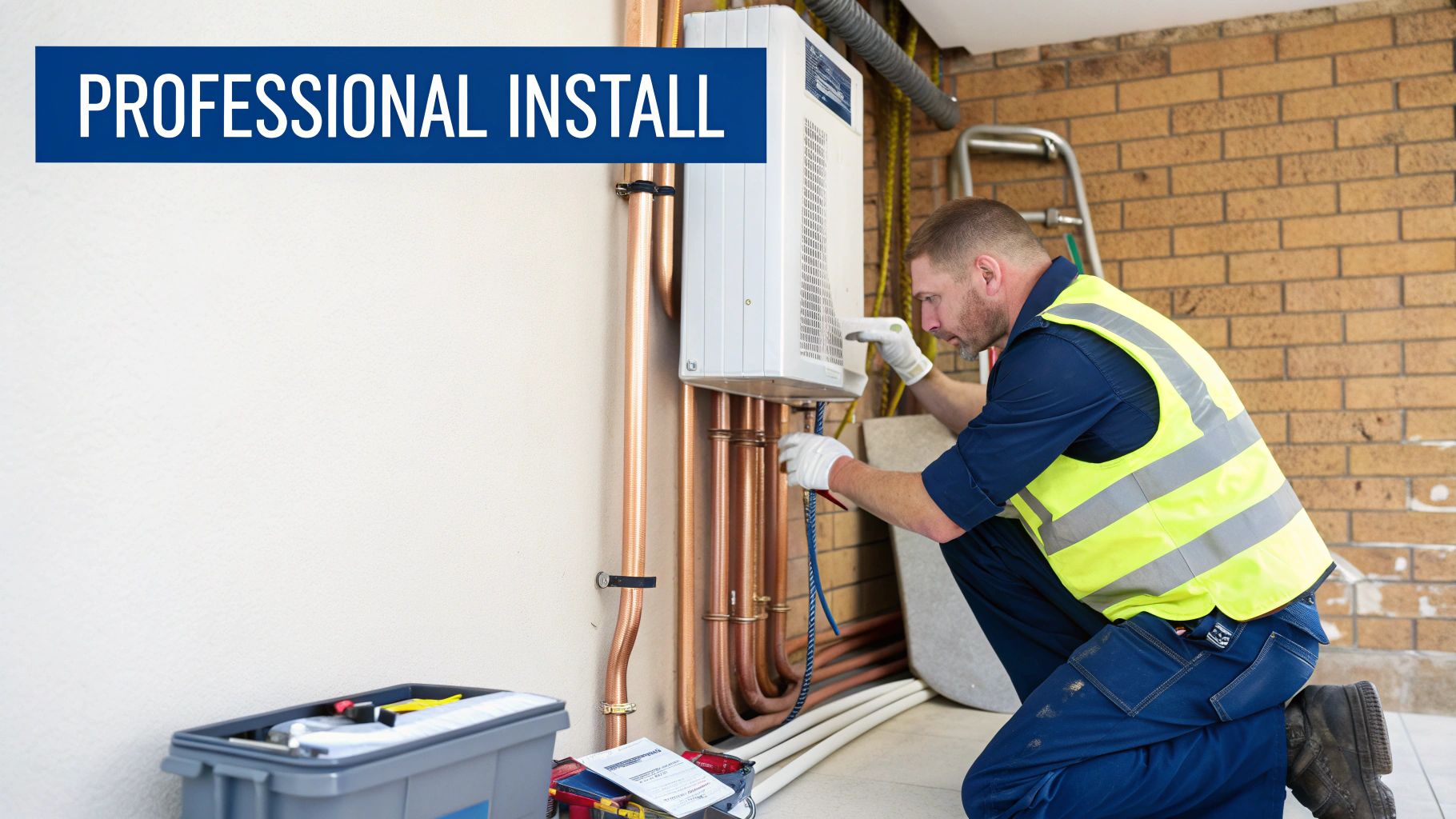
Legally, any work that involves refrigerant gases has to be done by a technician holding a valid ARCtick certification. This is non-negotiable and ensures those environmentally sensitive gases are handled safely and correctly. On top of that, every electrical connection must be completed by a licensed electrician to meet SafeWork NSW rules and Australian Standards like AS/NZS 3000.
Labour: The Biggest Installation Cost
The single biggest slice of your installation fee will always be the labour. You’re not just paying for a few hours of someone’s time. You’re investing in years of training, hands-on experience, and the specialised tools needed to get the job done right the first time.
This expertise is what guarantees your system is installed for peak performance, efficiency, and a long lifespan. A pro knows exactly where to position the indoor and outdoor units, how to perfectly balance the refrigerant charge, and will test everything to make sure it’s running exactly as the manufacturer designed it to. Paying for professional labour means you dodge the expensive headaches that come with a botched job, like refrigerant leaks, drainage nightmares, or dangerous electrical faults.
The 'Back-to-Back' Standard Installation
The most common and budget-friendly setup is what we in the industry call a "back-to-back" installation. This is where the indoor head unit is mounted on a wall that faces the outside, and the outdoor compressor unit sits directly behind it on the ground.
This configuration is the most straightforward because it uses the shortest possible run of pipes and electrical cables, usually around three metres. Because it keeps materials and time to a minimum, a back-to-back installation is the baseline for pricing. Most standard installation quotes you'll see will be based on this exact scenario, and for many homes across the Central Coast and Sydney, it’s the perfect fit.
How Site Complexity Adds to the Cost
Of course, not every home is built for a simple back-to-back job. Plenty of factors can introduce a bit of complexity, which naturally adds to the final cost.
Wall Materials: Drilling through double brick takes a lot more time and requires different gear than working with a simple weatherboard or plasterboard wall. That extra effort will be factored into the quote.
Unit Placement: If the indoor and outdoor units need to be far apart or on different floors, you’ll need more copper piping, more ducting to conceal it, and longer electrical cables. For instance, putting a unit in an upstairs bedroom with the compressor tucked away down the side of the house will cost more than a simple back-to-back.
Accessibility: Is the outdoor unit going on a second-storey wall bracket or a hard-to-reach spot on the roof? This might call for extra safety gear, scaffolding, or even a scissor lift, which all add to the labour time and overall price.
A crucial part of any professional installation is making sure your home's electrical system can handle the load. Sometimes, this requires bringing in residential electrical panel services to safely accommodate the new unit. To get a better sense of what a quality job involves from start to finish, you can read our detailed guide on the split system air conditioner installation process.
The Bottom Line: Investing in a professional installation isn't just about ticking a legal box. It’s about protecting your warranty, keeping your family safe, and making sure your new air conditioner runs as efficiently as possible for its entire lifespan.
How Your Home's Layout Affects the Final Quote
The standard "back-to-back" installation is a useful starting point for estimating cost, but let's be honest, no two homes are the same. Your property's unique layout and existing infrastructure play a massive role in shaping the final quote. What works for a single-storey brick home in Lake Macquarie is a completely different ball game to a two-storey terrace in inner Sydney.
These site-specific variables are exactly why a professional on-site assessment is so important. It lets a qualified technician spot any challenges that could affect the labour and materials needed, making sure you get an accurate, fixed-price quote with no nasty surprises down the line.
Electrical Switchboard Health
One of the first things a licensed electrician will check is your home’s electrical switchboard. A modern reverse cycle split system is a power-hungry appliance, especially on startup, and it needs its own dedicated circuit to run safely and efficiently.
Many older homes, particularly those in established areas of the Hunter Valley or the Central Coast, were built long before air conditioning was a household staple. Their switchboards often just don't have the capacity or the necessary safety switches (RCDs) to handle the electrical load. If an upgrade is needed to comply with AS/NZS 3000 electrical standards, this will be an extra cost on your quote. It's a non-negotiable step for safety.
Distance Between Indoor and Outdoor Units
In a perfect world, the installation involves a short, direct path between the indoor head unit and the outdoor compressor. But that’s not always practical or what you want aesthetically. You might prefer the outdoor unit tucked away from your entertaining area or positioned where the hum won't disturb your neighbours.
When the distance between the two units stretches beyond the standard three metres, the cost naturally goes up. This is because longer runs need more copper piping for the refrigerant, extra electrical cabling to power the unit, and more plastic ducting to hide and protect the lines. These extra materials, plus the additional labour to install them neatly and securely, will be reflected in the final price. Knowing [how to size an air conditioner for your room](https://alcairconditioning.com.au/blog/size-air- conditioner-for-room/) is crucial, but so is figuring out the most efficient placement.
Access and Siting Challenges
The location of the units themselves can throw up logistical hurdles that influence the cost. For example, installing an outdoor unit on the second storey of a home in Newcastle will almost certainly need specialised gear like a scissor lift or temporary scaffolding. This adds to both the equipment hire cost and the labour time.
Consider this scenario: A heritage-listed property in a Sydney suburb might have strict council or body corporate rules about where outdoor units can be placed. This could demand a more creative and careful installation, perhaps mounting the unit on a flat roof or a discreet wall bracket, which takes a lot more planning and time than a simple ground-level job.
Likewise, working in cramped roof spaces or navigating complex wall cavities adds a layer of difficulty that a skilled technician has to account for in the quote. Every one of these factors is assessed during an on-site visit to ensure the final price is spot-on for your specific home.
What About Long Term Running and Maintenance Costs?
The price you pay for the installation isn't the end of the story. The true cost of owning a split system air conditioner plays out over the next ten to fifteen years, showing up in your quarterly electricity bills and ongoing upkeep. Thinking about these long-term costs is crucial for making a smart investment, especially when energy prices are a major concern for every household.
The single biggest factor that will influence your power bill is the unit's energy efficiency rating. You've probably seen the star labels on appliances; they're a dead-simple way to see how much cooling (or heating) you get for every unit of electricity you pay for. More stars equals a more efficient machine.
The Power of Energy Efficiency
Opting for a unit with a higher star rating might feel like a bigger hit to the wallet upfront, but the savings it delivers over its lifetime are massive. It's like choosing a car based on fuel economy; the more efficient model saves you money every single time you use it. A high-efficiency system works smarter, not harder, to keep you comfortable, a huge win during a scorching summer in Western Sydney or a chilly winter in the Hunter Valley.
Just to put some numbers on it, a 7.0-star rated unit can cost around 25% less to run than a 5.0-star model. That adds up. In real terms, you can expect to pay roughly 25 cents per hour to run a small bedroom unit, climbing to 95 cents per hour for a unit powerful enough for a large living area.
Why You Can't Afford to Skip Regular Maintenance
Just like your car, your air conditioner is a complex piece of machinery that needs a regular tune-up to perform at its peak. Skipping an annual service is a false economy, plain and simple. Over time, dust and grime build up on filters, coils, and fans, forcing the system to work much harder to push air around. This not only spikes your power consumption but also puts extra strain on vital components, leading to premature wear and tear.
Why Maintenance Pays for Itself: An annual service by a licensed professional ensures your unit runs as efficiently as the day it was installed. It helps catch small issues before they become expensive, catastrophic failures, and is essential for maintaining clean, healthy air quality inside your home.
This is especially critical in the humid, salty air of the Central Coast and Newcastle, where corrosion can be a real problem for outdoor units. A professional clean and check-up is the best way to protect your investment from our harsh local climate. To get a clearer idea of what’s involved, have a look at our guide on professional aircon servicing and maintenance.
Beyond the direct costs, it’s also smart to think about how broader economic factors, like the real effect of inflation on household expenses, might shape your long-term budget. Planning for these ongoing expenses ensures your system remains a comfortable asset, not a financial burden.
How to Get an Accurate Fixed Price Quote
Working out the cost of a split system can feel a bit murky, but the single best way to avoid budget blowouts is to get a detailed, fixed-price quote. This is your roadmap. It tells you exactly what you’re paying for. A vague estimate over the phone leaves the door wide open for surprise charges, whereas a proper, written quote is a firm figure you can actually budget around.
A quality quote is much more than just a final number. It should be an itemised breakdown that lists every single cost. This means spelling out the specific unit model and its price, the labour costs, a list of all materials like copper piping and electrical cabling, and any extra electrical work needed, like a new circuit. That level of transparency is the hallmark of a professional you can trust.

The Importance of an On-Site Assessment
Let’s be clear: there is simply no substitute for an on-site assessment. Any quote given over the phone, without a technician ever setting foot on your property, is nothing more than a rough guess. A true fixed price can only be locked in after a professional has walked through your home.
This visit allows our technician to take precise measurements, check your insulation, and note the size and direction of your windows. These details matter immensely. For instance, a west-facing living room in a Penrith home cops a brutal afternoon sun and has a much higher heat load than an east-facing room in coastal Newcastle. This completely changes the required kW capacity of the unit.
During this assessment, we’re also hunting for any potential installation challenges. We'll check the state of your switchboard, map out the most efficient run for the pipework, and figure out the safest, most practical spot for the outdoor unit. This thorough approach is how we make sure we recommend the perfect system and give you a firm quote that won't creep up later. You can dive deeper into this topic by reading our guide on the installation cost for split system air conditioners.
Key Questions to Ask Your Installer
When you get a quote, you should feel confident asking questions. This is a big investment in your home, and you deserve to know exactly what you’re getting. A reputable installer will be more than happy to give you straight answers.
Here are a few essential questions to ask before you sign off on anything:
- Is this a fixed-price quote? You need to hear them confirm that the price you see is the final price you'll pay, with no nasty surprises.
- What warranties are included? A proper installation is backed by two warranties: the manufacturer's warranty on the unit (usually five years) and the installer’s warranty on their workmanship (we provide a lifetime warranty).
- Are your technicians fully licensed and insured? Don't be shy. Ask to see their ARCtick certification and electrical licence numbers for complete peace of mind.
Our Promise: A quality quote is about more than just numbers; it's about building trust. It should clearly outline the full scope of work, the exact equipment being installed, and the comprehensive warranties that protect your investment for years to come.
By insisting on a detailed, on-site assessment and asking the right questions, you can move forward with confidence, knowing the total cost of your new air conditioner with no hidden extras.
Frequently Asked Questions About Split System Costs
When it comes to air conditioning, cost is always a big question. We get asked about it every day. Here are some clear, no-nonsense answers to the most common queries we hear from homeowners across the Central Coast, Sydney, and Newcastle.
Is It Cheaper to Install a Split System in Winter?
There's a good chance, yes. Demand for air conditioning installation goes through the roof during summer heatwaves, and installers are flat-out. In the cooler off-season, like autumn or winter, technicians have more availability and are often more competitive on price to keep their teams busy.
Booking your installation during these quieter months is a smart move. You can get quotes without the pressure of a 40-degree day breathing down your neck, and you'll be ready to go long before summer hits, often for a slightly better price.
How Does a Multi-Head System Cost Compare to Single Units?
A multi-head system is a clever setup where several indoor units connect to a single, more powerful outdoor unit. This can sometimes be a more cost-effective route than installing multiple individual split systems, especially when you factor in the electrical work.
While the initial equipment cost for the multi-head unit might be higher, you save on the labour and wiring for what would have been several separate outdoor units. Which option is better really comes down to your home’s layout and how you need to cool it. An on-site assessment is the only way to properly weigh up the costs for your specific situation.
Are Government Rebates Available for Air Conditioners in NSW?
Yes, from time to time, various government schemes in NSW offer rebates or incentives for installing high-efficiency air conditioners. Programmes like the NSW Energy Savings Scheme (ESS) are designed to help with the upfront cost and nudge homeowners towards models that use less power.
Eligibility rules and the value of these rebates can change year to year, so it's always worth checking the latest info on the official government websites. Any reputable installer will be across the current programmes and can help guide you through what’s available.
Does the Brand of Split System Really Affect the Price?
Absolutely. There's a reason premium brands like Daikin and Mitsubishi Electric have a higher price tag; it reflects their massive investment in technology. That tech delivers better energy efficiency, quieter operation, and more advanced features for controlling your home's climate.
The Value of a Warranty: Top-tier brands also back their products with longer, more comprehensive warranties, which gives you real peace of mind. While a more budget-friendly brand can still do a decent job of cooling, the long-term reliability and lower running costs of a premium unit often deliver far better value over the system's entire life.
Ready to get a clear, fixed-price quote for your home? The team at ALC Air has over 15 years of experience providing transparent and professional air conditioning solutions across the Central Coast, Sydney, and Newcastle. We offer a free, no-obligation on-site assessment to give you an accurate cost with no surprises. Call us today or fill out our online form to schedule your consultation.