


When your cool room, freezer, or display fridge gives up, it’s not just an inconvenience—it’s a genuine business emergency. A breakdown means spoiled stock, lost revenue, and operational chaos, which makes finding a fast, reliable commercial refrigeration service absolutely critical. The key is to act fast to cut your losses and get a fully licensed technician on the phone who offers emergency support.
What to Do When Your Refrigeration Fails
A refrigeration breakdown can bring your entire operation to a grinding halt. Imagine your café's main display fridge in Gosford dying during the morning rush, or a restaurant cool room in Newcastle failing on a Friday night.
Your first priority is always to secure your perishable stock to prevent expensive waste. We always tell our clients to keep the doors shut as much as you can to trap what’s left of the cold air. If possible, move high-value items to a backup unit.
Once you’ve done what you can to protect your inventory, your next move is to call a professional. You need someone who not only responds quickly but has the right qualifications to work on your specific equipment. This means finding a technician with a valid ARCtick licence—a legal requirement in Australia for anyone handling refrigerants. Without it, you’re risking a dodgy repair that could lead to more damage or even compliance issues.
This decision tree breaks down the simple, crucial steps to take in a refrigeration emergency.
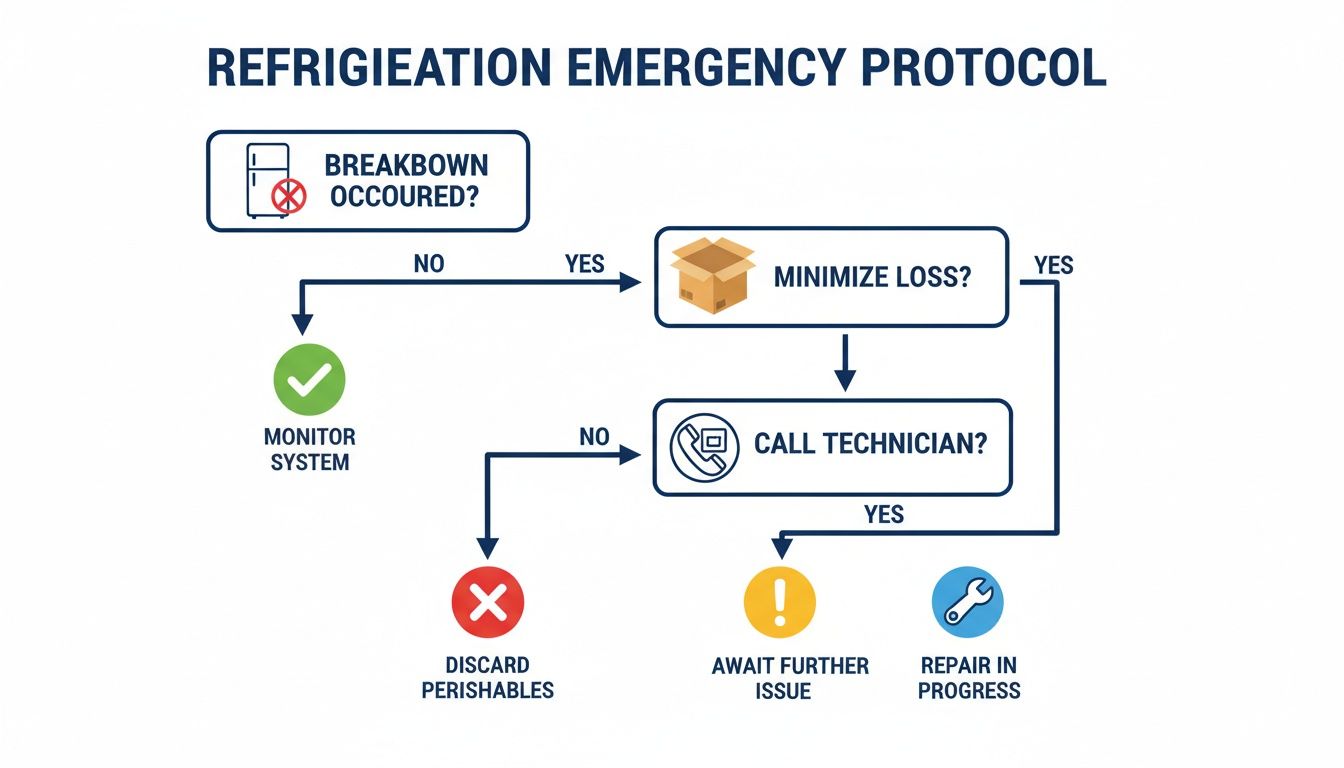
The flowchart lays out a clear protocol: confirm the breakdown, minimise your stock loss immediately, and then call a qualified technician without delay.
Key Services to Look For
When you're searching for help, you want a partner who can offer more than just a one-off fix. A dependable refrigeration service company should provide a complete range of solutions to support your business for the long haul.
These essential services should always include:
- Emergency Repairs: For any business in hospitality or food retail, 24/7 availability is non-negotiable. You need a team that can get to your Central Coast, Sydney, or Hunter Valley location quickly to diagnose the problem and get it fixed.
- Preventative Maintenance: Scheduled servicing is the best way to stop unexpected breakdowns before they happen. It also improves energy efficiency and extends the life of your equipment, saving you money and stress down the line.
- New System Installations: From small under-counter fridges to large walk-in cool rooms, a quality provider can help you select, size, and install the right system for your needs, ensuring it complies with all Australian Standards.
For a deeper look into handling system failures, you might find our guide on what to do during an HVAC repair emergency helpful. Making the right choice when time is critical can save you a world of stress and money.
Choosing a Refrigeration Service Provider Checklist
When a breakdown happens, it’s easy to just call the first number you find. But taking a moment to check a few key things can be the difference between a quick, lasting repair and a costly, recurring headache. This checklist summarises the most critical factors to consider.
| Factor to Check | Why It Matters For Your Business | What ALC Air Provides |
|---|---|---|
| ARCtick Licence | This is a legal requirement in Australia for handling refrigerants. An unlicensed operator could void your warranty and insurance. | All our technicians are fully licensed, qualified, and insured for your peace of mind. |
| 24/7 Emergency Service | Breakdowns don’t stick to business hours. You need a team that will answer the phone and show up on a Saturday night or public holiday. | We offer 24/7 emergency repair services across the Central Coast, Sydney, Newcastle, and Lake Macquarie. |
| Local Presence & Fast Response | When stock is spoiling, every minute counts. A local team can get to you faster, minimising your losses. | With technicians based locally, we guarantee prompt response times to get your business back up and running. |
| Experience with Your Equipment | Not all refrigeration is the same. You need a technician who knows your specific brand and type of unit, from cool rooms to display fridges. | Our team has extensive experience with all major commercial refrigeration brands and system types. |
| Transparent Pricing | Hidden fees and vague quotes add stress to an already difficult situation. You should know what you're paying for upfront. | We provide clear, itemised quotes with no hidden charges before any work begins. |
| Preventative Maintenance Plans | A good partner helps you avoid future emergencies, not just fix current ones. Proactive maintenance is key to reliability. | We offer customised preventative maintenance plans to keep your equipment efficient and reliable year-round. |
Ultimately, choosing a service provider is about trust. You need to know that when you call, a qualified professional is on their way who can solve the problem efficiently and stand by their work.
Understanding the Real Cost of Refrigeration Downtime
When a commercial fridge or cool room fails, the repair bill is just the beginning of your problems. The real cost of that downtime runs far deeper, hitting your stock, your revenue, and even your reputation.
Picture a popular café in Terrigal losing its main cool room on a heaving Friday afternoon. Or a busy restaurant on Newcastle's Honeysuckle Drive watching its freezer die right before a fully booked weekend service. The financial damage doesn't just trickle in; it floods.
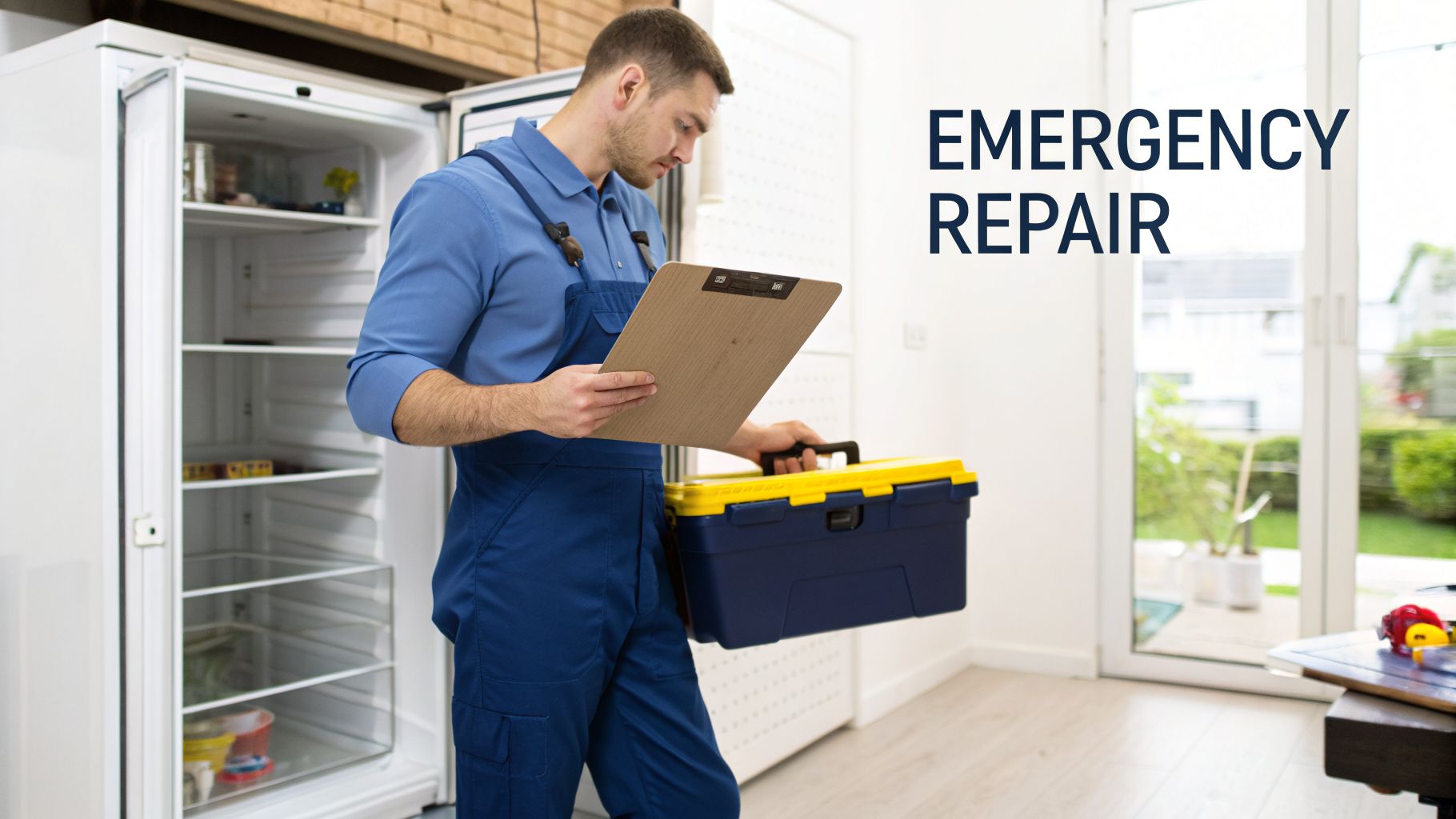
This isn’t some rare, unlucky scenario—it's a real and growing risk for any business that relies on keeping things cold. In fact, the Australian commercial refrigeration market hit USD 854 million in 2024 and is expected to climb to over USD 1.2 billion by 2033. This isn't just about more fridges; it's about our food retail, hospitality, and healthcare sectors becoming more dependent on them every single day. For these businesses, a temperature failure is nothing short of a catastrophe.
The Hidden Financial Impacts
Beyond the immediate stress of calling a technician, the financial fallout from a breakdown is where the real pain lies. It’s absolutely critical for you as a business owner to see these hidden costs for what they are, because they almost always dwarf the price of the actual repair.
The first, most obvious hit is spoiled inventory. For a restaurant, butcher, or grocer, a dead cool room means thousands of dollars of meat, produce, and dairy are suddenly rendered unsafe and unsellable. That's a direct, unrecoverable blow to your bottom line.
Then there's the loss of revenue. If you can’t serve half the items on your menu or your display fridges are empty, customers will simply walk away and go somewhere else. This isn't just about a few slow hours; that lost momentum can linger if word gets around that you're not properly operational.
Protecting Your Reputation and Operations
Harder to measure, but just as damaging, is the harm to your brand's reputation. Customers have a fundamental expectation that your products are fresh and safe. One equipment failure can spark negative online reviews and shatter trust that takes years to rebuild. In competitive environments like the Hunter Valley wineries or Sydney's bustling dining scene, your reputation is everything.
Finally, there’s the sheer operational chaos. A breakdown throws your entire workflow into disarray, stressing out your staff and dragging your attention away from actually running the business. All those disruptions—the frantic phone calls, the emergency stock movements, the apologies to customers—have a real cost in lost productivity.
This is exactly why investing in proper preventative maintenance isn’t just another expense. It’s a non-negotiable strategy to protect your entire business. To dig deeper into this, check out our guide on commercial refrigeration repairs in Sydney.
Spotting Early Warning Signs of Refrigeration Failure
Your cool room or display fridge rarely just dies without a whisper. It usually sends out quiet distress signals long before it gives up completely. Learning to recognise these subtle hints is just as important as identifying hazards in your workplace—it lets you get ahead of the problem.
Catching an issue early means you can call for help before you’re staring at thousands of dollars of spoiled stock. By simply paying attention to the daily hums and chills of your equipment, you can avoid the chaos of a full-blown breakdown.
Unusual Noises and Constant Running
One of the first and most obvious red flags is a change in sound. You know what your equipment sounds like day in, day out. If it suddenly starts clunking, grinding, or buzzing in a way it never has before, that’s a clear signal that a mechanical part—like a fan motor or the compressor—is in trouble. You should never ignore new noises.
Another tell-tale sign is a motor that just won't quit. A healthy fridge system cycles on and off to hold its temperature steady. If your compressor seems to be running a marathon without ever taking a break, something’s wrong. It could be a refrigerant leak, worn-out door seals, or a failing compressor working overtime just to keep up. This not only puts huge strain on the system but also sends your power bills through the roof.
Temperature Fluctuations and Frost Build-Up
Are you finding that drinks aren't quite as icy or that produce feels a little warmer than it should? Any kind of temperature fluctuation is a serious symptom that the system isn’t doing its primary job. This could be anything from a dodgy thermostat or low refrigerant levels to a blocked evaporator coil.
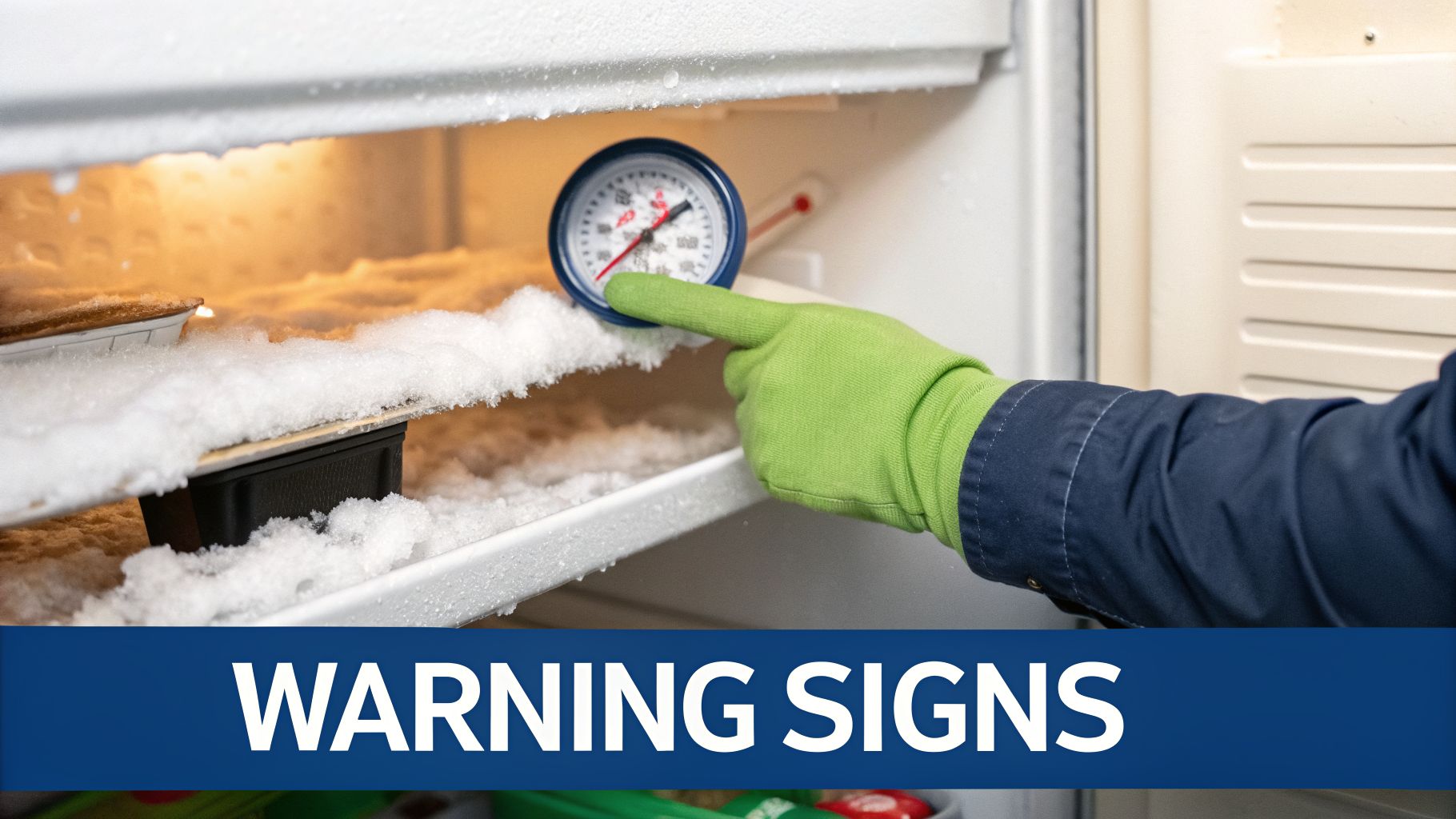
Likewise, if you’re seeing excessive frost or ice inside your freezer or cool room, that's a clear sign of trouble. A light dusting of frost can be normal, but thick sheets of ice point to a problem with the defrost system or restricted airflow. This chokes the unit's efficiency and can easily lead to a major component failure if you let it go.
Key Takeaway: Any change from normal operation—a new sound, constant running, or wobbly temperatures—is your cue to act. Getting a licensed technician in straight away can stop a minor hiccup from turning into an emergency that shuts down your business.
Preventative Maintenance Versus Emergency Repairs
When it comes to your commercial refrigeration, you really only have two ways to play it: you can be proactive and stay ahead of problems, or you can be reactive and wait for them to happen. This isn’t just a small operational choice; it’s a strategic decision that hits your budget, your stress levels, and your ability to keep the doors open.
Think about it like your work ute. You can get it serviced on a regular schedule, catching small things like worn brake pads or a dodgy belt before they turn into a major failure. Or, you can just drive it until it conks out on the M1 during the morning peak. One path involves a predictable, planned cost and zero drama. The other is a recipe for chaos, huge unexpected bills, and serious downtime. The exact same logic applies to your cool rooms and freezers.
The Proactive Approach: Scheduled Maintenance
A scheduled maintenance plan is all about getting out in front. It means having a qualified technician visit your site at regular, planned intervals to give your systems a proper health check. This isn't just a quick look-see; it’s a deep dive into the nuts and bolts to keep everything running at its absolute best.
During these visits, our techs get their hands dirty cleaning condenser and evaporator coils, checking refrigerant levels, testing all the electrical components, and making sure door seals aren't leaking precious cold air. These simple, routine tasks head off the most common—and costly—causes of breakdowns.
The payoff is massive: improved energy efficiency (lower power bills), a much longer lifespan for your gear, and a huge drop in the number of surprise failures. It’s a planned, predictable way to manage your costs and keep your business humming along smoothly.
The Reactive Approach: The Emergency Call-Out
Relying on emergency repairs means you only pick up the phone when something has already gone horribly wrong. On paper, it might seem cheaper to skip the maintenance fees, but this break-fix approach almost always costs you more in the long run. An emergency call-out naturally comes with higher labour rates, especially if it’s after hours or on a weekend.
But the real cost is the downtime. Your business grinds to a halt. Stock starts to spoil. Customers get turned away while you’re scrambling for a fix. That lost revenue and wasted inventory will cost you far more than a maintenance plan ever would.
While our team is always ready for emergency calls across the Central Coast, Sydney, and Newcastle, our real goal is to help you avoid making them in the first place. The core principles are the same whether we're talking about fridges or air con, as you'll see in our guide to air conditioning service and maintenance.
A proactive maintenance plan isn’t an expense; it’s a strategic investment in business continuity. It shifts your focus from crisis management to controlled, predictable upkeep, protecting your bottom line and your peace of mind.
To make the difference crystal clear, let’s compare the two approaches side-by-side.
Scheduled Maintenance Plan vs. Emergency Repair Call-Out
| Feature | Scheduled Maintenance Plan | Emergency Repair Call-Out |
|---|---|---|
| Cost Structure | Predictable, fixed annual or quarterly cost. | Unpredictable, high cost per incident. Often includes premium rates. |
| Budgeting | Easy to budget for as a regular operating expense. | Impossible to budget for. Creates cash flow shocks. |
| Downtime | Minimal to none. Service is done during off-peak hours. | Significant. Business stops until the repair is complete. |
| Stock Loss | Risk is dramatically reduced. | High risk of spoilage and wasted inventory. |
| Equipment Lifespan | Maximised. Well-maintained units last years longer. | Shortened due to stress and running to failure. |
| Energy Efficiency | Kept at peak performance, keeping power bills low. | Degrades over time, leading to higher energy consumption. |
| Stress Level | Low. Issues are found and fixed before they become crises. | Extremely high. Involves panic and scrambling for a solution. |
Looking at the table, the long-term value of a maintenance plan becomes obvious. While it requires an upfront investment, it protects you from the far greater financial and operational damage of an unexpected system failure. It's about spending a little to save a lot.
How Poor Maintenance Inflates Your Energy Bills
Your refrigeration units are some of the hardest-working pieces of equipment you own, and they're almost certainly one of the biggest drivers of your electricity bill. When they aren't properly maintained, that cost can quietly spiral out of control, eating into your profits month after month.
This isn’t just a small issue. In fact, Australia's refrigeration and air conditioning sector is the country's single largest electricity user, consuming a massive 24% of the nation's total power production in 2022. With over 62 million units running nationwide, the energy demand is immense, which you can learn more about in this deep dive into Australia’s refrigeration sector.
How Neglect Drives Up Costs
The link between poor maintenance and high energy bills is direct and unforgiving. The main culprit is often the system’s compressor, the component that does the heavy lifting of cooling.
Imagine you have a cool room in your Hunter Valley restaurant with dirty, clogged condenser coils. These coils are responsible for releasing heat from the system. When they’re covered in dust and grime, they simply can't do their job efficiently.
The compressor is then forced to work much harder and run for longer periods just to reach and maintain the target temperature. This extra labour directly translates to higher energy consumption, showing up as a nasty surprise on your next power bill.
Common Maintenance-Related Energy Wasters
Beyond dirty coils, several other common issues can secretly inflate your running costs. Each one forces your system to fight against itself to keep things cold.
- Faulty Door Seals: Tiny gaps in a cool room or freezer door's seals create a constant battle. Warm, moist air leaks in, forcing the system to run more frequently just to compensate for the temperature rise.
- Low Refrigerant Levels: A slow refrigerant leak makes the system less effective at transferring heat. The compressor has to work overtime to achieve the same level of cooling, wasting significant energy.
- Blocked Evaporator Coils: Excessive ice build-up on the interior evaporator coils acts like an insulator, preventing cold air from circulating properly and making the unit struggle.
Addressing these issues is not just about preventing a breakdown; it’s about optimising one of your biggest operational expenses. The savings from regular servicing often far outweigh the cost of the maintenance itself. For more insights on this topic, you can check out our guide on how much an air conditioner costs to run.
Finding a Local Refrigeration Partner You Can Trust
When you punch "commercial refrigeration service near me" into Google, you're not just looking for a phone number. You're looking for a solution to a problem that’s probably causing you a lot of stress. You need a reliable, local partner who gets that a malfunctioning cool room isn't an inconvenience—it's a crisis that could cost you thousands in lost stock.
It’s about finding a team that answers the phone, shows up quickly, and knows what they’re doing, especially when the pressure is on. This is where a genuine local business makes all the difference. Knowing what Google My Business is helps you connect with technicians who are actually part of your community, not a faceless call centre hundreds of kilometres away. A true local partner understands the unique challenges of our area, from the relentless coastal humidity on the Central Coast to the baking summer heat of Western Sydney, and that means they can get to you faster.
What to Look For in a Technician
First things first, let's talk about the absolute non-negotiables. Any technician who touches your equipment must be fully licensed and hold a current ARCtick licence. This isn't just a piece of paper; it's your guarantee that they are legally qualified to handle refrigerants safely and according to strict Australian laws. No licence, no work. It's that simple.
Beyond the licence, you want to see real-world experience. A technician who has seen it all—from a tiny under-counter fridge in a Lake Macquarie café to a massive cool room for a Newcastle club—brings a wealth of practical knowledge to your problem. That kind of experience means faster, more accurate diagnosis, which saves you time and money.
Our Commitment to You: At ALC Air, we’ve built our reputation on three simple promises: rapid response times when you have an emergency, sending only fully licensed and accredited technicians to your door, and providing clear, upfront pricing so there are never any nasty surprises.
Adapting to Modern Systems
The world of commercial refrigeration is moving fast, especially with the big push towards more environmentally friendly refrigerants. By December 2024, Australia had 330 supermarkets running on transcritical CO2 systems. This is a massive industry shift towards natural refrigerants, and it's not slowing down.
Servicing these modern, high-tech systems isn't the same as working on older gear; it demands specialised training and equipment to keep them running safely and at peak efficiency. This is where you separate the pros from the amateurs.
Choosing a service partner who is up-to-date with these changes is critical for the long-term health of your equipment. Our team is fully trained and equipped to handle everything from your trusty traditional systems to these newer, more complex technologies. And just like finding the right refrigeration tech is crucial for your business, you might find our guide on choosing an air conditioning service near me just as helpful for your other cooling needs.
Your Commercial Refrigeration Questions Answered
When you’re searching for "commercial refrigeration service near me," we know you’ve got questions and you probably need answers fast. To give you some clarity, here are a few of the most common queries we get from business owners across the Central Coast, Sydney, and Newcastle.

How Often Should My Commercial Refrigeration Be Serviced?
For most cafes, restaurants, and retail businesses, we find that preventative maintenance twice a year hits the sweet spot. But if you’re running a high-use environment, like a busy commercial kitchen in a Sydney CBD restaurant, you’ll definitely benefit from a quarterly service schedule.
Think of it like a car service. Regular maintenance keeps your system running efficiently, nips potential breakdowns in the bud before they cost you a fortune, and makes sure you’re always compliant with food safety regulations. A qualified technician can look at your specific equipment and how you use it to recommend the right schedule for you.
What Is an ARCtick Licence and Why Does It Matter?
The ARCtick licence is non-negotiable in Australia. It’s a legal requirement for any technician who works with refrigerants, certifying they’re properly trained to handle these substances safely and without harming the environment.
Before anyone touches your gear, you should always ask to see their current ARCtick licence. Hiring an unlicensed operator isn’t just a massive risk for your equipment; it can land you with some seriously hefty fines under Australian law. It's simply not worth it.
Why Is My Cool Room Not Getting Cold Enough?
When a cool room starts losing its chill, it usually points to one of a few common culprits. It could be a refrigerant leak, a dirty condenser coil that can’t get rid of heat effectively, a compressor that’s on its last legs, or even something as simple as worn-out door seals letting warm air seep in.
Whatever the cause, you need to get it looked at by a professional, and quickly. Running a struggling system just puts more strain on the components, leading to more expensive damage down the line. Plus, your power bills will skyrocket as the unit works overtime trying to hit a temperature it can no longer reach.
Can You Repair All Brands of Commercial Refrigerators?
Yes, absolutely. Our technicians are experienced across the board and are trained to service and repair a huge range of commercial refrigeration brands. We’ve seen it all, from walk-in cool rooms and freezers to glass-door display fridges and under-counter units.
Our whole goal is to get your business back on track, regardless of the make or model of your equipment. We keep our vans stocked with a wide inventory of common parts to make sure we can sort out the problem on the first visit and keep your downtime to an absolute minimum.
If you need fast, reliable support for your commercial refrigeration equipment, the team at ALC Air is here to help. Get in touch with us for professional advice and a free, no-obligation quote today.
https://alcairconditioning.com.au