


When a commercial fridge dies, the clock starts ticking. Every minute means more risk to your stock and your bottom line. For businesses needing commercial refrigeration repairs in Sydney, the game plan is simple: preserve what you can, run a few safe checks, and then get a licensed tech on the phone with the right information.
Acting fast, and smart, can literally save you thousands of dollars. We're here to walk you through exactly what to do when your equipment fails, helping you stay calm and in control.
Your Emergency Action Plan for Fridge Breakdowns
There’s a unique sinking feeling that comes with walking into your commercial kitchen to find the walk-in freezer is dead silent. It's a scenario no Sydney hospitality or retail business owner ever wants to face. In a city that lives and breathes food, a refrigeration breakdown isn't just a hassle; it's a full-blown crisis.
When the summer heat is pushing past 35°C, which happens all too often here, a quick repair isn't just a convenience. It's the only thing standing between you and a skip full of spoiled inventory.
When a breakdown hits, panic is the first instinct, but a cool head and a clear plan will serve you far better. The absolute first rule of a failing fridge or freezer? Keep the doors shut. Every time that door opens, warm air rushes in, and your window to save that stock shrinks.
If you’re lucky enough to have another working cold storage unit, start moving your most valuable or perishable items over. You should work fast, be organised, and minimise the time the doors on both units are open.
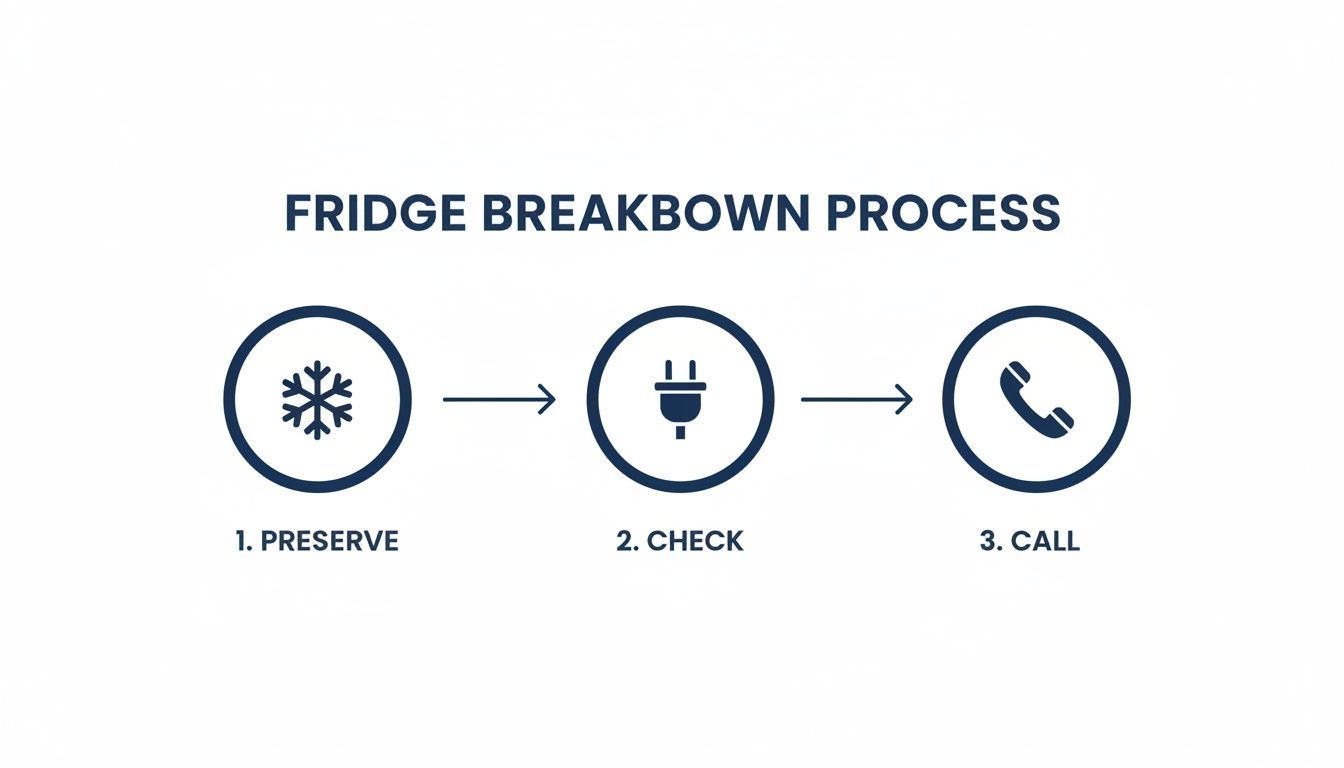
This workflow isn't about fixing it yourself. It's about damage control and gathering intel before you hand the problem over to a professional who can.
Your Immediate On-Site Action Checklist
When your fridge goes down, you need a quick, safe way to assess the situation. This isn't about grabbing a screwdriver; it's about gathering clues for your technician. The table below is your go to guide for what to do in those first critical moments.
| Symptom You Notice | Immediate Action To Take | What To Safely Check | Crucial Info For Your Technician |
|---|---|---|---|
| Unit is completely silent, no lights or fans | Keep doors closed. Move high-value stock to another unit if possible. | Is the plug secure in the wall? Is the power switch on? Has a circuit breaker tripped in your switchboard? | "The unit has no power at all. We've checked the plug and the circuit breaker, and both seem fine." |
| Lights are on, but it’s not cooling | Keep doors closed. Check the internal temperature if you can safely. | Is the thermostat set correctly? Has it been knocked? Are the condenser coils blocked with dust or debris? | "The lights are on, but it's not getting cold. The thermostat is set to 2°C, and the compressor sounds like it's trying to run." |
| Unusual noises (clicking, grinding, buzzing) | Don't open the doors unless absolutely necessary. | Can you pinpoint where the noise is coming from (e.g., the top, the back)? Is it constant or intermittent? | "There's a loud, repetitive clicking noise coming from the back of the unit every 30 seconds." |
| Water pooling on the floor | Keep the area clear to prevent slips. Turn off power at the source. | Is the drain line blocked or kinked? Is there excessive ice buildup inside the unit? | "We've got a significant water leak at the front of the freezer. We've switched it off at the wall for safety." |
| Strange chemical smell or visible refrigerant | Evacuate the immediate area. Ensure good ventilation. Call a pro ASAP. | Do not touch anything. This is a job for a licensed technician only due to safety risks. | "There's a strong chemical smell, and we suspect a refrigerant leak. The area is clear, and we need an emergency call-out." |
Using this checklist helps you stay safe and gives your repair technician a massive head start before they even arrive on site.
Safe Checks You Can Do While You Wait
While you’re waiting for the professionals, there are a few simple things you can check to help diagnose the problem. Again, this isn't about attempting a DIY repair. It's about collecting information for us.
First, check the obvious stuff. Is the unit plugged in properly? You can test the power point with another appliance, like a phone charger, just to be sure it’s live. Head over to your switchboard and see if a circuit breaker has tripped. It's a quick fix if it has, but if it trips again straight away, leave it off and tell your technician. That points to a deeper electrical fault.
Also, check the thermostat. It’s amazing how often they get knocked by staff or bumped during cleaning, changing the temperature setting.
Make a mental note of any strange sounds. Is the compressor humming but the fans aren't spinning? Is there a loud buzzing or a repetitive clicking? This kind of information is gold for a technician trying to diagnose a fault over the phone. When you're dealing with an urgent breakdown, knowing what to look for can prevent further damage. For reliable commercial refrigeration repair solutions, having a clear plan makes all the difference.
Safety First: If you see water pooling around the unit, smell a strange chemical odour, or see any sparks, do not touch anything. Isolate the power at the switchboard if you can do so safely, and call a professional immediately.
The principles of safety and clear communication are the same, whether it’s a freezer or an air conditioner.
How To Find A Reliable Refrigeration Technician In Sydney
When your cool room or freezer goes down, the last thing you want is to gamble on a random technician from a Google search. The Sydney market is flooded with options, and picking the wrong one doesn't just mean a dodgy repair. It can lead to catastrophic stock loss, bigger electrical problems, and more downtime later.
Let's cut through the noise and look at what actually matters when you need professional commercial refrigeration repairs in Sydney.

First up, there are a few absolute non-negotiables. Any technician who touches refrigerant gas in Australia must hold a valid ARCtick licence. This isn't a friendly suggestion; it's a legal requirement under federal law, designed to protect both you and the environment.
Just as critical is their electrical licence. Your refrigeration unit is a powerful, complex piece of electrical machinery. Letting an unqualified person work on it is a serious safety risk that could void your insurance and breach SafeWork NSW regulations. Always ask for their licence numbers and confirm they carry public liability insurance. This protects your business if any accidental damage happens on your property.
Beyond The Paperwork: What Separates The Pros From The Amateurs
Once the essential licences are sorted, you can focus on what makes a technician genuinely good at their job.
Experience with your specific type of equipment is a huge advantage. Let's say you run a butcher shop in Blacktown. A technician who spends their week servicing walk-in freezers for butchers and restaurants will diagnose a problem far quicker than someone who mainly deals with small under-counter bar fridges. Specialised knowledge saves you time and money.
Another huge factor is genuine 24/7 availability. Picture this: your main cool room in a busy Surry Hills café dies at 8 pm on a Friday. You need a company that actually sends a technician, not one that just promises a callback on Monday morning. Test their "24/7" claim before you have an emergency.
A reliable technician provides transparent, upfront quoting without hidden fees. You should know the full cost of labour and parts before any work begins, giving you complete control over the decision.
The Right Questions To Ask Before You Hire
To find the right fit, you need to ask the right questions. Having a short list ready helps you quickly filter out the time-wasters and find a pro you can build a long-term relationship with.
Here’s what we suggest you ask:
- "What’s your typical response time for an emergency in my area?" This tells you how well they can service your specific part of Sydney, whether you're in the CBD or out in Parramatta.
- "Do you provide a warranty on both your labour and the parts you use?" A professional will always stand behind their work. A decent warranty shows they're confident in their skills and the quality of their suppliers.
- "Are you familiar with my brand of equipment?" If they have direct experience with brands like Skope, Williams, or Orford, they'll know the common quirks and have the right parts on hand.
- "Can you provide me with a fixed, itemised quote before you start?" This is the most important question. It stops any nasty surprises when the invoice arrives and ensures total transparency.
Finding the right repairer often goes hand-in-hand with a good maintenance schedule. Being proactive is always cheaper than being reactive. For more on that, our guide on commercial air conditioning servicing has some great insights that apply just as well to refrigeration. Taking these steps ensures you’re not just hiring a repair person, but partnering with a professional who helps keep your business running.
What To Expect During a Professional Repair Visit
Knowing what happens during a professional service call can take a lot of the stress out of a breakdown. A quality repair visit for commercial refrigeration in Sydney isn't just a quick patch-up. It's a methodical process designed to be safe, transparent, and get you back up and running with minimal fuss.
It all starts with your first phone call. A good company won't just ask for your address; they'll want to know the specifics. What brand is the unit? Is it a walk-in freezer or an under-counter display fridge? What exactly is it doing (or not doing)? Giving us these details helps the technician arrive with the right gear and potential parts, saving everyone valuable time.
Arrival and Initial Assessment
When the technician turns up at your Sydney business, their first job is ensuring the site is safe. They'll introduce themselves, confirm the job details, and do a quick risk assessment of the area. This is especially important in a busy commercial kitchen or a bustling retail space, making sure their work doesn't create a hazard for your staff or customers.
Next, they’ll get into the diagnostic process. This is where a real expert shows their worth. It's not about guesswork; it's a systematic approach using specialised tools to find the actual root of the problem.
You should expect to see them using equipment like multimeters to check electrical components like relays and thermostats, along with a set of pressure gauges to check refrigerant levels and pressures. This methodical approach means they’re fixing the core fault, not just a symptom.
Diagnosis and Quoting
Once the technician has identified the problem, they should walk you through it in plain English. No jargon, just a clear explanation of what’s failed, why it’s happened, and what needs to be done to fix it properly. You should never feel like you're in the dark.
This is the critical part: you must receive a fixed-price quote for the entire job, covering all parts and labour, before any work begins. A reputable technician will not pick up a single tool until you've seen and approved the cost. This guarantees no nasty surprises on the final bill and is a true hallmark of a trustworthy service provider.
Completing the Repair and Documentation
With your approval, the technician gets to work, using quality parts and treating your premises with respect. A professional works cleanly and efficiently. Once the repair is done, they’ll run and test the unit thoroughly to make sure it’s holding the correct temperature and cycling as it should.
Finally, you’ll be given proper documentation. This isn't just a receipt. It’s a detailed invoice and service report that outlines the work performed, the parts that were replaced, and any recommendations for future maintenance. This paperwork is essential for your business records and for any warranties on the parts and labour. Just like with regular maintenance, clear records are vital for the long-term health of your equipment. For more on this, our advice on servicing split system air conditioners offers similar insights into why good documentation matters.
Common Refrigeration Problems Plaguing Sydney Businesses
After years of providing commercial refrigeration repairs across Sydney, we start to see the same patterns. A failure that feels like a sudden disaster has often been brewing for weeks. Knowing the common culprits behind a breakdown can help you spot the early warning signs before your stock is at risk and you're facing an emergency call-out.

The tricky part is that a single symptom, like a fridge that just isn't cold enough, can point to a dozen different underlying faults. This is exactly why a professional diagnosis is so critical. An experienced tech can tell the difference between a simple thermostat glitch and a compressor on its last legs, saving you from paying for the wrong fix.
Temperature Troubles and Thermostat Faults
One of the most frequent calls we get is for a unit that’s either too warm or has decided to flash-freeze everything inside. More often than not, the issue lies with a faulty thermostat or a dislodged temperature sensor.
These components are the brains of the operation, telling the compressor when to kick in and when to rest. When they start to fail, the entire cooling cycle goes haywire.
You might notice the unit is running constantly but never hitting the target temperature. Or maybe it’s doing the opposite, short-cycling by turning on and off every few minutes. While it seems like a minor part, a faulty thermostat puts enormous strain on the whole system if it's not sorted out quickly.
Compressor and Motor Failures
The compressor is the heart of your refrigeration system. It works incredibly hard, especially in the thick of a demanding Sydney summer. A failing compressor is one of the most serious, and expensive, repairs you can face.
The giveaways are usually audible. You might hear strange grinding sounds, a loud, angry buzzing, or a repetitive clicking as the unit tries and fails to start up. That clicking is often the compressor's relay switch overheating as it fruitlessly attempts to engage a seized motor.
Another red flag can be a sudden, sharp spike in your electricity bill. This can indicate the motor is drawing a massive amount of power just to keep turning over.
Why It Matters: A struggling compressor isn't just a cooling problem; it's a significant electrical hazard. If you suspect a compressor issue, it's crucial to call for a professional diagnosis immediately to prevent further damage or a potential fire risk.
Ice Build-Up and Airflow Issues
Sydney's coastal humidity is a nightmare for refrigeration systems, directly contributing to another all too common problem: excessive ice build-up on the evaporator coils. These coils are what actually absorb the heat from inside your unit.
When they get smothered in a thick layer of ice, airflow is completely blocked, and the system can no longer cool effectively.
You might see a sheet of frost forming on the back wall of the fridge or find that items stored right near the coils are frozen solid while everything else is lukewarm. This is often caused by a faulty defrost system, a blocked drain line, or something as simple as a worn-out door seal that’s letting humid air pour in. Many of the same airflow principles apply across cooling systems; for a deeper dive, check out our guide on common air conditioner repairs.
Common Faults And What They Might Mean
This table breaks down the symptoms you might notice versus what a technician will be looking for as the root cause.
| Common Problem | What You Might Notice (Symptoms) | Potential Cause (For Technician to Diagnose) |
|---|---|---|
| Unit Not Cooling | The temperature inside is rising, food is spoiling. | Refrigerant leak, faulty compressor, blocked condenser coils, thermostat failure. |
| Excessive Frost/Ice | Thick ice build-up on coils or back wall. | Faulty defrost heater/timer, blocked drain line, damaged door seals letting in moist air. |
| Constant Running | The motor never seems to switch off. | Low refrigerant levels, dirty condenser coils, faulty thermostat, significant air leak. |
| Strange Noises | Loud buzzing, grinding, clanking, or clicking sounds. | Failing compressor motor, worn-out fan motor bearings, loose components. |
| Water Leaking | Puddles of water on the floor around the unit. | Clogged defrost drain, cracked or disconnected drain pan, condensation line issue. |
| Power Tripping | The unit trips the circuit breaker when it tries to start. | Compressor drawing too much current, faulty wiring, failing capacitor. |
Remember, these are just common scenarios. A proper diagnosis from a licensed technician is the only way to be certain and avoid unnecessary repairs.
Sydney's extreme weather puts massive pressure on these systems, making timely maintenance and repairs absolutely vital. During summer heatwaves, neglected units are pushed to their breaking point, while ongoing issues like dirty coils and refrigerant leaks can quietly inflate energy costs for hospitality and retail businesses. For more on this, you can find industry analysis at ibisworld.com.
Why Proactive Maintenance Is Your Best Investment
The best repair is always the one you never have to make.
It’s a simple truth, but one that gets lost in the day-to-day chaos of running a business. While having a go to team for commercial refrigeration repairs in Sydney is essential, shifting your mindset from reactive panic to planned maintenance is the single smartest thing you can do for your bottom line. It saves you money, stress, and, most importantly, stock.
Think of it like servicing your delivery van. You wouldn't drive it for years without an oil change and expect it to run perfectly, especially not through a relentless Sydney summer. Your refrigeration units work just as hard, if not harder, 24/7.
What A Comprehensive Service Actually Involves
Proper maintenance is a whole lot more than a quick wipe-down and a visual check. A professional service is a deep dive into the health of your system, specifically designed to catch the small, inexpensive issues before they spiral into catastrophic, costly failures.
Any decent maintenance visit should always include:
- Thoroughly cleaning condenser and evaporator coils to ensure efficient heat exchange. Dirty coils make the system overwork, burn more power, and wear out faster.
- Checking refrigerant pressures to spot the slow leaks that kill efficiency and eventually lead to total compressor failure. This is often the most expensive component to replace.
- Testing all electrical connections and components to prevent faults that could cause a complete breakdown or, even worse, create a serious safety hazard.
- Calibrating thermostats to ensure your unit holds the correct temperature. This is crucial for protecting your stock and staying compliant with food safety laws.
- Inspecting door seals and hardware to stop cold air from escaping. A dodgy seal is a leading cause of high energy bills and frustrating ice build-up.
This detailed approach makes sure every critical part of your system is working in harmony, which reduces strain and immediately lowers your daily running costs.
Maintenance Is an Investment, Not an Expense
Picture this common scenario. A restaurant in Parramatta with a quarterly maintenance plan sails through a brutal summer heatwave, its cool room holding steady at 2°C. Meanwhile, other businesses on the same street are scrambling for emergency repairs as their neglected units finally give up under the strain.
The maintained unit isn't just lucky; it's prepared.
This preparation connects directly to your bank account. An efficient, well maintained fridge uses significantly less energy, something you’ll see clearly on your next power bill. It also ensures you remain compliant with food safety regulations, helping you avoid fines and protect your hard earned reputation. Our guide on the importance of air conditioning maintenance explores these benefits in more detail, and the principles are exactly the same for refrigeration.
Ultimately, proactive maintenance delivers the most valuable asset of all: peace of mind. Knowing your critical equipment is reliable allows you to focus on running your business, not worrying about what might break next.
When your business depends on keeping things cold, a refrigeration breakdown isn't just an inconvenience. It’s a crisis that brings a flood of urgent questions. We get calls like this every day from Sydney businesses, so we've put together some straightforward answers to the questions we hear most often.
How Fast Can a Technician Get to My Sydney Business in an Emergency?
This is always the first question, and rightly so. While response times can vary depending on traffic and current jobs, any reputable company will treat an emergency call as a top priority. For most of the Sydney metro area, you should expect a licensed technician on-site within a few hours.
For businesses where stock loss is catastrophic, like hospitality, healthcare, or food retail, a genuine 24/7 service is non negotiable. To help us get to you faster, have your address, the type of equipment, and a clear description of what’s happening ready when you call.
What Is the Typical Cost for Commercial Refrigeration Repairs in Sydney?
There's no single price tag here. The cost really depends on what's gone wrong, what parts are needed, and the time it takes to fix it. A simple job like replacing a faulty thermostat or a split door seal is going to be far less expensive than a major repair like swapping out a dead compressor.
Most professional services will have a standard call-out fee that covers the technician's travel and their initial diagnostic time. After they’ve had a look at the unit, they should give you a fixed, upfront quote for the entire repair. Be very wary of anyone who is vague about pricing or won't lock in a cost before they start the work.
Should I Repair or Replace My Old Refrigeration Unit?
This is a classic dilemma. It really comes down to balancing the unit's age, the cost of the repair, and how much energy it's chewing through.
A good rule of thumb: If the repair is going to cost more than half the price of a new, comparable unit, replacement is almost always the smarter long-term financial move.
An experienced technician can offer more than just a quick fix. They can give you an honest assessment of your unit's overall health, helping you weigh the one-off repair cost against the potential energy savings and improved reliability you’d get from a brand new system.
Do Your Refrigeration Repairs Come with a Warranty?
Absolutely. Any professional repairer worth their salt will stand behind their work. We provide a comprehensive warranty that covers both the new parts we install and the labour involved in fitting them.
This gives you peace of mind, knowing the job was done to a high standard and protecting you if the same issue pops up again. Always ask about the warranty terms before you give the go-ahead for any work. It's a key sign of a company that's committed to quality and accountability.
For a deeper dive into common issues, troubleshooting, and maintenance, consulting a detailed resource is a great idea. This Commercial Refrigeration Repair Ultimate Guide is a fantastic starting point for any business owner.
When you need fast, reliable, and professional commercial refrigeration repairs, you can count on ALC Air. We're here to get your business back up and running with minimal disruption.
Get a free quote today!