


Your business runs on people, products, and processes. But underpinning all of it is the environment they operate in. When the air conditioning fails in the middle of a Sydney summer, it's not just an inconvenience—it's a genuine business disruption.
Commercial air conditioning servicing isn't just a "nice to have"; it's a critical part of your operational strategy. It’s the scheduled, professional work that keeps your HVAC systems running efficiently, safely, and in line with Australian regulations. Think of it as a strategic investment to prevent expensive breakdowns, keep energy bills in check, and ensure the air your staff and customers breathe is clean and healthy.
Your Guide to Commercial Air Conditioning Servicing
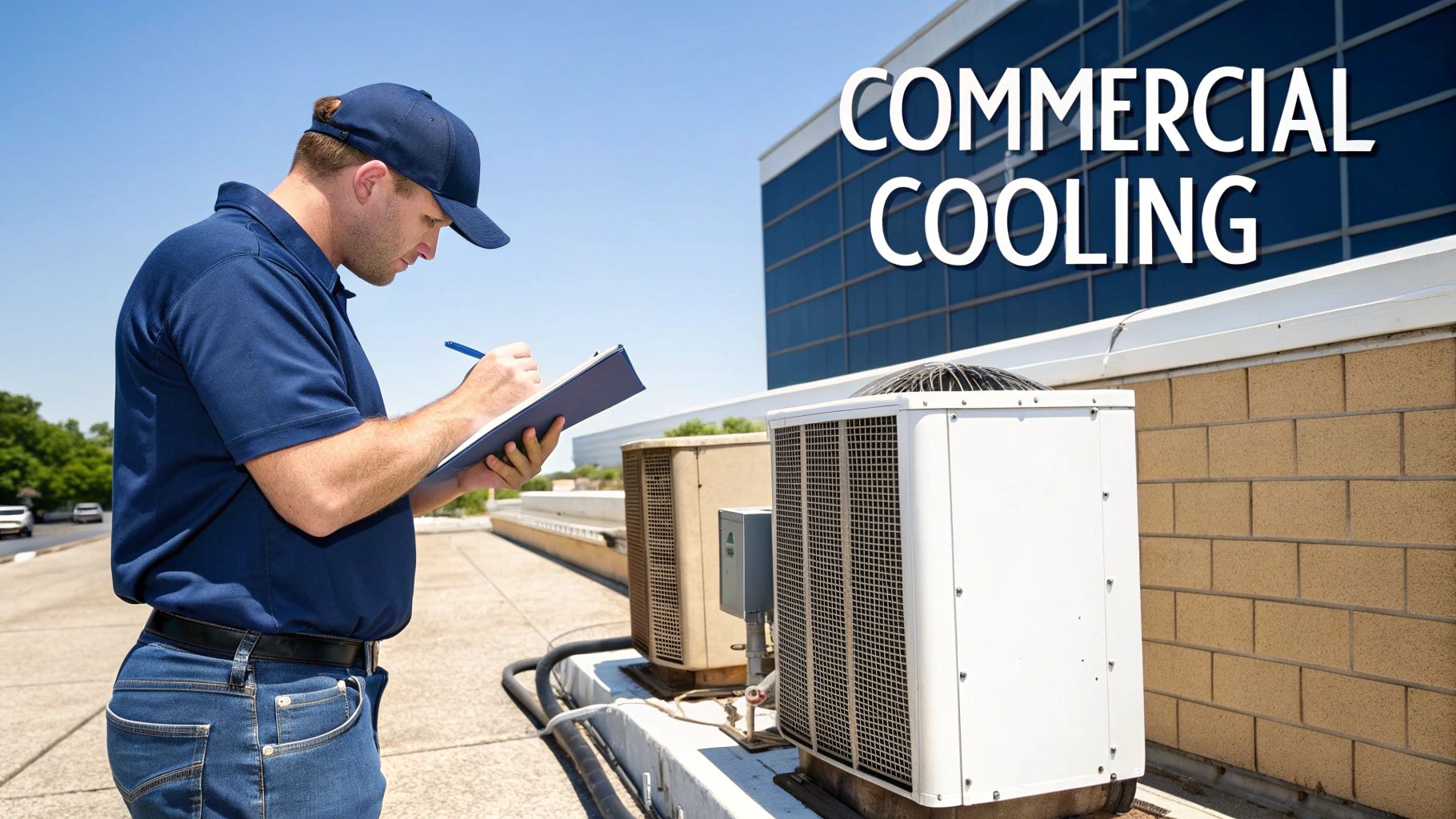
For any business in Sydney, the Central Coast, or the Hunter Valley, a reliable air conditioning system is non-negotiable. A sudden failure can bring operations to a grinding halt, potentially spoil stock, and drive customers away. This guide is here to walk you through why professional servicing is one of the smartest investments you can make in your business's future.
Commercial systems are a different beast entirely compared to the units we have at home. They're bigger, more complex, and work a whole lot harder. When one goes down, the stakes are much higher. A breakdown can tank staff productivity, create an unsafe workplace, and send potential customers straight to your competitor. This is exactly why a proactive approach isn't just recommended—it's essential.
Understanding the Local Challenges
Operating a business in NSW throws some unique environmental curveballs at your equipment. A retail store on the Central Coast has to deal with corrosive salt air that eats away at metal components. An office in Western Sydney battles the intense heat radiating from concrete and asphalt. A Hunter Valley winery needs a system that can handle punishing summer heat and chilly winter mornings.
This is why you need a local expert who gets it. They understand the specific pressures your system is under. In this context, proactive servicing stops being an expense and becomes a strategic move to protect your assets and keep your doors open.
A well-maintained commercial air conditioner is an asset that contributes directly to your business's performance. It protects inventory, ensures employee comfort and productivity, and keeps customers in your premises longer. Neglecting it turns a valuable asset into a significant liability.
Ultimately, a scheduled service plan shifts your climate control from a potential crisis to a reliable business tool. Instead of reacting to expensive, emergency repairs, you're investing in planned, preventative upkeep that saves you money and stress in the long run. To get a better idea of what's involved, have a look at our guide on essential air conditioning maintenance. It breaks down exactly what you should expect from a professional service.
Commercial vs. Residential: Why Servicing is a Different Game
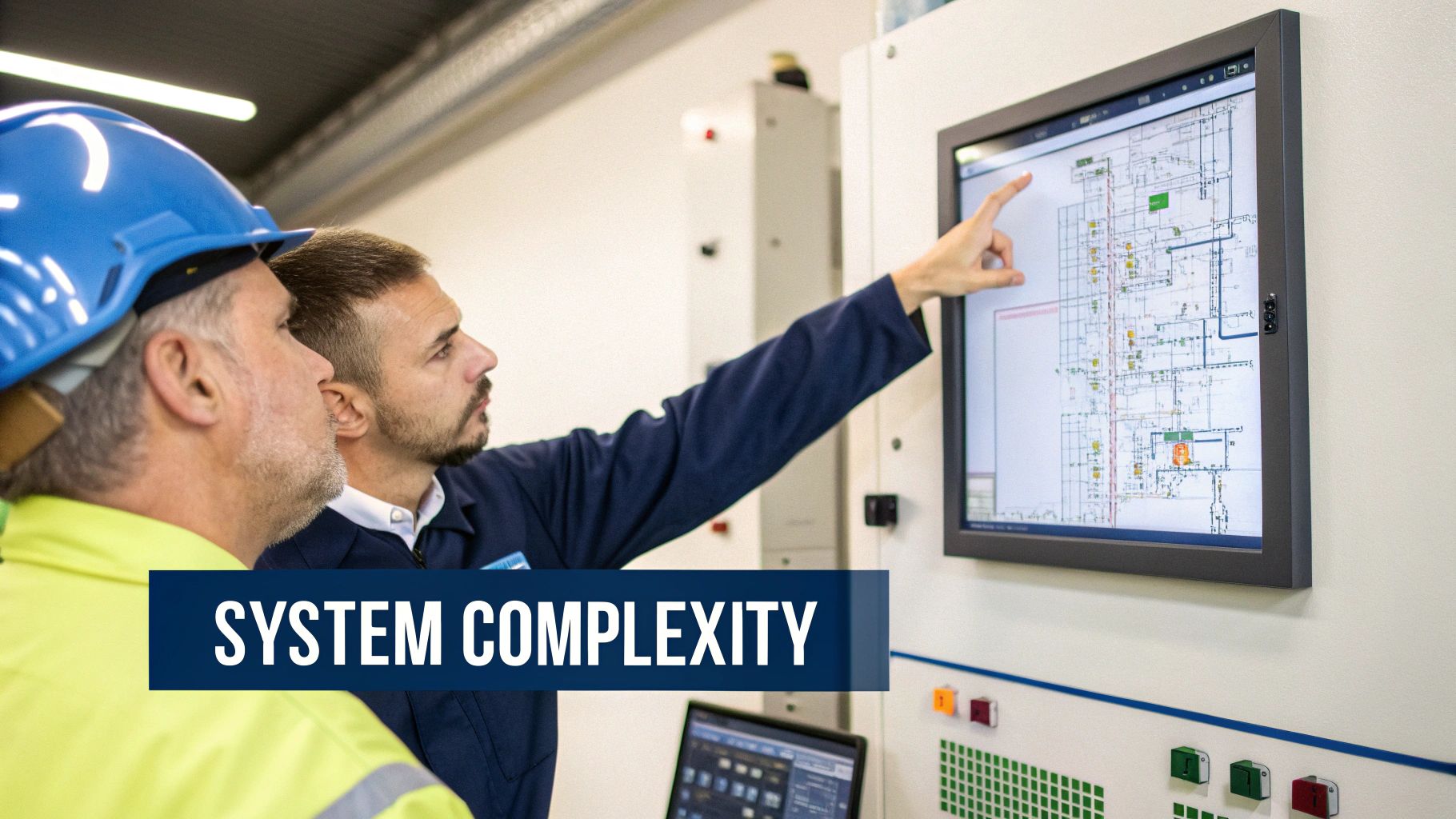
It’s easy to think of air conditioning as just a box that blows cold air. But the difference between a residential unit and a commercial system is like comparing a small car to a prime mover. While both get you from A to B, the scale, complexity, and importance are on completely different levels.
Your home split system is designed for one straightforward job: cooling a specific room. Commercial systems are powerful, intricate networks designed to manage large, complex spaces with constantly changing demands. They have to cope with fluctuating numbers of people, heat-generating equipment, and massive window frontages, all while maintaining a perfectly consistent temperature.
If you're curious about the basics, our DIY guide on split system maintenance shows just how much simpler things are on the residential side.
Understanding Commercial System Types
Unlike the familiar wall-mounted units in homes, commercial properties use a range of specialised HVAC (Heating, Ventilation, and Air Conditioning) systems. These are engineered for higher capacity, durability, and integration.
Some of the most common setups you'll find in businesses across Sydney and the Hunter Valley include:
- Rooftop Packaged Units: These are the self-contained workhorses you see on the roofs of retail stores or single-storey offices. They house everything in one cabinet, making them an efficient way to condition large, open-plan spaces.
- Multi-Zone Ducted Systems: Think of your home ducted system, but on a much larger scale. A central unit distributes conditioned air through a network of ducts to multiple zones or rooms, each with its own thermostat for individual control.
- VRV/VRF Systems: Variable Refrigerant Volume (or Flow) systems are incredibly efficient and flexible. They use one powerful outdoor unit to run multiple indoor units, allowing simultaneous heating and cooling in different parts of a building—perfect for multi-tenanted office buildings.
- Chiller Plants: Found in large-scale commercial buildings like hospitals or high-rise offices in Newcastle's CBD, chillers use cooled water to remove heat from the building's air. They offer immense cooling capacity for the most extensive facilities.
The Higher Stakes of Commercial Operations
The real difference boils down to the consequences of failure. If your home air con stops working, it’s an uncomfortable inconvenience. If the system fails in a busy Central Coast restaurant during a summer heatwave, it means lost customers, stressed staff, and a direct hit to your revenue.
In a commercial setting, air conditioning is not a luxury; it's a critical piece of business infrastructure. A system failure can halt productivity, damage temperature-sensitive stock, and create an unsafe environment, making specialised commercial air conditioning servicing absolutely essential.
Imagine a server room in a Sydney tech company overheating—the potential data loss could be catastrophic. Or a medical clinic where precise temperature control is vital for storing sensitive materials. The demands placed on these systems are relentless, and the cost of downtime is far more than just a repair bill. This is why commercial servicing demands a higher level of expertise, specialised tools, and a deep understanding of the business-critical nature of the equipment.
Legal Requirements for Commercial AC Maintenance in NSW
As a business owner or facility manager in NSW, your air conditioning system comes with a few non-negotiable legal responsibilities. It’s not just about comfort; it's about safety, compliance, and protecting your business from some pretty hefty fines or even voided insurance claims.
Think of these rules less as red tape and more as a framework for responsible business management. They’re there to ensure your workplace is safe, your energy use is reasonable, and you’re not accidentally harming the environment. Getting this right is fundamental.
Workplace Health and Safety (WHS) Act
Under the NSW Work Health and Safety Act 2011, you have a clear duty of care to provide a safe working environment. This isn't just about hard hats and safety boots; it explicitly covers things like air quality and thermal comfort. An old, neglected air conditioner can fail on both fronts.
Imagine your office in a Parramatta high-rise during a summer heatwave. If the AC gives out because it hasn't been serviced, you're not just dealing with grumpy, unproductive staff. You could be facing a WHS breach for failing to provide a safe thermal environment. Regular, documented servicing is your proof that you’re taking your duty of care seriously.
The National Construction Code (NCC)
The National Construction Code (NCC) dictates the minimum standards for Australian buildings, including critical rules around energy efficiency for HVAC systems. When your system is first installed or gets a major upgrade, it has to meet these benchmarks. But your responsibility doesn’t stop the day it’s commissioned.
Ongoing maintenance is what keeps that system running at the efficiency level the NCC demands. A system with clogged filters and dirty coils can chew through far more electricity, completely undermining the code's purpose. The Australian HVAC market continues to grow, with a significant part of that growth driven by the demand for high-efficiency systems that meet these strict standards. You can read more about the drivers of this growing market and see why compliance is key.
Following these codes isn't just a suggestion—it's a legal requirement. It protects your team, your bottom line, and your reputation. Cutting corners with unlicensed techs or skipping a service is a risk that just doesn't make business sense.
ARCtick Licensing and Refrigerant Laws
This is probably the most critical one to get right. In Australia, any technician who touches the refrigerant in your air conditioning system must hold a valid Refrigerant Handling Licence from the Australian Refrigeration Council (ARCtick). This is a federal law under the Ozone Protection and Synthetic Greenhouse Gas Management Act 1989.
Why so strict? Because refrigerants can be seriously potent greenhouse gases and cause damage to the ozone layer if they leak. Hiring someone without a licence is illegal for them, and it’s illegal for you, too. Always ask to see their ARCtick licence card before they start any work. It’s your only guarantee they’re qualified, insured, and working legally.
To make things simpler, here’s a quick checklist of the key compliance areas for your NSW business.
Commercial AC Servicing Compliance Checklist for NSW Businesses
Keeping track of your obligations is much easier with a clear plan. This checklist breaks down the main legal and safety requirements for maintaining your commercial air conditioning in NSW.
| Requirement Area | What You Need to Do | Why It Matters |
|---|---|---|
| Work Health & Safety (WHS) | Ensure regular maintenance to maintain safe air quality and thermal comfort. Keep detailed service records. | Fulfills your legal 'duty of care' to provide a safe workplace. Protects staff from heat stress and airborne contaminants. |
| ARCtick Refrigerant Handling | Only use technicians with a valid ARCtick Refrigerant Handling Licence for any refrigerant-related work. | Prevents illegal refrigerant emissions. Avoids heavy fines for both you and the technician. |
| National Construction Code (NCC) | Maintain the system to operate at its designed energy efficiency level. | Ensures your building continues to meet national energy standards, reducing running costs and environmental impact. |
| Electrical Safety | Ensure all electrical work is performed by a licensed electrician and the system is regularly inspected for electrical faults. | Prevents fire hazards and electrical shocks. A critical part of your WHS obligations. |
| AS/NZS 3666 (Air Handling) | Follow maintenance protocols for cooling towers and internal components to prevent microbial growth (like Legionella). | This is a public health requirement. Non-compliance can lead to serious health outbreaks and legal action. |
| Record Keeping | Keep a detailed logbook of all maintenance, repairs, filter changes, and refrigerant checks. | Provides documented proof of compliance for regulators, insurance claims, and WHS audits. |
Ultimately, the legal side of things points to a clear solution: partner with a fully licensed, insured, and reputable commercial HVAC provider. A proactive approach doesn't just keep you compliant with WHS, the NCC, and federal laws—it helps create a safer, more productive, and more efficient workplace for everyone.
How Often Should You Service Commercial Aircon?
When it comes to servicing commercial air conditioning, there’s no such thing as a one-size-fits-all schedule. The right frequency really depends on your specific business – the type of system you have, how hard it works, and the environment it operates in day after day. A cookie-cutter approach just doesn’t make sense when your operations, staff comfort, and energy bills are on the line.
Think about the massive difference between two local businesses. The air con in a busy restaurant kitchen in Sydney's CBD is constantly fighting intense heat, grease, and steam. Now, compare that to the system in a quiet professional office in Gosford. The kitchen unit is in a high-stress environment that will clog filters and strain components in no time.
This is exactly why we tailor our service recommendations. A proactive plan shifts servicing from a reactive cost into a smart investment that keeps your business running, cuts down your energy spend, and genuinely extends the life of your equipment. For a deeper look at this, our article on how long air conditioners should last explains how proper maintenance directly impacts longevity.
High-Demand vs. Standard-Use Environments
So, how do you figure out your schedule? First, we need to look at your operational intensity, because not all commercial spaces are created equal.
A high-demand environment is any space where the system is under constant pressure. We're talking about restaurant kitchens, busy retail stores with doors always opening, gyms, medical centres, and industrial sites in Newcastle that generate their own heat. For these businesses, we strongly recommend quarterly servicing (every three months). This frequency makes sure filters, coils, and drains stay clear, stopping the rapid build-up that leads to poor performance and sudden breakdowns.
On the other hand, a standard-use environment might be a typical office, a small boutique, or a community hall on the Central Coast. The system is still critical, but it isn't battling the same level of airborne contaminants or extreme heat loads. For these situations, a bi-annual service (every six months) is usually more than enough to keep everything running reliably and efficiently.
What A Preventative Maintenance Agreement Covers
The best way to manage your commercial servicing is with a formal preventative maintenance agreement. It’s a proactive plan that locks in your service visits ahead of time, ensuring nothing gets missed and giving you predictable costs to budget for. A quality agreement should always cover detailed checks of all critical system functions.
This flowchart gives a simple overview of the essential compliance checks that must be part of any professional service.

The key thing to remember is that any work involving refrigerant legally requires an ARCtick licensed technician. This is a non-negotiable part of compliance in Australia.
Your agreement should clearly spell out tasks like:
- Thorough Cleaning: This means cleaning or replacing filters, cleaning both indoor and outdoor coils, and clearing out condensate drains to prevent leaks and water damage.
- Mechanical Checks: The technician will inspect fan motors, belts, and bearings for wear and tear, lubricating parts where needed to keep things moving smoothly.
- Electrical Safety Inspection: A critical WHS requirement, this involves checking and tightening all electrical connections to prevent fire hazards.
- Refrigerant Level and Pressure Testing: This must be done by an ARCtick licensed tech to confirm the system is cooling efficiently and not leaking harmful greenhouse gases.
- Thermostat and Control Calibration: Making sure your controls are accurate ensures the system runs only when it needs to, which can save a surprising amount on your power bills.
By setting up a regular, documented service schedule, you move from putting out fires to preventing them in the first place. It’s the smartest way to protect your investment and ensure your business stays comfortable and productive, no matter what the NSW weather throws at you.
Commercial AC Service Costs: What to Expect
Figuring out the cost of commercial air conditioning servicing isn't as simple as looking up a price list. It's about understanding what goes into the investment, because unlike a straightforward residential service, the price is shaped by the sheer scale and complexity of your business's system. The real goal here is to shift from dealing with unpredictable, reactive repair bills to having a planned, manageable budget that actually protects your assets.
A standard preventative maintenance service for a small, single-unit commercial system (like a rooftop package unit on a shop) might start from around $350-$500 per visit. For larger, more complex multi-zone or VRF systems in office buildings, costs can range from $800 to several thousand dollars per scheduled service, depending on the number of units and the work involved.
Key Factors Influencing Service Costs
Several key things will determine what you pay for a service visit. The biggest factor by far is your system's size and type. Servicing a single 10kW rooftop unit for a retail shop in Tuggerah is a completely different job than maintaining dozens of individual systems spread across a multi-storey office building in Sydney’s CBD. Every extra unit, zone, or complex piece of equipment adds to the time and labour needed.
How easy it is to get to your equipment—accessibility—is another massive consideration. A ground-level unit is simple to work on. But if our technicians need specialised height safety gear to get onto a roof, or have to navigate a cramped, crowded plant room, that's going to be reflected in the cost. The age and condition of your gear also play a huge role. An older system can take more time to diagnose and might have parts that are harder to track down, pushing up the final expense.
The Return on Your Servicing Investment
Just looking at servicing as a cost is missing the bigger picture. Think of it as an investment that pays you back by boosting energy efficiency, dramatically cutting the risk of breakdowns, and squeezing more operational life out of your expensive equipment. A well-maintained unit uses a lot less power, which can lead to some serious savings. For a detailed breakdown, our article explores how much running an AC can cost and shows just how much efficiency really matters.
Proactive servicing isn't an expense; it's cost management. The predictable cost of a maintenance plan is almost always lower than the combined cost of emergency repairs, lost productivity, and higher energy bills from an inefficient system.
The industry is also seeing a major shift towards more energy-efficient and environmentally friendly solutions like inverter technology and smart HVAC systems. Government incentives often encourage businesses to upgrade, and professional servicing is crucial to ensure these advanced systems perform as designed and deliver those promised cost savings. You can read more about these commercial AC market trends to understand the direction the industry is heading.
Ultimately, once you get a handle on these variables, you can budget much more effectively. A tailored preventative maintenance plan from a qualified provider like ALC Air ensures your system gets the exact level of care it needs. It transforms your HVAC from a potential liability into a reliable, efficient asset that supports your business day in and day out.
Choosing the Right Commercial Servicing Partner

Picking a company to service your commercial air conditioning isn’t just another line item on the budget. It's a fundamental business decision. The right partner becomes an extension of your own team, protecting your assets, ensuring you’re compliant, and keeping everything running smoothly behind the scenes.
Get it wrong, and you’re looking at recurring breakdowns, surprise costs, and even serious legal risks. It’s a choice that deserves proper attention. Making a smart decision starts with a few non-negotiable checks. You need a partner who isn’t just skilled, but fully licensed and insured to set foot on your premises. Before you even think about signing a contract, you need to ask for their credentials. This isn’t being difficult; it’s just responsible business.
Verifying Essential Credentials
Anyone who touches your equipment has to be properly licensed. This is the absolute baseline for any professional commercial air conditioning provider.
Here’s what you must verify, no exceptions:
- NSW Contractor Licence: Any business carrying out air conditioning work in NSW is legally required to hold a valid contractor licence. You can check this in a minute on the Service NSW website.
- ARCtick Refrigerant Handling Licence: As we've covered, this is a legal necessity for anyone handling refrigerants. Always ask to see their physical licence card. It’s your guarantee they are properly trained and authorised.
- Public Liability Insurance: Things can go wrong. Your servicing partner must have adequate public liability insurance to cover any potential damage to your property or, worse, injury to a person. They should be able to produce a certificate of currency without any hesitation.
Choosing a partner is really about building trust. A professional, compliant company will have no problem showing you their licences and insurance details. If a provider gets cagey about it, that’s a massive red flag.
The Value of Local Expertise and Brand Experience
Beyond the paperwork, it’s the practical, hands-on experience that really counts. Does the company have a genuine track record with systems like yours? For instance, if your building runs on a large Daikin VRV system, you want a team that knows the quirks and complexities of that specific technology. Don't be afraid to ask about their experience with the best ducted air conditioning brands to see how familiar they are with your setup.
Local knowledge is another huge advantage. A company like ALC Air, with years of experience across the Central Coast, Sydney, and Newcastle, gets the unique environmental challenges here. We know exactly how the corrosive salt air in Terrigal eats away at outdoor units and how the intense summer heat in Sydney's western suburbs puts a massive strain on commercial systems. This isn't something you learn from a textbook; it comes from years of fixing problems in the field, and it allows us to provide far more effective, preventative solutions.
Ultimately, choosing the right partner means finding a team that is not only technically brilliant but also understands your business's day-to-day operational needs.
Ready to partner with a local, fully licensed, and experienced team? Contact ALC Air today for a comprehensive assessment of your commercial servicing needs. We’re here to provide the reliable, compliant support your business deserves.
Got Questions? We’ve Got Answers.
When it comes to the systems that keep your business running, you need clear, straightforward information. Here are the real-world answers to the questions we hear most often from business owners across Sydney, the Central Coast, and Newcastle.
What Does a Standard Commercial Air Con Service Actually Involve?
A professional commercial service is a world away from a quick residential check-up. Our technicians run through a comprehensive multi-point inspection designed from the ground up to ensure the safety, efficiency, and reliability your business depends on.
We get right into the nuts and bolts of the system. A standard service includes a thorough check of everything from filters and coils to electrical connections and refrigerant levels. We’ll clean or replace filters, sanitise the indoor and outdoor coils to get air flowing freely again, and test your thermostat’s operation to make sure it’s controlling the temperature accurately. We also check refrigerant pressures and inspect every electrical terminal for safety, ensuring your system is running at its best and complying with Australian Standards.
For bigger, more complex systems, this also means checking belts, bearings, and air handling units. The whole point is to find those small, hidden issues before they escalate into major, costly breakdowns that bring your business to a grinding halt.
Can Regular Servicing Genuinely Lower Our Energy Bills?
Yes, absolutely. A neglected commercial air conditioner is an energy glutton, working far harder than it should and chewing through electricity just to keep up.
Think about it this way: when filters and coils are choked with dirt and grime, airflow is suffocated, and the system can't exchange heat properly. This forces the compressor and fans to run longer and harder, day in and day out. By keeping these core components clean and ensuring refrigerant levels are spot on, we restore the system to its peak efficiency.
The numbers don't lie. Consistent, professional servicing can slash your system's energy consumption by up to 20%. That translates directly into real, noticeable savings on your power bills and helps shrink your business’s carbon footprint—a big plus for many companies today.
What Are the Warning Signs My Commercial AC Needs Urgent Attention?
Ignoring the early whispers of a failing system is a recipe for a full-blown shutdown and much more expensive repairs. You should get a qualified technician on the phone immediately if you notice any of these red flags.
Listen out for unusual noises—grinding, squealing, or loud clanking sounds often signal serious mechanical trouble. Other tell-tale signs include strange odours coming from the vents, noticeably weak airflow, or the system pushing out lukewarm air when it should be cooling.
Water leaking from any part of the unit is another urgent problem, as is an air conditioner that keeps tripping a circuit breaker. And finally, if you see a sudden, unexplained spike in your energy bills, it’s a strong signal your system is struggling and needs a professional eye on it, fast.
Is a Maintenance Contract Really Worth It for My Small Business?
For the vast majority of small businesses, a preventative maintenance contract is one of the smartest financial decisions you can make. While it’s a planned operational cost, it’s your best defence against the much higher, unplanned expense and chaos of a sudden breakdown—especially in the middle of a summer heatwave.
It's best to think of it as an insurance policy for your business's comfort and continuity. A contract not only keeps your system energy-efficient, holding down running costs, but more importantly, it guarantees a comfortable environment for your staff and customers. That has a direct impact on productivity and sales.
Ultimately, a maintenance agreement delivers peace of mind and predictable budgeting for one of your most critical assets. It’s a proactive investment in extending the life of your equipment and safeguarding your day-to-day operations.
If you're ready to protect your business with a reliable, compliant, and proactive servicing plan, the expert team at ALC Air is here to help. We offer tailored maintenance agreements for businesses across the Central Coast, Sydney, Newcastle, and Lake Macquarie.
Get a Free Assessment for Your Commercial Air Conditioning System