


Choosing the right commercial air conditioning installers isn't just another item on your to-do list; it's a fundamental investment in your business's day-to-day operation and its future. The system you choose—and more importantly, the team you trust to install it—directly impacts everything from customer comfort and staff morale to your monthly power bills. We're here to walk you through making a smart, future-proof decision for your business.
Why Your Choice of Installer Is a Critical Business Decision
When you're running a business, every decision sends ripples through your operation. Picking a commercial air conditioning installer is no exception. This isn't about just getting a box installed; it's about finding a partner who genuinely understands the demands of your specific space and how climate control affects your bottom line.
Consider this scenario: you run a busy retail shop in Gosford during a scorching summer heatwave. If the system is undersized or poorly installed, it will struggle, leaving customers hot, bothered, and heading for the exit. Or imagine a multi-level Sydney office building where one floor is freezing and another is sweltering. An inefficient or badly designed system creates these problems, leading to a drop in productivity and a spike in staff complaints.
A quality installation is about more than just feeling cool; it's about creating a stable, productive environment. A cheap or rushed installation almost always ends up costing you more in the long run. Suddenly, you're dealing with headaches you never planned for, like sky-high energy bills because the system is constantly working overtime to keep up.
You might also face frequent breakdowns that disrupt your business, frustrate staff, and lead to expensive emergency repairs. A poor install can even void manufacturer warranties or drastically shorten the system's lifespan, meaning you have to foot the bill for a full replacement much sooner than expected. Your HVAC system is a core component of your commercial environment, and it has to work seamlessly with the rest of your operations. The right installer gets this.
A Long-Term Partnership for Success
With over 15 years of hands-on experience helping businesses across the Central Coast, Sydney, and Newcastle, we've seen firsthand how a professional installation sets the foundation for years of reliable performance. A skilled team does more than just connect the dots. We design a system that’s actually right for you.
This means considering things like your building’s orientation to the sun, daily foot traffic patterns, heat generated by your specific equipment, and the unique climate challenges from the humid Central Coast to hotter inland suburbs like those in the Hunter Valley. This guide is designed to cut through the technical talk and focus on what really counts.
Understanding Your Commercial Air Conditioning Options
Walking into the world of commercial air conditioning can feel like learning a new language. Unlike the unit you have at home, commercial systems are built for a completely different scale, designed to handle vast spaces, constant use, and the specific demands of a business. Getting your head around the main types is the first real step towards a solution that keeps your customers happy, your staff productive, and your operating costs in check.
The right system for your business depends entirely on what you do and where you do it. The perfect setup for a sprawling warehouse out in Western Sydney would be a terrible fit for a multi-room medical clinic on the Central Coast. Let's break down the most common systems you'll come across.
Rooftop Packaged Units: The Workhorse
Think of a rooftop unit as the heavy-lifter for large, open-plan buildings. These are all-in-one systems where the compressor, condenser, and evaporator are all housed in a single, robust cabinet that sits on your roof. This makes them the go-to choice for places like shopping centres, big-box retail stores, and cinemas in areas like Tuggerah or Newcastle.
Because everything is "packaged" together, they're relatively straightforward for experienced commercial air conditioning installers to get up and running. Having all the machinery outside is a huge plus. It frees up precious indoor floor space and, crucially, keeps the operational noise away from your customers and employees. They're built tough for performance and a long service life.
Ducted Systems: The Discreet Solution
When you need consistent, floor-wide climate control for a space like an office, a medical centre, or a school, ducted air conditioning is almost always the answer. A central indoor unit, tucked away in a ceiling cavity or under the floor, pushes conditioned air through a network of ducts to discreet vents, or louvres, in each room.
This gives you a clean, almost invisible finish, with only the small grilles visible. The real magic of a ducted system, though, is zoning. This lets you cool or heat different parts of your building on different schedules. For example, a modern office in Chatswood could run the air con in the main workspace all day but keep the empty boardroom powered down, which makes a huge difference to your power bills.
VRF and VRV Systems: The Smart Network
Variable Refrigerant Flow (VRF), or Variable Refrigerant Volume (VRV), systems are the most sophisticated and efficient technology on the market today. The best way to think of a VRF system is as an intelligent climate network for your entire building. One large outdoor unit connects to numerous indoor units, which can be a mix of different types—ducted, wall-mounted, or ceiling cassettes.
The real power of VRF/VRV is its incredible flexibility and energy efficiency. It can simultaneously cool one part of your building while heating another. Imagine cooling a sun-drenched, west-facing office in the afternoon while gently warming a chilly, south-facing reception area at the exact same time. This makes them the perfect match for buildings with diverse needs, like hotels, multi-tenanted office blocks, and large, complex commercial spaces where individual control is a must.
Industry leaders like Daikin and Mitsubishi Electric are masters of this tech, delivering outstanding energy savings by sending only the precise amount of refrigerant needed to each individual indoor unit. That level of control is why they’re becoming the standard for new commercial developments across the Hunter Valley and Sydney CBD.
Commercial Air Conditioning System Comparison
Choosing the right system can be tough, so here’s a quick comparison to help you match your business needs to the best technology.
| System Type | Best For | Key Advantages | Considerations |
|---|---|---|---|
| Rooftop Packaged Unit | Large, open-plan spaces like warehouses, retail stores, and factories. | Saves indoor space; all-in-one design; keeps noise outside; robust and powerful. | Requires adequate roof space and structural support; less suited for multi-zone control. |
| Ducted System | Offices, medical centres, and whole-floor climate control. | Discreet appearance; consistent temperature distribution; offers zoning capabilities. | Requires ceiling or floor space for ductwork; installation can be more involved. |
| VRF / VRV System | Hotels, multi-tenanted buildings, and large, complex offices. | Highly energy-efficient; allows simultaneous heating and cooling; excellent individual zone control. | Higher initial investment cost; requires specialised installers and maintenance. |
| Multi-Head Split System | Small commercial spaces like cafes, small offices, or boutique retail shops. | Cost-effective for smaller areas; flexible placement of indoor units. | Multiple outdoor units can be visually unappealing; less efficient for large buildings. |
Ultimately, landing on the right system requires a proper look at your building’s layout, insulation, daily heat loads, and how your business actually operates. A professional site assessment from experienced commercial air conditioning installers is the only way to guarantee you get a solution that works for you today and will continue to perform for years to come.
The Non-Negotiables of Compliance, Licensing, and Safety
When you’re investing in a major asset like commercial air conditioning, it’s easy to focus on the hardware. But the real value, and the real risk, lies with the qualifications of your chosen commercial air conditioning installers. This is the part many business owners overlook, but it’s where the biggest headaches are hiding. In New South Wales, the rules are clear and strict to protect your business, your people, and your customers from potential disasters.
ARCtick Licences and Refrigerant Handling
First and foremost, it is illegal for anyone without a valid ARCtick licence to purchase, handle, or work with refrigerants in Australia. This isn’t just bureaucratic red tape. Refrigerant gases can be seriously harmful to the environment and require specialised equipment and training to manage safely. You should always ask to see an installer's ARCtick licence. A legitimate professional will expect you to ask. This confirms they are qualified and protects you from fines.
Electrical Work and Australian Standards
Every air conditioning system involves complex electrical wiring, and this is where things can get truly dangerous if not handled by a professional. All electrical work absolutely must be performed by a licensed electrician and must comply with the AS/NZS 3000 wiring rules, the national standard for all electrical installations. This is not optional.
Let's say you're doing a new office fit-out in a North Sydney high-rise. If an unlicensed person does the electrical hook-up, you could be facing immediate dangers like electrical faults or even fire risks. Worse still, it will almost certainly void your building insurance and can lead to severe penalties from regulators like SafeWork NSW. When selecting a commercial air conditioning installer, it's crucial to verify their commitment to safety, often demonstrated by their adherence to rigorous standards like a recognised ISO 45001 certification in Australia.
This helpful infographic gives you a simple decision tree for picking the right type of system based on your building's layout.
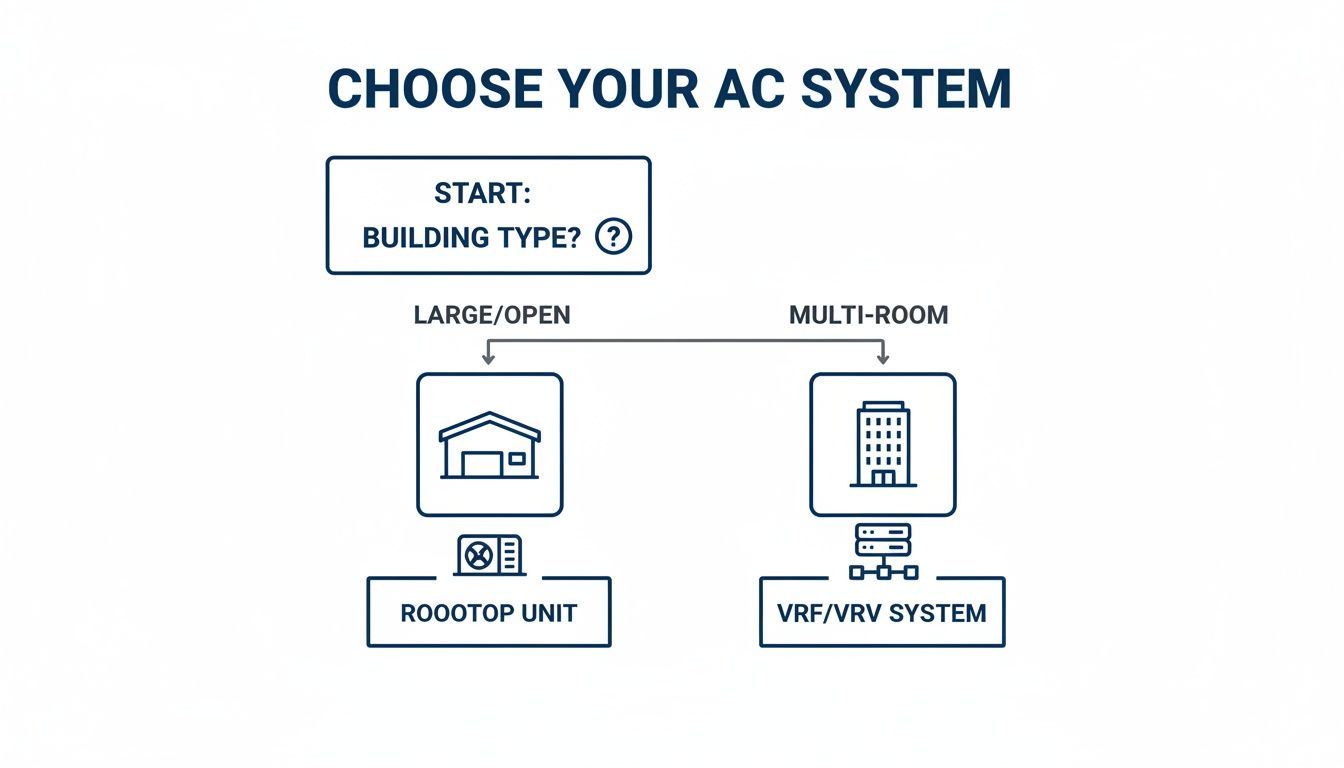
As the flowchart shows, the choice is often driven by your building type. A rooftop unit is a great fit for large, open areas, while a VRF/VRV system is ideal for buildings with multiple rooms needing their own climate control. Compliance is the foundation of a safe, efficient, and reliable installation that protects your investment. By asking the right questions about licensing and standards from the start, you give yourself the power to choose a genuinely professional installer. For more insight into the compliance needed even on a smaller scale, you can explore our detailed guide on the process for a split system installation.
How Sizing and Efficiency Impact Your Bottom Line
It’s easy to get lost in the technical specs when you’re looking at a new commercial air conditioner. But if you want to understand the long-term cost to your business, it all boils down to two things: getting the size right and choosing an energy-efficient model. Get these wrong, and you’ll be paying for it on every single power bill.
First, let’s clear up a common point of confusion. When you see a system’s capacity measured in kilowatts (kW), it's not talking about how much electricity it uses. That kW rating actually refers to the system's cooling and heating output, how much climate control it can deliver to your space.
The Goldilocks Principle of Air Conditioning Sizing
Getting the size of your commercial system right is absolutely everything. An undersized unit will be forced to run flat-out all day, desperately trying to hit the temperature on the thermostat. This puts enormous strain on the components, leading to early breakdowns and shockingly high energy bills. But an oversized system is often even worse.
Imagine you’ve installed a huge, powerful system in a Hunter Valley winery’s tasting room. It will blast the space with cold air, hit the target temperature in minutes, and then shut off. This constant on-off process is known as short-cycling, and it's a huge problem. Because the system never runs long enough to dehumidify the air, you end up with a room that feels cold, but clammy and uncomfortable, all while chewing through power.
A correctly sized system, put in by professional commercial air conditioning installers, runs for longer, more consistent cycles. This allows the unit to properly strip humidity from the air while maintaining a stable temperature, delivering far better comfort while using significantly less energy.
How Energy Efficiency Ratings Translate to Real Savings
Once you have the right size nailed down, the next place to look for savings is the energy efficiency rating. Every air conditioner has an energy rating label with a simple star system. More stars mean better efficiency and lower running costs. Simple as that. A system with a higher star rating might have a bigger price tag initially, but that extra upfront cost is almost always paid back through dramatically lower electricity bills.
Choosing a high-efficiency system from a trusted brand like Fujitsu or Daikin, combined with a quality installation, can save a business thousands of dollars over the unit's lifespan. Think of your air conditioning not as a necessary expense, but as an investment in your property and your operating budget. A higher initial spend on a correctly sized, high-efficiency unit will almost always result in a much lower total cost of ownership.
To get a better handle on the specifics for your own space, take a look at our guide on how to size an air conditioner.
The Commercial Installation Process from Start to Finish
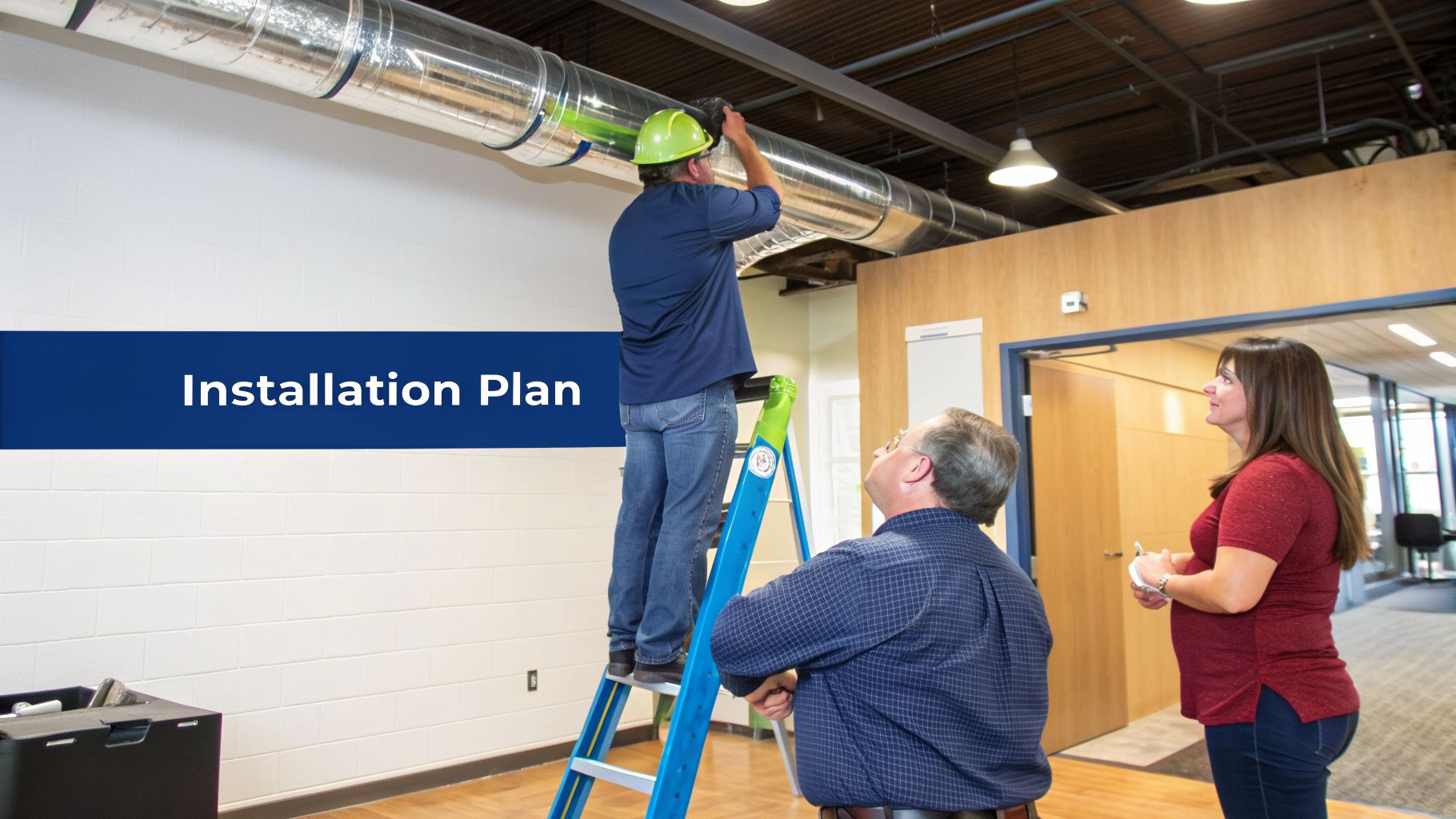
A commercial air conditioning installation isn't just about bolting a unit to your roof. It’s a carefully managed project that, when done right, flows smoothly without derailing your business operations. We believe in a completely transparent process. You should know exactly what's happening, when it's happening, and why.
Step 1: Initial Consultation and Site Assessment
It all starts with a proper conversation. We need to get a handle on what you're trying to achieve, whether it’s keeping customers comfortable in a busy Terrigal cafe or maintaining precise temperatures across a multi-storey Newcastle office block. We’ll talk about your budget, how your business operates, and any specific frustrations you have with your current setup. After that, our senior technicians get on-site for a thorough assessment, measuring your space and calculating your building’s specific heat loads.
Step 2: Custom System Design and Fixed Quote
Using the data we gathered on-site, we design a system that’s genuinely right for your space. We'll map out the ideal system type, whether that’s a powerful rooftop package unit, a versatile VRF system, or a classic ducted setup, and calculate the exact capacity needed to do the job efficiently. Once the design is locked in, you get a detailed, fixed upfront quote. Every cost is itemised: the units, all materials, and the professional labour from our licensed commercial air conditioning installers. What you see is what you pay.
Step 3: Scheduling and Pre-Installation Coordination
Once you give the quote the green light, we shift into detailed planning. Our number one goal here is to minimise disruption to your business. We'll work directly with you to build a project schedule that fits around your trading hours. For bigger jobs, like a full VRF fit-out for a commercial building in Lake Macquarie, this stage involves serious coordination with other trades to keep the project moving forward seamlessly. You can find more details on this in our guide to commercial AC unit installation.
Step 4: Installation and Commissioning
This is where the plan becomes a reality. Our team of qualified, licensed technicians gets to work, focusing on safety, quality, and tidiness. We treat your property with respect, keeping work areas clean and ensuring every single task adheres strictly to Australian Standards. After the physical install is done, we move to commissioning. This is a crucial final step where we run a comprehensive set of tests on the entire system. We don't sign off on a job until we've proven the system performs exactly as it was designed to.
Beyond the Installation: Service, Maintenance, and Warranty
Getting your new commercial air conditioning system installed is a great first step, but it’s not the end of the story. The relationship with your commercial air conditioning installers should last the entire life of your system. Scheduled preventative maintenance is what guarantees longevity, efficiency, and helps you avoid a catastrophic breakdown in the middle of a January heatwave.
What Does a Commercial Service Plan Actually Involve?
A proper service and maintenance plan is a lot more than just a quick filter clean. It’s a comprehensive health check designed to catch small issues before they snowball into major, business-halting problems. This typically includes a deep clean of filters and coils, checking refrigerant levels, inspecting all electrical components as per AS/NZS 3000 standards, testing thermostats, and clearing all drain lines to prevent water leaks.
Understanding Your Warranty Coverage
Real peace of mind comes from knowing you’re completely covered if something goes wrong. When you work with a reputable installer like us, you get a dual warranty system that protects you from every angle. First up is the Manufacturer’s Warranty. This covers the air conditioning unit itself against defects, usually for five years on parts and labour, but it's only valid if the unit is installed by a licensed professional.
Second is the Installer’s Workmanship Warranty. This is our promise to you. It covers every part of the installation labour—from the pipework and electrical connections to the mounting and ducting. Choosing professional commercial air conditioning installers who offer both guarantees you have a single point of contact and complete accountability. To get a better handle on what's involved in keeping your system running perfectly, check out our guide on commercial air conditioning servicing.
Your Commercial Air Conditioning Questions Answered
When you're looking at a significant investment like a new commercial air conditioning system, you're going to have questions. It's only natural. We’ve been installing systems for businesses across Sydney, the Central Coast, and Newcastle for a long time, so we’ve heard just about all of them. Here are some straight-up answers to the most common things people ask us.
How Much Does a Commercial Air Conditioning Installation Cost?
There's no simple price list for commercial air conditioning. The final cost depends entirely on the system you need, the size of your space, and how complex the building is. A simple multi-head split system for a small retail shop on the Central Coast is a completely different project to a large-scale VRF system for a multi-storey office building in the Sydney CBD. Our approach is to give you a detailed, fixed upfront quote after we’ve done a proper on-site assessment.
How Long Will a Commercial Installation Take?
Just like the cost, the timeline is all about the scope of the project. A straightforward multi-split system for a small office might only take us one to three days, with very little disruption to your business. On the other hand, a big ducted or VRF system for a new build or a tricky retrofit could take anywhere from one week to several weeks. We always give you a clear project timeline before we start.
What Information Do You Need to Provide a Quote?
To give you a genuinely accurate quote, nothing beats having one of our senior technicians on-site. But to get the ball rolling, any information you can share upfront is a huge help. If you can send over building plans, tell us what the building is used for (e.g., retail, office, hospitality), and give us any details on insulation or special needs like server room cooling, our team can start putting together a picture of what you need. This initial info helps us understand your unique situation, whether you’re in Newcastle, Sydney, or right here on the Central Coast.
Can You Install a System I Have Already Purchased?
We can, but we honestly advise against it. While we can offer an "install-only" service, you get far more protection and peace of mind when you let one professional company handle the whole thing, from supply to installation. When we supply the unit, we take full responsibility for it. We make sure it's the right size and model for your space, and you’re covered by both the manufacturer’s warranty and our own workmanship warranty. It gives you one number to call if anything goes wrong.
Ready to create a more comfortable and efficient environment for your business? The team at ALC Air has over 15 years of experience providing reliable commercial air conditioning solutions across the Central Coast, Sydney, Newcastle, and Lake Macquarie.
Get a free, no-obligation quote and let our experts design the perfect system for your needs.