


Choosing the right system is the single most important decision you'll make for your commercial AC unit installation. The needs of a small café in Terrigal are worlds apart from a multi-storey office in the Sydney CBD, and your choice will directly impact efficiency, comfort, and long-term running costs. Getting this right from the start saves a lot of headaches down the road.
Matching the Right AC System to Your Business Needs
Picking an air conditioning system for a business isn’t a one-size-fits-all job. We find the best solution always balances powerful performance with sensible running costs, keeping your staff and customers comfortable without blowing the budget. Let’s walk through the three main contenders for commercial spaces across NSW, from the Central Coast to the Hunter Valley.
To make sense of the options, it helps to see them side-by-side. Here’s a quick comparison of how these systems stack up for typical business applications in our region.
Commercial AC System Comparison for NSW Businesses
| System Type | Best For | Key Benefit | Typical NSW Application |
|---|---|---|---|
| Ducted Systems | Large, open-plan spaces needing uniform temperature. | Centralised control and clean, unobtrusive aesthetics. | Retail showrooms in Lake Macquarie, open-plan offices in Newcastle. |
| Multi-Head Split Systems | Buildings with multiple, smaller, separate rooms. | Independent temperature control for individual spaces. | Medical clinics on the Central Coast, serviced office suites. |
| VRF / VRV Systems | Large, complex buildings with diverse heating/cooling needs. | Simultaneous heating and cooling with exceptional energy efficiency. | Hotels, multi-storey corporate buildings in the Sydney CBD. |
This table gives you a starting point, but the real value is in understanding how each system works in practice and where it truly shines.
Ducted Air Conditioning Systems
Ducted systems are the go-to solution for consistent, even temperature control across large, open areas. Think of a big office in Newcastle or a retail showroom in Lake Macquarie. A powerful central unit, usually hidden away in the ceiling space, distributes conditioned air through a network of ducts to vents in different rooms or zones.
The main advantage here is the clean, professional look; all you see are the discreet grilles in the ceiling. Modern ducted systems also offer fantastic zoning capabilities, meaning you can cool the boardroom for a meeting without freezing the empty reception area. That level of control is crucial for managing energy consumption effectively. You can learn more about the top players in our guide on the best ducted air conditioning brands.
Multi-Head Split Systems
When your business needs individual temperature control for separate rooms, a multi-head split system is a brilliant option. This setup connects several indoor units to a single, powerful outdoor condenser. It's the perfect fit for places like medical clinics on the Central Coast, where each consultation room needs its own climate setting, or a small building with different business tenants.
The real win here is flexibility. Each indoor unit can be operated on its own, so you’re not wasting a single dollar cooling empty spaces. It's a smart, tailored approach for managing comfort in buildings where different areas are used at different times.
Variable Refrigerant Flow (VRF) Systems
VRF, also known as Variable Refrigerant Volume (VRV), is the powerhouse of commercial air conditioning. This is the most sophisticated and flexible solution for large or complex buildings. Imagine a multi-floor building in Sydney with retail on the ground floor, offices above, and a server room that needs constant, dedicated cooling. A VRF system can actually heat one area while cooling another by cleverly redirecting heat from the cooled rooms to those that need warming up.
This incredible energy efficiency makes VRF systems a smart long-term investment for businesses with demanding and varied climate needs, like hotels or large corporate headquarters. While the initial outlay is higher, the ongoing energy savings and precise control are simply unmatched. This market is a huge part of Australia's air conditioning and heating services industry, which recently hit $13.1 billion in revenue, largely driven by commercial building booms across NSW.
Why Accurate Sizing and Load Calculations Matter
Ever worked in an office that’s either an icebox or a sauna, but never just right? That’s the classic calling card of an incorrectly sized air conditioning system. Honestly, getting the size wrong is one of the most common and costly mistakes we see in commercial AC installations.
An undersized unit will be forced to run flat-out on hot days, constantly fighting a losing battle. It never quite reaches the temperature you’ve set, leading to uncomfortable staff and customers, not to mention eye-watering energy bills. It’s like trying to cool a warehouse with a tiny bedroom air conditioner; it’s just an expensive exercise in futility.
On the flip side, a system that’s too powerful is just as bad. It will blast the space with cold air, cool it down way too quickly, and then shut off. This process, known as short cycling, puts massive wear and tear on the components. More importantly, it doesn't run long enough to properly dehumidify the air, leaving your space feeling clammy and damp; a particularly nasty problem in the humid coastal climate of the Central Coast.
What Goes into a Professional Load Calculation
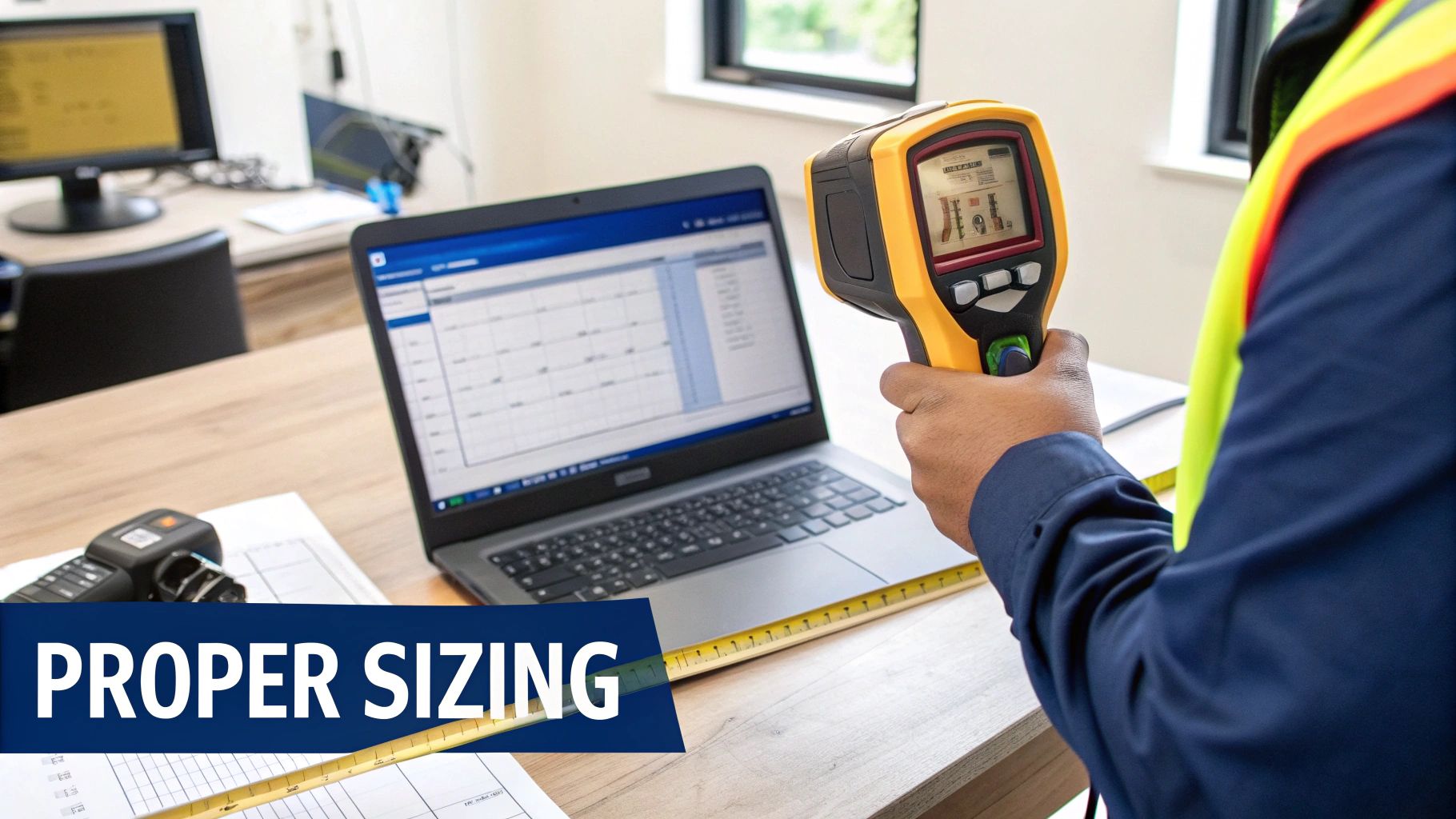
A proper, professional load calculation is a world away from just glancing at a floor plan. It's a deep dive into every single factor that contributes to your building's heat load. Our technicians analyse a whole range of variables to make sure the system we recommend is perfectly matched to what you actually need.
Some of the factors we assess include:
- Building Size and Layout: We measure the total volume of the space, not just the floor area. Ceiling height is a massive factor.
- Insulation Quality: The R-value of your wall and ceiling insulation has a huge impact on how much heat gets in or escapes.
- Window Specifications: We look at the size, number, and orientation (those west-facing windows in Sydney's hot suburbs are brutal) and even the type of glass.
- Internal Heat Sources: Every computer, server, commercial oven, and light fitting pumps out heat that the air conditioner has to deal with.
- Occupancy Levels: The number of staff and customers typically inside the building adds a significant and often overlooked heat load.
Why a Custom Calculation Is Non-Negotiable
Consider this scenario: a data centre on the Central Coast has a massive internal heat load from servers but very few people. In contrast, a bustling restaurant in Lake Macquarie has a lower equipment load but a huge occupancy and heat pouring out of the kitchen. A generic, "one-size-fits-all" approach would fail both of these businesses spectacularly.
By performing a detailed load calculation, we ensure your system runs efficiently, maintains consistent comfort, and doesn't waste a single dollar on unnecessary energy consumption. This tailored approach is the foundation of a successful and cost-effective commercial installation.
This detailed analysis is the only way to guarantee the system performs as it should. If you're keen to dive deeper into the nuts and bolts, our guide explains more about correctly sizing an air conditioner. Without this crucial first step, you’re just guessing, and that’s a risk no business can afford to take.
Navigating NSW Compliance and Site Surveys
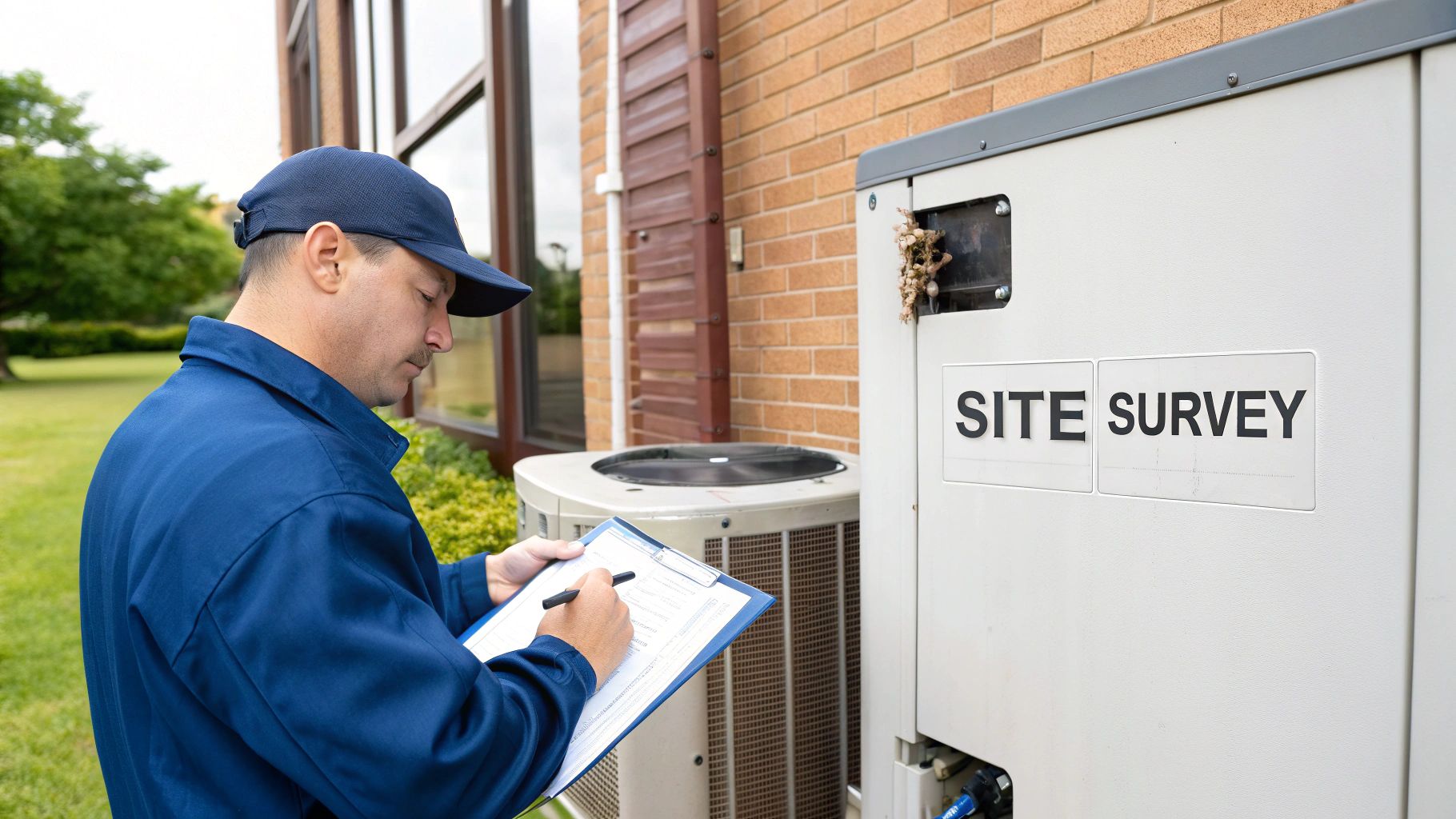
Before a single tool gets picked up, the most important work on your commercial AC unit installation happens. We call it the site survey, but it’s really the project’s entire foundation. This isn’t just about measuring up; it’s a critical planning and safety phase that ensures everything from here on out is smooth, efficient, and compliant.
Frankly, this is where years of experience prevent thousands of dollars in problems down the track.
A huge part of this initial check is a deep dive into your building's electrical backbone. We need to be 100% certain your existing switchboard can safely handle the load from a powerful new commercial system. An overloaded circuit is a major fire risk, and it's a non-negotiable safety check for us.
The On-Site Assessment Process
During the survey, our technicians are also meticulously planning the physical real estate for every component. For the outdoor condenser units, we have to guarantee there's more than enough clearance for airflow. A unit crammed into a tight space simply can't "breathe," causing it to overheat, work inefficiently, and burn out years before it should.
Inside, it’s all about mapping out the smartest, most effective runs for ductwork or refrigerant lines. The goal is always the shortest, most direct path possible. This minimises performance loss and preserves the clean look of your workspace. It's the difference between a system that feels built-in and one that looks like an ugly afterthought.
Understanding NSW Compliance and Licensing
Cutting through the web of compliance in New South Wales is a massive part of our job, and it’s what protects your business. Every single part of the installation must stick to strict Australian Standards. This isn't just bureaucratic red tape; it’s about guaranteeing the safety and longevity of your investment.
Using a fully licensed and compliant company isn't just a good idea; it's your protection against liability. It ensures the work is done safely, to the highest standard, and that your warranties remain valid.
Key compliance areas we handle for you include:
- AS/NZS 3000: Known in the industry as the "Wiring Rules," this standard is the bible for all electrical work, ensuring every connection is safe and up to code.
- ARCtick Licence: It is illegal for any technician to touch refrigerants without an ARCtick licence from the Australian Refrigeration Council. This proves they are trained to handle these substances safely and responsibly.
- SafeWork NSW: We follow all workplace health and safety (WHS) regulations to the letter, protecting our team, your staff, and your property during the entire project.
- Local Council Regulations: Rules can vary, especially in places like Sydney or heritage zones in Newcastle, on everything from noise levels to the visual impact of outdoor units. We make sure you stay on the right side of these local requirements.
Commercial rooftop units, for instance, are a big part of the HVAC market in Australia, and particularly in NSW where businesses from retail to hospitality rely on them. While powerful and efficient, their installation demands strict adherence to structural and safety standards that we are fully equipped to manage. You can read more about the growth of the commercial HVAC market in Australia.
Ultimately, the site survey and compliance check are everything. They make sure that from day one, your new commercial air conditioning system is set up for safe, efficient, and reliable performance for many years to come.
Budgeting for Your Commercial Installation Costs
When you're planning for a new commercial air conditioner, the budget involves a lot more than just the sticker price on the unit. Getting a handle on all the factors that feed into the final figure is the key to making a smart, long-term investment for your business. A realistic budget avoids nasty surprises and guarantees you get a system that performs reliably for years to come.
Naturally, the biggest line items are the type of system you choose and its capacity (measured in kilowatts or kW). A simple split system for a small, ground-floor office in Gosford will have a much lower upfront cost than a complex ducted system being retrofitted into a heritage building in Newcastle. The scale and power of the equipment itself are always the starting point for your budget.
Key Factors That Drive Installation Costs
Beyond the unit, the complexity of the installation itself plays a huge role in the final price. A straightforward job with easy access is always going to be more cost-effective than one that needs specialised equipment or extra labour to get it done right. We assess every part of the site to give you a clear, fixed-price quote with no hidden extras.
Several common factors can add to the cost of a commercial installation:
- Switchboard Upgrades: A lot of older buildings across Sydney and the Central Coast have switchboards that simply weren't designed to handle the electrical load of a modern, high-powered air conditioner. Upgrading the switchboard is a common and necessary extra cost, handled by a licensed electrician to ensure everything is safe and compliant with AS/NZS 3000 standards.
- Crane or Equipment Hire: Rooftop installations are common for commercial packaged units, and that often means a crane is needed to get the equipment safely into place. It’s a significant but unavoidable cost for lifting heavy, expensive machinery where it needs to go.
- Accessibility: Tricky sites always mean more labour. Multi-storey buildings with no lift access or tight ceiling cavities that are difficult to work in require more time and specialised techniques, which will be reflected in the final quote.
- Ductwork and Materials: For ducted systems, the sheer amount and type of ductwork, vents, and zoning components needed will directly influence both the material and labour costs.
Focusing on Long-Term Value and Running Costs
While the upfront cost is obviously important, focusing only on that initial price tag is one of the most common mistakes we see. The real cost of any commercial air conditioning system is its total cost of ownership over its entire lifespan. This doesn't just include the purchase and installation, but the ongoing energy bills you'll be paying for the next decade or more.
Investing in a high-efficiency system with a better energy rating might mean a higher initial outlay, but it delivers a far better return on investment. The monthly savings on your power bills can be substantial, often paying back the initial difference in just a few years.
This is where the true value lies. A cheaper, less efficient system will end up costing you significantly more in the long run through higher electricity consumption. We always make it a priority to show you how investing in quality and efficiency upfront protects your business's bottom line down the track.
For a more detailed breakdown of what goes into the pricing, you can find a comprehensive overview in our guide on how much air conditioner installation costs.
The Installation Process From Start to Finish
When it comes to commercial air conditioning installation, the last thing you want is prolonged disruption to your business. A well-planned project isn't just about bolting a unit to the wall; it’s a carefully staged operation designed to get your new system up and running with as little downtime as possible.
It all starts long before the first tool comes out. Our first step is always preparation. We lay down protective coverings and section off our work areas to keep your premises clean and safe for your staff and customers.
Core Installation Tasks
With the site prepped and protected, our licensed technicians get down to the core tasks. This is where the physical units are mounted, whether that’s an indoor head unit in a retail space, a rooftop unit on a Sydney office building, or a large outdoor compressor on a concrete slab beside a Hunter Valley warehouse.
Next, we run the insulated refrigerant piping and electrical cabling that connects the indoor and outdoor units. For ducted systems, this is also when we install the network of insulated ductwork throughout the ceiling cavity, carefully placing the ceiling vents and return air grille for optimal airflow. Every connection is made with absolute precision to create a sealed, highly efficient system.
Final Commissioning for Peak Performance
The final stage, known as commissioning, is arguably the most critical part of the entire process. It's not just about flipping a switch to see if it works; this is a detailed technical procedure that ensures the longevity and efficiency of your new air conditioner.
First, we pressure test all the refrigerant lines with dry nitrogen. This lets us confirm there are absolutely no leaks in the system; even a microscopic one can cause major problems down the track.
Then, using a specialised vacuum pump, we evacuate the entire system to remove every trace of air and moisture. This step is vital. Even a tiny amount of moisture reacting with the refrigerant can create corrosive acids that cause catastrophic internal damage to the compressor.
Finally, we charge the system with the exact amount of refrigerant specified by the manufacturer. With the system now operational, we test every function, check the airflow from each vent, and balance the different zones to ensure everything performs exactly as it should. Our detailed approach to the air conditioning installation process on the Central Coast and beyond guarantees reliable, efficient performance from day one.
This flowchart shows how the system choice, installation complexity, and long-term running costs all play a part in your total investment.
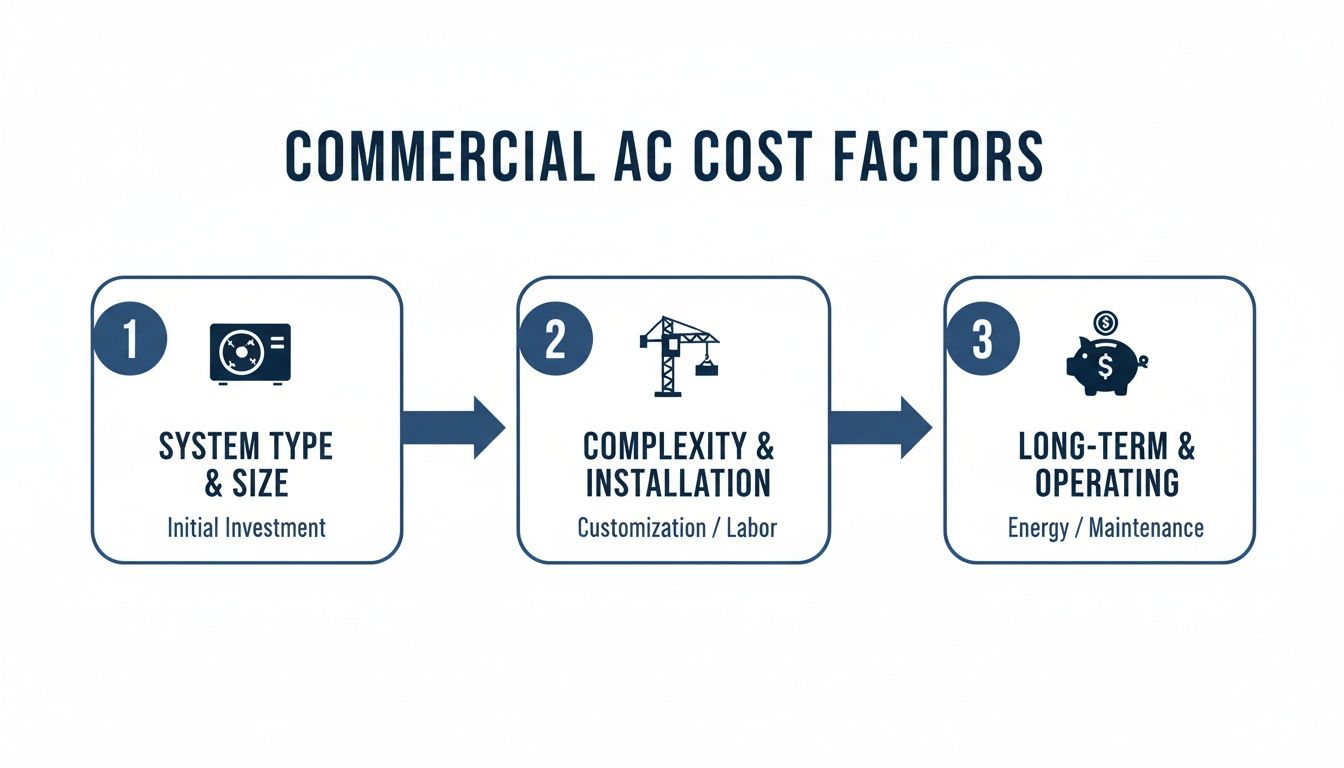
As you can see, a successful project is about more than just the upfront price. It’s about balancing that initial outlay with the ongoing efficiency that saves your business money for years to come.
Realistic Installation Timelines
So, how long does all this take? The timeline can vary dramatically depending on the scale of the job. A simple back-to-back split system for a small cafe might be done in a single day.
On the other hand, a large-scale VRF project for a multi-storey office block could be carefully staged over several weeks. In these cases, we often work outside your business hours to ensure minimal disruption to your operations. This kind of careful planning is what separates a professional installation from a chaotic one.
Protecting Your Investment with Warranties and Maintenance
Your new commercial air conditioning system is a serious asset, a major investment in your business's comfort and productivity. Making sure that investment pays off for the long haul comes down to two things: a solid warranty and a proactive maintenance plan. You really can't have one without the other.
When you get a system installed by a professional outfit, you’re protected by two different safety nets. First, there’s the manufacturer's warranty, which covers the physical hardware against any defects. Second, you have our installer's warranty, which covers the quality of our actual workmanship. It’s a dual-layer approach that gives you peace of mind, knowing both the machine and the labour are guaranteed.
The Role of Warranties
The manufacturer’s warranty is their promise that the equipment is free from faults. This typically lasts for five years on parts. If a compressor fails or a circuit board gives up the ghost due to a manufacturing issue within that time, the replacement part is covered.
Our installer's warranty then picks up where the manufacturer leaves off, covering everything to do with the physical installation: the refrigerant lines, the electrical connections, the ductwork, and the mounting. It’s our guarantee that the job was done right, to the highest professional standard, so your system runs reliably from day one.
Think of it like a partnership. The manufacturer guarantees the machine itself, and we guarantee the quality of the setup that makes it run. But this partnership has one crucial condition: regular, professional maintenance.
Why Scheduled Maintenance is Non-Negotiable
Just about every air conditioning warranty out there, whether from the manufacturer or the installer, comes with a condition. They require the system to be professionally serviced at least once a year. If you skip these essential check-ups, you risk voiding your warranty entirely, leaving you on the hook for the full cost of repairs if something goes wrong.
But a scheduled maintenance plan is much more than a box-ticking exercise for warranty compliance. It’s the single best thing you can do to keep your system running efficiently, head off expensive breakdowns, and squeeze every last year out of its operational life.
During a service, our technicians get into the nitty-gritty: cleaning coils, checking refrigerant levels, testing electrical components, and clearing drains. This is where we catch the small issues before they snowball into major disasters. You can get a full rundown of what’s involved in our guide to commercial air conditioning servicing.
This proactive approach doesn't just protect your warranty; it keeps your system running at peak efficiency, which means lower power bills. More importantly, it prevents an unexpected failure on a scorching summer day in Western Sydney or during your busiest trading period, ensuring your business stays cool, productive, and open when it matters most.
Your Commercial Installation Questions, Answered
Stepping into a commercial AC installation can feel like navigating a maze of new terms and regulations. To give you a clearer path forward, we've answered some of the most common questions we hear from business owners across NSW.
How Long Does a Typical Commercial Installation Take?
This is usually the first question on everyone's mind, and the honest-to-goodness answer is: it really depends on the scale of your project. There's no single timeline because every business has different needs.
A simple job, like installing a single split system in a small Gosford office, can often be wrapped up in a single day. If we're looking at a multi-head system with a few indoor units, that might stretch to two or three days.
For a full ducted system in a medium-sized retail store in Lake Macquarie, you’re typically looking at three to five days. That gives us the time we need to run all the ductwork properly, set up your zones, and make sure everything is commissioned and running perfectly.
Big projects, like fitting out a multi-storey Sydney office building with a complex VRF system, are a different ball game entirely. These can be staged over several weeks, carefully planned to work around your business hours and keep disruption to an absolute minimum. The only way to give you a firm timeline is with a detailed site survey.
What Is the Difference Between a Residential and a Commercial Unit?
While they both produce cool air, residential and commercial air conditioners are completely different beasts, engineered for vastly different environments. Think of it like comparing a family sedan to a delivery truck; both have engines, but they're built for entirely different jobs.
Commercial units are built tougher, with more power and complexity. They're designed to run for 10-12 hours a day under heavy loads, keeping places like a busy Newcastle restaurant or a Central Coast medical centre consistently comfortable.
They also have much more sophisticated drainage systems to manage the sheer volume of condensation they produce. Plus, systems like ducted and VRF offer advanced zoning that lets you control the temperature in different areas of a large building independently, something far beyond what a typical home system can do. The installation itself is also a more involved process, requiring strict adherence to SafeWork NSW standards and often a three-phase power supply.
Do I Need Council Approval for a Commercial AC Installation in NSW?
This is a critical question, because getting compliance right from the start saves a world of headaches later on. For many straightforward jobs, you might not need to lodge a formal council application. However, there are a few important exceptions you need to know about.
Always check with a professional first. Navigating local council and body corporate rules can be tricky, and getting it wrong can lead to costly fines or even orders to remove the system.
You will almost certainly need some form of approval if:
- The outdoor unit is clearly visible from the street, particularly in heritage-listed areas of Sydney or Newcastle.
- The system's operational noise might breach your local council’s restrictions.
- The project involves major structural work or the installation of large rooftop units, which usually requires a development application (DA).
- Your business is in a strata-managed building. In this case, you must get approval from the body corporate before any work can begin.
Part of our service includes assessing your specific situation during the site survey and advising you on what compliance steps are needed. We'll help you navigate the red tape to ensure your installation is fully approved and above board.
Ready to discuss what your business needs to stay cool and comfortable? The team at ALC Air has the local knowledge and technical expertise to deliver a seamless and compliant commercial AC installation. Contact us today for a free, no-obligation assessment and quote.