


Choosing the best reverse cycle air conditioner really comes down to finding the right fit for your home and your lifestyle. For most Aussie homes, particularly across the Central Coast and Sydney, a high-quality inverter split system offers the perfect blend of powerful cooling, efficient heating, and genuine year-round value. This guide is designed to cut through the jargon and help you understand what actually matters.

Deciding on a new air conditioner can feel overwhelming, but it’s a significant long-term investment in your family’s comfort. Whether you’re battling the humid summers of Lake Macquarie or waking up to chilly winter mornings in the Hunter Valley, a reverse cycle system gives you a single, energy-efficient solution for year-round climate control.
Finding Your Ideal Climate Control System

This guide will walk you through our top picks for different situations. We’ll cover everything from units ideal for a large, sun-drenched living room in Terrigal to a compact apartment bedroom in Newcastle. A well-chosen system means powerful cooling for scorching summers and cost-effective heating for winter, all without those shocking energy bills.
Why Reverse Cycle is The Australian Standard
Reverse cycle air conditioners have become the go-to choice for Australian households for a reason. Their popularity comes down to one thing: versatility. For the varied climate we experience from Sydney’s western suburbs to the Central Coast, this dual functionality is incredibly practical. Instead of running separate cooling and heating appliances, you have one system that does it all, and does it efficiently.
Split System or Ducted: What’s The Difference?
When you hear someone talk about a “reverse cycle air conditioner,” they’re usually referring to a split system. This is the most common type you’ll see for single rooms or specific zones, with an indoor unit mounted on the wall and a connected outdoor unit. It’s perfect for targeted comfort in a living area or bedroom.
For whole-home climate control, a ducted system is another reverse cycle option. It uses a central unit, typically hidden in the roof space, to distribute conditioned air via discreet ceiling vents. If you’re weighing up your options, understanding the key differences between split system and ducted air conditioning is a great first step.
Our Top Picks: Australia’s Best Reverse Cycle Air Conditioners for 2025
Picking the “best” reverse cycle air conditioner isn’t about grabbing the most famous brand. It’s about matching a specific model’s strengths to what your home actually needs. We’ve spent over 15 years installing and servicing these machines, so we know what works. Here’s our honest breakdown of the leading models available in Australia right now.

Best for Energy Efficiency: Daikin Cora Series
Best for: Homeowners prioritising low running costs and premium performance.
Price Range: $1,200 – $3,500 (unit only)
Daikin’s reputation for quality is well-earned, and the Cora series is a perfect example of their focus on efficiency. This is often our go-to recommendation for homeowners on the Central Coast who are keeping a close eye on their power bills. Its advanced inverter technology intelligently adjusts power, resulting in significant energy savings and stable indoor temperatures.
Pros:
- Exceptional Energy Efficiency: Consistently achieves high star ratings, which you’ll notice on your electricity bills.
- Quiet Operation: Both indoor and outdoor units are engineered for minimal noise, making it fantastic for bedrooms.
- Advanced Air Filtration: Includes Daikin’s specialised filters to break down odours and neutralise common airborne allergens.
Cons:
- Higher Initial Cost: You’re paying for premium engineering, so the upfront price is higher than some other brands.
Best Value for Money: Mitsubishi Heavy Industries Avanti Series
Best for: Families and investors looking for reliable performance without the premium price tag.
Price Range: $900 – $2,200 (unit only)
For anyone looking for that sweet spot between performance and a sensible price, the Mitsubishi Heavy Industries (MHI) Avanti series is a fantastic choice. It packs in features you’d find in more expensive models without the high cost. We find this series is a popular pick for investment properties and families in Newcastle who want dependable climate control that just works.
Pros:
- Excellent Performance-to-Cost Ratio: You get robust, reliable cooling and heating for a very competitive price.
- Clean Air Technology: Uses a combination of filters to capture and neutralise airborne nasties like pollen and dust.
- Good Operating Range: It performs well even during those extreme heatwaves we often see in the Hunter Valley.
Cons:
- Slightly Louder: While not noisy, its operating sound levels can be a touch higher than premium models.
Best for Large Open-Plan Living: Fujitsu Lifestyle Range (High Capacity Models)
Best for: Cooling or heating large, open-plan living and dining areas.
Price Range: $2,000 – $4,500+ (for 7.1kW+ models, unit only)
Those big, open-plan living areas common in many Central Coast homes present a real challenge. You need serious power, and that’s where the high-capacity models (7kW and above) in the Fujitsu Lifestyle range come in. These units are built with powerful fans and advanced louvre designs that can push conditioned air further and more evenly across a large space.
Pros:
- Powerful Airflow: Specifically engineered to handle large, open spaces without breaking a sweat.
- Human Sensor Control: This clever feature detects when people leave the room and automatically switches to a low-power mode, saving energy.
- User-Friendly Controls: Comes with a simple, intuitive remote control that makes it easy for anyone in the family to use.
Cons:
- Higher Power Consumption: A simple fact of physics—their large capacity means these units naturally use more electricity.
Quietest Operation: Mitsubishi Electric MSZ-AP Series
Best for: Bedrooms, nurseries, and home offices where quiet is essential.
Price Range: $1,100 – $3,800 (unit only)
If whisper-quiet operation is your number one priority, the Mitsubishi Electric MSZ-AP series is arguably the best reverse cycle split system you can buy. On its quietest setting, the indoor unit runs at a barely audible 19 decibels, which is literally softer than a whisper. It’s a premium choice for those who value absolute peace and quiet.
Pros:
- Virtually Silent Operation: Class-leading low noise levels make it the undisputed champion for quiet spaces.
- Standard Wi-Fi: Built-in smart control is included, offering the convenience of pre-cooling your home before you arrive.
- Compact and Stylish Design: The indoor unit has a sleek, unobtrusive profile that blends with modern interiors.
Cons:
- Complex Remote: The remote is packed with features, which some people might find a bit less intuitive at first.
For a deeper look at what separates the top brands, check out our guide on the best air conditioner brands in Australia.
Comparison Table: Top Reverse Cycle Split Systems
To help you compare these top contenders side-by-side, we’ve put together a table summarising the key specifications. This should give you the confidence to make an informed choice for your home.
| Model | Best For… | kW Range | Noise Level (Indoor) | Key Feature | Price Guide (Unit Only) |
|---|---|---|---|---|---|
| Daikin Cora Series | Energy Efficiency | 2.0kW – 9.4kW | From 19 dBA | Premium inverter for superior energy savings | $1,200 – $3,500 |
| Mitsubishi Heavy Industries Avanti Series | Best Value | 2.0kW – 5.0kW | From 19 dBA | Great balance of price and performance | $900 – $2,200 |
| Fujitsu Lifestyle Range | Large, Open Rooms | 2.5kW – 9.5kW | From 22 dBA | Powerful airflow and Human Sensor | $2,000 – $4,500+ |
| Mitsubishi Electric MSZ-AP Series | Quietest Operation | 2.0kW – 9.0kW | From 19 dBA | Whisper-quiet operation and standard Wi-Fi | $1,100 – $3,800 |
Ultimately, the best model is the one that fits your space, your budget, and your lifestyle. Each of these units excels in a particular area, so the right choice comes down to identifying what’s most important for your comfort.
What Makes a Good Reverse Cycle System?
When you’re comparing different models, it’s easy to get lost in brand names and marketing claims. The best systems share a few core features that deliver better comfort, efficiency, and long-term value. Understanding these is the key to making a smart investment.
The Power of Inverter Technology
The single most important feature in any modern reverse cycle system is inverter technology. Think of an older, non-inverter unit like a light switch; it’s either on full blast or completely off. This constant on-off cycle is inefficient and creates noticeable temperature swings.
An inverter system, on the other hand, is like a dimmer switch. It constantly adjusts its compressor speed to precisely match the heating or cooling your room needs. Once it reaches your set temperature, it slows right down, using just enough energy to maintain it. This is why inverter models are significantly more energy-efficient and quieter.
Understanding the Energy Rating Label
Every air conditioner sold in Australia has a Zoned Energy Rating Label (ZERL), which shows you how the unit performs across three distinct climate zones: hot, average, and cold. For us here in NSW, this is incredibly helpful.
A home in Newcastle (average zone) has different needs from one in the hotter inland parts of the Hunter Valley (hot zone). The ZERL helps you choose a unit that performs efficiently in your specific climate. Look for the highest star rating you can afford in your relevant climate zone, as that’s your ticket to the best long-term savings.
Why Air Filtration Matters
A good reverse cycle system does more than just control the temperature; it also cleans the air you breathe. This is especially important for families with allergies or asthma. While basic filters just capture dust, high-quality units come with advanced, multi-stage filtration systems to neutralise airborne bacteria, odours, and fine particles like pollen. If you want to dive deeper into how these systems work, we have a helpful guide explaining the fundamentals of reverse cycle heating and cooling.
Smart Features That Add Real Value
Modern air conditioners are increasingly becoming “smart” appliances. Wi-Fi control is now a common feature, letting you turn your system on or off remotely from your phone. This means you can pre-cool your home on a scorching summer afternoon before you even leave work. Another useful feature is a motion sensor, which detects if a room is empty and automatically switches to a more energy-efficient mode.
Why Sizing and Installation Are Critical for Performance
Picking out a top-rated reverse cycle air conditioner is a great first step, but it’s really only half the job done. To actually get the performance and efficiency you’re paying for, the system must be perfectly sized for your space and installed by a true professional. This is where the real value of your investment is either realised or lost.
Get the sizing wrong, and you’re signing up for headaches. A unit that’s too small will run flat-out on a hot day and never quite get the room comfortable. This puts immense strain on the components, leading to early breakdowns and shockingly high power bills.
The Dangers of an Oversized System
It might seem like going bigger is safer, but an oversized air conditioner is just as bad. It blasts the room with cold air so quickly that it shuts off before it’s had a chance to do one of its most important jobs: dehumidify the air. This rapid on-off process is known as short cycling.
This is a huge comfort issue, especially in the humid coastal climates of the Central Coast and Newcastle. Your room might technically be cool, but it will feel damp and clammy. Worse still, that constant starting and stopping puts massive stress on the compressor, which can cause it to fail years before it should.
How We Determine the Right Size for Your Home
Figuring out the right kW capacity for your home is much more than a quick glance at the floor plan. A professional assessment digs into all the factors that influence how much heating and cooling power you actually need, such as room volume, insulation quality, window size and orientation, and local climate.
This decision tree helps visualise the key things we weigh up when recommending the best reverse cycle air conditioner for your space.
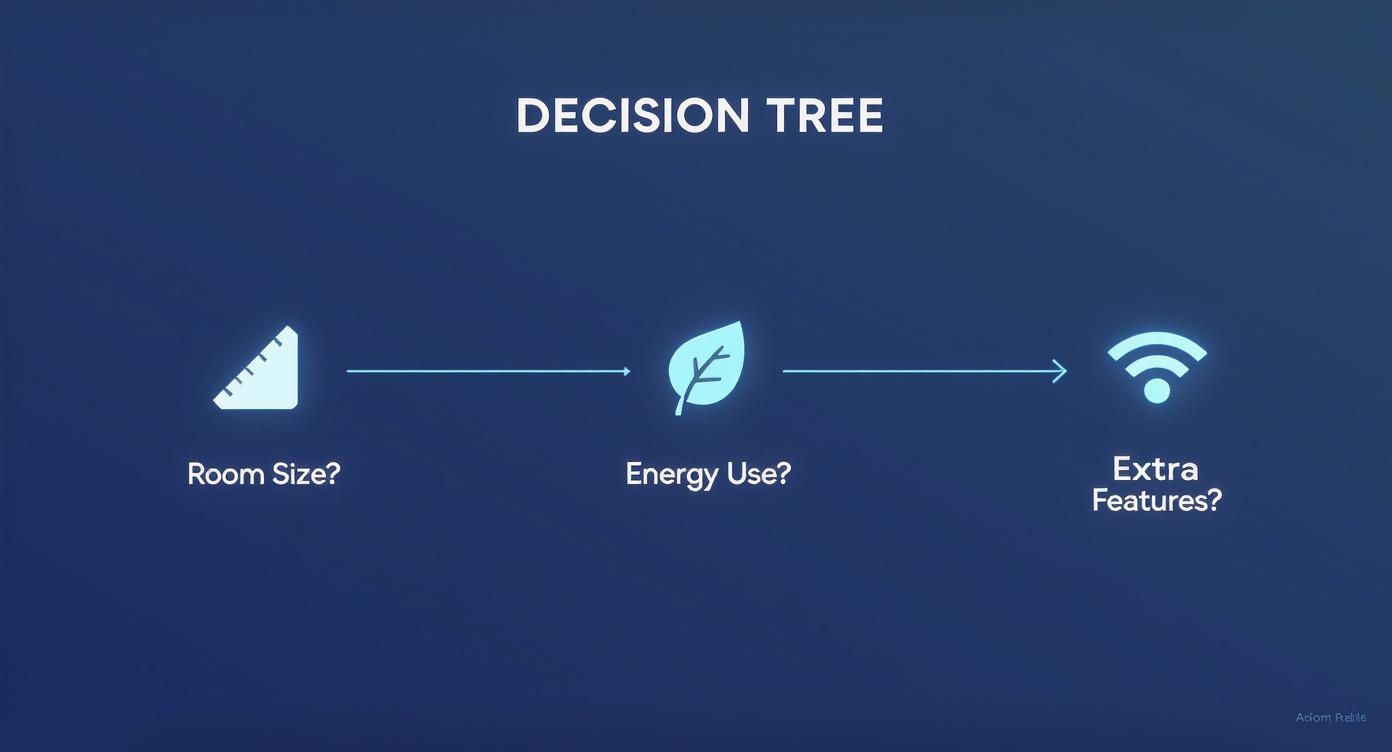
As you can see, a proper assessment is about balancing the unique characteristics of your home, your energy goals, and the features that matter most to you. For a deeper dive into this, check out our guide on how to choose the right size air conditioner for your home.
Why Professional Installation Is Non-Negotiable
In Australia, installing a split system air conditioner is not a DIY job. It’s illegal and for very good reason. The work involves licensed electrical connections and the handling of pressurised refrigerant gases, both of which are strictly regulated for safety and environmental protection under Australian Standards like AS/NZS 3000.
When you hire a professional, you’re engaging a technician who holds both a full electrical licence and an ARCtick certification. This is your guarantee that the work is compliant and safe. A professional installation is the only way to validate your manufacturer’s warranty and ensure the system operates efficiently for years to come.
Understanding the True Cost of Air Conditioning
When you’re budgeting for a new reverse cycle air conditioner, it’s easy to focus on the unit price. But the real cost of ownership is a combination of the unit, professional installation, and ongoing running costs. The price of the unit is just the starting line; installation costs can vary depending on the complexity of the job.
Factors Influencing Installation Costs
A licensed technician will need to see your property to give you an accurate quote. The specific needs of your home will shape the final price.
- Property Type: A multi-storey home or an apartment in Newcastle with body corporate rules often requires more labour.
- Electrical Work: Older homes might need a new, dedicated circuit or a switchboard upgrade to comply with AS/NZS 3000 electrical standards. This is a critical safety requirement.
- Location of Units: The distance between the indoor and outdoor units impacts the amount of materials and labour required.
Decoding Ongoing Running Costs
This is where spending a bit more on an efficient model upfront really pays off. A system with a higher star rating uses less electricity to deliver the same amount of cool or warm air, leading to serious savings over its lifetime. We’ve put together a guide that breaks down exactly how much running your air conditioner costs, so you can make smarter choices.
A highly efficient reverse cycle system might cost more to buy, but its lower running costs can save you hundreds, or even thousands, of dollars over the life of the system. This makes it a smarter financial decision for any homeowner.
Partner with Your Local Climate Control Experts
Picking out the best reverse cycle air conditioner is a great first step, but you need to pair it with a top-notch installation team. This is where a local specialist who understands our climate, from the coastal humidity in Newcastle to the temperature swings of the Hunter Valley, makes all the difference.
For over 15 years, ALC Air has been the go-to for air conditioning solutions across the Central Coast, Sydney, and Lake Macquarie. Our approach is about finding the right fit, not just making a sale. We take the time to look at your home, listen to what you need, and recommend a system that’s perfectly sized for your lifestyle and budget.
Our fully licensed and ARCtick certified technicians are obsessed with quality workmanship that follows Australian Standards like AS/NZS 3000 for electrical safety. From our first chat to ongoing maintenance, we provide a seamless experience to make sure your investment keeps you comfortable for years to come.
When you’re ready to find the perfect climate solution for your home, our team is here to help. Get in touch with us for a free, no-obligation quote and system assessment.
Got Questions? We’ve Got Answers.
When you’re about to invest in a new air conditioner, a few questions are bound to pop up. To help you feel completely confident, we’ve put together some straightforward answers to the queries we hear most often from homeowners here on the Central Coast and in Sydney.
How often should I get my reverse cycle air conditioner serviced?
We strongly recommend booking in a professional service once a year. The best time is usually just before summer or winter kicks in. This annual check-up ensures peak performance, extends the unit’s lifespan, and keeps the air in your home healthy. In between professional visits, you can help by cleaning the filters on the indoor unit yourself every one to three months.
Isn’t reverse cycle expensive for heating in winter?
This is a common myth. Modern reverse cycle systems are one of the most energy-efficient ways to heat your home. Instead of creating heat from scratch like old-school electric heaters, a reverse cycle unit absorbs warmth from the outside air and transfers it inside. This process is remarkably efficient and can lead to a pleasant surprise on your winter power bills.
What does the ‘kW’ rating on an air conditioner actually mean?
The kilowatt (kW) rating is about its output capacity, not how much electricity it consumes. A higher kW number means a more powerful unit designed for a larger space. For example, a 2.5kW system is generally perfect for a standard bedroom, while a punchier 7kW system is what you’d be looking at for a big, open-plan living area in a home in Terrigal.
Can I just install a split system air conditioner myself?
In a word: no. In Australia, it is both illegal and extremely dangerous for anyone without the proper licences to install a split system. The job involves prescribed electrical work that must comply with AS/NZS 3000 and the handling of pressurised refrigerant gases. This work legally requires a fully licensed electrician and a technician holding an ARCtick licence. A DIY job will instantly void your warranty and create a serious safety risk.
Ready to find the perfect reverse cycle air conditioner system for your home and have it installed by experts who know our local climate? The team at ALC Air is here to give you honest advice and a free, no-obligation quote to keep your home comfortable all year round.