


When you’re trying to cool a small room, like a bedroom, home office, or study, getting the air conditioner choice right is more important than you might think. Go too big, and the unit will constantly switch on and off, leaving the room feeling clammy and wasting power. Go too small, and it will struggle on hot days, running endlessly without ever making you comfortable.
This guide will walk you through what you actually need to know to find the perfect fit for your small space. We'll help you stay comfortable all year round without the shock of a massive power bill.
For most small rooms in NSW, from a home office in Newcastle to a bedroom in a Sydney apartment, a high-wall, reverse cycle split system is almost always the answer. They’re quiet, incredibly energy-efficient, and give you both cooling for summer and heating for winter.
Why Split Systems Are the Go-To Choice
It's no accident that homeowners across NSW are overwhelmingly choosing split systems for their smaller rooms. Just look at the numbers. Australia’s air conditioner market hit USD 3.1 billion in 2024 and is expected to climb to USD 5.3 billion by 2033, with split systems dominating residential installations, especially for spaces under 30 square metres.
This isn't just a trend; it's a practical decision. Their combination of efficiency, quiet operation, and year-round functionality is simply unmatched for compact areas. You can find more detail on the Australian air conditioner market in OMR Global's research.
Of course, a great air conditioner is only part of the puzzle. To really get the most out of your system, it pays to think about passive cooling too. For instance, many people wonder, do blackout curtains help with heat? The answer is a resounding yes. Blocking direct sunlight can make a huge difference to your room's temperature before you even turn the AC on.
Comparing Your Options for Small Rooms
While split systems are the clear front-runner, it’s worth understanding why other options usually fall short. Let's quickly compare the most common choices you'll find.
Quick Guide to Small Room Air Conditioner Types
| System Type | Best For | Typical Noise Level | Efficiency |
|---|---|---|---|
| Split System | Long-term, single-room comfort (bedrooms, offices). | Very quiet. | Excellent. |
| Portable Unit | Temporary or rental situations where installation isn't possible. | Noisy and intrusive. | Poor. |
| Window/Wall Box | Budget-conscious installations where noise isn't the primary concern. | Loud. | Fair to poor. |
As you can see, the alternatives come with some pretty big trade-offs.
Portable Air Conditioners: Sure, you can move them between rooms, but they are notoriously loud, inefficient, and need a bulky ducting kit hanging out your window, which is often a pain to set up and seal properly.
Window/Wall Box Units: This is older technology. While they can certainly cool a room, they are much louder and far less energy-efficient than a modern split system, meaning you'll pay for that lower upfront cost on your power bills.
For the vast majority of homeowners, the quiet performance, superior efficiency, and long-term value of a reverse cycle split system make it the obvious winner. It’s the smart choice for keeping a small room comfortable, efficiently and effectively.
Why AC Size Matters More Than You Think
When it comes to choosing an air conditioner, getting the 'size' or kilowatt (kW) capacity right is the single most important decision you'll make. It’s a bit like buying shoes for a long hike; too small and they'll pinch and cause pain, but too big and you'll be sliding around, uncomfortable and full of regret. An air conditioner works exactly the same way for your small room.
A system that’s too small for the space is going to chug away constantly on hot days, desperately trying but failing to reach the temperature you’ve set. This nonstop effort not only leaves you sweating but also sends your power bills through the roof. It's a classic mistake that leads to a whole lot of frustration, especially during those scorching summer afternoons in Sydney’s western suburbs.
The Problem with Going Too Big
On the flip side, getting a unit that’s too powerful for the room is just as bad. An oversized system will blast the room with cold air, hit the target temperature in a flash, and then shut down. This constant on-off process is known as 'short cycling', and while it might sound efficient, it creates two major headaches.
First, it puts a huge amount of wear and tear on the unit's components, which can shorten its lifespan. More importantly for your comfort, short cycling doesn't give the system enough time to do its other crucial job: dehumidifying the air. This leaves you in a room that feels cool but unpleasantly damp and clammy, a common complaint in the humid coastal climate of the Central Coast.
This simple infographic breaks down the key steps to finding your perfect system.
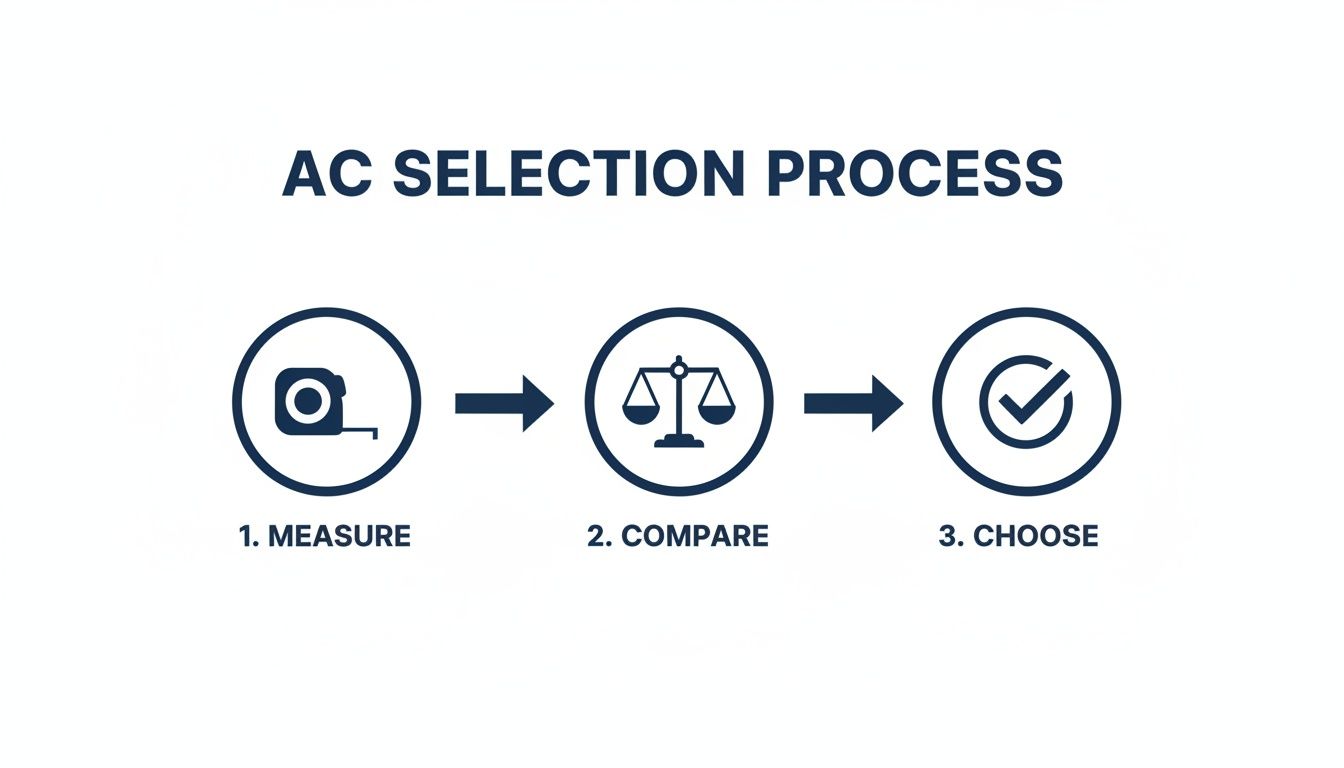
It all begins with truly understanding your room's specific needs, then comparing the right metrics to make a smart, informed choice.
How Professionals Calculate the Right Size
To make sure you avoid both of these traps, we perform a detailed heat load calculation. This isn't just a quick look at the floor area. It's a proper professional assessment that takes into account every single factor that lets heat into (or out of) your room.
A proper calculation considers:
- Room Dimensions: We look at the length, width, and ceiling height to figure out the total volume of air that needs cooling.
- Window Size and Orientation: A massive, west-facing window in Terrigal is going to bake in the afternoon, letting in far more heat than a small, south-facing one.
- Insulation Quality: How good your wall and ceiling insulation is plays a massive role in how much heat the room holds onto.
- Local Climate: A bedroom in the Hunter Valley, with its wild temperature extremes, has very different needs than a similar room in Newcastle that gets cooling sea breezes.
For example, a well-insulated 15 square metre bedroom might only need a 2.0kW unit. But a 20 square metre home office in Gosford with big windows and a hot north-facing aspect could easily need a 2.5kW or even a 3.5kW system to keep you comfortable.
Why this matters: A professional heat load calculation is the only way to guarantee your system is perfectly matched to your space. It ensures you’re comfortable, protects your investment, and keeps your running costs as low as they can be.
When figuring out the right size AC, some technical specs are key. Metrics like CFM (Cubic Feet per Minute) directly relate to how well an air conditioner can circulate air and cool a specific room volume. While an online calculator might give you a rough idea, it simply can’t account for all these critical, real-world variables.
For a precise assessment and to learn more about this crucial first step, you can check out our detailed guide on how to size an air conditioner for your room. Getting this right is the foundation for finding the best air conditioner for your small room and enjoying years of efficient comfort.
Comparing Split Systems to Other AC Types
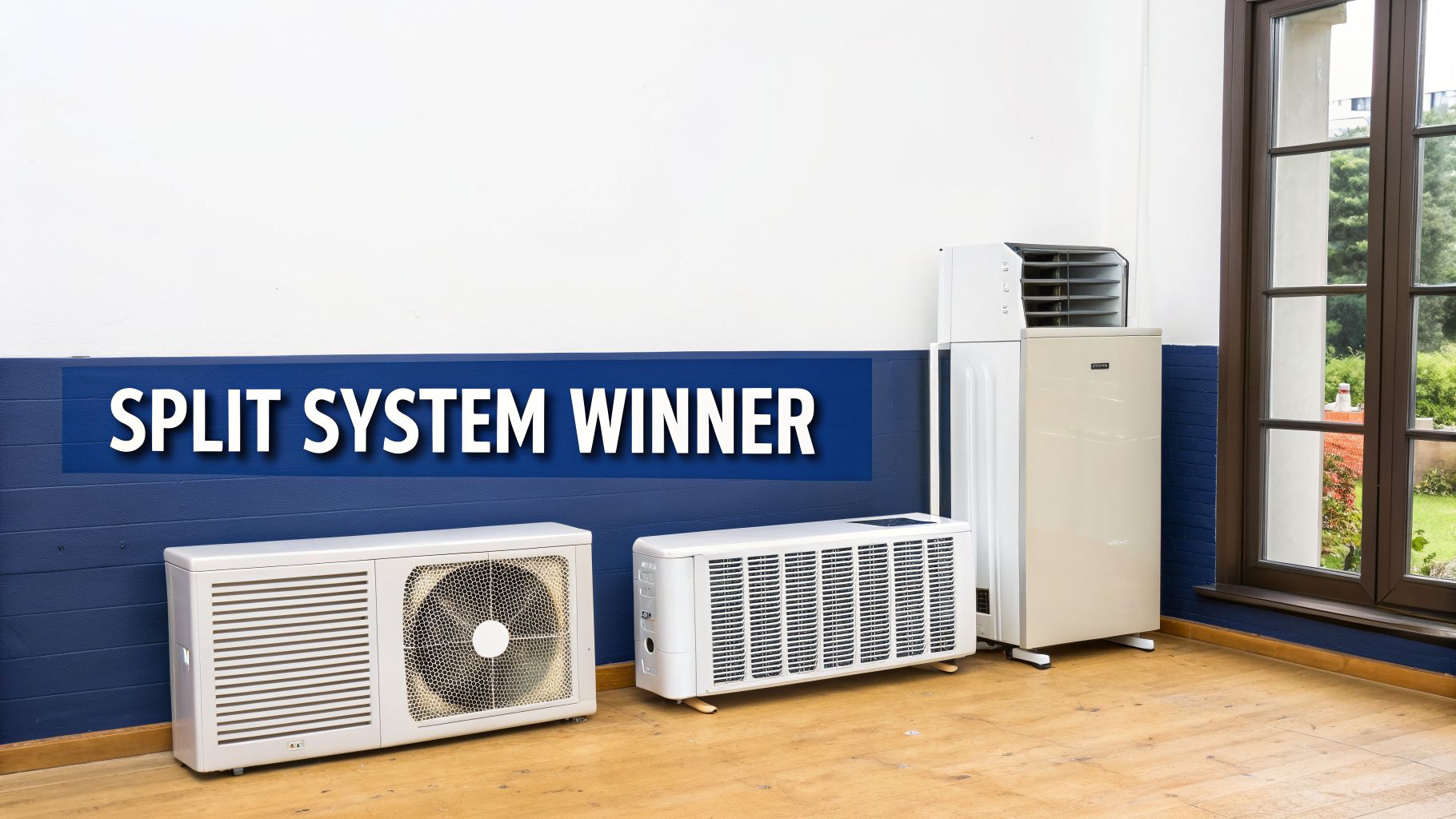
When you start looking for an air conditioner for a small room, you’ll find a few different options on the market. Let's be honest, though, for most Australian homes, one type almost always comes out on top for its quiet performance and sheer cooling power.
Let's break down the main contenders to see why.
The undisputed champion for single-room cooling is the high-wall reverse cycle split system. This is the familiar setup you’ve seen everywhere: a sleek indoor unit mounted high on the wall, connected to a separate outdoor unit that houses the noisy compressor. That "split" design is the secret sauce, keeping the loudest parts of the machine outside your living space.
This makes them incredibly quiet and efficient, exactly what you need for a bedroom or home office. For homeowners in Lake Macquarie or anywhere along the Central Coast, the whisper-quiet operation and powerful performance make a reverse cycle split system the best long-term investment for year-round comfort.
Why Split Systems Are the Clear Winner
Split systems are the most popular choice in Australia for good reason. They dominate the market, especially in humid regions like the Central Coast and Sydney. With the boom in apartment and granny flat living, market analysis shows split ACs are Australia's top seller, perfectly suited for zoned cooling in rooms between 10 to 40 square metres.
Here’s exactly why they are the best air conditioner for a small room:
- Whisper-Quiet Operation: With the compressor humming away outside, the indoor unit is exceptionally quiet, often running at a noise level lower than a soft conversation. This is absolutely critical for bedrooms where a noisy unit will ruin your sleep.
- Superior Energy Efficiency: Modern split systems, especially those with inverter technology, are engineered for high efficiency. That translates directly to lower running costs on your power bills.
- Effective Heating and Cooling: As ‘reverse cycle’ units, they provide powerful cooling in summer and surprisingly efficient heating in winter, giving you a single, elegant solution for every season.
The Alternatives and Their Downsides
While split systems are the gold standard, you’ll definitely come across portable units and old-school window units. It’s important to understand their limitations before you even consider them for your home.
Portable Air Conditioners
These freestanding units promise flexibility since you can wheel them from room to room. But this convenience comes at a serious cost to both your comfort and your wallet. They are notoriously noisy and far less effective at actually cooling a room.
Portable units also need a clumsy exhaust hose to be vented out a window, which is often difficult to seal properly. Hot air inevitably leaks back into the room, forcing the unit to work even harder and chew through more energy. Honestly, they’re best seen as a temporary, last-resort solution for renters, not a permanent fixture for homeowners.
Window or Wall 'Box' Units
These are the single-box units that sit in a window frame or a hole in the wall. This is much older technology, and while they do work, they are significantly louder and less energy-efficient than a modern split system. The entire unit, including the noisy compressor, is in one box, creating a constant drone right inside your room.
While the upfront cost might look tempting, their poor energy efficiency means you’ll pay for it in the long run through higher power bills.
If you want to understand how different systems fit into a whole-home cooling strategy, check out our guide on finding the best air conditioner for your home.
An air conditioner isn't just a box that blows cold air anymore. Once you've figured out the right capacity for your room, the next step is to look at the technology inside. This is where you separate a good purchase from a great one, and it's these features that genuinely impact your comfort and your power bills.
The single most important feature to look for is inverter technology. Honestly, if a unit doesn't have it, just walk away. It’s the difference between a car that smoothly maintains its speed on the highway and an old banger that lurches and jerks.
Old air cons used to blast on at full power until the room was cold, then shut off completely, only to slam back on again when it got warm. Inverter systems are much smarter. They adjust their power up and down to hold a steady temperature, using far less energy. On a scorching 45°C summer day, that efficiency difference can cut your cooling costs by up to 40%.
Decoding Energy Ratings and Noise Levels
When you’re comparing units in a store, the Zoned Energy Rating Label (ZERL) is your best friend. It’s a huge improvement on the old star ratings because it shows you how efficient a unit is for your specific climate zone in Australia. Whether you're in coastal Sydney or the hotter Hunter Valley, the ZERL gives you real-world performance data for both cooling and heating.
For a small room, especially a bedroom or office, noise is a deal-breaker. You’ll see this measured in decibels (dB) on the spec sheet. For context, a quiet whisper is around 30dB. A top-quality air conditioner for a small room will have an indoor unit that hums along in the low 20s on its quietest setting, so it won’t disturb your sleep or your concentration.
Smart Controls and Durability Features
Modern systems are also full of clever tricks to improve convenience and save even more money. ‘Human presence’ sensors are a brilliant example. The unit knows when you’ve left the room and can automatically switch to a low-energy mode, then power back up when you walk back in.
Wi-Fi control has gone from a luxury to a must-have feature. It lets you run your air con from a smartphone app wherever you are. Pre-cool your bedroom on the train home from the city or double-check you turned it off after leaving the house. It puts total control right in your pocket.
The Australian air conditioning market is booming and has been driven by people wanting highly efficient systems, especially in cities like Sydney and Newcastle where inverter technology is now the standard.
If you live anywhere near the coast, like in Newcastle or on the Central Coast, there's one more thing to insist on: corrosion resistance. Salty sea air is brutal on the outdoor unit’s metal parts. Look for models that specifically mention anti-corrosion coatings on the outdoor coil and casing. It’s a small detail that can add years to your system's life, protecting your investment from the elements.
Why Professional Installation Isn't Optional
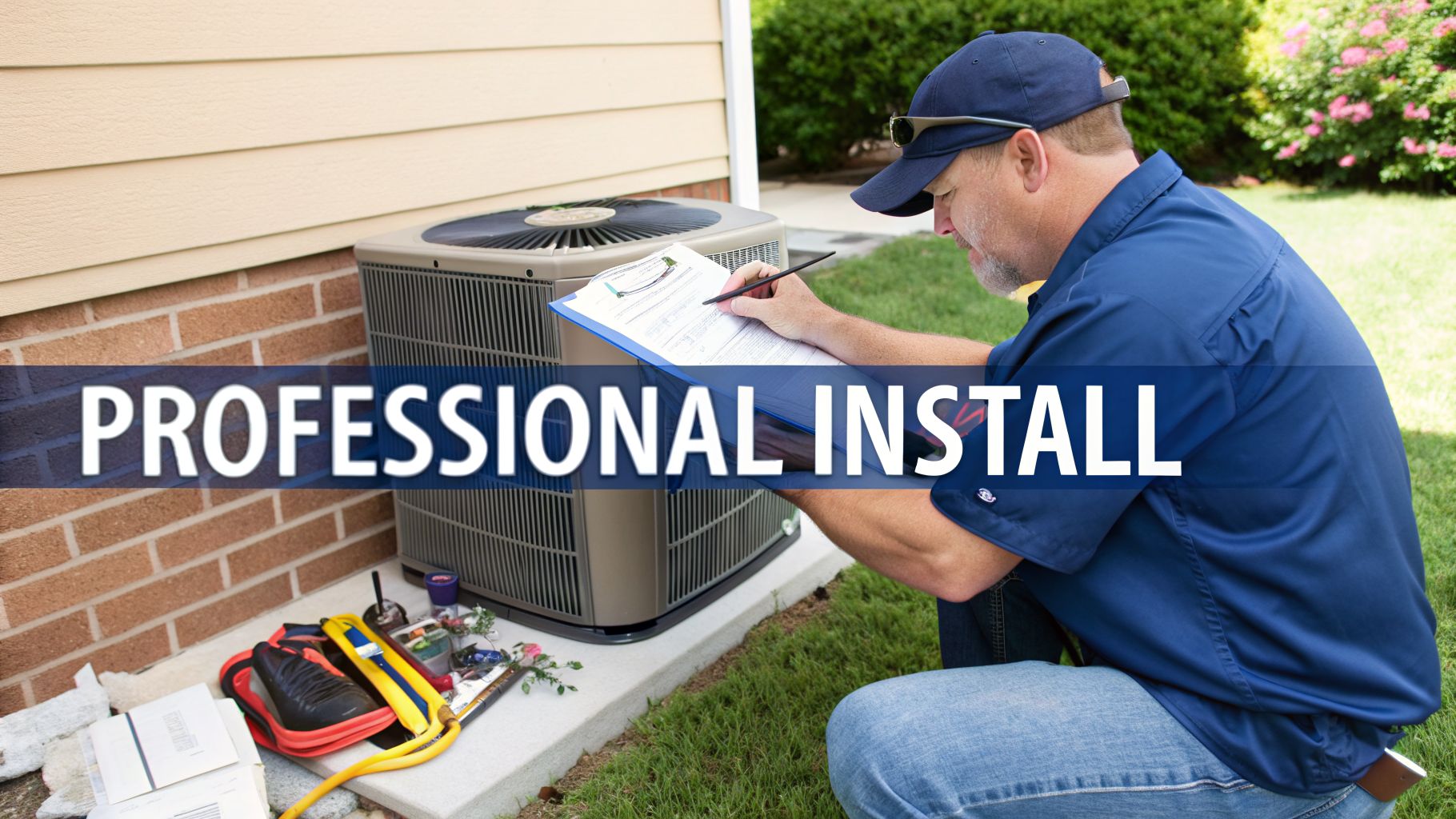
You can spend weeks choosing the perfect air conditioner for your small room, but all that research and money can be completely wasted if the installation is a botched job. A poor install can cripple your system's performance, slash its lifespan, and even introduce serious safety hazards into your home.
This isn’t just a friendly recommendation. In Australia, professional installation is a legal requirement. Split systems contain high-pressure refrigerant gas and must be wired into a dedicated electrical circuit. This means the work absolutely must be done by a technician holding two specific, non-negotiable licences.
The Two Licences Your Installer Must Have
When you're ready to hire someone, you need to verify they hold both of these qualifications. It's not rude to ask to see their licence cards. It's your right, and it's a critical step in protecting your investment and your family's safety.
A Full Electrical Licence: Any work that involves wiring an appliance back to your switchboard must be performed by a licenced electrician. This is the only way to ensure the circuit is safe, complies with AS/NZS 3000 electrical standards, and doesn’t create a fire risk. We ensure all our work is compliant with SafeWork NSW guidelines.
An ARCtick Refrigerant Handling Licence: It is illegal for anyone without an ARCtick licence to handle the refrigerant gases in an air conditioner. This is a federal law designed to protect our environment from ozone-depleting gases and to ensure your system is charged correctly for peak performance.
Hiring an installer without these licences isn't just illegal; it also instantly voids your manufacturer's warranty. If anything goes wrong, you’ll be left to foot the entire bill for repairs or a full replacement.
What a Quality Installation Actually Involves
A quality installation is so much more than just hanging a couple of boxes on your walls. A true professional takes the time to get every detail right, ensuring the system runs reliably for years to come.
This includes positioning the indoor unit for the best possible airflow, making sure the outdoor unit is secured on a stable, level base to minimise noise and vibration, and properly flaring the copper pipes to create a perfect seal that prevents refrigerant leaks. These are the small details that separate a professional job from a rushed one.
A critical takeaway: At the end of the installation, your electrician is legally required to provide you with a Certificate of Compliance for Electrical Work (CCEW). This is your official proof that the electrical side of the job was done safely and to standard. If an installer tells you it’s not necessary or can't provide one, do not let them do the work.
Checklist for Hiring Your Installer
Before you give anyone the go-ahead, run through this simple checklist. A few minutes of due diligence now can save you from a world of headaches later on.
- Can you please show me your electrical licence card?
- Can you also show me your ARCtick licence card?
- Do you have public liability insurance?
- Do you offer a warranty on your workmanship?
- Will I receive a Certificate of Compliance for the electrical work when the job is done?
Making sure your installer is fully licenced and insured is the final, crucial step. It’s the secret to a safe, efficient system that gives you years of perfect comfort, truly making it the best air conditioner for your small room.
Budgeting for Your New Small Room Air Conditioner
Figuring out what your new air conditioner is actually going to cost helps you budget properly and avoid any nasty surprises down the line. It's easy to focus on the sticker price of the unit, but the final figure is always made up of two key parts: the air conditioner itself and the professional installation.
The cost of the unit is the first piece of the puzzle. Prices can vary quite a bit depending on the brand, its kilowatt (kW) capacity, and whether it has extra features like clever sensors or Wi-Fi control. A premium brand with all the bells and whistles will naturally have a higher price tag than a more basic, but still reliable, model.
Understanding Installation Costs
The second major part of your budget is the installation labour, and this is where the costs can change the most. It all comes down to the complexity of the job.
A simple ‘back-to-back’ installation, for instance, is the most common and cost-effective job. This is where the indoor unit is mounted on an external wall, and the outdoor unit sits right behind it on the ground outside. It’s a straightforward setup.
Things get more complicated, though, if you live in a two-storey home in Newcastle. We'll need extra piping and specialised equipment just to reach the second floor. Likewise, fitting an air conditioner in a Sydney apartment often means dealing with strict body corporate rules, finding a suitable spot for the outdoor unit, and planning for much longer pipe runs. These factors add time to the job and, as a result, increase the installation cost.
Upfront Cost vs. Long-Term Savings
While it’s always tempting to grab the cheapest unit you can find, it’s really important to think about the long-term running costs. A highly energy-efficient model might cost a bit more to buy, but its lower power use can save you a bundle on your electricity bills over the years. This is where paying attention to the Zoned Energy Rating Label (ZERL) really pays off.
For a quality 2.5kW reverse cycle split system, the perfect size for most small bedrooms and home offices, you should expect the total supply and installation to be a significant investment. Yes, cheaper options are out there, but they often deliver poor performance and much higher running costs. A quality system is an investment in years of reliable comfort.
A more energy-efficient model is not just a purchase; it's an investment that pays you back. The upfront difference in cost is often recouped through lower power bills within just a few years, especially with rising energy prices.
Thinking about long-term savings also means keeping an eye out for financial incentives. For example, it's worth learning more about how a split system rebate could help offset some of the initial cost, making a higher-efficiency unit much more affordable. By looking at the total cost of ownership, not just the initial price tag, you can confidently pick the right air conditioner for your small room and your wallet.
Common Questions About Small Room Air Conditioners
Even after you've landed on the right size and type, a few questions always pop up. It's a big decision, so we’ve put together straightforward answers to the questions we hear most often from homeowners across the Central Coast, Sydney, and Newcastle.
What Is the Best Brand for a Small Room Air Conditioner?
There isn’t one single ‘best’ brand, because leading manufacturers like Daikin, Mitsubishi Electric, Fujitsu, and Panasonic all build fantastic, reliable units. The right choice for you really comes down to your specific needs, your budget, and which features you actually value.
For instance, some brands are famous for their whisper-quiet operation, making them a perfect fit for a bedroom. Others specialise in advanced smart home integration that might be ideal for a home office setup. We can help you pinpoint the exact model that gives you the best performance and value for your situation, whether you're in a humid coastal spot like Avoca Beach or a hotter inland suburb.
How Often Should I Service My Small Split System?
We always recommend a professional service once a year. This isn't just an upsell; annual maintenance is the key to keeping your system efficient, catching small issues before they become expensive breakdowns, and making sure your air quality stays healthy. A licensed technician will give the units a deep clean, check refrigerant levels, inspect all the electricals, and make sure it’s all running safely to Australian Standards like AS/NZS 60335.
Between those professional visits, it’s a good idea to clean the filters on your indoor unit yourself every one to three months, especially during summer. It’s a simple job that makes a huge difference to airflow and efficiency.
Can I Install a Split System Myself?
Absolutely not. In Australia, it is illegal and genuinely dangerous to install a split system yourself. The job involves two completely separate licensed trades: high-voltage electrical wiring and the handling of pressurised refrigerant gas.
A DIY installation won’t just put you at risk and break the law; it will also instantly void your manufacturer's warranty. You must hire a professional with both a full electrical licence and an ARCtick refrigerant handling licence to ensure the work is safe, compliant, and actually works properly.
Will a Small Air Conditioner Work for Heating in Winter?
Yes, it certainly will. The vast majority of split systems sold in Australia are ‘reverse cycle’ models. This means they’re designed to provide both powerful cooling in summer and incredibly efficient heating in winter.
In fact, reverse cycle air conditioning is one of the most energy-efficient ways to heat a small room, often costing much less to run than a standard portable electric heater. A properly sized 2.5kW reverse cycle unit is more than enough to keep a bedroom or study cosy and warm during the milder winters we get across Sydney and the Central Coast. If you're curious what that means for your power bills, you can learn more about how much an air conditioner costs to run in our detailed guide.
At ALC Air, our fully licensed and accredited team has over 15 years of experience helping homeowners across the Central Coast, Sydney, and Newcastle find the perfect air conditioning solution. We provide expert advice and a free, no-obligation quote to ensure you get the best system for your home and budget.