


Choosing the right air filters for your home is one of those small jobs that makes a huge difference. It’s a simple but vital step in protecting both your family’s health and your air conditioner’s efficiency.
Think of the filter as the lungs of your home. It’s working away quietly in the background, trapping dust, pollen, and other irritants before they can get into the air you breathe. A clean, effective filter means cleaner air, lower running costs, and a healthier system.
Why Your Air Conditioner Filter Is So Important
So, why does this simple mesh screen deserve so much attention? At its core, an air filter’s only job is to screen out airborne particles. But that single function has a massive ripple effect on your home, your health, and even your wallet.
The quality of the air inside our homes has become a major focus for families across New South Wales. From the humid coastal climate of the Central Coast to the urban pollution in Sydney's western suburbs, airborne nasties are a constant presence. Regularly changing your air filter is one of the easiest and most effective ways of improving your home's indoor air quality and overall comfort.
Protecting Your Health and Home
For many of us, especially those with allergies or asthma, a high-quality filter can be life-changing. It captures common triggers like pet dander, pollen, and mould spores, stopping them from being endlessly recirculated through your living spaces. The result is fewer allergy symptoms and a healthier environment for everyone under your roof.
Concerns over air quality have understandably grown, particularly after events like the 2019-2020 Black Summer bushfires which blanketed the state in smoke. This has driven a huge number of homeowners to seek out high-efficiency filters capable of capturing incredibly fine particles.
In fact, the air purifier market in New South Wales now holds a 32.2% share of the national total—the largest in Australia—fuelled by worries over bushfire smoke and pollution. You can discover more insights about this trend and the Australian air filter market on mordorintelligence.com.
Safeguarding Your Air Conditioning Investment
Beyond air quality, your filter is the primary line of defence for your air conditioning system itself. It’s the gatekeeper, stopping dust and debris from building up on sensitive internal parts like the evaporator coil and fan motor.
When a filter gets clogged, it forces the entire system to work harder just to pull in air. That strain leads to some serious problems:
- Higher electricity bills because the fan motor is running flat out.
- Reduced cooling and heating performance as airflow is choked off.
- Increased risk of breakdowns and expensive repairs down the track.
A small investment in the right filter, changed regularly, protects your much larger investment in a reliable air conditioning system. To learn more about filtration in specific setups, check out our guide on how to clean a ducted air conditioner filter.
Next up, we’ll walk through the different types of filters available—from standard fibreglass to advanced HEPA models—to help you make the best choice.
Getting to Know Your Air Filters: MERV Ratings and Filter Types
When you start digging into air filters, you'll come across a bit of industry-speak. The most important term to get your head around is the MERV rating. It stands for Minimum Efficiency Reporting Value, which is just a fancy way of saying "how good is this filter at catching tiny particles?". The scale for home filters usually runs from 1 to 16.
A low MERV rating (1-4) is like using a basic kitchen colander. It will catch the big stuff—think pet hair, carpet fibres, and large dust bunnies—but all the smaller irritants will sail right through. On the other hand, a high MERV rating (13-16) is like a professional-grade sieve, fine enough to trap microscopic nasties like smoke, bacteria, and fine dust.
So, What MERV Rating Do I Actually Need?
Choosing the right MERV rating is all about finding the right balance. While a higher number means cleaner air, it also means the filter is thicker and denser. This can restrict airflow, forcing your air con system to work much harder, which can drive up your power bills and put unnecessary strain on the fan motor.
For most homes across Newcastle, Lake Macquarie, and the Central Coast, a filter in the MERV 8 to 11 range is the sweet spot. This mid-range rating provides an excellent balance. It’s effective enough to capture common household allergens like pollen, dust mite debris, and mould spores without choking the airflow to your air conditioning system.
If someone in your family suffers from severe allergies, asthma, or you live in an area with noticeable air pollution, you might be tempted to jump to a MERV 13. Before you do, it’s a good idea to check your system's manual or have a quick chat with a professional. Pushing it too far can do more harm than good.
The Different Flavours of Home Air Filters
Beyond MERV ratings, you'll find a few different types of filters on the shelf. Each has its pros and cons, and knowing the difference will help you pick the best option for your ducted or reverse cycle system. Let's break down the most common types you will find.
Disposable Fibreglass Filters
These are the bargain-bin filters you'll see everywhere. Made of spun fibreglass, they're the cheapest option and usually have a rock-bottom MERV rating of 1 to 4. Their real job isn't to clean your air, but to stop large debris from getting sucked into your air conditioner and damaging it. While the low price is tempting, they do next to nothing for the finer particles that actually trigger allergies.
Pleated Filters
For good reason, this is the go-to choice for most Australian homes. Pleated filters are made from polyester or cotton paper that's folded, concertina-style, to dramatically increase the surface area. This clever design lets them trap a whole lot more particles without massively restricting airflow. You can find them with MERV ratings from 6 up to 13, making them a versatile and cost-effective solution for a typical family home in the Hunter Valley.
Washable Electrostatic Filters
Just as the name implies, you can reuse these filters. They use self-charging electrostatic fibres that act like a magnet for airborne particles. To clean them, you just take them out, give them a good rinse with a hose every one to three months, let them dry completely, and pop them back in. The main drawcard is long-term cost savings, but they demand consistent cleaning to stop mould and bacteria from growing.
HEPA Filters
HEPA stands for High-Efficiency Particulate Air, and these filters are the undisputed champions of air filtration. A true HEPA filter is certified to capture an incredible 99.97% of airborne particles right down to a microscopic 0.3 microns in size. However, most residential air conditioning systems are not built to handle the extreme airflow restriction of a HEPA filter. Forcing one into a standard system can burn out the fan motor.
How to Choose the Right Filter for Your System
Choosing the right air filter isn’t as simple as grabbing the one with the highest number on the packet. You have to match the filter to your specific air conditioning system, your home's layout, and even your family's health needs. Get it wrong, and you can create more problems than you solve.
Not all air filters for home systems are made the same, and what works for a big ducted system in a Hunter Valley house won't be right for a small split system in a Sydney apartment. Getting the compatibility right is the key to both cleaner air and an efficient, happy air conditioner.
Matching Filtration with Airflow
One of the biggest mistakes we see people make is going for the highest possible MERV rating, thinking "more is always better". While a high-MERV filter is a champion at scrubbing the air clean, its density can also make it incredibly hard for your system to pull air through it.
This resistance is what we in the industry call static pressure, and it forces your system's fan motor to work overtime. Think of it like trying to breathe through a thick, woolly jumper—you can do it, but it takes a huge amount of effort. That extra effort leads to higher power bills, weaker cooling or heating, and can even cause your system to fail prematurely.
To help you visualise the decision, this flowchart breaks down the main things to think about.
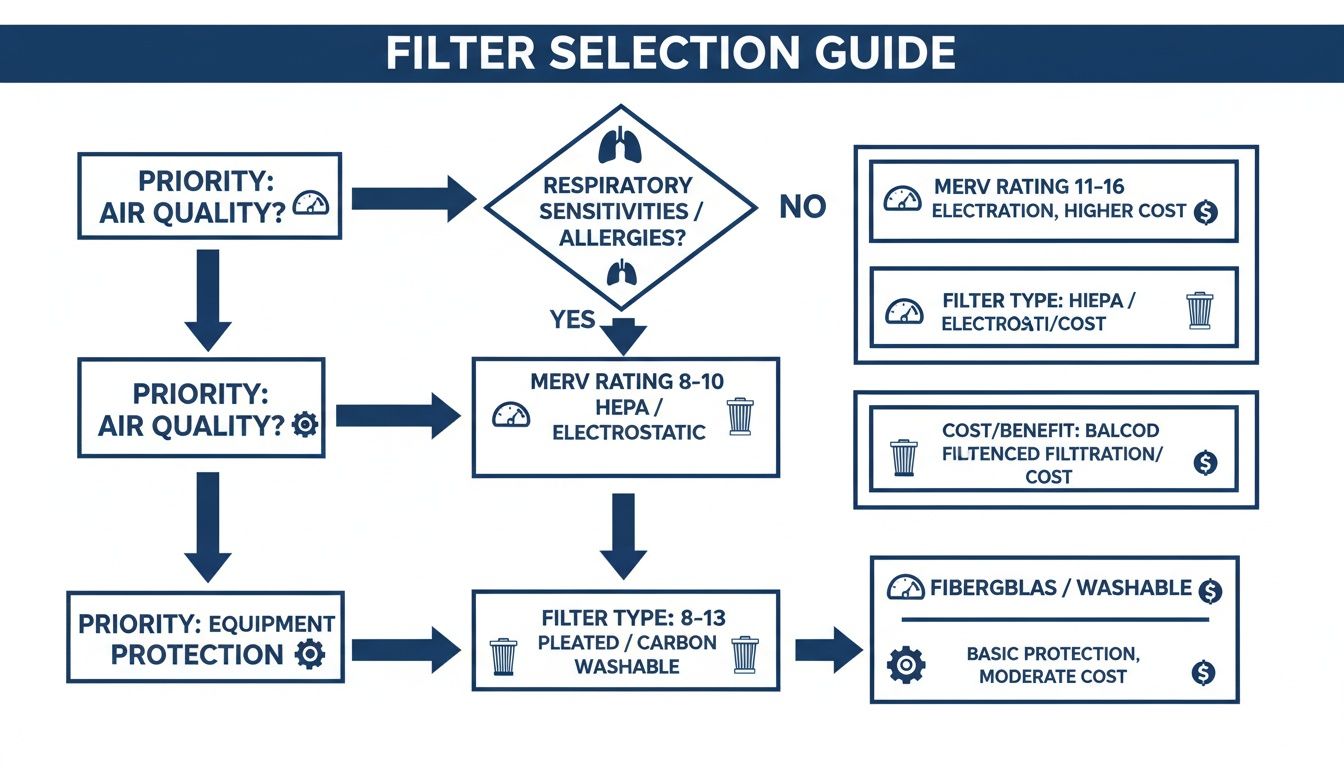
As you can see, it’s all about finding that sweet spot between MERV rating, filter type, and cost, based on whether you're managing allergies or just trying to protect your unit.
A Practical Scenario in Terrigal
Let's make this real. Imagine a family living in Terrigal on the Central Coast (postcode 2260). In spring, the pollen count is through the roof, and the coastal humidity encourages mould to grow. Their first thought might be to slap a MERV 13 filter in to catch all those allergens.
But here’s the catch: their ducted system is 10 years old and just doesn't have the grunt to handle such a restrictive filter. The airflow would drop right off, leaving moist, stagnant air sitting in the ductwork. This could actually make the mould problem they were trying to fix even worse. A much smarter choice here would be a high-quality MERV 8 or MERV 11 pleated filter. This gives them a fantastic balance, capturing a huge amount of pollen and mould spores while still letting the air conditioner breathe easily.
This way, they manage their allergies without pushing their air conditioning unit to the brink of collapse.
Checking Your System for Compatibility
So, how do you know what your system can actually handle? The first port of call should always be your air conditioner's user manual. The manufacturer will lay out exactly what filter types and sizes are recommended, and often they'll specify a maximum MERV rating.
- For Ducted Systems: Your filter is usually hiding in the return air grille. That's the big vent you often see in the ceiling of a central hallway.
- For Split Systems: The filters are inside the indoor head unit. You can usually get to them by lifting the front panel. These are often washable, and you can find out more in our guide on split system air conditioner maintenance.
Sticking to the manufacturer's advice is non-negotiable. Using the wrong filter can do serious damage and might even void your warranty, landing you with a very expensive repair bill. If you're ever in doubt, it’s always best to get a licensed professional to take a look.
How Often You Should Change Your Air Filter
It’s one of the first questions we get asked: "So, how often do I really need to change my air filter?" While there are general guidelines floating around, the honest answer is that it completely depends on your home and your lifestyle. There’s simply no single schedule that works for every household across the Central Coast or Sydney.
A standard pleated filter might last a comfortable three months in a single-person apartment in Newcastle. But that exact same filter? It could be choked with dust after just one month in a busy family home in a new Hunter Valley housing estate, especially if you’ve got kids, a couple of dogs, and someone who struggles with hay fever.
Factors That Influence Your Filter Replacement Schedule
To work out the right rhythm for your home, you need to think about what your filter is battling every single day. The environment right outside your door and the activity inside play a huge role in how quickly it gets dirty.
Picture this: a family lives in a recently developed area near Warnervale (postcode 2259), where there's still a ton of construction dust being kicked up. Add to that a golden retriever that sheds constantly. In this house, the system is working overtime, and they’d be wise to check their filter monthly, not just once a season.
Your home's unique conditions dictate the schedule. A household with smokers, pets, or allergy sufferers will always need to change filters more often than a home without these factors. Living near main roads or industrial areas also puts a heavier load on your filter. Here are the key things to think about when setting your own replacement schedule:
- Pets: Our furry friends introduce a lot of dander and hair into the air, which is a fast track to a clogged filter.
- Allergies or Asthma: If anyone in your home deals with respiratory issues, more frequent changes are non-negotiable for maintaining clean, healthy air.
- Smokers: Smoke particles are incredibly small and sticky, and they will block up a filter in no time.
- Local Air Quality: Living near a busy road, a construction site, or in an area prone to bushfire smoke means your filter has a much tougher job to do.
- System Usage: How often is your reverse cycle system running? If it’s cranking all day during a hot Sydney summer, that filter will need changing far sooner than if you only use it for a few hours in the evening.
Telltale Signs Your Filter Needs Changing
The good news is, your air conditioner will give you some pretty clear hints when its filter is overdue for a change. You don’t need to be a technician to spot them. Learning these visual cues is a key part of knowing how often you should service your air conditioner and its various components.
The most obvious sign is the eye test. If you pull the filter out and hold it up to a light, can you see the light shining through? If not, it’s definitely time for a new one. A thick, fuzzy blanket of grey grime means it's completely saturated and can't trap another speck of dust.
You might also notice other clues popping up around your home:
- Weaker Airflow: If the air trickling from your vents feels weaker than usual, it’s a classic symptom of a blocked filter literally suffocating the system.
- Increased Dust: Is your furniture getting dusty again just a day or two after you’ve cleaned? Your filter is likely full and is now letting dust circulate freely through your home.
- Higher Power Bills: A sudden, unexplained jump in your electricity bill can often be traced back to a clogged filter forcing your system to work much, much harder just to move air.
Common Air Filter Mistakes to Avoid
Preventing problems with your air conditioner is always smarter and cheaper than fixing them. Over our years serving homeowners across the Central Coast, Sydney, and Newcastle, we've seen a few common—and costly—mistakes people make with their air filters for home systems. Getting this simple part of your maintenance right can save you a whole lot of hassle down the track.
These simple errors can snowball into much bigger issues, from sky-high power bills to serious mechanical failures. By knowing what not to do, you can keep your system humming along smoothly for years to come.
Installing the Filter Backwards
This is probably the most frequent mistake we come across. Most disposable filters have little arrows printed on the cardboard frame, and they aren’t just for decoration. Those arrows show the direction of airflow, and they should always point towards the air conditioner's indoor unit—not towards the return air vent where the air is coming from.
When you install it backwards, the filter is forced to work against its design. The less reinforced side faces the powerful suction of the fan, which can cause the filter to buckle and get sucked right into the unit. That's a quick way to damage the fan motor.
Buying the Wrong Size
Close enough is not good enough with filter sizes. An ill-fitting filter, even if it's only off by a centimetre, creates gaps around the frame. This allows unfiltered, dirty air to bypass the filter media completely.
Think of it like leaving a window open while the air con is on full blast. All that dust, pollen, and debris gets a free pass to enter your system, eventually coating the sensitive evaporator coil and choking its efficiency. This build-up often leads to expensive problems, including some pretty unpleasant odours. If you've ever wondered why your air conditioner smells musty, a poorly fitted filter could very well be the culprit.
Forgetting to Change It Entirely
We get it—life is busy. But neglecting your air filter is a sure-fire way to cause problems. A completely clogged filter starves your system of air, forcing it to work incredibly hard for very little cooling. In the humid summers we see in places like Lake Macquarie, this often leads to a frozen evaporator coil.
When warm, humid air can’t flow properly over the freezing cold coil, the moisture condenses and turns to ice. Before you know it, you're left with a solid block of ice and no cool air, a problem that needs a technician to fix safely.
Choosing a Filter with Too High a MERV Rating
As we touched on earlier, grabbing the filter with the highest MERV rating can feel like the healthiest choice, but it can literally suffocate your system. Using a filter that’s too restrictive for your unit is like forcing a marathon runner to breathe through a coffee straw.
This restriction, known as high static pressure, puts immense strain on the fan motor. It will drastically increase your power consumption and can lead to premature motor burnout. Always stick to the manufacturer’s recommended MERV range to make sure you're balancing good air quality with your system's long-term health.
When to Call a Professional for Help
Changing your air filter is usually a straightforward job that most homeowners can handle themselves. It’s a great bit of routine maintenance. But there are definitely times when a simple filter swap isn’t the solution, and calling in an expert is the smartest—and safest—move you can make.
Knowing when to put down the tools and pick up the phone can save you from accidentally causing damage and ensures your system gets the proper attention it needs.
Sometimes, the first hurdle is just finding the filter, especially in older homes or those with complex ducted setups. If you’ve searched high and low and still can’t locate the return air grille, it’s far better to let a professional find it than to risk damaging your ceiling or ductwork.
When a New Filter Doesn’t Fix the Problem
The most telling sign you need professional help is when you've done everything right—you’ve installed a brand new, correctly-sized filter—but your system's performance is still disappointing.
If your home just isn't cooling down, the airflow from the vents feels weak, or your power bills are still stubbornly high, the dirty filter was likely just a symptom of a deeper issue. This could point to anything from a struggling fan motor or a refrigerant leak to a blocked evaporator coil. These are not DIY fixes and require the diagnostic tools and expertise of a licensed technician. Trying to push a struggling system can lead to a complete breakdown, which is always a much more expensive problem to solve.
Safety is paramount. If you notice any unusual noises, strange odours, or your system starts cycling on and off frequently after you change the filter, turn it off at the switchboard immediately. Call for professional help, as these could be signs of serious electrical or mechanical faults.
Signs of Deeper Contamination
Another critical time to call us is when you see signs of mould or excessive dust buildup deep within the system itself. A new filter won't solve the problem if you can see dark specks or fuzzy growth on the vent louvres or looking up into the ductwork. The source of the contamination needs to be found and professionally cleaned to make your air safe again.
A professional service from ALC Air goes far beyond a simple filter swap. Our fully licensed and ARCtick certified technicians perform a comprehensive health check on your entire system. We can diagnose underlying performance issues, safely clean critical components, and ensure your system is operating efficiently and according to Australian Standards. You can find out more about what's involved in our guide to professional aircon servicing and maintenance.
We’ll also give you expert advice on the best filtration solution for your specific home and health needs, whether you're in coastal Lake Macquarie or the suburbs of Sydney. With our hassle-free, fixed-price servicing, you get the peace of mind that comes from knowing your system is in safe hands.
Frequently Asked Questions About Home Air Filters
We get a lot of questions about air filters, and for good reason. It’s a small detail that has a massive impact on your home's air quality, your comfort, and your system's long-term health. To help out, we've gathered the most common queries our technicians hear from homeowners across the Central Coast, Sydney, and Newcastle.
Can a Dirty Air Filter Really Increase My Electricity Bill?
Absolutely. It’s one of the most direct and noticeable impacts of a neglected filter. Think of it like trying to breathe through a dusty cloth. When a filter gets clogged with dust and debris, your air conditioner's fan motor has to work much, much harder just to pull air through the system. This extra strain directly translates to higher electricity consumption. A clean filter allows for effortless airflow, meaning the system runs efficiently.
What's the Difference Between a Standard Filter and a HEPA Filter?
The real difference comes down to the microscopic level of filtration they provide. A standard pleated filter, typically in the MERV 8-11 range, is fantastic for capturing bigger stuff like dust, pet dander, pollen, and mould spores. A true HEPA (High-Efficiency Particulate Air) filter, on the other hand, is certified to capture at least 99.97% of airborne particles right down to 0.3 microns, including bacteria and smoke. However, most residential systems simply can't handle a HEPA filter because they aren't powerful enough to pull air through such a dense material.
I Have a Split System Air Conditioner. Does It Have a Filter?
Yes, it certainly does. Every split system indoor unit has filters hiding just behind the front panel that you lift up. Unlike the disposable ones often found in ducted systems, these are usually washable and reusable. Taking care of them is easy. Just slide the filters out, give them a gentle wash under lukewarm water, and let them air dry completely before popping them back in. This is a job for every couple of months, especially during heavy use.
Are Expensive Air Filters Always Better?
Not necessarily. The "best" air filter isn't the most expensive one; it's the one that’s most compatible with your specific system and suits your household's needs. While a pricey, high-MERV filter offers superior filtration, it's the wrong choice if your air conditioner isn't powerful enough to handle the reduced airflow it causes. Forcing a high-MERV filter into a system not designed for it can cause more harm than good. For most Australian homes, a quality mid-range pleated filter strikes the perfect balance between performance, healthy airflow, and affordability.
Still have questions or need a hand choosing the right air filters for your home? The expert team at ALC Air is here to help. We provide professional advice and servicing to ensure your system runs efficiently and keeps your family comfortable. Get a free, no-obligation quote online or give us a call today.