


It’s a story we’ve all lived through. One minute you’re comfortable, the next the air is still, the familiar hum of your air conditioner has vanished, and the sweltering heat of a Central Coast summer starts creeping back in.
Before you panic and assume the worst, it’s worth knowing that not every air con failure needs an immediate, complex repair. There are a few simple troubleshooting steps you can safely perform yourself.
Think of it as a quick pre-flight check before calling in the experts. These simple actions can help you figure out if the problem is a minor oversight or something that genuinely needs a licensed technician. Plus, if you do need to call us, knowing this information helps us diagnose the issue faster when we arrive.
What To Do When Your Air Conditioner Stops Working
So, your air con has decided to take an unscheduled holiday. The first thing to remember is not to panic. Often, the cause is surprisingly simple and something you can fix in a couple of minutes without any tools.
A Quick Checklist Before You Call
Before you pick up the phone, we suggest running through these common culprits. It could save you the time and cost of a service call.
First, check your thermostat or controller. Make sure it's set to "Cool" and the temperature is lower than the current room temperature. If it's a battery-powered remote, try popping in a fresh set of batteries.
Next, have a look at your switchboard. Look for a circuit breaker labelled "Air Con" or similar. If the switch is off, you can flip it back on once. If it trips again straight away, leave it off and call a professional. This points to an electrical fault that needs expert attention.
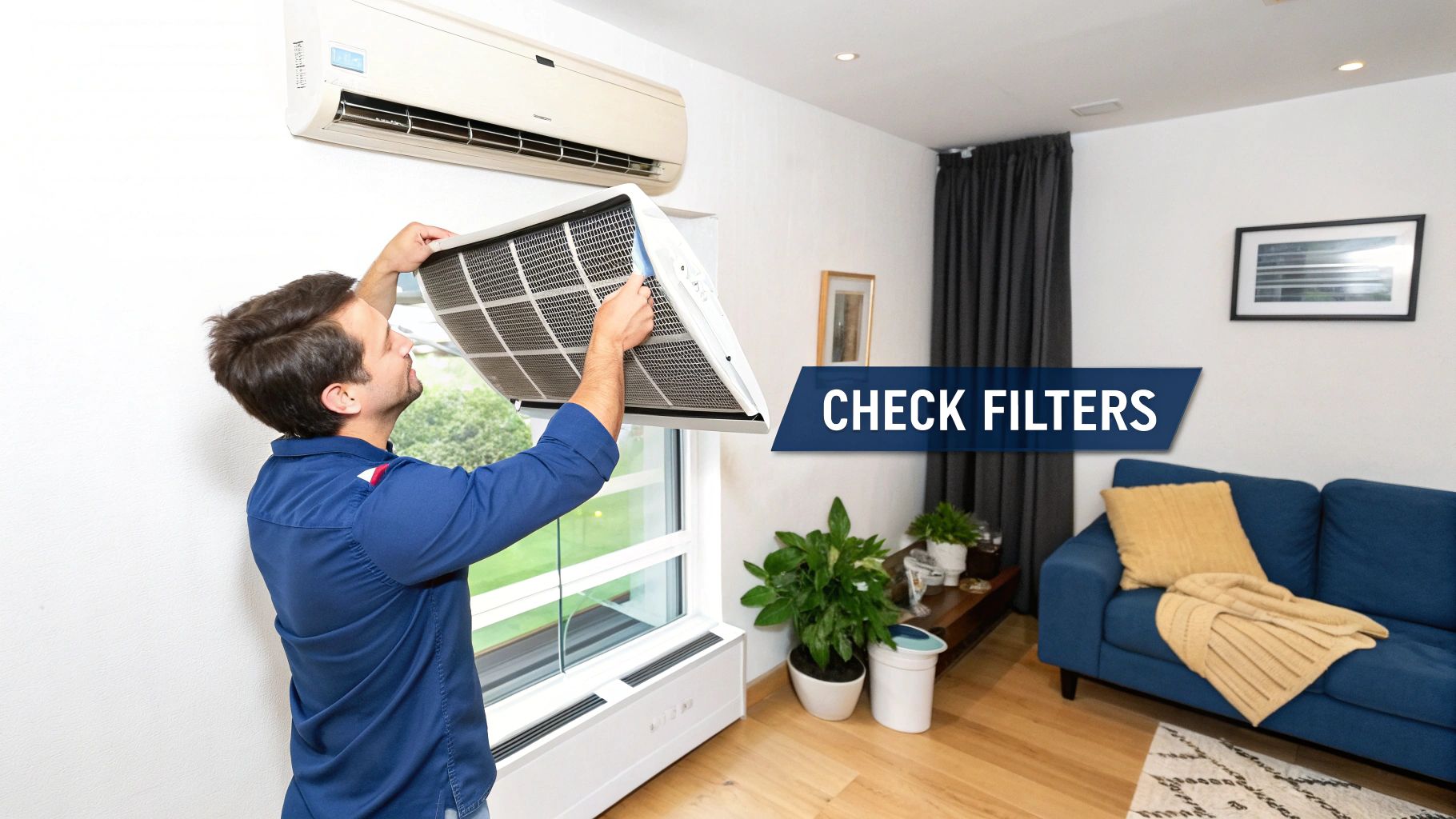
Then, inspect your indoor unit filters. If they are visibly clogged with dust and fluff, that's likely your problem. Turn the power off at the switchboard first. Then, you can remove the filters and give them a gentle clean with water. Let them dry completely before putting them back in.
Finally, check the outdoor unit. Is anything blocking it, like overgrown plants, leaves, or a leaning wheelie bin? We recommend at least 30-50cm of clear space around the entire unit so it can breathe properly. If you've done all this and it’s still not working, it's time to call us.
Why Dirty Filters Are Such a Common Problem
You’d be amazed how often a complete system shutdown is caused by nothing more than clogged air filters. It’s the number one cause of reduced performance and one of the leading reasons for breakdowns that we see on the Central Coast.
When a filter is choked with dust, it starves the system of air. This forces the whole unit to work much harder to try and pull air through, which can lead to the indoor coil freezing over into a solid block of ice. Once that happens, your system can’t cool at all.
Checking and cleaning your filters is a safe and effective DIY task that should be part of your regular home maintenance. If you want to learn more about keeping your system in top shape, check out our guide on finding a local air conditioning service.
The demand for reliable air conditioning services is massive. Australia's air con industry is a huge $13.1 billion market, and a large slice of that is driven by the constant need for maintenance and repairs. In booming areas like Sydney, Newcastle, and right here on the Central Coast, that means more systems are being installed and, eventually, needing repairs. This just highlights how important it is to have a qualified, experienced team you can trust to get the job done right.
Diagnosing Common Air Conditioning Problems
When your air conditioner starts playing up, knowing what might be wrong helps you give a technician a clear picture of the problem. Think of it like your car. Different models have their own common quirks, and air conditioners are no different. Understanding the likely culprits can get the diagnosis moving faster and get your comfort back sooner.
Let’s walk you through the typical faults we see across the most common system types, from the split systems in Newcastle apartments to the sprawling ducted units in Hunter Valley homes. This isn't about turning you into a technician, but about giving you the knowledge to understand what's happening.
Common Issues With Split Systems
Split system air conditioners are hugely popular on the Central Coast for their ability to cool specific rooms efficiently. But their design also makes them prone to a few distinct problems.
One of the most common calls we get is for a blocked drain line. Your indoor unit is constantly pulling moisture out of the air, which collects and is meant to flow outside through a small pipe. When that pipe gets clogged with mould or gunk, the water has nowhere to go but back inside, usually leaving an ugly water stain dripping down your wall.
Another classic is a refrigerant leak. Refrigerant is the lifeblood of your air conditioner; it’s what actually does the cooling. A small leak is like a slow puncture in a tyre. It might seem to work for a while, but it gradually loses its ability to cool. You might notice the air just isn't as icy as it used to be, or you might see ice forming on the pipes of the outdoor unit. It's critical to know that only an ARCtick licensed technician is permitted to handle refrigerant, as it requires specialised gear and strict adherence to environmental laws.
Why it Matters: A minor refrigerant leak doesn’t just stop your system from cooling. It forces the compressor to work overtime, chewing through electricity and risking a complete burnout of the most expensive part in your entire unit.
Common Issues With Ducted Systems
Ducted air conditioning is fantastic for whole-home comfort, but its hidden complexity means there are more places for things to go wrong. Because the main unit and ductwork are tucked away in your roof space, problems can sometimes brew for a while before you notice them.
Zone motor failure is a regular offender in ducted setups. These small motors control the dampers that open and close to send air to different parts of your house. When a zone motor gives up, a room might get no airflow at all, or it might get stuck permanently on, wasting a heap of energy cooling an empty space.
We also see our fair share of thermostat communication errors. The wall controller is the brain of the whole operation. If it can't talk to the main unit in the roof, the system simply won't respond to your commands. This can be caused by anything from a simple chewed wire to a fried circuit board.
Finally, damaged or collapsed ductwork is a major issue, especially in older Sydney homes. Over the years, flexible ducting can be torn by possums or accidentally crushed, leading to massive air leaks in your roof cavity. This means you’re paying a fortune to cool your ceiling space instead of your living room, resulting in terrible performance and shockingly high power bills. If you want to dive deeper into the mechanics of it all, you can learn more about how an air conditioner works in our detailed guide.
The Professional AC Repair Process From Start To Finish

So, you’ve tried the DIY checks, and your air con is still on the blink. It can be frustrating, but knowing what happens next helps. When one of our licensed technicians arrives at your home, they follow a clear, systematic process designed to find the problem fast and fix it right the first time.
We believe in being upfront about everything. From the moment we step inside your property in Newcastle or on the Central Coast, our goal is to get you comfortable again with minimal fuss. We don’t just treat the symptoms; we dig deeper to find the root cause, so you’re not calling us back for the same issue in a month.
The Initial Diagnosis and Assessment
First things first, we investigate. Our technician will start by listening to you. What noises have you heard? When did it stop working properly? After that, they’ll begin a series of diagnostic tests on your system. This isn't just a quick glance; it’s a deep dive into the unit’s electrical components, refrigerant pressures, airflow, and mechanical parts.
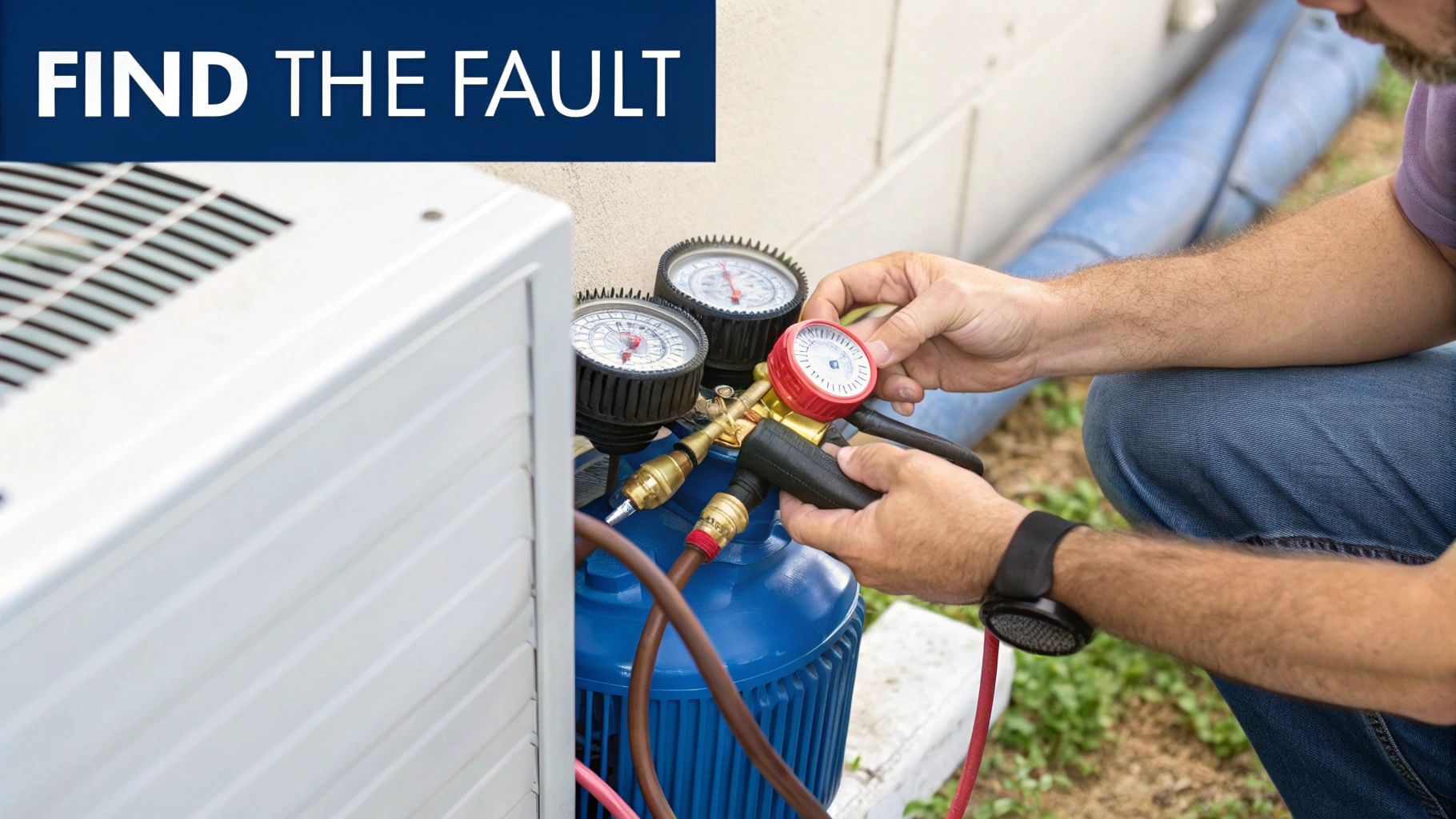
Let's say your split system in a Lake Macquarie home is blowing warm air. We’ll connect specialised gauges to check the refrigerant charge. If it’s low, that almost always points to a leak. We don't just top it up; we find the source of that leak. Simply adding more refrigerant without fixing the cause is a temporary fix at best, and it’s also illegal.
Quoting and Getting Your Approval
Once we’ve pinpointed the exact fault, we’ll walk you through it in plain English. You’ll know precisely what’s wrong, which part has failed, and what it’s going to take to get it running again. We provide a fixed upfront quote for the entire job, which covers both labour and any new parts.
This means the price we quote is the price you pay. There are no hidden fees or nasty surprises on the final bill. It allows you to make an informed decision with all the facts right in front of you.
We won’t touch a single tool for the repair until you’ve given us the green light. This transparent approach is central to how we operate, ensuring you feel completely in control of the process.
Carrying Out the Repair Safely and Correctly
With your approval, our technician gets to work. This is where experience and proper licensing are absolutely non-negotiable. Every repair we undertake is performed in strict accordance with Australian Standards, including the AS/NZS 3000 for all electrical work.
Our technicians all hold the necessary electrical licences and ARCtick refrigerant handling licences, which are required by SafeWork NSW. This is your guarantee that the work is not only effective but, most importantly, completely safe for your family and your home.
Whether we're replacing a capacitor, fixing a tricky refrigerant line, or swapping out a faulty fan motor, we only use high-quality parts and proven techniques. Our guide to a professional split system air conditioning service gives you a bit more detail on what quality workmanship really looks like.
After the repair is done, we don’t just pack up and leave. We test the entire system thoroughly to make sure everything is running perfectly, check the airflow temperatures, and clean up our work area. We’ll even show you the repaired system in action, so you can feel that cool air for yourself and know the job is done right.
Breaking Down The Cost Of Air Conditioning Repairs
When your air conditioner gives up the ghost, one of the first things you worry about is the repair bill. It's a completely fair concern, and we believe in being upfront about what goes into the final price. While it's impossible to give a flat rate without seeing the unit, we can walk you through the key factors that shape the cost of an air con repair.
Understanding these variables helps you see where the value is in a professional job. A simple fix is going to have a very different price tag compared to a complex, labour-intensive repair. Our goal is always to give you a clear, fixed quote before we pick up the tools, so you’re never left guessing.
System Type And The Nature Of The Fault
The two biggest drivers of cost are the type of system you own and what’s actually gone wrong with it. Fixing a straightforward split system is often less complex than diagnosing a problem hidden somewhere in the ductwork of a large system tucked away in a roof cavity.
For instance, replacing a failed capacitor on a split system is a common and relatively quick job for a technician. On the other hand, tracking down and repairing a refrigerant leak in a ducted system is a much more involved process that requires specialised gear and more time on the job.
The cost of the parts themselves also varies wildly. A new fan motor is one thing, but a compressor, the heart of the system, is one of the most expensive components you can replace. To get a better idea of how system types affect pricing, you can check out our guide to split system air conditioning installation costs.
Accessibility And Unit Location
Where your air conditioner is located plays a surprisingly big part in the repair cost. An outdoor unit sitting on a concrete slab at a ground-level home in Newcastle is simple for our technicians to access.
Contrast that with an outdoor unit mounted on the wall of a second-storey apartment in Sydney's inner west. That job immediately requires extra safety equipment, harnesses, and a lot more time just to access and work on the unit safely. This extra labour and risk assessment naturally gets factored into the total cost. The same goes for ducted indoor units crammed into tight, hard-to-reach roof spaces.
Why Upfront Quotes Matter: A fixed, upfront quote protects you from spiralling costs. It means the price is based on a thorough diagnosis of the issue, not an hourly rate that can blow out if the job turns out to be more complicated than expected.
Age And Brand Of The Air Conditioner
The age and brand of your unit also influence the final repair bill. Parts for older or less common brands can be harder to source, and that hunt can add time and cost to the job. A technician might need to spend extra time tracking down a specific circuit board for a 15-year-old system.
On the flip side, parts for popular, modern brands like Daikin or Mitsubishi Electric are usually well-stocked and easy to get, which helps streamline the repair. A very old unit might also have multiple worn-out components, which can complicate the diagnosis and blur the line between a sensible repair and a necessary replacement.
The demand for reliable HVAC services is booming across Australia, with the maintenance market generating USD 1,157.5 million in 2024 alone. This growth is being driven by older systems, especially those from the early 2010s, that are now failing under the strain of intense summers in regions like the Central Coast and Hunter Valley. As coastal salt air corrodes components and puts immense pressure on ageing units, timely repairs become crucial to avoiding a full, costly replacement. Discover more insights about the growing HVAC maintenance market on Grand View Research.
Deciding Between Repairing Or Replacing Your System
It’s the question every homeowner dreads when their air conditioner gives up the ghost. Do you sink more money into another repair, or is it finally time to bite the bullet and replace the whole system? This is a big decision, and the right answer isn't just about the immediate cost. It's about making a smart financial choice for the long run.
Making an informed call means looking at the bigger picture. We'll walk you through the key factors to consider, helping you weigh up the short-term pain of a repair bill against the long-term benefits of a brand-new, efficient system. This way, you can be confident you’re putting your money where it makes the most sense.
The Age Of Your System
The single biggest factor in this decision is the age of your air conditioner. Like any major appliance, it has a finite lifespan. While regular servicing can certainly stretch its working life, nothing lasts forever. Most modern systems are built to last around 10 to 15 years, though this can shift depending on how hard it works and the local climate.
If your system is under ten years old and has been a reliable workhorse, a repair is usually the most logical path. But if your unit is creeping towards that 15-year mark, pouring a significant amount of cash into a major fix might be throwing good money after bad. You could easily find yourself facing another costly breakdown in just a year or two.
For a deeper dive, check out our guide on how long air conditioners typically last.
The 50 Percent Rule: A Helpful Guideline
A useful rule of thumb many technicians use is the "50 percent rule." It’s beautifully simple: if the cost of the repair is more than 50% of the cost of a new, comparable system, it’s generally more economical to replace it.
Let’s paint a picture. Your 12-year-old ducted system in your Central Coast home needs a new compressor. The repair quote is $2,500. But a brand-new, far more energy-efficient system would cost around $4,500 installed. In this case, putting that money towards a new unit is the smarter long-term move.
This guideline helps you avoid getting trapped in a frustrating cycle of constant repair bills, sinking money into an ageing system that's likely to fail again soon.
Energy Efficiency And Running Costs
Let's be honest, today's air conditioners are miles ahead of models from a decade ago when it comes to energy efficiency. Big improvements in inverter technology and overall design mean a new system can cool your home using a fraction of the electricity. This is where a replacement can start to pay for itself.
If you’re staring down a hefty repair bill for an old, inefficient unit, do a quick mental calculation of the potential savings on your power bills. A modern unit with a high energy star rating could save you hundreds of dollars each year, especially if you live somewhere like Western Sydney or the Hunter Valley where the air con runs for months on end. Those ongoing savings can quickly eat into the initial cost of the replacement.
Frequency Of Repairs
How often have you had to call a technician out in the last couple of years? If this is the first real problem you’ve had in five years, a repair is perfectly reasonable. But if you’re on a first-name basis with your repair tech because they’re at your house every summer, that’s a massive red flag. Your system is on its last legs.
Think of it like an old car. Once the breakdowns become a regular event, you know it’s only a matter of time until the next expensive failure. Continual repair bills can quickly add up to more than the cost of a new, reliable system that comes with a full manufacturer’s warranty for complete peace of mind.
How Regular Maintenance Prevents Costly Breakdowns
The best way to handle air conditioning repairs is to avoid them in the first place. You wouldn't drive your car for years without getting it serviced, and your cooling system deserves the same attention. Proactive maintenance isn't just another expense; it's a smart investment that stops small, fixable issues from snowballing into expensive and inconvenient meltdowns.
Regular servicing keeps every component, from the intricate electronics to the hardworking mechanical parts, running exactly as they should. By catching potential problems early, you not only extend your unit's lifespan and boost its performance but also save a surprising amount on your power bills. It’s the single most effective way to ensure your home stays comfortable, especially during a gruelling Hunter Valley summer.
What A Professional Service Involves
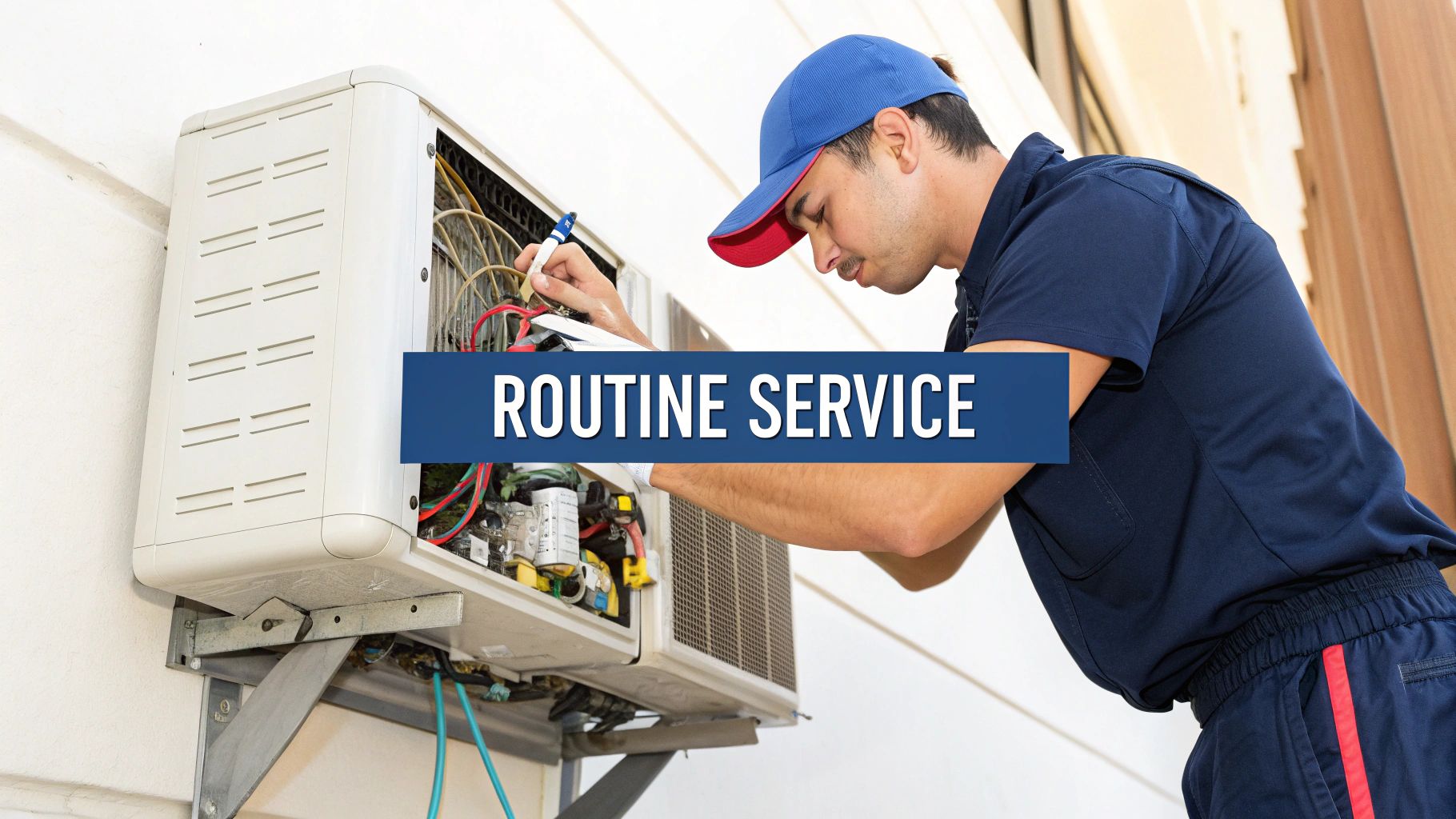
A professional maintenance visit is much more than a quick filter clean. It’s a comprehensive health check for your entire air conditioning system, carried out by a licensed technician with specialised diagnostic tools. Our team follows a detailed checklist to make sure nothing gets missed.
During a typical service, we clean both the indoor and outdoor coils to get rid of built-up grime and salt residue, which is a must for homes near the Central Coast. We also test the refrigerant pressure to make sure it’s at the exact level specified by the manufacturer. If it's too high or too low, the compressor has to work overtime, wasting energy and risking a major failure.
Our checks also involve inspecting and tightening every electrical connection and testing critical parts like capacitors and contactors. This helps prevent sudden electrical faults that can leave you without cooling. We also check fan motors, clean fan blades, and clear any blockages in the drain lines to guarantee strong, consistent airflow and stop annoying water leaks before they start.
Investing in regular maintenance is one of the most effective ways to lower your energy bills. A clean, well-maintained system can be up to 40% more efficient than a neglected one, directly translating to savings every time you turn it on.
The Long-Term Benefits Of Maintenance
The immediate perks of a service are obvious: colder air, better airflow, and a quieter unit. But the real value is in the long-term advantages that protect both your investment and your wallet.
For property managers juggling portfolios in busy centres like Sydney and Newcastle, this is crucial. A well-maintained system guarantees tenant comfort, slashes the number of unexpected repair call-outs, and helps preserve the property's overall value. It’s a clear sign of proactive, quality management.
Regular servicing also keeps your manufacturer's warranty valid. Many brands require proof of annual maintenance to honour warranty claims, making it an essential part of protecting your purchase. Ultimately, a scheduled service once a year is a small price to pay for the peace of mind that comes from knowing your system is reliable, efficient, and ready for whatever the weather throws at it.
Got Questions About AC Repairs? We’ve Got Answers.
Here are the answers to some of the most common questions we hear from customers across the Central Coast and beyond. With over 15 years of experience in air conditioning repairs, we've pretty much seen it all, from the simple fixes to the head-scratchers.
How Often Should I Service My Air Conditioner to Avoid Repairs?
We strongly recommend a comprehensive professional service at least once a year. The best time is in spring, before the summer heat really kicks in, allowing a technician to catch any minor issues before they become major, inconvenient problems.
For systems that work hard all year round for both cooling and heating, or for units in challenging environments like coastal Newcastle homes exposed to salt air, a twice-yearly check-up is a smart investment. Think of it as preventative medicine for your air conditioner; it’s always cheaper than a cure.
Is It Normal for My Air Conditioner to Make Loud Noises?
A gentle hum is the normal sound of your system doing its job. However, any sudden or unusual noises are a definite red flag that something’s not right.
Sounds like grinding, squealing, or loud rattling are absolutely not normal and almost always signal a mechanical problem. This could be anything from a failing fan motor bearing to loose components rattling around inside the unit. It’s crucial to turn the system off immediately and call for a repair to prevent a small issue from causing serious, expensive damage.
My Air Conditioner Is Running but Not Cooling. What’s Wrong?
This is one of the most frequent calls we get, and it can be caused by a few different things. The first, and simplest, thing to check is a completely clogged air filter. If the unit can't breathe, it can't cool your home.
If you’ve checked the filter and it’s clean, the issue is likely more serious. It could be a refrigerant leak or a problem with the compressor. Because refrigerant is a controlled substance, any work involving it must be performed by a technician with an ARCtick licence. This isn't a DIY job—it requires specialised tools and training to handle safely and legally.
How Long Does a Typical Air Conditioning Repair Take?
The timeframe for air conditioning repairs really depends on the fault. A straightforward fix, like replacing a faulty capacitor or clearing a blocked drain line on a split system, can often be sorted out in under an hour.
However, more complex jobs will naturally take longer. For instance, diagnosing and repairing a refrigerant leak on a ducted system or sourcing a specific circuit board for an older model might require a return visit. We always provide a clear diagnosis and a realistic timeline with our upfront quote so you know exactly what to expect from the start.
Don't let a faulty air conditioner ruin your comfort. For fast, reliable, and fully licensed air conditioning repairs on the Central Coast, Sydney, Newcastle, or Lake Macquarie, the team at ALC Air is here to help. Get in touch today for a free, no-obligation quote and expert advice you can trust. https://alcairconditioning.com.au