


At its core, a split system air conditioner is a clever climate control setup with two main parts: one that lives inside your home, and one that sits outside. Think of it as a dedicated courier for heat. On a sweltering summer day, it grabs all the unwanted warmth from your living room, carries it outside, and leaves you with refreshingly cool, comfortable air.
When winter rolls around, a reverse cycle model does the exact opposite—it finds warmth in the chilly outside air and brings it inside to keep you cosy. This guide is designed to walk you through everything you need to know, from how they work to choosing the right one for your home, whether you're in Sydney, Newcastle, or on the Central Coast.
What is a Split System Air Conditioner?
When people talk about air conditioning for their homes, they’re usually picturing a split system. Often called a wall-hung split, it's hands down the most common type of air conditioner we install in homes right across the Central Coast, Sydney, and Newcastle.
The name comes from its smart 'split' design, which cleverly separates the noisy, hard-working components from the quiet, sleek unit inside your room. This simple but effective setup makes it incredibly versatile and efficient for controlling the temperature in a single room or a specific area of your home.
Its popularity is no accident. A split system gives you a powerful, energy-conscious way to manage your comfort without needing the complex and expensive ductwork that larger ducted systems require. This makes it the perfect solution for almost any property, from a modern apartment in Newcastle to an older family home in Lake Macquarie.
The Two Core Components
The whole system works using two interconnected parts that team up to move heat around. We find that explaining it this way helps homeowners understand what they're actually getting.
The indoor unit is the slim, wall-mounted unit you see inside your home. It houses a quiet fan and an evaporator coil. Its main job is to draw in the warm air from the room, run it over the chilled coil to cool it down, and then gently push the refreshingly cool air back out.
The outdoor unit, tucked away outside your home, contains the compressor, condenser coil, and another fan. The compressor is the real engine of the system, pumping refrigerant through pipes to transfer heat between the indoor and outdoor units. Putting this workhorse outside is precisely why modern split systems are so whisper-quiet inside.
A Growing Trend Across Australia
The shift towards split systems isn't just something we see on the job; it's a massive trend right across the country. Their unbeatable combination of efficiency, affordability, and adaptability has made them the number one choice for Australian homes.
The numbers back this up. In 2022 alone, sales of single split systems hit an incredible 1.14 million units. To put that in perspective, the number of units being imported has climbed by 33 percent since 2015, showing just how many homeowners are choosing this reliable and effective solution for their comfort. You can dig into more of the data on this Australian AC market trend on Climate Control News.
What a Split System Air Conditioner Offers Your Home
A split system offers a practical, efficient, and targeted way to control the climate in the most important areas of your home. You get room-specific control, meaning you only cool or heat the rooms you're actually using, which is a great way to save money on your power bills.
Because the noisy compressor is outside, the indoor unit runs almost silently, which is perfect for bedrooms or a home office. Modern inverter models are also incredibly energy efficient, gently maintaining temperature without big power spikes.
Installation is much simpler and cheaper than ducted systems because no ductwork is needed, making it ideal for existing homes. Plus, the indoor unit's filters help remove dust, pollen, and other allergens from the air, improving your home's air quality.
How a Split System Actually Cools Your Home
Ever wondered what’s really going on inside those two white boxes that make up your air conditioner? It might seem like magic, but it’s actually a clever and continuous cycle designed to do one simple thing: move heat from where you don’t want it (inside) to where you don’t mind it (outside).
Let's walk through how a split system pulls this off to keep you comfortable. It's a process we explain to our customers every day to help them understand their new system.
The Indoor Unit's Role: Absorbing the Heat
It all starts with the sleek indoor unit mounted on your wall. Inside that unit, a quiet fan draws in the warm, humid air from your room and passes it over a component called the evaporator coil.
This is where the real work begins. A special substance known as a refrigerant circulates through this coil. As the warm air from your room flows over it, the refrigerant absorbs the heat, causing it to transform from a cool liquid into a gas. The now-chilled, dehumidified air is then gently blown back into your room, creating that refreshing feeling you crave on a hot day.
This diagram shows how the indoor and outdoor units work together in a continuous loop to shift that unwanted heat.

As you can see, the refrigerant’s journey is the key. It soaks up the heat inside your home and carries it outside to be released. This is the fundamental principle of how an aircon works.
The Outdoor Unit's Job: Releasing the Heat
Now carrying all that unwanted warmth from your Terrigal living room or Hornsby bedroom, the refrigerant gas travels through insulated copper pipes to the outdoor unit. This unit houses two critical parts: the compressor and the condenser coil.
Think of the compressor as the heart of the system. It pumps and pressurises the refrigerant gas, which concentrates the heat and makes it extremely hot. This super-hot gas then flows into the condenser coil, where a large fan blows outdoor air across the coil's fins. This action effectively dumps the heat from the refrigerant into the outside air.
As it sheds its heat, the refrigerant cools down and condenses back into a liquid state. This cool liquid is then pumped back to the indoor unit, ready to start the whole cycle over again. It’s this non-stop process that allows your split system to maintain a consistently cool temperature inside.
The Smart Technology Behind Modern Efficiency
Older air conditioners were a bit like a light switch—they were either on at full blast or completely off. This constant stopping and starting chewed through a lot of electricity and often led to uncomfortable temperature swings.
Modern split systems use inverter technology, which we often describe as cruise control for your air conditioner. Instead of jarring stops and starts, the compressor smoothly adjusts its speed to precisely match the cooling needed, keeping the temperature perfectly stable while using far less energy.
Imagine trying to cool a western-facing apartment in Parramatta on a scorching summer afternoon. An old non-inverter unit would blast cold air until it hit the target, then switch off, letting the room warm up again before lurching back to life.
An inverter system, on the other hand, runs hard initially to cool the room down, then slows right down, using just enough power to counteract the heat seeping through the windows. This smarter, smoother operation not only keeps you more comfortable but also leads to much lower power bills. It’s a feature you should always look for in any new air conditioner split unit you’re considering.
Choosing the Right Size Split System
When it comes to your new air conditioner split unit, getting the size right is the single most important decision you’ll make. It’s a common mistake to think it’s just about the square metres of a room, but the reality is far more detailed. The "size" we’re talking about is its cooling and heating power, measured in kilowatts (kW).
Picking the wrong capacity is a recipe for frustration and high power bills. An undersized unit will be forced to run flat out on hot days, constantly struggling to reach the temperature you’ve set. Not only will you never feel truly comfortable, but the non-stop operation causes excessive wear and sends your electricity usage through the roof.
On the other hand, a unit that’s too powerful for the space is just as bad. It will blast the room with cold air, hit the target temperature way too quickly, and then switch off. This process, known as short cycling, is a serious problem. Because it doesn't run long enough, it fails to properly dehumidify the air, leaving the room feeling cold but unpleasantly clammy. This constant stopping and starting is also highly inefficient and puts unnecessary strain on the compressor.
More Than Just Floor Space
To size a split system correctly, a professional technician looks at a whole range of factors beyond just the length and width of the room. Think of it like dressing for the weather; you don’t just look at the temperature, you also consider if it’s sunny or windy.
These are the key things we have to assess on-site:
- Room Volume: Ceiling height is crucial. A room with high ceilings in a new Hunter Valley home has a much larger volume of air to cool than a standard room in an older Central Coast cottage.
- Windows and Aspect: The amount of glass and the direction it faces is a huge factor. A large, west-facing window in a Penrith home will let in a massive amount of afternoon heat, demanding a far more powerful unit than a south-facing window on a shaded Hornsby street.
- Insulation: The quality of your ceiling and wall insulation directly impacts how much heat gets in or out. A well-insulated house holds its temperature for much longer, allowing the air conditioner to work less.
- Local Climate: Regional differences really matter. The sticky, humid summers around Lake Macquarie require a unit with excellent dehumidification, while the dry, intense heat of the inland Hunter region calls for raw cooling power.
A Quick Look at Sizing
To give you a rough idea, here’s a general guide. But remember, this is just a starting point; the factors above can easily shift the recommendation up or down a size. A professional assessment is the only way to be certain.
For a small room up to 20 m², like a standard bedroom or home office, a 2.5kW unit is usually a good fit. For larger master bedrooms or small living areas between 20 – 35 m², you'd likely look at a 3.5kW to 5.0kW system.
Open-plan living and dining areas from 35 – 60 m² typically need a 6.0kW to 8.0kW unit to handle the larger space effectively. And for very large open-plan areas over 60 m², you would need a system with 8.0kW of power or more.
Real-World Sizing Scenarios
Let's put this into a real-world context. Imagine a 20 square metre master bedroom in a Newcastle home. A basic online calculator might suggest a 2.5kW unit.
But what if that bedroom is on the top floor, has a large north-facing window, and only average insulation? That 2.5kW unit is going to struggle on a 35°C day. It will run flat out all afternoon and may never properly cool the room for a comfortable night's sleep.
In this scenario, a slightly larger 3.5kW system would be the smarter, more effective choice. It would cool the room down quickly and then ramp down to a lower power mode, quietly maintaining the temperature without breaking a sweat. This is precisely why a professional, on-site assessment is non-negotiable for getting the best result.
What to Expect During a Professional Installation
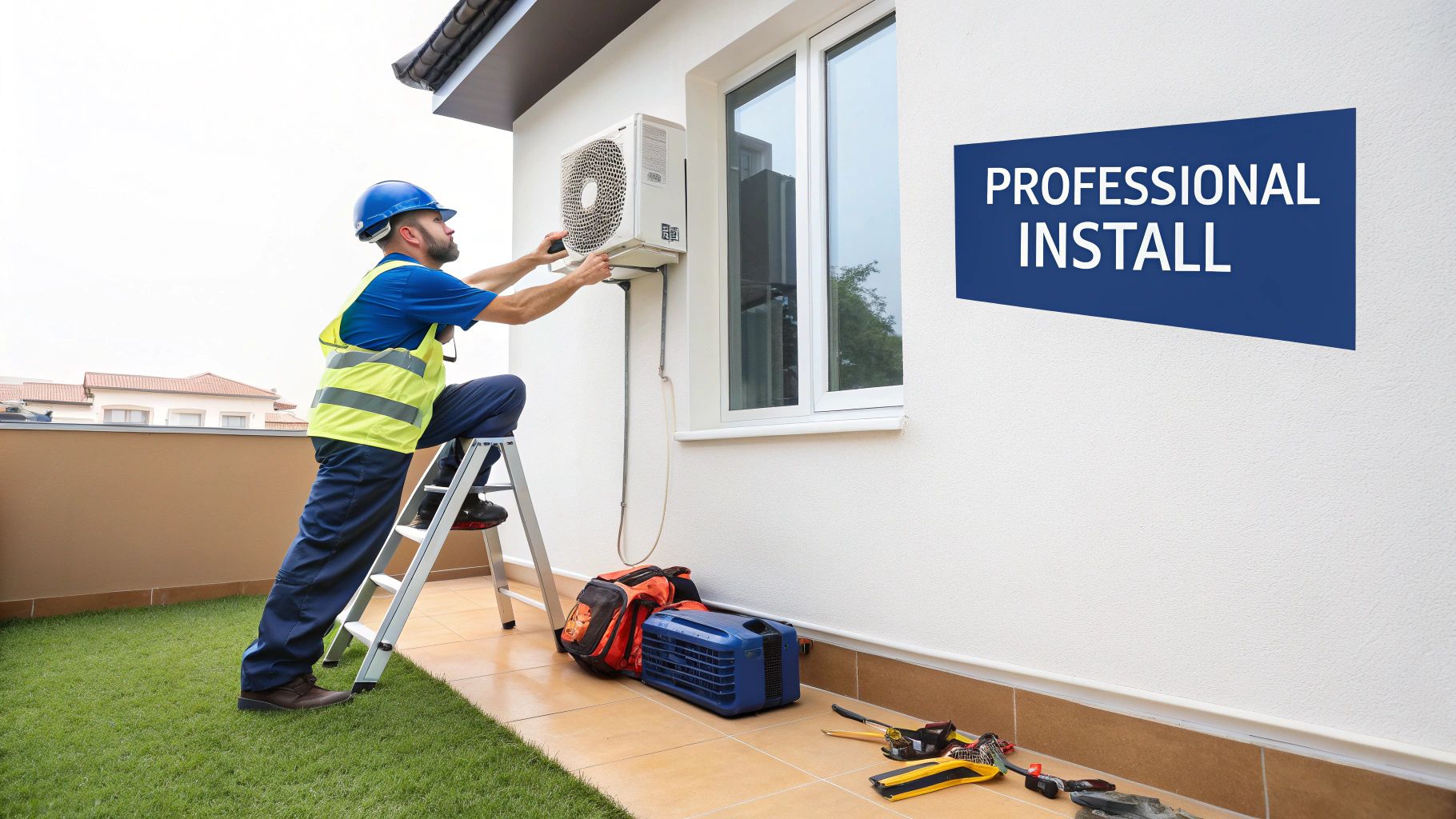
Choosing a great air conditioner split unit is only half the job. A quality installation is just as crucial for its long-term performance, efficiency, and reliability, and it's something we take very seriously.
When our professional team arrives at your property, you can expect a clear, respectful, and fully compliant process from start to finish. Our goal isn't just to get the system running; it's to make sure it's set up perfectly for your home’s unique layout and your family's needs.
Before any tools come out, our technicians will walk you through the plan one last time. We'll confirm the proposed locations for both the indoor and outdoor units and explain why these spots have been chosen for the best results. This is your chance to ask any final questions and make sure everything feels right.
The Initial Site Assessment and Preparation
Once you've given the final go-ahead, our team gets to work preparing the area. We treat your home with respect, laying down drop sheets to catch any dust or debris. This simple step sets the tone for a tidy and professional job, whether we're in a compact Sydney apartment or a spacious family home on the Central Coast.
A key part of this stage is marking out the precise locations for mounting brackets and the hole needed to connect the two units. Our installers use specialised tools to ensure everything is perfectly level and positioned for optimal performance. This isn't just about looks—it prevents future issues like poor drainage or annoying vibrations.
Placing the Indoor and Outdoor Units
Positioning each part of your split system is a bit of a science. The indoor unit needs to be placed high on a wall where it can distribute air evenly across the room without creating uncomfortable draughts. We're careful to avoid putting it directly above your bed or your favourite spot on the couch.
The placement of the outdoor unit is just as critical. It needs to sit on solid, level ground with plenty of clearance for airflow, which is essential for it to get rid of the heat it pulls from your home. We also think about noise, positioning the unit away from bedroom windows or outdoor entertaining areas to minimise any disturbance. For coastal properties in suburbs like Terrigal or Newcastle, we also factor in protecting it from harsh salt spray where we can.
Critical Safety and Compliance Steps
This is the most important part of any installation, and there are no shortcuts. All electrical work for your new air conditioner must be performed by a fully licenced electrician. This is a non-negotiable legal requirement under Australian Standard AS/NZS 3000, ensuring the connection is safe and won't overload your home's circuits.
Furthermore, the refrigerant gas inside every split system is a controlled substance. Only a technician holding a valid ARCtick licence is legally allowed to handle these gases. This certification guarantees they are properly trained to manage refrigerants safely, protecting both your family and the environment. Our entire team is fully compliant with all SafeWork NSW regulations.
Why does compliance matter? A non-compliant installation doesn't just void your manufacturer's warranty—it poses a serious safety risk. It can lead to electrical faults, refrigerant leaks, and poor performance, costing you a lot more in the long run.
After the units are mounted and connected, we commission the system. Our technicians perform a series of checks to make sure everything is operating correctly, from the refrigerant pressure to the thermostat controls. Finally, we'll give you a full handover and show you how to operate your new system before we leave. To understand how these professional steps factor into the price, our guide provides more detail on the installation cost for a split system air conditioner.
Understanding Costs and Energy Efficiency
So, let's talk about what a split system air conditioner actually costs. The price you see on the box is only half the story; the total investment is a mix of the unit itself and how complex the installation is. A simple 'back-to-back' install, where the indoor and outdoor units sit on opposite sides of the same wall, will always be the most budget-friendly option. Things get pricier when you need long pipe runs or tricky access to a second storey.
The purchase price is a one-off hit, but running costs are where your focus should be for the long term. With power prices constantly on the move, the energy efficiency of your system is a massive deal. This is where you need to pay close attention to that Energy Star Rating label.
How the Energy Star Rating Affects Your Bills
Every air conditioner sold in Australia has a Zoned Energy Rating Label (ZERL). This little sticker is your best friend, showing you two sets of star ratings: one for cooling and one for heating. It’s pretty simple: the more stars a unit has, the more efficient it is, which means it costs you less to run.
Think of it like choosing a car based on its fuel consumption. A five-star air con might have a higher price tag than a three-star model, but it will save you a huge amount on your power bills over its 10 to 15-year lifespan. For a family in the Hunter Valley, running the cooling for months in summer and then the heating in winter, those savings really start to stack up.
Choosing a unit with just one extra star can cut your running costs by about 10%. Over a decade, that's a serious saving that often makes the higher initial price well worth it.
Practical Tips to Maximise Your Unit's Efficiency
Beyond picking an efficient model, how you actually use your air conditioner makes a massive difference to your bills. A few simple, consistent habits can slash your energy consumption without you having to sacrifice comfort.
Here are a few actionable tips we give our clients every day:
- Clean Your Filters Regularly: This is the single easiest and most effective thing you can do. A clogged filter forces the unit to work much harder to pull air through, which absolutely chews through power. Check them every month or two during heavy use.
- Use Timers and Smart Controls: Set your air con to switch on 30 minutes before you get home instead of blasting it all day. Many modern units have Wi-Fi control, letting you manage them from your phone for ultimate efficiency.
- Seal Your Home: It sounds obvious, but close your windows and doors. On a hot, sunny afternoon, draw the blinds or curtains. Every bit of heat you stop from getting in is heat your air conditioner doesn't have to work hard to pump back out.
The demand for these systems is only growing. The Australian air conditioning market is tipped to hit AUD 6.48 billion by 2035, a massive jump driven by rising temperatures and a bigger focus on energy-efficient living. If you want a detailed look at what contributes to your energy usage, check out our guide on how much it costs to run your aircon. Honestly, investing in an energy-efficient air conditioner is one of the smartest long-term moves you can make for your home.
Maintaining Your System for Peak Performance

Once your new air conditioner split unit is installed and running beautifully, a little bit of care will go a very long way. Proper maintenance is the secret to making sure your system runs efficiently, lasts longer, and keeps your family breathing clean, healthy air for years.
Think of it less as a chore and more as a simple health check-up for one of your home's most important appliances. The good news is, you can handle some of the most important jobs yourself.
Simple DIY Maintenance You Can Do
These simple DIY tasks don't require any special tools but make a huge difference to your system's performance and running costs. The most crucial job is regularly cleaning the filters in your indoor unit. These filters are your first line of defence against dust, pollen, and other airborne nasties. When they get clogged, your system has to work much harder, which chews up more electricity and reduces its cooling power.
We recommend checking and cleaning your filters every 1-2 months, especially during heavy use in the middle of a Central Coast summer or a chilly Hunter Valley winter. Just slide them out, give them a gentle wash with lukewarm water, let them dry completely, and pop them back in.
It's also really important to keep the area around your outdoor unit clear. Make sure leaves, grass clippings, and garden debris aren't blocking the air intake fins. A quick check every few weeks, especially after mowing the lawn or a big storm, is all it takes.
Why Professional Servicing is Essential
While DIY cleaning is vital, it doesn’t replace the need for a comprehensive annual service by a qualified technician. There are critical checks and adjustments inside your system that can only be safely and legally performed by a professional holding an ARCtick licence.
An annual professional service is the single best investment you can make in your air conditioner's health. It's not just about preventing breakdowns; it helps maintain peak energy efficiency, improves indoor air quality, and can significantly extend the life of your entire system. During a service, a technician will check refrigerant levels, test electrical connections, clean the coils, and make sure the whole system is running exactly as the manufacturer intended.
When to Call for Help
Sometimes your system will give you clues that it needs attention outside of its regular service schedule. If you notice any of the following, it’s best to get in touch with a professional:
- Unusual Noises: Any new rattling, buzzing, or grinding sounds.
- Reduced Performance: The system just isn't cooling or heating like it used to.
- Water Leaks: Any sign of water dripping from the indoor unit is a red flag.
- Foul Odours: Musty or strange smells coming from the vents when you turn it on.
These signs can indicate anything from a simple blockage to a more serious component issue. For a more detailed look at what you can handle and when to call in the experts, our split system air conditioner maintenance guide offers a comprehensive breakdown.
Common Questions About Split System Air Conditioners
When you’re thinking about a new air conditioning system, a lot of questions pop up. We get calls from people across the Central Coast, Sydney, and Newcastle every day asking the same things. To make it easier, we've put together some straight answers to the most common queries we hear.
How Long Does A New Air Conditioner Split Unit Typically Last?
You can realistically expect a quality air conditioner split unit from a trusted brand like Daikin or Mitsubishi Electric to last anywhere from 10 to 15 years. Getting to the upper end of that lifespan really boils down to one thing: consistent, professional maintenance.
For example, in coastal areas like Newcastle or the Central Coast suburbs (postcodes 2250-2264), the salty air can be brutal, speeding up corrosion on the outdoor unit. Choosing a model with good anti-corrosion treatments and getting it serviced annually is the best way to protect your investment and make sure it keeps working efficiently for years to come. A regular check-up lets a technician spot small issues before they become expensive problems.
Are Split Systems Noisy To Run?
This is a big concern for a lot of people, but modern inverter split systems are genuinely quiet. The indoor unit usually operates at a sound level that’s no louder than a soft whisper, making it perfect for bedrooms and living rooms where you don't want any distractions.
The outdoor unit, which houses the compressor doing all the hard work, does make more noise. That’s why professional placement is so important. A good installer will find a spot for it away from bedroom windows, your neighbour’s property, and any outdoor entertaining areas to keep things peaceful. If your current system suddenly starts making a racket, it’s a big sign it needs a service to check for things like a struggling fan or loose parts.
Which Brand Of Split System Is The Best For My Home?
There’s no single ‘best’ brand that’s perfect for every home. The right choice for you comes down to your budget, the unique needs of your home, and which features you actually care about.
At ALC Air, we stick with brands that have a solid track record in Australia for reliability, great performance, and decent after-sales support. We find ourselves recommending and installing leading names like Mitsubishi Electric, Daikin, Fujitsu, and Panasonic day in and day out. Each one has its strengths; Daikin might be known for its clever features, while a Fujitsu could offer fantastic value for money. Our job is to walk you through the options and help you land on the model that’s going to deliver the best long-term comfort for your family.
Ready to find the perfect climate solution for your home or business? The team at ALC Air has over 15 years of experience providing honest advice and quality installations across the Central Coast, Sydney, Newcastle, and Lake Macquarie.
For a free, no-obligation quote and a professional assessment of your needs, get in touch with our friendly experts today. Visit us online at https://alcairconditioning.com.au or give us a call to find out how we can help.