


When your air conditioner gives up on a scorching hot day in Newcastle or the Central Coast, it feels like a proper emergency. Before you start imagining the worst-case scenario (and the bill that comes with it), take a breath. Many of the most common air con problems have surprisingly simple explanations.
Often, the issue is something you can sort out yourself in just a few minutes, potentially saving you the hassle and cost of a service call. This guide will walk you through the most common problems, give you an idea of repair costs, and explain how to prevent expensive breakdowns in the first place.
Is Your Air Conditioner Not Working? First Steps to Take
That sinking feeling when your air con fails is something no homeowner wants to experience. Whether your split system in Terrigal is suddenly blowing warm air or your ducted unit in Sydney’s western suburbs has gone completely silent, the mind immediately jumps to a hefty repair bill.
But before you pick up the phone, running through a few basic checks can often solve the problem right then and there.
Think of this as your initial diagnostic checklist. A surprising number of issues that feel like major failures are actually just simple power or setting errors. Walking through these steps first will save you time and stress, and if you do end up needing a technician, you’ll have some valuable information to give them.
Check Your Thermostat First
It sounds almost too obvious, but you’d be surprised how often the thermostat is the culprit. Someone in the house might have accidentally bumped a button or changed the mode without realising.
First, ensure it’s set to ‘Cool’, which is usually shown with a snowflake symbol, not ‘Heat’ or ‘Fan Only’. Next, check the temperature setting. The temperature you’ve set needs to be lower than the current room temperature, otherwise the air con has no reason to kick in. Finally, if you have a battery-powered thermostat, a pair of dead batteries will stop it from sending any commands to your air conditioner at all.
Inspect the Circuit Breaker
The next place to look is your home’s switchboard. Air conditioners draw a serious amount of power and are almost always on their own dedicated circuit. If there’s been a small power surge or the circuit is overloaded, the breaker will trip as a safety measure.
Find your switchboard and look for a switch that’s in the ‘off’ position or perhaps stuck halfway between on and off. Flick it firmly back to the ‘on’ position.
If it trips again straight away, do not reset it again. This is a clear sign of a more serious electrical fault that needs a licensed electrician to inspect safely.
This simple decision tree shows how these first two steps should always be your starting point.
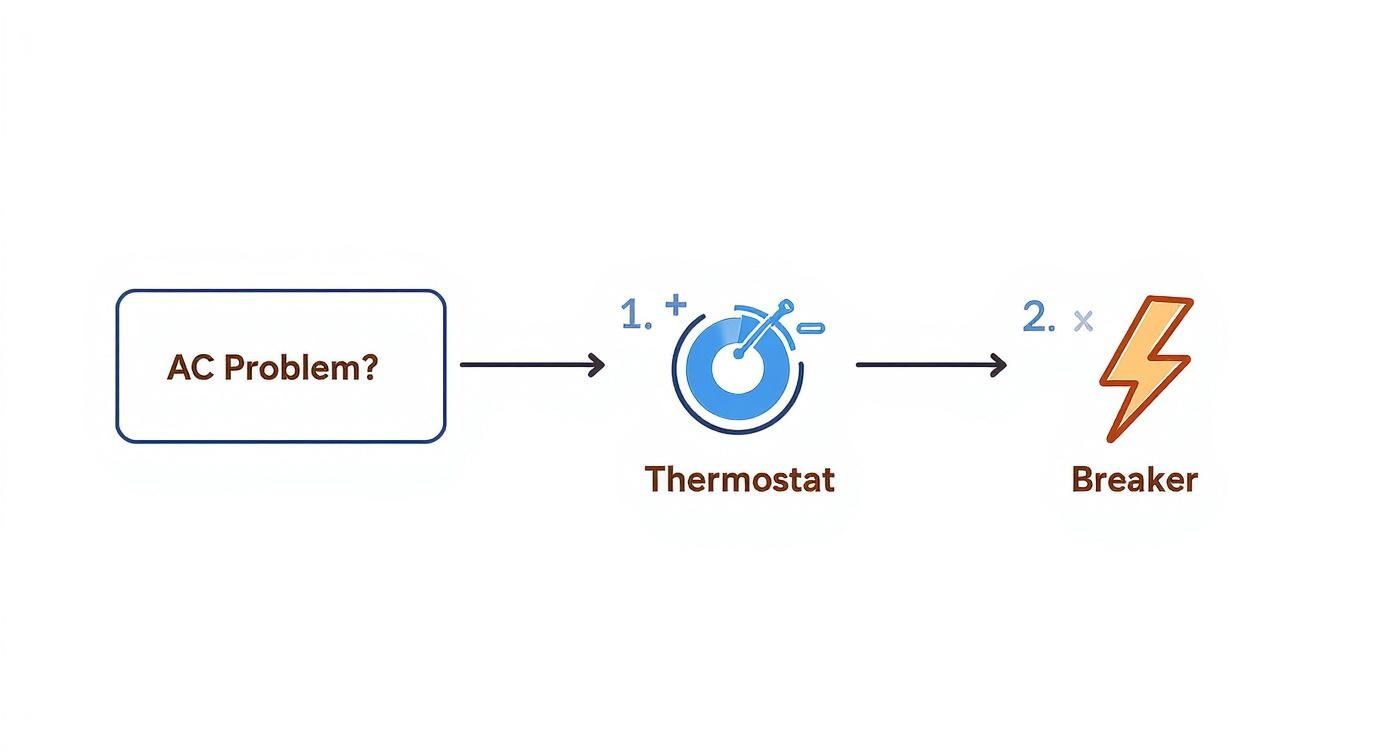
As you can see, checking the thermostat and the circuit breaker should always be your first move before you start worrying about more complex issues.
10 Most Common Air Conditioner Problems and Their Fixes
Okay, so you’ve already checked the simple stuff like the thermostat settings and the circuit breaker. Now it’s time to dig a little deeper into the common faults that can bring your air conditioner to a grinding halt. With over 15 years of hands-on experience across the Central Coast, Sydney, and Newcastle, we’ve pretty much seen it all.
We’ll walk you through the most frequent air con repairs we handle. For each one, we’ll explain what’s going on, what you can safely check yourself, and when it’s absolutely time to call in a licensed professional. Knowing the difference can save you time and money, not to mention keep you and your family safe.
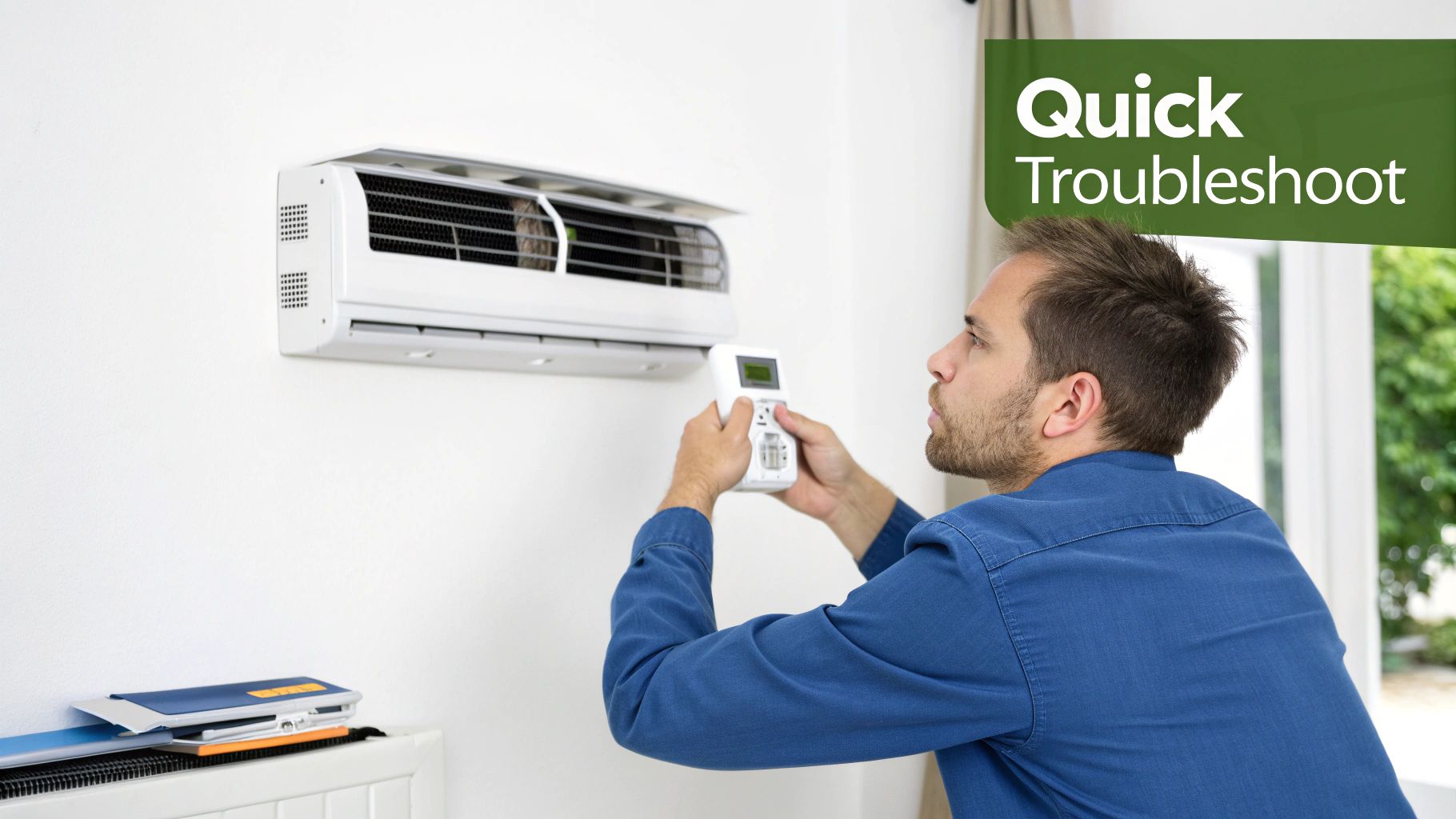
1. Air Conditioner is Not Cooling Properly
This is, without a doubt, the number one complaint we hear, especially when a heatwave hits Sydney’s western suburbs. Your system is running, air is blowing from the vents, but it’s lukewarm at best.
- DIY Fix vs Professional Repair: Before you do anything else, check your air filters. A clogged filter chokes the airflow and kills your cooling performance. Cleaning or replacing them every 1-3 months is crucial. Also, ensure the outdoor unit isn’t suffocated by bushes or leaves. If those checks don’t work, you must call a professional. The problem could be low refrigerant, a failing compressor, or a faulty capacitor, which all require a technician with an ARCtick certification.
2. The System is Making Strange Noises
Your air conditioner should be a background hum. If you suddenly hear grinding, rattling, squealing, or clunking, it’s a clear cry for help.
- DIY Fix vs Professional Repair: For your own safety, switch the system off at the circuit breaker. Look at the outdoor unit for loose debris like twigs rattling in the fan. You can also gently check if any casing panels are loose. If the noise persists, call a pro. A grinding noise often points to a dying compressor motor, while a squeal could be a worn-out fan belt. Letting it run could turn a small repair into a complete system failure.
3. The Outdoor Unit is Freezing Up
Seeing a layer of ice on your outdoor unit’s coils, even on a scorching hot day, is a massive red flag. It points to a problem with either airflow or refrigerant.
- DIY Fix vs Professional Repair: A frozen unit is often caused by a dirty air filter or blocked airflow. Turn the system off completely and let the ice melt. Then, clean your filter and clear anything blocking the outdoor unit. If the unit ices up again after sorting out the airflow, it’s almost certainly a refrigerant leak. Only a licensed professional can legally find the leak, repair it, and recharge the system according to Australian regulations.
4. Water is Leaking from the Indoor Unit
Finding a puddle under your indoor split system is usually caused by a blockage in the condensate drain line, which is designed to carry moisture away.
- DIY Fix vs Professional Repair: Your air con pulls humidity out of the air, and that moisture flows outside through a small drain pipe. Sometimes, the end of this pipe can get clogged with dirt. You can safely check the outlet of the pipe outside and gently clear any gunk. If the blockage is further up the line, it needs to be flushed out professionally to prevent water damage to your walls and floors.
5. The Air Conditioner Turns On and Off Repeatedly (Short Cycling)
Short cycling is when your air conditioner runs for just a few minutes, shuts off, then fires up again shortly after. This is incredibly inefficient and puts huge stress on the system.
- DIY Fix vs Professional Repair: A blocked air filter can be the culprit here, causing the system to overheat and shut down. Also, check that your thermostat isn’t sitting in direct sunlight, which can give it false readings. If simple fixes don’t solve it, you could be looking at a faulty thermostat or a refrigerant leak. A professional diagnosis is crucial to pinpoint the exact cause.
6. The Fan Isn’t Working on the Outdoor Unit
If the fan on your outdoor unit isn’t spinning but you can hear the compressor humming, you have a problem. The fan is essential for dissipating heat.
- DIY Fix vs Professional Repair: This is not a DIY job. Turn the system off immediately to prevent the compressor from overheating and failing. The issue is almost always electrical, such as a burnt-out fan motor or a failed capacitor. Both repairs require a licensed electrician to handle the high-voltage components safely.
7. The Air Conditioner Smells Bad
A musty or mouldy smell coming from your vents is a sign of mould or mildew buildup inside your indoor unit. A burning smell is more serious.
- DIY Fix vs Professional Repair: For musty smells, cleaning your air filters may help slightly. However, the problem is likely deeper in the evaporator coils and drain pan, which requires a professional deep clean. If you smell burning plastic or electrical odours, turn the unit off at the switchboard immediately and call a technician. This indicates a serious electrical fault.
8. My Electricity Bill Has Suddenly Spiked
If your power bill is unexpectedly high but your usage habits haven’t changed, your air conditioner could be running inefficiently.
- DIY Fix vs Professional Repair: Start with the basics: clean your filters and check that windows and doors are sealed properly. Ensure the outdoor unit is clear of obstructions. If the bill remains high, it’s time for a professional service. The system may be low on refrigerant, or a component could be failing, forcing it to work harder and consume more power.
9. The Thermostat is Unresponsive
If your thermostat screen is blank or not responding to your commands, it can’t tell the air conditioner what to do.
- DIY Fix vs Professional Repair: The first and easiest DIY fix is to replace the batteries. If it’s a hard-wired thermostat, check the circuit breaker. If neither of these actions solves the problem, it’s time to call a professional. The issue could be faulty wiring or a failed thermostat, both of which require an expert to diagnose and replace.
10. Airflow from Vents is Weak
If the air coming out of your vents feels weak or low, it’s a classic sign that something is restricting the airflow somewhere in the system.
- DIY Fix vs Professional Repair: The number one cause is a severely clogged air filter, so start by cleaning or replacing it. For ducted systems, check that all your vent louvres are open. If these steps don’t improve airflow, you could have a bigger problem like a failing fan motor or blocked ductwork, which requires a professional inspection.
Understanding Air Conditioner Repair Costs
When your air con gives up the ghost on a scorching summer afternoon, the first thought that flashes through most people’s minds is, “Okay, how much is this going to set me back?” The final cost isn’t some number plucked from thin air; it’s a combination of a few key things.
The technician’s time and expertise, the specific parts needed for the job, and how tricky the repair is all have a say in the total price to get your home cool again.
Key Factors That Influence Repair Costs
When we put together a quote for a air con repair, several variables come into play. It’s not as simple as having a fixed price list, because every air con and every breakdown is a little different.
Here’s what we’re looking at:
- Type of System: There’s a world of difference between fixing a simple split system in a Gosford apartment and troubleshooting a large, complex ducted system in Newcastle. Ducted systems have more parts, which can make fixing the problem more labour-intensive.
- The Faulty Part: This is the big one. Replacing a common part like a capacitor is a much smaller job than swapping out a major component like the compressor. Think of the compressor as the heart of your system, it’s one of the most significant repairs you can face.
- Labour and Call-Out Fee: You’re paying for a licensed technician’s time, experience, and specialised diagnostic gear. Most companies have a standard call-out fee which covers the first chunk of labour and getting the tech to your door.
Realistic Cost Ranges For Common Repairs
While we can’t give you a precise figure without seeing the unit, here are some realistic cost ranges for common air conditioner repairs.
- Minor Repairs ($150 – $400): This range typically covers issues like a basic service call, cleaning a blocked drain line, or replacing a simple electrical component like a capacitor on a split system.
- Moderate Repairs ($400 – $800): You might expect costs in this range for more involved jobs. For example, replacing a fan motor on an outdoor unit or finding and repairing a minor refrigerant leak.
- Major Repairs ($800 – $2,500+): This is for the most significant jobs. A full compressor replacement is the most common repair in this bracket, due to the high cost of the part and the extensive labour needed to fit it. This is often the point where you weigh up repair versus replacement.
How to Prevent Expensive Air Conditioner Repairs
The best kind of air conditioner repair is the one you never have to make. While some breakdowns are unavoidable, proactive maintenance is the single best way to keep your system running smoothly. A bit of attention now can save you a massive headache and an even bigger bill down the track.
A lot of homeowners across the Central Coast and Sydney treat their air con like a “set and forget” appliance. But just like your car, it’s a complex machine that needs regular tune-ups to perform at its best.
Simple Maintenance You Can Do Yourself
You don’t need to be a technician to handle the basics. First and foremost: keep your filters clean. Dirty filters are the number one cause of poor cooling and unnecessary strain on your system. Checking and cleaning the filters in your indoor unit once a month is a great habit.
Next, take a look outside. Your outdoor unit needs clear, unobstructed airflow to do its job. Make it a seasonal task to ensure there’s at least half a metre of clear space around the entire unit. Trim back any encroaching bushes and clear away fallen leaves.
The Value of Professional Annual Servicing
While your own checks are vital, an annual professional service is the ultimate preventative measure. It gives a licensed technician the chance to spot small issues before they snowball into major failures.
During a comprehensive service, our technicians do much more than just a quick clean. We check refrigerant levels, thoroughly clean the indoor and outdoor coils, test all electrical components, and flush the condensate drain to prevent blockages. Think of it as an investment. A small annual cost for a professional service is far easier to manage than a surprise four-figure repair bill on the hottest day of the year in the Hunter Valley.
Choosing a Qualified Repair Technician in NSW
When your air conditioner gives up, choosing the right technician is the most critical part of the repair process. This isn’t just about getting cool air back; it’s about making sure the job is safe, legal, and won’t create a bigger problem later on.
Hiring an unqualified person for air conditioner repairs is a massive gamble. These systems combine high-voltage electricity with pressurised refrigerant gases, a mix that’s seriously dangerous in untrained hands. A botched job can fry your system, void its warranty, and pose a genuine safety risk.
The Non-Negotiable Licences and Certifications
In NSW, the air conditioning trade is properly regulated. Any technician working on your system must have two key credentials. These aren’t optional extras; they’re legal requirements.
First is a refrigerant handling licence, often called an ARCtick licence. This is a federal requirement proving they’re trained to handle these substances safely. Secondly, any work on the electrical side of your air con must be done by a fully licensed electrician, as mandated by SafeWork NSW and Australian Standards (AS/NZS 3000).
Questions to Ask Before You Hire Anyone
Think of hiring a technician like a mini job interview. A genuine professional will have no problem answering your questions.
Here’s a quick checklist to run through:
- Are you and your business fully licensed and insured? Ask for their licence numbers. You can easily verify electrical licences on the Fair Trading NSW website.
- Do you offer a warranty on your parts and labour? A professional service will always stand by their workmanship.
- Can you provide a clear, written quote before starting? You need to know exactly what you’re paying for.
- What experience do you have with my specific brand and system type? Direct experience counts.
Why Local Experience Matters
Australia’s air conditioning and heating services industry is huge. As of 2025, there are over 7,300 businesses in operation across the country. Discover more insights about the growth of the HVAC industry on IBISWorld.
With so many choices, picking a technician with proven local experience is a smart move. Someone who has worked for years in places like Lake Macquarie or Newcastle understands the unique challenges our coastal climate presents, like how salt air can accelerate corrosion on outdoor units.
Common Questions About Air Conditioner Repairs
We get it. When your air conditioner stops working, you’ve got questions. Over our 15+ years of providing air conditioner repairs across the Central Coast and Sydney, we’ve heard them all. Here are straight answers to the most common queries.
How Long Do Air Conditioner Repairs Usually Take?
The honest answer? It really depends on the problem. A straightforward fix, like replacing a failed capacitor, can often be sorted in about an hour. However, complex jobs like hunting down a tricky refrigerant leak will naturally take longer. If we need to order a specific part, that will mean a return visit is necessary.
Is It Worth Repairing an Old Air Conditioner?
This is a classic dilemma. A good rule of thumb is to weigh the age of your unit against the cost of the repair. If your system is over 10 to 12 years old and needs a major fix (like a new compressor), you’re often better off putting that money towards a new, more energy-efficient system.
What Should I Do if My Air Conditioner Is Still Under Warranty?
If your system is still covered by the manufacturer’s warranty, your first port of call should always be the original installer or the manufacturer. They’ll direct you to an authorised service agent. Using an unauthorised technician for any repairs can instantly void your warranty, so it’s critical to follow the right procedure.
Why Is My Indoor Air Conditioner Unit Leaking Water?
Seeing water dripping down your wall is almost always caused by a blocked condensate drain line. As your air con cools your home, it pulls moisture from the air, which is supposed to drain outside. If that line gets clogged with dust or sludge, the water backs up and overflows. Getting it sorted quickly is key to preventing serious water damage.
For trusted, professional advice and reliable air conditioner repairs across the Central Coast, Sydney, Newcastle, and Lake Macquarie, get in touch with ALC Air. Request a free, no-obligation quote online or call us today to get your system back up and running.