


Think of an air conditioner rebate as a financial thank you from the government for choosing an energy-efficient cooling system. These programs are much more than just a random discount; they’re a deliberate strategy to encourage NSW homeowners to swap out older, power-hungry units for modern, efficient ones.
It’s a simple switch that helps reduce the strain on our entire power grid, especially during those scorching summer peaks, and it lowers your home's carbon footprint. Let's break down how this state-wide push for efficiency translates into real dollar savings for you.
Why Do These Rebates Even Exist?
At its heart, the goal is to manage energy consumption on a massive scale. When thousands of households, from Sydney apartments to family homes on the Central Coast, switch to more efficient technology, the collective energy saving is enormous.
This widespread upgrade reduces the need for expensive new power grid infrastructure and helps NSW meet its environmental targets. For you, the homeowner, it means the government is willing to co-invest in an upgrade that ultimately benefits everyone.
To make this clearer, let's summarise the key ideas you'll come across when looking into these programs.
Rebate Essentials at a Glance
| Concept | What It Means for You |
|---|---|
| Financial Incentive | You get actual money back after buying and installing a qualifying system. |
| Energy Efficiency | The rebate is tied to choosing a high-star-rated unit that uses less electricity. |
| Grid Stability | Your upgrade helps prevent blackouts during peak summer demand. |
| Environmental Goals | By using less power, you’re helping NSW reduce its overall carbon emissions. |
Essentially, the government is helping you pay for a new air conditioner because your choice helps them solve a much bigger problem. It's a genuine win-win.
What Kind of Systems Actually Qualify?
You won't find a rebate for every air conditioner on the market. These incentives are almost always reserved for systems that hit a high energy star rating, ensuring the program's energy-saving goals are met.
The most common systems that qualify usually fall into two categories:
- High-Efficiency Reverse Cycle Split Systems: These are fantastic for cooling and heating specific rooms or zones in your home. We've got a whole guide on how a reverse cycle split system works if you want to dive deeper.
- Modern Ducted Air Conditioning: Perfect for whole-home climate control, the newer ducted units with impressive energy ratings are often included in these schemes.
The underlying principle is very similar to general cashback programs you might see elsewhere. You get money back for making a specific, encouraged choice. In this case, that choice is investing in long-term energy efficiency for your home.
So, you're thinking about a new air conditioner for your home in Gosford or Hornsby and wondering if you can get some money back. Good thinking. Let's break down who typically qualifies for these rebates so you can see where you stand.
Most of the time, you need to be the homeowner. The other biggie is that you’re usually replacing an old, power-hungry system with a shiny new high-efficiency model. While some programs are tied to your income, a lot of government rebates are simply there to reward any homeowner for making a smart, energy-saving choice.
Key Eligibility Factors to Consider
Honestly, the single most important factor is almost always the new air conditioner itself. To get a rebate, you'll need to buy a model that meets a certain high energy star rating. This is the government's way of making sure their investment actually leads to real energy savings across the grid, which, in turn, means lower power bills for you.
This focus on efficiency is really shaping the industry. These government incentives are a big reason Australia's air conditioning market is growing so strongly, with NSW programs driving a lot of the uptake in places like Sydney, Newcastle, and Lake Macquarie. In fact, NSW homeowners make up a massive 31.2% of the country's entire air conditioner market, and these rebates are a key part of that trend.
The other non-negotiable rule? The installation. It must be done by a licensed and accredited professional.
This is the one rule you absolutely can't bend. Any DIY attempt or a cash job by an unlicensed installer will instantly disqualify you from claiming a rebate. The government needs proof the system is installed safely and correctly to ensure it runs at peak efficiency.
Why Professional Installation Is Mandatory
To get your rebate approved, your installer has to have the right tickets. This means holding a full electrical licence to meet Australian Standards (AS/NZS 3000) and an ARCtick certification for safely handling the refrigerant gases.
Think of it like this: a rebate is the government's investment in lowering energy demand. A compliant, professional installation guarantees that investment pays off. It ensures your new unit is safe, running as efficiently as it was designed to, and that your manufacturer’s warranty stays valid. This makes picking the right installer a critical part of the whole process.
If you want to know what a proper installation involves, have a look at our guide on what's involved with split system installation near you. Getting this step right is the key to securing your savings without any headaches down the track.
Understanding the Different Types of Rebates
When you hear the term ‘air conditioner rebate’, it can mean a few different things. It’s worth getting your head around the main types you'll come across when upgrading your system in NSW, as it helps you know what to expect from the process, whether you’re in Sydney or the Hunter Valley.
Sometimes, an offer is a simple point-of-sale discount, where the saving is knocked straight off your invoice on the day. Easy. Other times, you might see mail-in rebates, which mean you pay the full price upfront and then go through the process of claiming the money back yourself by submitting paperwork. Both are out there, but the main government-backed schemes usually work a little differently.
The Certificate-Based Rebate Model
The most common structure for government incentives in NSW is a certificate-based scheme, like the NSW Energy Savings Scheme (ESS). Now, that might sound a bit complicated, but for you as a homeowner, it’s designed to be incredibly simple when you work with an accredited installer like us.
Here’s the gist of how it works, without getting lost in the jargon:
- You install an eligible system: You pick a high-efficiency air conditioner that meets the scheme's standards.
- Certificates are created: For every chunk of energy your new, efficient system is predicted to save over its lifetime, an Energy Saving Certificate (ESC) is generated.
- The certificates are traded: These certificates have a real market value. They get sold to big electricity retailers who need them to meet their own government-mandated energy-saving targets.
- The discount is passed on to you: This is the important part. As the accredited installer, we handle all the complicated paperwork and trading behind the scenes. The money we get from selling those certificates is then passed directly to you as a significant, upfront discount on your final installation invoice.
This model is a clever way to reward everyone involved. You get a cheaper installation for making an energy-smart choice, and we get recognised for doing a fully compliant, high-quality installation.
A Practical Example of Certificate Rebates
Let's put this into a real-world scenario. Imagine you're organising an installation for your home in the Hunter Valley, a region that gets both scorching summers and properly chilly winters. You might be weighing up the benefits of a ducted system versus a split system for your property. Whichever you land on, as long as it’s a high-efficiency model, it’s almost certainly going to be eligible for the ESS.
When we put together your quote for that new ducted system, we calculate exactly how many certificates your specific installation will create. That value is then shown clearly as a line-item deduction on your quote. You see the savings from day one. You don't have to fill out any complex government forms or wait by the letterbox for a cheque that might arrive months down the track.
The key takeaway is that the savings are applied directly by us, your accredited installer. This simplifies the entire air conditioner rebate process, making the savings immediate and completely hassle-free for you.
This certificate-based approach cuts through all the red tape, removing the administrative headache from your shoulders. It guarantees you get the maximum saving you’re entitled to without having to become an expert on the energy market yourself. The only thing you need to do is choose a compliant installer who knows how to manage the process for you.
How to Claim Your Air Conditioner Rebate
Figuring out how to claim your air conditioner rebate might seem a bit daunting at first, but it's actually a pretty straightforward process once you break it down. Think of it as a clear path from getting a compliant quote to enjoying a cooler home with a bit more money left in your pocket.
Let's walk you through how it typically works.
Your journey almost always kicks off with getting a quote from a licensed and accredited installer. This is the most important first step, because rebate schemes only apply to eligible, high-efficiency systems installed by a qualified pro. We make sure any system we recommend for your home in Newcastle or on the Central Coast meets the strict criteria for current NSW programs.
Gathering Your Documentation
Once you’ve given our quote the green light and we've locked in an installation date, the next step is getting your paperwork in order. Don't stress, we're here to help you pull it all together. The trick is just to be organised from the get-go.
Generally, you'll need a few key documents:
- Proof of purchase (your final invoice from us).
- The specific model and serial numbers for both the indoor and outdoor units.
- Compliance certificates provided by your technician after the job is done.
These certificates are the official proof that your installation meets all the required Australian Standards, like the AS/NZS 3000 for electrical work.
A practical tip: Before your new indoor unit is permanently fixed to the wall, whip out your phone and take a quick photo of the compliance plate that shows the model and serial number. It’s so much easier to snap a picture then, rather than trying to find it later on. Keeping digital copies of all your receipts and certificates in one folder is also a smart move.
The way your rebate gets processed can vary. The diagram below shows the most common pathways, from instant discounts at the point of sale to the certificate-based savings common here in NSW.
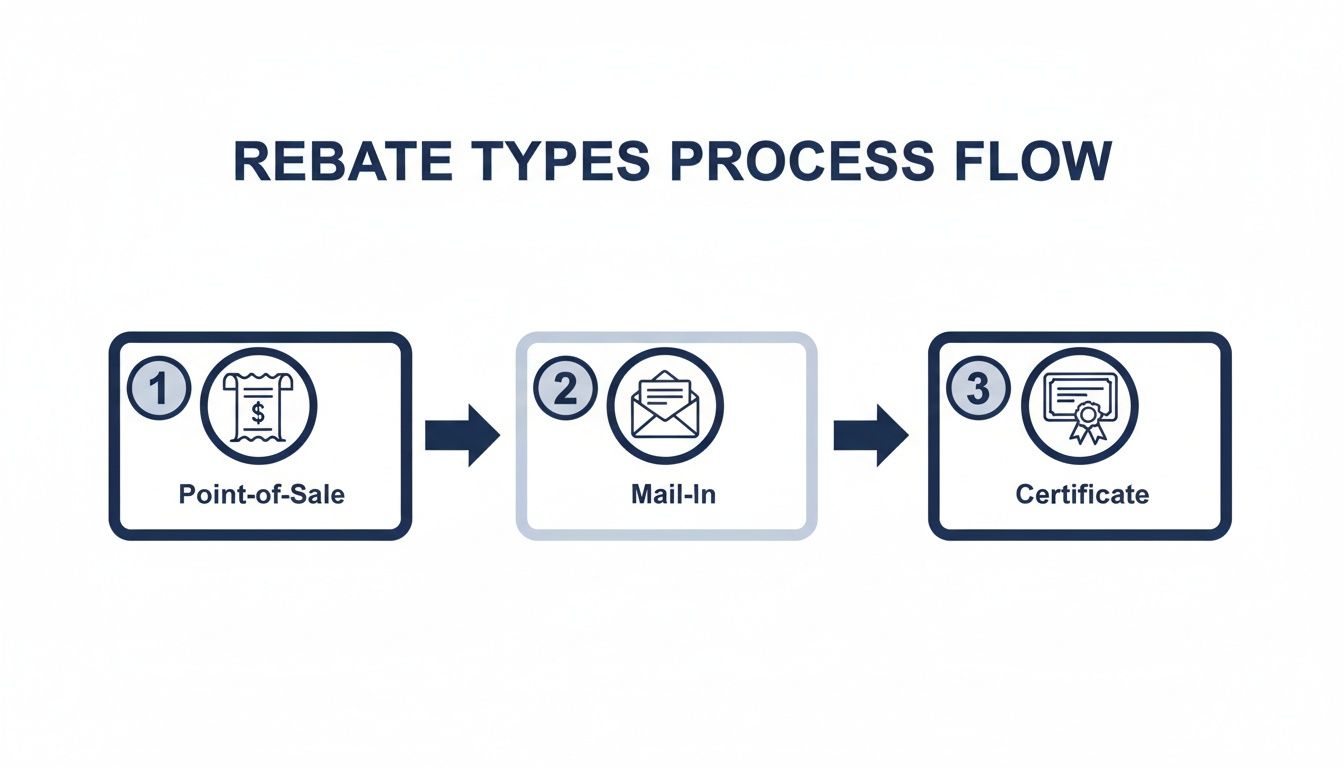
As you can see, the certificate model popular in NSW often offers the most direct path to savings, handled right there on your invoice by your installer.
The Application and Timeline
With certificate-based schemes like the NSW ESS, we handle all the tricky parts for you. It's our job.
We calculate the value of the energy saving certificates your new system generates and apply that amount as a direct, upfront discount on your final invoice. This means you get the benefit immediately without having to fill out forms or lodge a separate claim later. It’s savings in your hand from day one.
For other types of rebates, like a mail-in offer from a manufacturer, you would typically submit your documents through an online portal or by post. If you're going down that path, timelines can vary; expect to wait anywhere from four to twelve weeks for processing and payment.
By working with an experienced team, you sidestep the common mistakes that can delay or even void an application. We provide all the necessary paperwork, correctly filled out, to make sure everything goes off without a hitch. If you want to know more about what the installation day itself looks like, you can read about our approach to split system air conditioner installation.
Why Professional Installation Is a Rebate Requirement
Here’s a critical point that’s easy to overlook: your air conditioner rebate is directly tied to a professional, compliant installation. You simply can’t claim a government rebate for a system installed by an unlicensed person, and for very good reason. Let's break down why this is a non-negotiable part of the process.
In NSW, any technician installing an air conditioner must hold two key qualifications. The first is a full electrical licence, ensuring all wiring is safe and complies with the Australian Standard AS/NZS 3000. The second is an ARCtick licence, which is a legal requirement for anyone handling refrigerant gases. This protects both the environment and your family's safety.
Protecting the Government's Investment—and Yours
Think of it this way: a rebate is the government's investment in boosting our state’s energy efficiency. They need to make sure that investment is protected by a safe, correct installation that actually allows the air conditioner to perform at its peak efficiency. A shoddy job doesn't just waste energy; it can be a genuine safety hazard.
This requirement also safeguards you in a couple of important ways. It confirms your new system will deliver the energy savings promised on the box, which is the whole point of getting the rebate in the first place. On top of that, it ensures your manufacturer's warranty remains valid, as almost all warranties are voided by unlicensed installation work.
The Link Between Compliance and Performance
A professional installation is the only way to guarantee your unit’s performance, and this is becoming more important than ever. The recent surge in air conditioner rebates is happening as more households look for long-term energy savings, fuelling a boom in the market. This growth is driven by the promise of lower running costs, a promise that can only be kept with a correct setup.
For example, a technician doing a compliant installation will do far more than just connect the wires. They’ll ensure the refrigerant lines are the right length, the system is charged correctly, and the unit is positioned for the best possible airflow. Each of these steps is crucial for efficiency and is covered in detail when we discuss the specifics of installing a reverse cycle air conditioner.
Ultimately, the mandatory professional installation is a quality control measure. It ensures the air conditioner rebate achieves its goal of reducing grid strain while providing you with a safe, reliable, and genuinely efficient system for your home.
This commitment to compliance means that when you receive a rebate, you're not just getting a discount. You're getting an assurance that your new air conditioner is set up to perform at its best for years to come, keeping your home comfortable and your energy bills down.
Finding Savings Beyond the Initial Rebate
An air conditioner rebate is a fantastic head start, but the real, long-term value comes from slashing your day-to-day running costs. This is where smart planning transforms your new air conditioner from a simple appliance into a lasting financial investment for your home.
The journey to ongoing savings starts with choosing the right size system. It’s absolutely crucial to match the unit's capacity, measured in kilowatts (kW), to the room it needs to cool.
Why System Sizing Is So Important
Think about it this way: a small 2.5kW split system might be perfect for a bedroom in a Terrigal apartment that doesn't get much direct sun. But that same unit would be fighting a losing battle, chewing through electricity, trying to cool a big, open-plan living area in a sun-drenched Newcastle home. An undersized unit never gets a break, leading to excessive wear and shocking power bills.
On the other hand, an oversized system will blast the space with cold air too quickly and shut off. This constant stop-start cycle, known as short cycling, is horribly inefficient and puts unnecessary strain on the compressor. Getting the size just right means the system runs smoothly and efficiently, sipping power instead of guzzling it.
Preserving Efficiency with Regular Maintenance
Your new system’s day-one efficiency won't last forever without a little help. Regular, professional maintenance is the secret to preserving its performance and keeping your running costs low year after year.
A well-maintained air conditioner can hold onto up to 95% of its original efficiency. Simple things like cleaning filters, checking refrigerant levels, and ensuring coils are clear of debris prevent the system from having to work harder than it should.
This focus on efficiency isn't just a good idea; it's a nationwide trend. In fact, historical data shows that while air conditioner ownership in Aussie homes surged, the overall energy used for cooling actually dropped. This was thanks to huge gains in the average Energy Efficiency Ratio (EER) of new units. You can find more insights about these energy efficiency trends on optenergy.com.au.
By pairing the initial rebate with a correctly sized and properly maintained unit, you ensure your investment pays you back for many years to come.
Answering Your Air Conditioner Rebate Questions
When it comes to government rebates, there's often a bit of confusion about who qualifies and what's involved. We hear these questions all the time from homeowners across NSW, so let's clear up a few of the most common ones.
Can I Just Buy Any Air Conditioner and Get a Rebate?
Unfortunately, no. Rebates are specifically designed to encourage people to install high-efficiency systems. This means they are nearly always tied to specific models that meet or exceed a minimum Energy Star Rating.
When you get a quote from a professional installer like us, we only recommend systems that are eligible for the current government programs. It's part of our job to make sure you can actually claim the savings you're entitled to.
Do You Have to Be a Pensioner to Qualify?
While some programs are definitely targeted towards low-income households or pensioners, many of the broader energy efficiency rebates are open to any homeowner. The main requirement is usually that you're replacing an old, inefficient system with a new, compliant one.
The rules can change, so it's always smart to check the specific criteria for the scheme that's active when you're ready to buy.
Can I Install the System Myself and Still Claim the Rebate?
That’s a hard no. In fact, it’s one of the most critical conditions. Every single government rebate requires the air conditioner to be installed by a fully licensed and insured technician.
This isn't just red tape. The installer must hold a current electrical licence and an ARCtick refrigerant handling licence. This ensures the installation is safe, meets all Australian Standards, and is actually efficient, which is the whole point of the rebate in the first place.
Ready to see if your home upgrade is eligible for an air conditioner rebate? The team at ALC Air can provide a free, no-obligation quote on a compliant system and help you navigate the entire process. https://alcairconditioning.com.au