


Think of your air conditioner like your car. You wouldn't skip its regular service and expect it to run reliably through a harsh summer, and your air con is no different. Regular air con maintenance is the single most important thing you can do for its performance, your family’s health, and your wallet.
Why Maintenance Is Not a 'Set and Forget' Task
Your air conditioner is one of the hardest-working appliances in your home, especially during a scorching summer in Sydney's western suburbs or the humid heat of the Central Coast. Treating it as a 'set and forget' piece of equipment is a recipe for high power bills, poor air quality, and an unexpected breakdown right when you need it most.
Simply put, we find that preventative care saves you a world of money and stress down the track.
A neglected system has to work much harder to cool your home. Clogged filters and dirty coils choke the airflow, forcing the unit to run longer and draw more power just to hit the temperature you’ve set. This inefficiency doesn't just wear the components out faster; it shows up directly on your electricity bill.
The Impact on Your Home and Wallet
The numbers don't lie. Did you know that in New South Wales, a massive 60% of households rely on air conditioning to get through summer? Unfortunately, a lot of those units are chewing through far more power than they should. Nationally, Australians spent an estimated $3.1 billion on air con running costs last summer alone, and inefficient, poorly maintained systems were a huge part of that bill.
Keeping your system serviced can make a real dent in that expense. It ensures your unit runs just like the manufacturer intended, which brings a few key benefits:
- Lower Running Costs: An efficient system uses less electricity. It’s that simple. That means smaller power bills.
- Longer System Lifespan: Proactive care prevents the extra wear and tear that leads to expensive, premature failures. You get more years out of your investment.
- Improved Indoor Air Quality: Clean filters and coils actually trap dust, pollen, and other allergens instead of blowing them around your home for everyone to breathe in.
This principle of proactive care isn't just about your air con, either. For property owners, understanding how to manage essential maintenance on rental property is crucial for protecting an investment, much like looking after your air conditioner protects its longevity and performance.
Your Simple DIY Air Con Maintenance Checklist
While some of the heavy lifting is strictly for the pros, you can absolutely play a huge part in keeping your air con healthy. A few simple DIY tasks, done every couple of months, can make a massive difference to its performance and efficiency between professional tune-ups. Think of it as the basic housekeeping that stops tiny issues from turning into expensive problems.
Before you even think about touching the unit, we need to talk about safety. Always turn off the power to your air conditioning unit at your home’s main switchboard. This isn’t a suggestion; it’s the most important step to ensure you can work safely without any risk of electrical shock.
Cleaning Your Air Conditioner Filters
If you only do one thing on this list, make it this one. Cleaning the filters is the single most effective job you can do for your system's health.
For a split system, you just need to lift the front panel of the indoor unit to get to the mesh filters inside. If you have a ducted system, the return air grille (that big vent, usually in your hallway ceiling) will have a large filter sitting behind it.
Clogged filters are the number one enemy of good airflow and efficiency. They force your system to work much harder to pull air through. It’s like trying to breathe through a dusty old blanket. Just slide the filters out, give them a gentle clean with a vacuum or rinse them with lukewarm water, let them air dry completely, and pop them back in. This five-minute job can have a noticeable impact on both cooling power and your energy bills.
This chart lays out the simple choice between regular maintenance and the real risks of letting things slide.
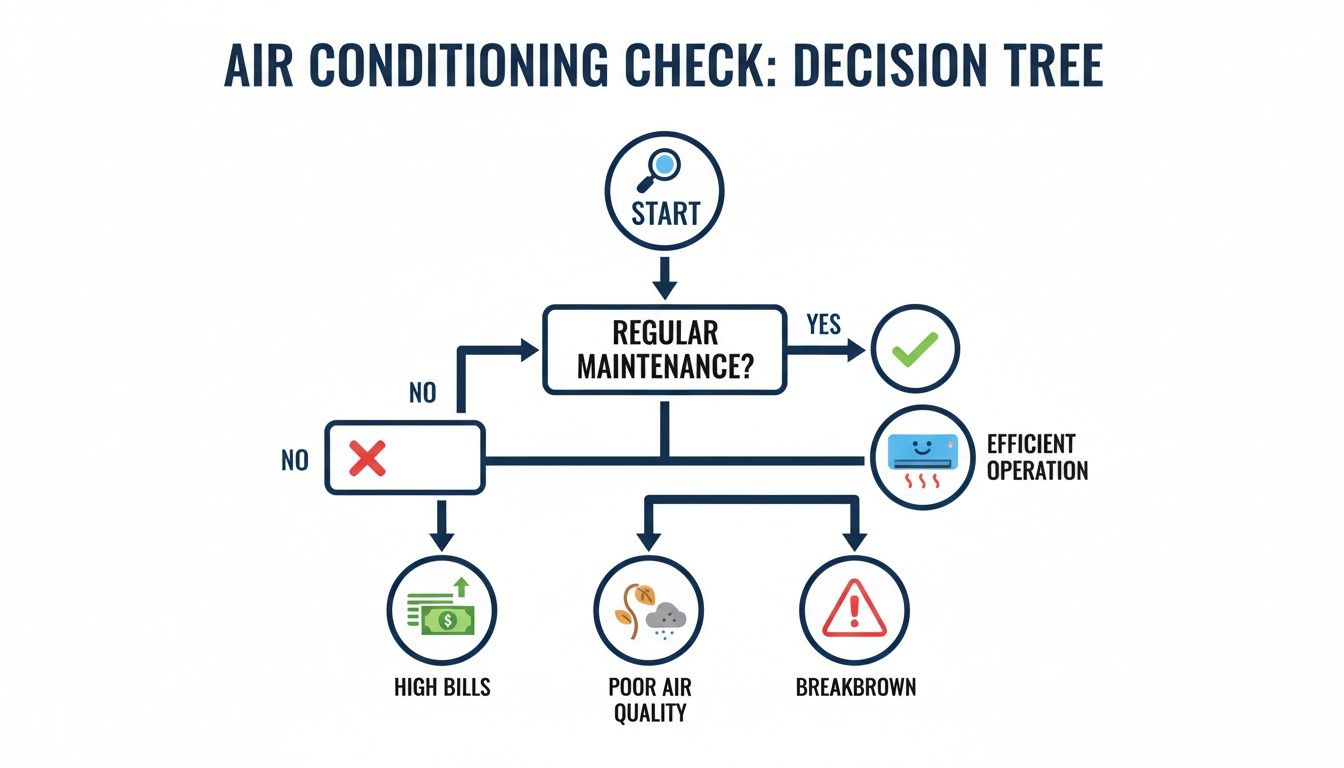
As you can see, ignoring the small stuff can directly lead to higher bills, poor air quality, and an eventual system breakdown. A little proactive care is always the smarter, cheaper choice in the long run.
Clearing the Outdoor Unit
Your outdoor condenser unit has a critical job: it pushes all the heat it has removed from your home back outside. For it to do that properly, it needs to be able to breathe.
Take a walk outside and have a look around your unit, especially if you live in a leafy Central Coast suburb like Woy Woy or have a garden in the Hunter Valley. You want to see at least a metre of clear space on all sides. Gently clear away any fallen leaves, grass clippings, or overgrown shrubs that might be blocking the fins and restricting that crucial airflow. A quick sweep or rake around the base is often all it takes to help your system run more efficiently.
We cover this in more detail in our [DIY guide for split system air conditioner maintenance](https://alcairconditioning.com.au/blog/split-system-air- conditioner-maintenance-diy-guide-when-to-call-a-pro/).
Quick Indoor Checks
Finally, there are a couple of quick things you can do inside. Gently wipe down the casing and the louvres (the adjustable slats) of your indoor unit with a damp cloth to get rid of any surface dust.
Once you’re done, turn the power back on at the switchboard and give your thermostat a quick test. Make sure it responds properly when you change the temperature and adjust the fan settings. If it seems sluggish or the temperature feels off, it might be an early sign that a professional inspection is on the horizon.
What a Professional Air Con Service Really Involves
While your DIY checks are fantastic for keeping your system healthy, they don't replace the deep-dive inspection a licensed professional can perform. An annual service is far more than just a filter clean; it’s a comprehensive health check that gets into the mechanical, electrical, and refrigerant components that are legally off-limits to anyone without the right qualifications.
Ever wondered what a technician actually does during a professional air con maintenance call? We’ll pull back the curtain and show you the immense value that comes from having an expert look over your system. It’s all about ensuring safety, maximising efficiency, and catching small problems before they become costly breakdowns.
The Critical Safety and Compliance Checks
First and foremost, a professional service is a safety inspection. Our technicians aren't just experienced; they are fully licensed electricians and hold ARCtick certification, which is a legal requirement in Australia for anyone handling refrigerants.
During a service, we meticulously inspect all electrical connections, terminals, and wiring. This ensures everything is secure, free from corrosion, and compliant with Australian Standards like AS/NZS 3000. Loose or faulty wiring is a serious fire hazard, and this check provides crucial peace of mind.
A key part of this is checking refrigerant levels. If your system is low on refrigerant, it’s not just underperforming; it has a leak. An ARCtick licensed technician is the only person legally allowed to handle, test for, and repair these leaks, protecting both your system's performance and the environment.
Deep Cleaning for Peak Performance
Beyond the electrics, a professional clean goes much deeper than what you can do yourself. We thoroughly clean the indoor evaporator coils and the outdoor condenser coils, which are the heart of your system's heat exchange process. Dirty coils force your compressor to work overtime, dramatically increasing your power bills.
We also flush the condensate drain line. This small pipe carries condensation away from your indoor unit, but it can get clogged with sludge and algae over time. A blockage can cause water to back up and leak inside your home, potentially causing serious water damage to your ceilings and walls. It’s a simple preventative step that avoids a huge mess.
Mechanical and Diagnostic Testing
Finally, we inspect all the moving parts. This includes checking the fan motors and blades for wear, lubricating components as needed, and making sure everything is running smoothly and quietly.
To finish, we run a series of diagnostic tests on the entire system. Whether it’s a Daikin split system in a Terrigal beach house or a large ducted Actron Air unit in a Newcastle family home, we test its full cooling and heating cycles. This allows us to confirm it’s reaching the right temperatures, cycling correctly, and operating at peak efficiency, just as the manufacturer intended. For more detail, you can learn about servicing your split system air conditioner in our dedicated guide.
Warning Signs Your Air Conditioner Needs a Service
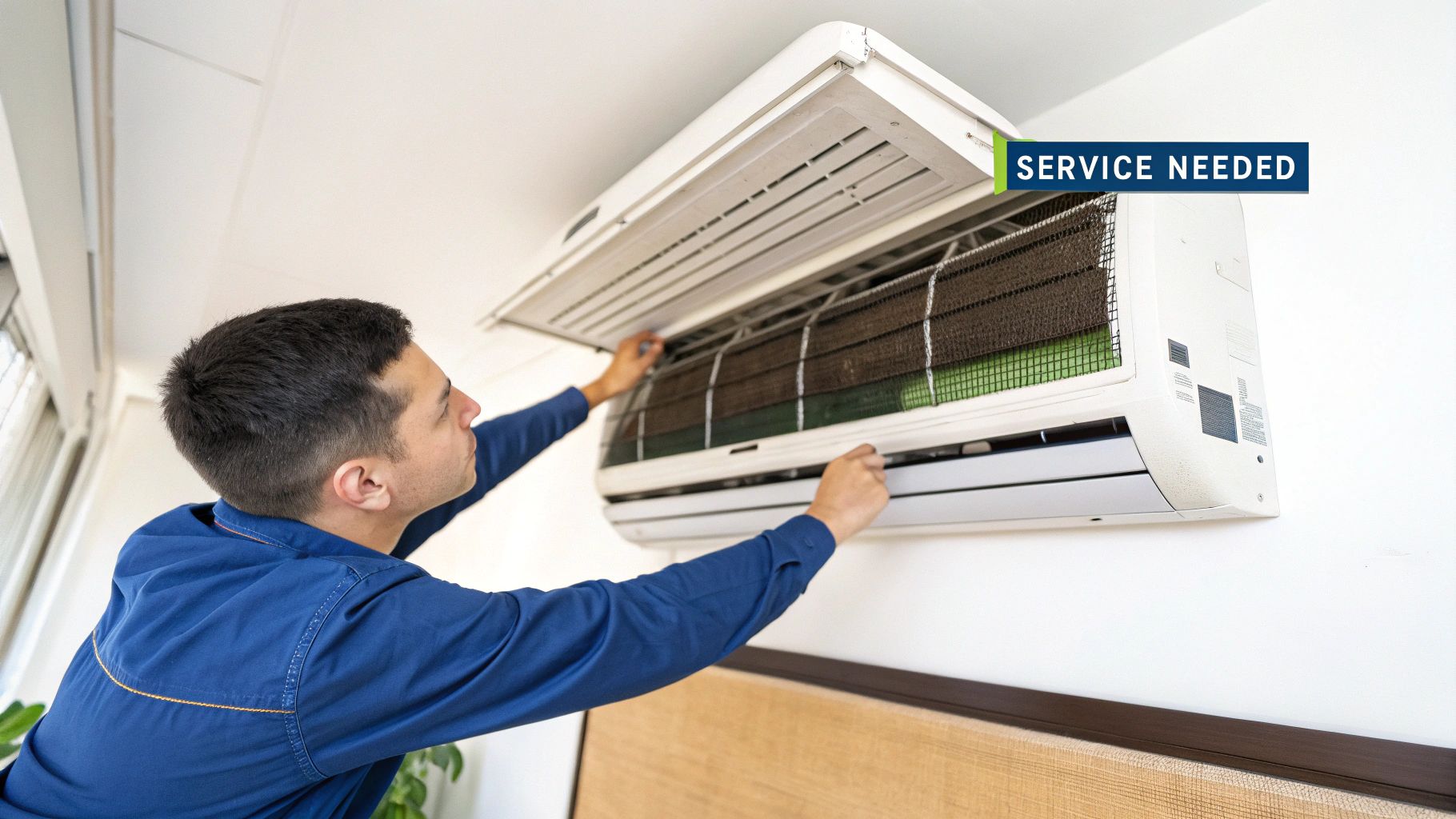
Your air conditioner will almost always give you a few clues that something’s wrong before it completely gives up. Learning to spot these early hints is the key to catching a small issue before it snowballs into a major, expensive breakdown right in the middle of a Hunter Valley heatwave.
Think of it as your system’s way of asking for a bit of attention. Acting on these signs with professional air con maintenance not only saves you money on emergency call-outs but also protects the long-term health of your unit.
Let's run through some of the most common red flags.
Strange Noises and Smells
One of the first things you'll usually notice is a change in how your system sounds or smells. Your air con should run with a consistent, gentle hum; it shouldn't be making noises that distract you from the TV.
- Grinding or Squealing: These harsh, mechanical sounds often point to trouble with motor bearings or a worn-out fan belt. Ignoring them can lead to the motor seizing up completely, which is a far more serious and expensive repair.
- Musty or Damp Odours: A persistent mouldy smell wafting from your vents is a dead giveaway for moisture buildup and potential mould or mildew growth inside the unit. This doesn't just hurt performance, it blows spores directly into the air you breathe.
A Drop in Cooling Power and Airflow
Another massive sign is a noticeable decline in performance. Is the system struggling to cool rooms on days it used to handle with ease?
Picture this: your split system in a western Sydney home used to cool the living room down in about 15 minutes. Now, it seems to run for an hour without ever really hitting that crisp, cool temperature. This loss of cooling power often signals an issue with low refrigerant levels or dirty coils that can't transfer heat properly.
Likewise, if you hold your hand up to the vents and the airflow feels weak or inconsistent, it's a classic symptom of clogged filters, a struggling fan motor, or even blockages in the ductwork. If you notice a performance drop, exploring professional air conditioning repairs sooner rather than later is the smartest move.
Unexpectedly High Power Bills
Finally, keep a close eye on your electricity bills. A sudden, unexplained spike in your energy usage during summer is one of the biggest red flags you can get.
If your daily habits haven't changed but your bill has shot through the roof, it means your air con is working much harder and less efficiently to do its job. It’s burning through excess power to compensate for an internal problem, and that cost gets passed directly on to you.
Setting the Right Schedule for Your Air Con Service
It's one of the first questions we get asked: “How often do I really need to get my air con professionally serviced?” While every home is different, a solid rule of thumb is to book in a professional air con maintenance check at least once a year. Think of it less like a chore and more like protecting your investment and guaranteeing comfort when you need it most.
The best time for this annual tune-up is during the shoulder seasons, which are spring or autumn. Getting a service done in September or October preps your system for the summer heatwave, while an April or May check-up ensures it’s ready for winter heating. This simple strategy helps you beat the peak season rush when technicians are swamped with emergency repair calls.
Your Location Changes Everything
That said, a standard annual service for a suburban home in Sydney might not be enough for everyone. Your local environment plays a massive role in how hard your system has to work.
Take a home in the Hunter Valley, for instance, where dry, dusty conditions can clog filters and coils much faster. In that situation, you’d want to consider more frequent checks. Likewise, if you live on the Central Coast or near Lake Macquarie, the salty sea air is a killer for outdoor units. More regular inspections are crucial to catch and treat corrosion before it chews through sensitive components.
Residential vs. Commercial Servicing Needs
The demands on a home air conditioner are worlds apart from a commercial unit. Your system at home might run for a few hours a day, but the air con in a busy Newcastle office or a Terrigal retail shop is often blasting away non-stop, all day long.
For this reason, we typically recommend a more frequent service schedule for commercial systems, often bi-annually or even quarterly. This proactive approach minimises the risk of disruptive downtime, maintains a comfortable environment for staff and customers, and keeps running costs predictable.
This focus on preventative care is becoming more critical right across Australia. The national HVAC maintenance market is projected to hit USD 1,605.6 million by 2030, and a staggering 59.28% of that is expected to come from system upgrades and replacements. This highlights a critical point: timely maintenance helps you avoid becoming part of that replacement statistic, stretching the life of your system by years. You can read the full research about HVAC market growth to see the trends for yourself.
Ultimately, setting the right schedule is about turning maintenance into a manageable routine instead of a stressful, emergency expense. You can learn more in our detailed guide on how often you should service your air conditioner.
The Real Cost of Skipping Your Air Con Maintenance
It’s easy to put off that annual service call. When your air conditioner seems to be blowing cold air, booking a maintenance check can feel like another expense you just don't need.
But here’s the thing: the real cost isn't in the service itself. It’s in the expensive, inconvenient consequences of skipping it. Neglecting your system is a gamble that rarely pays off, especially when a Central Coast heatwave hits.

Higher Power Bills and Shorter Lifespan
The first place you’ll feel the pinch is on your electricity bill. An air con with clogged filters and grimy coils has to fight to do its job. It’s like trying to breathe through a straw, it takes a lot more effort and energy.
This inefficiency means your unit is drawing significantly more power to achieve the same result. You end up paying more for less comfort, a cost that quietly adds up month after month. To get a real sense of the numbers, you can learn more about how much an air conditioner really costs to run and see just how much efficiency matters.
That constant strain also hammers the critical components inside your unit. The compressor, the heart of your system, is forced to work much harder than it was ever designed to. This dramatically shortens its lifespan, turning a unit that should have lasted 15 years into one that gives up the ghost after just eight or ten.
Breakdown Risk and Poor Air Quality
Of course, the biggest risk of all is a complete system failure. And it will, almost inevitably, happen during the hottest week of the year, the exact moment you need it most and when technicians are booked solid.
What could have been a minor, preventable fix found during a routine check suddenly becomes an emergency call-out. This often leads to a shockingly expensive repair, like replacing the compressor, or worse, needing to replace the entire system.
The comparison is stark. You're choosing between a predictable, modest fee for an annual service versus the potentially huge, unexpected expense of replacing a failed system. It’s the difference between proactive care and a reactive crisis.
Beyond the mechanical risks, a dirty system directly impacts your family's health. Neglected filters and damp internal coils become the perfect breeding ground for mould, mildew, and bacteria. Every time you turn the unit on, you’re circulating those contaminants through your home. This can trigger or worsen allergies and respiratory issues, a hidden cost that affects your wellbeing long before the unit actually breaks down.
Got Questions About Air Con Maintenance?
We hear the same questions from homeowners all the time, so let's get you some straight answers. Here’s what people across the Central Coast and Sydney often ask about keeping their air conditioning in good nick.
Can I Just Clean the Filters and Call It a Day?
While cleaning your filters every one to three months is genuinely the best thing you can do yourself, it's not a substitute for a proper air con maintenance check. Think of it like this: cleaning your filter is like washing your car's exterior, but a professional service is like getting the oil changed and the engine tuned.
A licensed tech does the things you can't, and legally aren't allowed to, do. They check critical electrical connections for safety, test refrigerant levels to ensure efficient cooling, and deep clean the internal coils and fans where mould and bacteria love to hide. Skipping this means you're missing the essential checks that keep your system safe and efficient for the long haul.
Does My Manufacturer’s Warranty Cover Maintenance?
That's a common misconception. Your warranty is there to cover defects in the parts or the way the unit was made, not for routine upkeep.
In fact, most brands now state in their terms that the warranty is only valid if you can show proof of regular professional servicing. Skipping your annual service could give them a reason to void your warranty, leaving you on the hook for a major component failure that could have been easily spotted and prevented with a bit of proactive care.
How Much Does a Professional Air Con Service Cost in NSW?
The cost really depends on what kind of system you have, whether it’s a single split, a multi-head setup, or a full ducted system, plus its size and general condition. But one thing is certain: a standard service is always a small, affordable investment compared to the eye-watering cost of major repairs or a full system replacement down the track.
The best way to know for sure is to get a clear, no-obligation quote that’s specific to your air conditioner. That way, you know the exact cost upfront with no surprises.
Ready to make sure your air conditioner is running as safely and efficiently as it should be? The licensed and experienced team at ALC Air is here to help with professional maintenance checks across the Central Coast, Sydney, Newcastle, and Lake Macquarie.