


Picking the right air conditioner is about more than just the brand on the box. The single most important factor for genuine comfort and efficiency is its size, or more accurately, its cooling capacity. Using an AC room size calculator is the first critical step to getting it right and avoiding the pain of high power bills and poor performance down the road.
Why Getting Your Air Conditioner Size Right Matters
When we talk about the "size" of an air conditioner, what we really mean is its cooling capacity, measured here in Australia in kilowatts (kW). There’s a common myth that bigger is always better, but when it comes to air conditioning, that’s a costly mistake plenty of homeowners make.
Choosing the correct kW capacity is genuinely the most important decision you'll make for your home's comfort and your wallet. If you get it wrong, the system will cause you headaches from the day it’s installed. It's our job to help you avoid that.
The Problem with an Undersized Unit
Imagine this: it’s a scorching 40-degree day in a western Sydney suburb, and you’re trying to cool a big, open-plan living area with a system that’s just too small. What happens? That unit will run flat out, all day long, desperately trying to hit the temperature you’ve set on the remote. It never will.
This constant, frantic operation puts a huge strain on the compressor and all the other moving parts, leading to premature wear and tear. Worse, your electricity bills will go through the roof, and your home will never feel properly comfortable. It’s an expensive and frustrating exercise.
The Dangers of an Oversized Unit
On the flip side, an oversized unit creates a whole different set of problems. Let's say you install a massive, powerful system in a small bedroom of a Central Coast apartment. The unit will blast out freezing air, cool the room down in a few minutes, and then abruptly switch off. This rapid on-off cycle is what we in the industry call “short cycling.”
Because the system doesn’t run long enough to do its job properly, it fails to dehumidify the air. This is a huge issue in humid coastal areas like Newcastle and Lake Macquarie. The room ends up feeling cold and clammy, not crisp and comfortable.
Short cycling also causes massive wear on the system’s motor and chews through a surprising amount of power on startup, leading to unnecessarily high running costs. Getting the size right is everything, and you can learn more about how to approach sizing your air conditioner correctly. A perfectly matched system gives you consistent temperature, manages humidity properly, and runs as efficiently as possible.
How to Calculate Your Home's Cooling Needs
Working out the right size air conditioner for your home doesn't require an engineering degree, but getting it right does need a bit of careful measurement. The good news is, there's a foundational formula that we technicians across Australia use, and it’s a brilliant starting point for any homeowner.
First things first, you need the size of your room. Grab a tape measure and find the length and width of the space you want to cool. Multiply those two numbers together, and you’ll have the total area in square metres (m²).
So, for a living room that’s 5 metres long and 6 metres wide, the total area is 30 square metres. Simple.
The Basic Sizing Formula
Once you’ve got your room’s area, you apply a standard wattage factor to figure out the cooling power you need. It’s an industry benchmark that gives you a solid, reliable estimate before you start diving into the finer details.
The standard formula used right across Australia is to multiply the room's area by 150 watts per square metre. This gives you the base cooling capacity required. It's a tried-and-tested method for getting you in the right ballpark.
Using our 30 square metre living room as an example, the calculation looks like this:
30 m² x 150 watts = 4,500 watts
That translates to 4.5 kilowatts (kW) of cooling power. This is the minimum size you should be looking at for that space.
An Easier Way to Find Your Size
To make things even simpler, we've put together an easy-to-use AC room size calculator. Just pop in your room's dimensions below, and it will give you an instant estimate of the cooling capacity you need. This tool takes the guesswork out of that initial calculation and gives you a clear figure to start with.
[EMBEDDED CALCULATOR WIDGET GOES HERE]
This calculator gives you a fantastic starting point, but remember, it’s a guide. If your home has unique features like high ceilings, large north-facing windows, or older insulation, you'll likely need to adjust this figure. We get into those critical factors in the next section. For an even deeper dive, you can also check out our guide on how to calculate the right size air conditioning for your room.
Important Takeaway: A basic calculation is a must, but it's not the final word. Always treat it as your baseline, then consider the other unique factors of your room. Things like ceiling height, window size, and insulation levels can significantly alter the required capacity.
Critical Factors Beyond Simple Room Dimensions
A basic room size calculation is a great place to start, but it really doesn't tell the whole story. To get the sizing right, you have to account for several other environmental and structural factors that dramatically affect your real-world cooling needs. Ignoring these is how you end up with an undersized unit that struggles on a hot day or an oversized one that cycles on and off, failing to properly manage humidity.
Think of it this way: the square metre calculation tells you the size of the container, but these other factors determine how much heat is actually pouring into it. We need to account for everything that adds to your home's "heat load" to find the perfect system size.
This diagram shows the basic flow from measurement to selection, which is the foundation of any professional assessment.
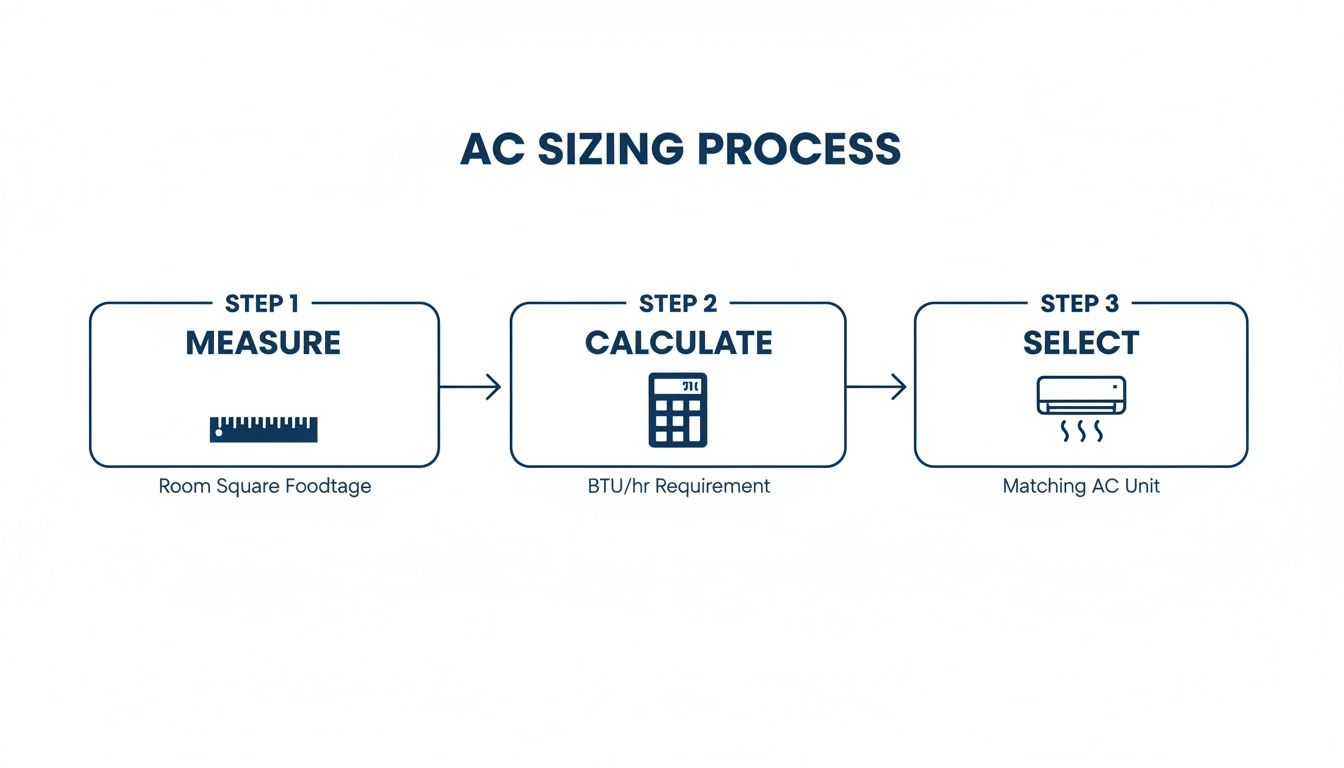
The key takeaway is that calculating size is a multi-step process. Room dimensions are just the first piece of the puzzle.
Ceiling Height And Room Volume
Most standard sizing formulas assume a ceiling height of 2.4 metres, which is pretty common in Australian homes. But if you have higher ceilings, the total volume of air in the room increases significantly.
Take an apartment in Newcastle East with 3-metre ceilings. Even if the floor area is identical to a standard home, it contains 25% more air. That extra volume requires a lot more energy to cool down. A simple square metre calculation would leave you with an underpowered unit that works way too hard and never quite gets the job done. This is why we always consider the room's total volume (length x width x height) for a more accurate assessment.
Windows And Natural Light
Windows are one of the biggest sources of heat gain in any home. The size, orientation, and type of your windows and glass doors have a massive impact on how much cooling power you'll need.
A home in the Hunter Valley with large, single-glazed, west-facing windows will get absolutely blasted by the intense afternoon sun. That scenario demands a much more powerful system to counteract all that solar heat gain.
On the other hand, a room with smaller, south-facing windows or double-glazing will require less cooling capacity. Things like shading from eaves, awnings, or nearby trees also play a crucial role in reducing this heat load.
Insulation And Building Materials
The quality of your home's insulation is another critical piece of the puzzle. Good ceiling and wall insulation basically acts like an Esky for your home, keeping the cool air in and the hot air out.
A well-insulated home in a suburb like Terrigal might only need a smaller, more efficient system than an uninsulated home of the exact same size just down the road.
Even the materials and colour of your roof have a big impact. Considering options like cool-coloured roofing or even white tile roofing to keep your house cool can dramatically reduce the burden on your AC system. Every element of your home's construction contributes to its overall thermal performance.
Local Climate And Microclimates
Finally, your specific location matters immensely. The humid, salt-laden air on the Central Coast requires an air conditioner that excels at dehumidification. In contrast, the dry, intense heat of Sydney's western suburbs demands raw cooling power.
These regional differences are why a one-size-fits-all approach just doesn't work. For a detailed breakdown of how local weather affects your choice, you can explore our guide on choosing air conditioning for Central Coast homes. A professional assessment will always factor in these local nuances to get the sizing just right.
Common Sising Mistakes and How to Avoid Them
Getting your air conditioner size wrong is one of the most frequent and costly mistakes we see homeowners make. It usually starts with a generic online calculator that doesn't know a thing about your actual home, leading you down a path of wasted money and constant frustration.
When the size is off, your system will never run efficiently. That means higher power bills, rooms that are never quite comfortable, and a much shorter lifespan for your air conditioner. Let's walk through the most common traps we see across the Central Coast and Sydney so you can steer clear of them.

The 'Bigger is Better' Myth
It's a natural assumption: a more powerful unit will cool your room faster and better. But this is a massive misconception. An oversized unit is just as bad as one that's too small.
Here's why. The oversized system blasts cold air and cools the room too quickly, but it doesn't run long enough to properly remove humidity from the air. This is a huge issue in coastal areas from Gosford to Newcastle.
The result? You're left in a cold, damp, and clammy space. The unit also "short-cycles" by constantly turning on and off, which puts huge strain on the compressor and sends your energy consumption through the roof.
Undersising to Save Money
On the flip side, we have people trying to save a few hundred dollars upfront by picking a smaller unit than they need. This is a classic false economy that will cost you far more in the long run.
On a genuinely hot day, an undersised unit will run non-stop, desperately trying to hit the temperature you've set on the remote but never quite getting there.
This constant, high-stress operation leads to premature wear and tear on all the system's components, paving the way for breakdowns and an early replacement. Your power bills will also be eye-wateringly high because the unit is always working at its absolute maximum capacity.
Ignoring How You Use the Room
Another critical mistake is failing to think about what a room is actually for. A basic AC room size calculator has no idea if it's sising for a kitchen full of heat-generating appliances like ovens and fridges, or a living room packed with electronics and frequently hosting family gatherings.
All these activities add a significant "heat load" that a rarely used guest bedroom simply doesn't have. For a more detailed look at all the factors involved, have a look at our guide on properly sizing an air conditioner.
Heads Up: A lot of online calculators can get it seriously wrong. CHOICE research found that commercial calculators often suggest capacities 30-40% higher than what's actually needed for a typical Australian home. Oversising by that much is a recipe for high bills and poor comfort.
Why a Professional Assessment Is Your Safest Bet
While an online AC room size calculator gives you an excellent starting point, it can never replace a detailed, on-site assessment from a licensed and experienced technician. Think of the calculator's result as a solid estimate, but the professional's evaluation as the final, tailored solution for your home.
An expert assessment goes far beyond just measuring your room's length and width. When we visit a home on the Central Coast or in Sydney, we're looking at the complete picture to ensure the system we recommend will perform efficiently for years to come.
What Our Technicians Look For
During a home visit, we analyse factors a calculator simply can't see. We assess airflow dynamics to find the optimal placement for the indoor unit, ensuring conditioned air reaches every corner of the room without creating uncomfortable draughts.
We also inspect your switchboard and existing electrical circuits. This is a critical step to confirm they can safely handle the load of a new air conditioner and comply with AS/NZS 3000 electrical standards.
Local council regulations, especially in built-up areas of Sydney and Lake Macquarie, can also influence system choice and placement. A professional is across these rules, saving you potential headaches later on.
Our Promise to You: A professional quote from ALC Air isn't just a price. It's a complete cooling and heating solution designed specifically for your home's unique layout, your family's lifestyle, and your budget.
This hands-on approach is vital. For complex new builds or major renovations where precise cooling load calculations are absolutely essential, it is often wise to seek mechanical engineering expertise to ensure every detail is accounted for.
The Importance of ARCtick Certification
Finally, it's crucial to stress the importance of using fully qualified professionals. Always ensure your installer holds a current ARCtick licence. It's a legal requirement in Australia for anyone handling refrigerants.
This certification is your guarantee that the technician is trained to work safely, protecting your family, your home, and your manufacturer's warranty. You can learn more about what's involved in our guide to [split system air conditioner installation](https://alcairconditioning.com.au/blog/split-system-air- conditioner-installation/).
Hiring an unlicensed person not only risks a poor installation but can also void your warranty and even your home insurance. It's a risk that's simply not worth taking.
Your Top AC Sising Questions, Answered
Even with a calculator and a bit of knowledge, it’s completely normal to have a few more questions rattling around. Choosing a new air conditioner is a big decision for your home, so getting straight answers is key.
We get asked these questions all the time by homeowners across the Central Coast, Sydney, and Newcastle. They’re the practical, real-world queries that come up when you try to apply general rules to your specific house. Let's clear them up so you can move forward with confidence.
My Room Has High Ceilings. Do I Need A Bigger AC?
Yes, absolutely. This is one of the most common things people overlook. Standard air con calculations are nearly always based on a typical ceiling height of 2.4 metres. If you've got higher ceilings, you have a much larger volume of air in the room that needs to be cooled down.
A simple square metre calculation just won't cut it here; it will leave you with an underpowered unit that struggles on hot days. A good technician will always factor in that extra volume to make sure the unit isn't constantly running at full tilt just to keep up. It's a crucial adjustment, especially in modern homes with raked or high ceilings.
Should I Just Get A Slightly Larger Unit To Be Safe?
It sounds logical, but this is a classic mistake that causes more problems than it solves. An oversized unit is actually a bad thing. It will blast the room with cold air and switch off too quickly, a process called "short-cycling".
The problem is, the system doesn't run long enough to do one of its most important jobs: removing humidity from the air. This leaves you with a room that feels cold but also unpleasantly damp and clammy, a common complaint in our humid coastal climate.
On top of that, short-cycling puts a huge amount of extra wear and tear on the compressor and drives your power bills through the roof. It is always, always better to get a unit that's perfectly matched to the room's calculated heat load.
How Much Difference Does Insulation Actually Make?
A massive difference. Insulation is probably the single biggest factor after room size. A well-insulated room, especially one with double-glazed windows, might need 15-20% less cooling capacity than a poorly insulated room of the exact same size.
Think of good insulation as a barrier that stops the cool air your AC produces from leaking out, and stops the summer heat from getting in. This simple difference means your air conditioner can maintain a comfortable temperature without having to work nearly as hard, which directly translates to lower running costs.
Can I Just Use One Big Split System To Cool A Few Rooms?
While a powerful split system is perfect for a large, open-plan living and dining area, it’s simply not designed to cool multiple separate rooms. Air doesn't flow effectively through standard doorways and down hallways.
What you'll end up with is one freezing cold room where the unit is, while the other rooms stay uncomfortably warm. For cooling several distinct spaces, a multi-head split system (which connects multiple indoor units to one outdoor unit) or a full ducted air conditioning solution is a far more effective and efficient way to go.
Ready to find the perfect air conditioner size for your home without the guesswork?
The team at ALC Air provides free, no-obligation assessments across the Central Coast, Sydney, Newcastle, and Lake Macquarie. We'll give you a precise recommendation tailored to your home and lifestyle.